








Is the Trend Irreversible? On-Chain Perpetual U.S. Equity Products Emerge as a New Liquidity Gateway
TechFlow Selected TechFlow Selected
Is the Trend Irreversible? On-Chain Perpetual U.S. Equity Products Emerge as a New Liquidity Gateway
Assets are no longer “held” but continuously invoked.
 Navigating Web3 tides with focused insights
By YettaS
As gold and silver continue hitting new all-time highs, Trade.xyz’s daily trading volume approaches $2 billion, and Binance launches TSLA perpetual contracts with virtually no hesitation—the trend has become impossible to ignore: traditional financial assets are emerging as a new gateway for the crypto market to absorb global liquidity. Just one year ago, most centralized exchange (CEX) operators likely could not have accepted the reality that an onchain trading venue—leveraging TradFi assets as a wedge—could begin directly eroding and reshaping the core territory of centralized exchanges.
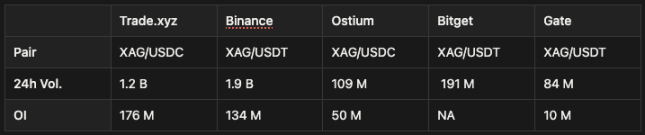
We all know crypto capital is inherently drawn to volatility. From a product-structure perspective, equity perpetuals sit precisely at the confluence of several critical upgrades—this is the fundamental reason they’ve stood out in this cycle:
As CBOE and CME progressively accept crypto in-kind margin this year, the liquidity and usability of crypto assets as collateral will increase significantly.
Once DTCC establishes direct onchain connectivity, the settlement layer will begin migrating onchain—granting equities native onchain settlement channels from the source.
The truly interesting part then emerges: tokenized equities as collateral → accepted by perpetual exchanges → institutions systematically engaging in basis farming.
Onshore Issuance, Offshore Distribution
The U.S. exports finance—not by exporting financial institutions themselves, but by exporting “access rights.” The petrodollar system distributes dollars globally, externalizing inflationary pressure; stablecoins replicate this logic—by wholesale purchasing of U.S. Treasuries, they turn the entire world into new dollar holders, without requiring banks or brokers. Onchain equities represent the next step in this logic. From unbanked to unbrokered, dollar-denominated assets will once again be dumped globally.
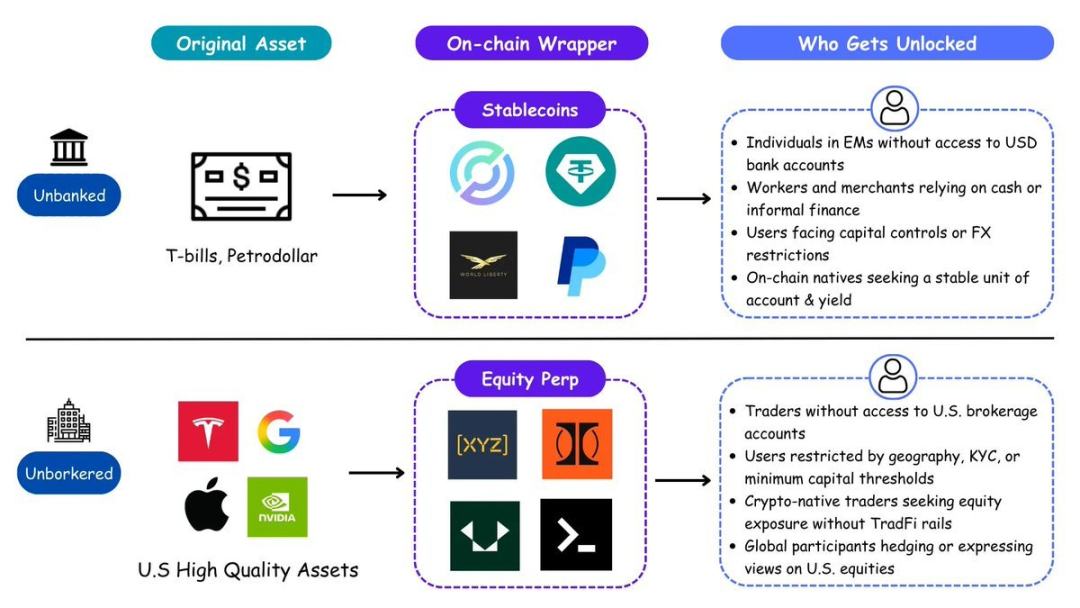
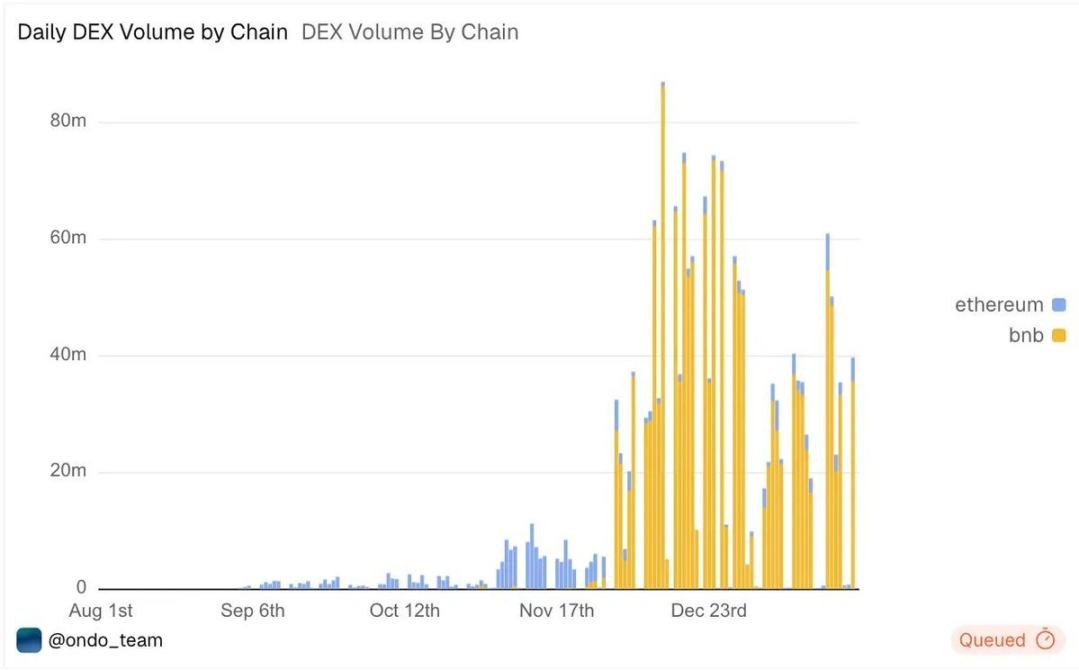
CEXs recognized both the opportunity and the potential threat early—and moved first to expand. Ondo and xStocks focused on issuance—connecting with broker-dealers, custodializing real equities, and minting 1:1 tokenized stocks across multiple chains—but in practice, issuance alone does not automatically create markets.
The first wave of genuine demand came from traders unable to access the U.S. brokerage system, and from crypto-native users seeking U.S. equity exposure without relying on TradFi infrastructure. Issuers completed the heaviest compliance and custody work—but capital flowed toward the side that actually controlled trading attention and distribution capacity. Offshore platforms embedded products directly into their trading interfaces, and trading volume naturally aggregated there. Ultimately, over 80% of tokenized equity trading volume concentrated on BNB Chain.
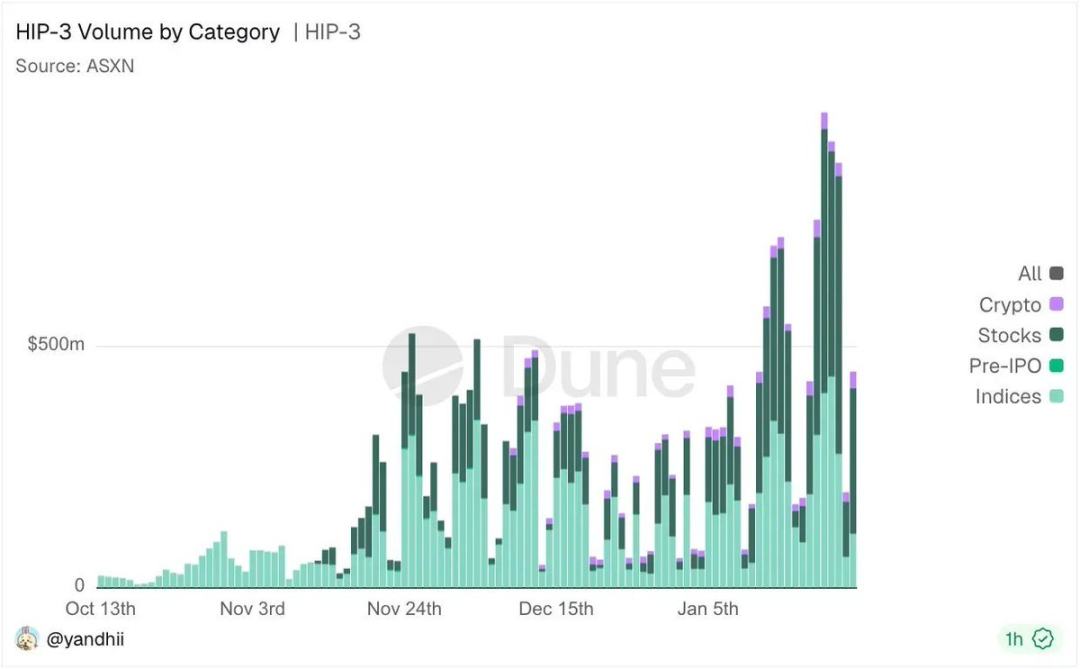
If offshore spot markets unlocked retail demand, onchain equity perps further attracted professional traders. These are global participants who want to trade or hedge U.S. equities without being constrained by brokerage access, trading hours, or jurisdictional boundaries. Take HIP-3 as an example: it offers professional traders a unified interface for systematic basis trading, capturing cross-market mispricings across equities, crypto assets, and indices. Combined with potential airdrop incentives, trading volume continues setting new records.
The Golden Window for Onchain Equity Perpetuals
Once a spot anchor exists, perpetual contracts almost always become the most efficient trading instrument—the reasons remain straightforward, as always:
- 24/7 trading, unrestricted by market hours
- Cross-margin across all assets, delivering extremely high capital efficiency
- High leverage unlocks genuine risk appetite
- Composable into DeFi strategies
- Provides a clear margin path for RWAs/tokenized assets
The entire tech stack is rapidly taking shape:
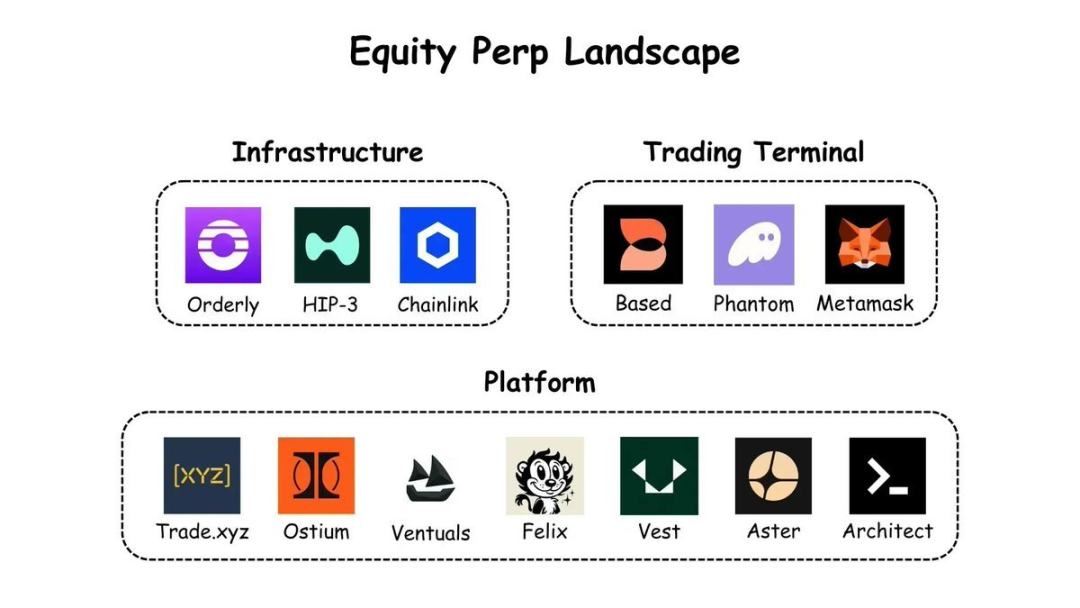
Infrastructure
- HIP-3 / HyperCore: High-performance order book engine supporting any perpetual market
- Orderly: Unified cross-chain order book—anyone can launch a perpetual exchange without code
- Chainlink: Equity price oracle (core data layer)
Platforms (Where Trading Happens)
- Trade.xyz: Built on HIP-3, currently the largest equity perp DEX
- Ostium: FX / commodities / equities, CFD-oriented structure
- Ventuals: Pre-IPO market (HIP-3)
- Felix / Vest / Aster / Architect: Each emphasizes different aspects—settlement, coverage, or distribution
Terminals (Current Upstream Traffic Entry Points)
- Based: Multi-asset interface aggregating Hyperliquid, HIP-3, and prediction markets
- Phantom / MetaMask-style frontends: Convert wallet traffic into trading behavior
Looking ahead, focus is shifting from “tokenization” to “monetary velocity”—true onchain GDP will emerge here. The ultimate winners won’t just be those capable of minting onchain wrapper assets, but those who—under scale—can convert any asset into usable margin, while delivering deepest liquidity and cleanest matching/risk-control engines.
Imagine the future as a globally unified “margin network”: Bitcoin, U.S. equities, gold, and U.S. Treasuries are no longer locked inside siloed systems—they become modular building blocks, instantly deployable as collateral; perpetuals become the most universal tool for expressing risk; stablecoins serve as cash; and various trading and arbitrage strategies run autonomously, 24/7 onchain, constantly composing and recomposing. Assets are no longer “held”—they are continuously deployed.
Racing Against Time
The window is open—but time for onchain equity perps is short. The greatest threat isn’t lack of demand, but rather formal regulatory approval of onshore products. History repeatedly shows that once regulators give the green light, distribution rapidly flows back into existing brokerage systems—the 0DTE options market is the clearest example: after approval, it was swiftly absorbed and dominated by Robinhood.
More importantly, the countdown has already begun. The SEC and CFTC are conducting systematic research into perpetual derivatives—including their market structure and associated risks—a process that typically signals regulators are actively defining boundaries. Meanwhile,
- Bitnomial has become the first CFTC-compliant perpetual exchange
- Coinbase has launched a five-year futures contract with a funding mechanism—functionally nearly indistinguishable from a perpetual.
Offshore and onchain players retain their lead only because products remain non-standardized. Once rules crystallize, that advantage vanishes rapidly. Real opportunity lies not with those waiting for certainty—but with those who, while the window remains open, move fast to lock in users and liquidity, and co-shape regulations through action. Time isn’t a background variable—it’s the decisive constraint, and the clock is already ticking.
Just as Tether leveraged crypto’s distribution power to quietly push the U.S. dollar globally, today’s onchain economy is doing the same—using crypto’s liquidity and trading tools to deliver U.S. equities and other U.S. assets to broader participants, at higher frequency, higher leverage, and higher liquidity. Onchain isn’t opposing offchain—it’s rewriting how the existing system operates, using greater speed and superior capital efficiency. The true watershed moment lies in timely recognition of this mechanism—and in securing cognitive and strategic footholds on the new frontier, onchain.
Join TechFlow official community to stay tuned
Telegram:https://t.me/TechFlowDaily
X (Twitter):https://x.com/TechFlowPost
X (Twitter) EN:https://x.com/BlockFlow_News
 @YettaSing


