
Bitget US Stocks Trading Guide
TechFlow Selected TechFlow Selected
Bitget US Stocks Trading Guide
Aimed at helping traders at different levels systematically master the operational procedures, risk management methods, and practical strategies for trading stock tokens and stock futures on Bitget.
 Navigating Web3 tides with focused insights
Source: Bitget
CEO's Letter
Dear esteemed U.S. stock trader,
From now on, you are no longer a "crypto day trader"—you are an esteemed U.S. stock trader. To all our respected Nasdaq & NYSE decentralized financial research consultants, analysts at the Chicago Mercantile Exchange, and U.S. stock traders: may the Bitget U.S. Stock Trading Guide illuminate your trading journey!
Bitget CEO
Gracy Chen
Preface
The boundary between crypto markets and traditional finance is being redefined.
With the emergence of stock tokens and stock contracts, traditional assets like U.S. equities are no longer confined to Wall Street’s trading hours—they have entered the realm of crypto trading. This allows traders to participate in price movements and thematic trends of the world’s leading companies through a single account, priced in USDT, using familiar crypto trading methods.
This is precisely the experience Bitget has built under its Universal Exchange (UEX) framework:
Bridging crypto and global assets, bringing fragmented market opportunities from different systems back into one unified trading logic.
Yet behind every opportunity lie new product structures, trading mechanisms, and sources of risk.
Stock tokens and stock contracts differ from both spot crypto assets and traditional securities trading, demanding higher levels of understanding and execution.
To address this, we’ve created the Bitget U.S. Stock Trading Guide, designed to help traders at all stages systematically master how to trade stock tokens and contracts on Bitget—covering operational workflows, risk management techniques, and practical strategies—so you not only know how to participate, but also how to identify opportunities amid volatility.
Unit 1: Getting Started with Bitget Stock Products
1.1 What Are Stock Tokens?
Definition
Stock tokens are tokenized products issued and traded on cryptocurrency platforms that track the price of shares in publicly listed companies. Their purpose is to allow users to gain exposure to the price fluctuations of traditional stocks via crypto accounts and stablecoins such as USDT.
Price Pegging Mechanism
Stock tokens supported by Bitget are issued by Ondo Finance, a leading industry player in the RWA space. Under Ondo's current mechanism, when a user places an order to buy $100 worth of a stock token, Ondo purchases $100 worth of the corresponding real stock in the market (e.g., Nasdaq) and mints the equivalent stock token on-chain. When the user sells, Ondo immediately burns the token and sells the underlying stock. This ensures a 1:1 peg between the stock token and the actual stock.
Ondo regularly publishes audit reports, which can be viewed under the “Token Holder Protections” section on the asset detail page of the Ondo Global Market site, for example: https://app.ondo.finance/assets/nvdaon
Trading Hours
Stock tokens are available for 5×24 trading; their prices are influenced by regular trading sessions, pre-market, and after-hours movements in the U.S. equity markets.
Stock Tokens Supported on Bitget (as of December 2025)
Bitget currently supports over 200 stock token trading pairs, including:
- Tech giants: Apple (AAPLon), Tesla (TSLAon), Microsoft (MSFTon), Google (GOOGLon), NVIDIA (NVDAon), Meta (METAon), Amazon (AMZNon), and other globally influential tech firms
- Crypto-related stocks: MicroStrategy (MSTRon), Robinhood (HOODon), Circle (CRCLon), Coinbase (COINon)—leading companies shaping the crypto industry
- Global blue-chip companies & ETFs: Disney (DISon), Netflix (NFLXon), Goldman Sachs (GSon), iShares series ETFs, SPDR S&P 500 ETF—high-quality assets spanning consumer, finance, energy, and global indices
- Chinese ADRs: JD.com (JDon), Futu (FUTUon), and other top-tier Chinese tech firms
1.2 What Are Stock Contracts?
Definition
Bitget stock contracts are USDT-margined perpetual contracts based on tokenized U.S. equity indices. By tracking the price index of tokenized stocks, they enable you to participate in the price movements of top global companies like Apple and Tesla using a familiar crypto perpetual contract interface—effortlessly and without barriers.
Three Key Differences from Traditional U.S. Stocks
- Trading hours: Available 5×24 weekly (Monday 00:00 to Saturday 00:00 UTC-4), far exceeding the limited daily trading window of traditional U.S. equities, though slightly less continuous than fully round-the-clock crypto markets
- Asset form: No ownership of actual shares—these are synthetic contracts based on tokenized indices
- Account opening process: No need for complex KYC, verification, or cross-border wire transfers
- Leverage and directionality: Supports two-way trading and high leverage (up to 25x). In contrast, traditional stock cash positions typically offer little or no leverage and make shorting difficult and costly
Stock Contracts Supported on Bitget (as of December 2025)
Since launching in September 2025, Bitget’s U.S. stock perpetual contracts have rapidly expanded, now supporting over 30 major U.S.-related perpetuals, with regular additions.
- Individual stock perpetuals: TSLAUSDT (Tesla), NVDAUSDT (NVIDIA), AAPLUSDT (Apple), MSTRUSDT (MicroStrategy), METAUSDT (Meta), COINUSDT (Coinbase), covering popular sectors like technology, semiconductors, crypto themes, and financials
- Index-based perpetuals: QQQUSDT (Nasdaq 100 Index), along with other sector-specific and broad-market U.S. equity index contracts
Popular trading pairs include TSLA, NVDA, MSTR, AAPL, and META, with cumulative trading volume surpassing tens of billions of dollars, and liquidity continuing to strengthen.
Key Trading Mechanisms and Parameters
- Contract type: USDT-M Perpetual Contracts (settled in USDT margin)
- Leverage: 1–25x (adjusted in tiers depending on the asset; up to 25x for popular stocks, 10–25x for certain indices)
- Margin mode: Isolated / Cross (beginners are advised to use isolated margin to manage risk)
- Funding rate: Settled every 4 hours (same mechanism as standard crypto perpetuals; long-term holders should monitor directional funding costs)
- Trading hours: Monday 00:00 – Saturday 00:00 (UTC-4); trading pauses during holidays and when underlying markets are closed
- Minimum tick size: Typically 0.01 USDT
- Liquidation mechanism: Triggered by mark price + protected by insurance fund
- Special note: No opening or closing positions during market closures; significant gap risks may occur upon reopening—exercise caution when holding over weekends
1.3 Why Choose Bitget?
Compared to traditional U.S. stock trading, Bitget’s stock features offer several core advantages:
- 24/5 trading: Following crypto market conventions, available from Monday 00:00 to Saturday 00:00 (UTC-4), breaking free from traditional market hours and enabling early positioning before official opens
- Long and short capabilities: Profit in both bull and bear markets via Bitget stock contracts
- Up to 25x leverage: Popular tech stocks support up to 25x leverage, while index contracts offer flexible 10–25x options
- No need to hold real stocks: Users benefit from price movements without owning physical shares. Additionally, Bitget stock contracts have no settlement or expiry dates, allowing indefinite position holding
- Transparency and security: All stock token transaction records are on-chain, reducing opacity and potential manipulation by traditional intermediaries
- On-chain utility: Stock tokens can integrate into DeFi ecosystems—users can stake them as collateral for lending or yield farming, unlocking liquidity
- Competitive fee structure: Bitget frequently runs zero-fee trading promotions, highly attractive for high-frequency traders
- Unified account compatibility: Bitget supports a universal account system—no separate accounts needed. Fund transfers are seamless and operations smooth within a single interface
- Broad coverage of popular stocks: Includes top tech and crypto-linked names like TSLA, NVDA, AAPL, MSTR, and META—high-volatility, high-interest U.S. equities meeting diverse investment needs
Who Should Use Bitget Stock Trading?
Bitget stock trading suits users familiar with crypto contract interfaces who prefer not to open traditional U.S. brokerage accounts, enjoy leveraging, seek 24/7 flexibility, and often trade both crypto and stocks.
1. Investors bullish or bearish on U.S. stocks but不愿 to open a traditional brokerage account
No need for conventional brokers, lengthy overseas KYC processes, or USD deposits/withdrawals—simply use USDT in your wallet to trade hot U.S. stocks like Apple, Tesla, NVIDIA, and Coinbase.
2. Traders accustomed to crypto interfaces and 24-hour markets
For crypto users, everything—from UI and order types (limit/market/conditional orders) to leverage adjustment, position management, and funding rate mechanics—is nearly identical to BTC/USDT or ETH/USDT perpetuals. Trading is nearly 24/5 (pausing during U.S. market holidays), vastly extending beyond traditional stock market hours.
3. Investors seeking amplified returns via leverage on U.S. stock volatility
Leverage up to 25x (10x for some index contracts)—far exceeding the typical 2–4x margin offered by most U.S. brokers. Whether aiming for outsized gains from Tesla or NVIDIA rallies, or heavily shorting overvalued tech stocks, leverage dramatically amplifies return potential.
4. Hybrid investors trading both crypto and traditional stocks
With one account, one USDT balance, one app, and one interface, you can instantly switch between:
- Trading BTC/ETH volatility via contracts
- Switching to NVDA, TSLA, META for earnings plays and tech stock trends
- Returning to altcoins or meme coins—all without inter-platform transfers, greatly improving capital efficiency and trading fluidity
5. Short-term traders looking to short overvalued tech stocks or capture quick moves
Crypto-native traders can easily short high-flying names like Tesla, NVIDIA, and Meta—without facing hard-to-borrow shares or expensive short fees. Capturing earnings, news-driven, or pre/post-market moves is also highly flexible (Note: Funding rates may spike during strong one-sided trends; watch for “funding rate kills” when shorting).
6. Seasoned crypto traders ("old degens")
Many crypto portfolios are concentrated in BTC and ETH, making them vulnerable to systemic market risk. Using U.S. stock perpetuals to short certain tech stocks or go long defensive names enables partial portfolio hedging.
7. Small-capital高频, quantitative, and grid strategy users
Low fees + USDT-denominated settlements + familiar API access + high leverage—ideal for bots, grid strategies, and martingale systems targeting U.S. stock directions.
8. Investors particularly interested in the RWA (real-world assets) sector
Bitget stock contracts represent one of the most mature and liquid on-chain RWA derivatives today—perfect for early movers in the RWA space.
Unit 2: Placing Your First Bitget Stock Trade
2.1 Introduction to the Bitget Stock Section
How to Access the Bitget Stock Section?
1. Update your Bitget App to the latest version. On the homepage, tap 【Market】 in the bottom bar, then select the top tab 【Stock】 to enter the Bitget stock section.
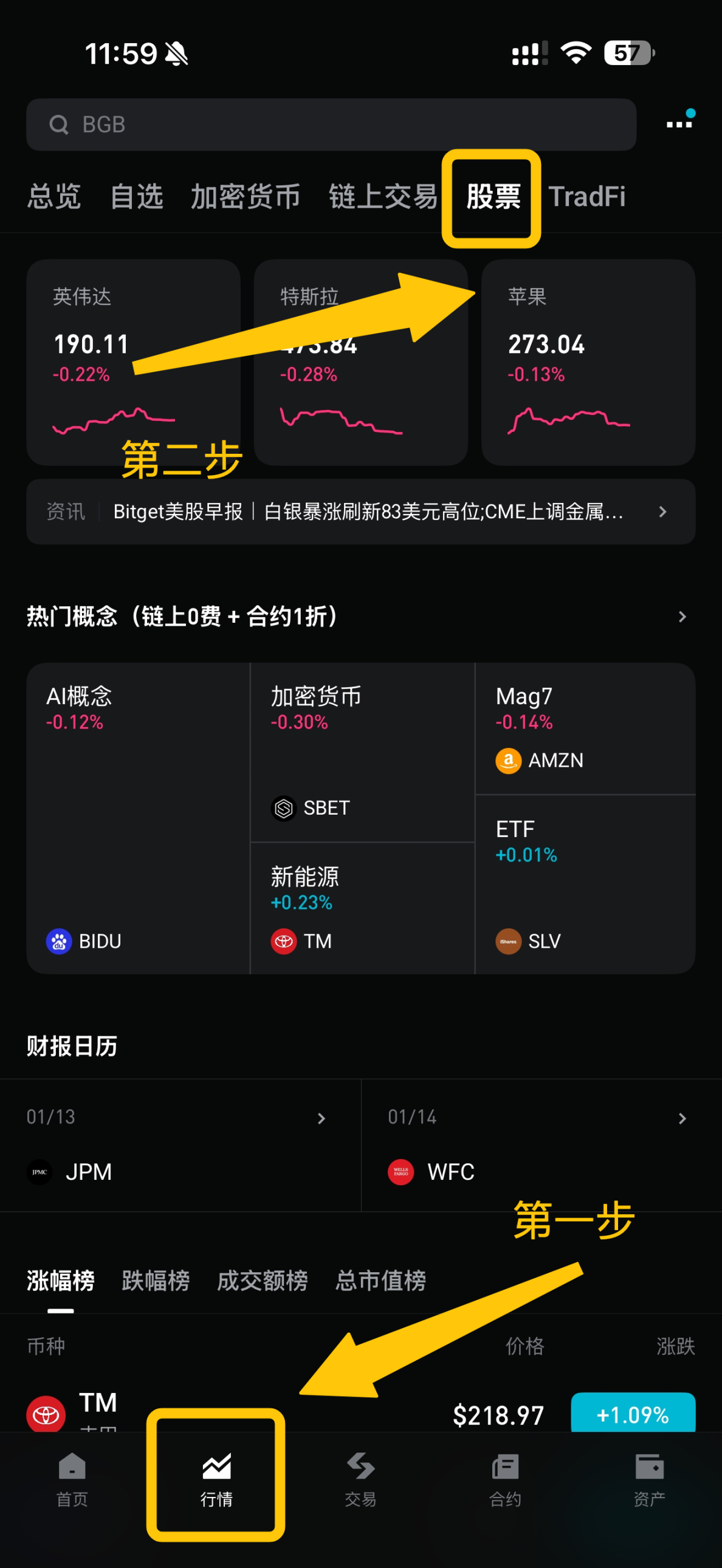
2. The stock section offers diverse data dimensions to help users fully understand real-time行情 and sector/concept trends, including:
- Popular stock trends — automatically highlights the hottest stock tokens
- Latest market news — quickly grasp global行情 within the Bitget App
- Hot concept categories — displays performance across different themes to assist decision-making
- Earnings calendar — presents key quarterly dates in calendar format
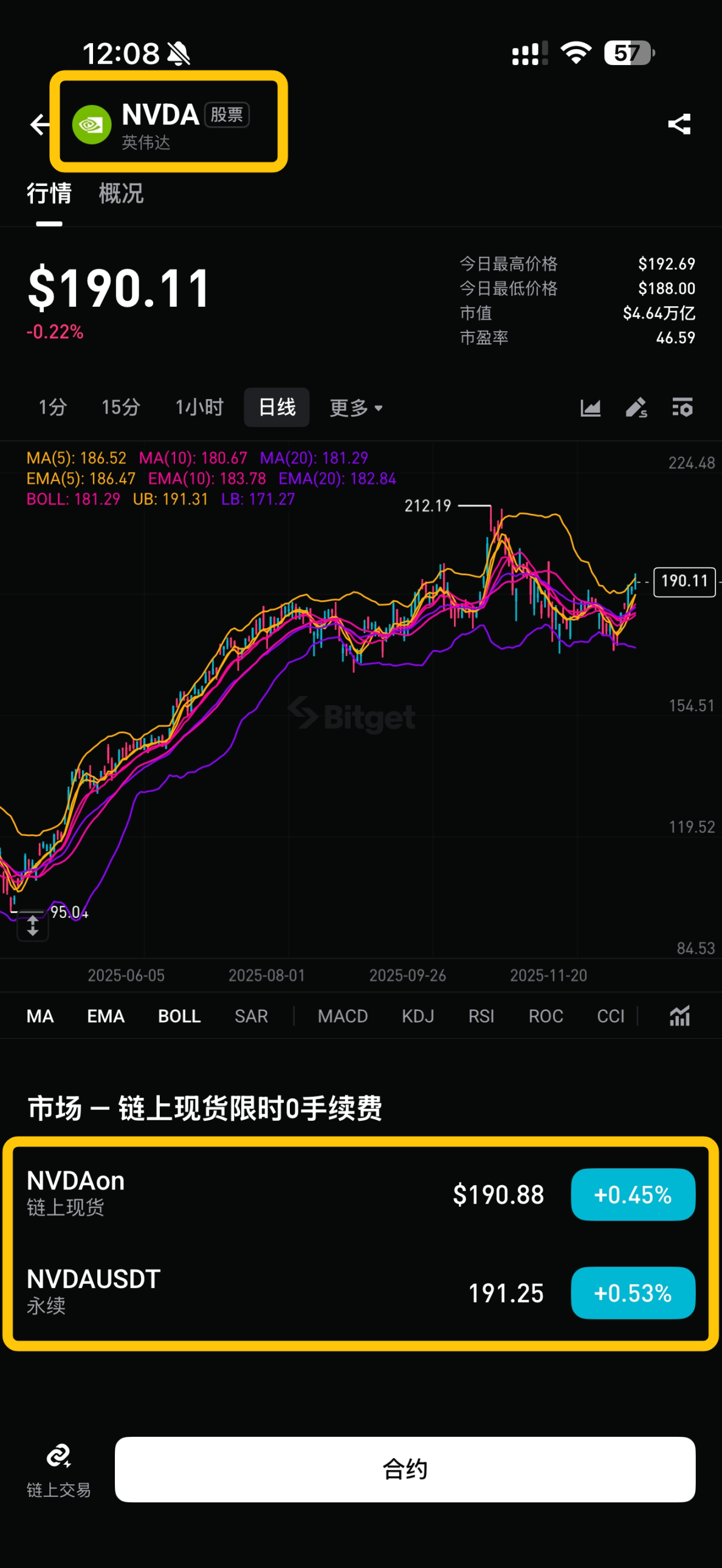
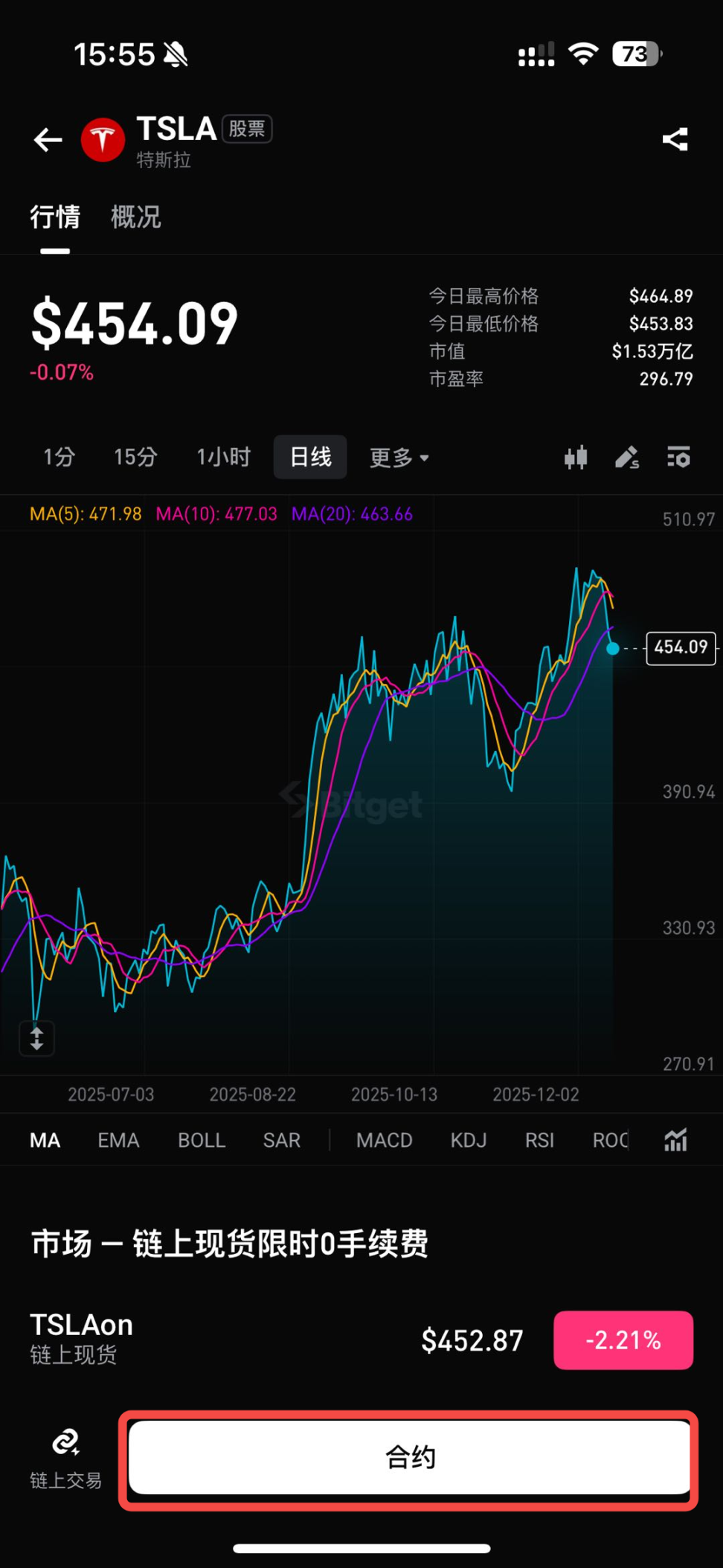
3. On individual stock pages, users can view price走势 across multiple timeframes. At the bottom, users can choose to trade either stock tokens or stock contracts.
2.2 How to Place Your First Stock Token Trade
How to Enter the Bitget Stock Token Trading Page?
1. On an individual stock行情 page, select “Stock Token” trading—for example, TSLA (Tesla)—and tap to enter the TSLAon trading interface.
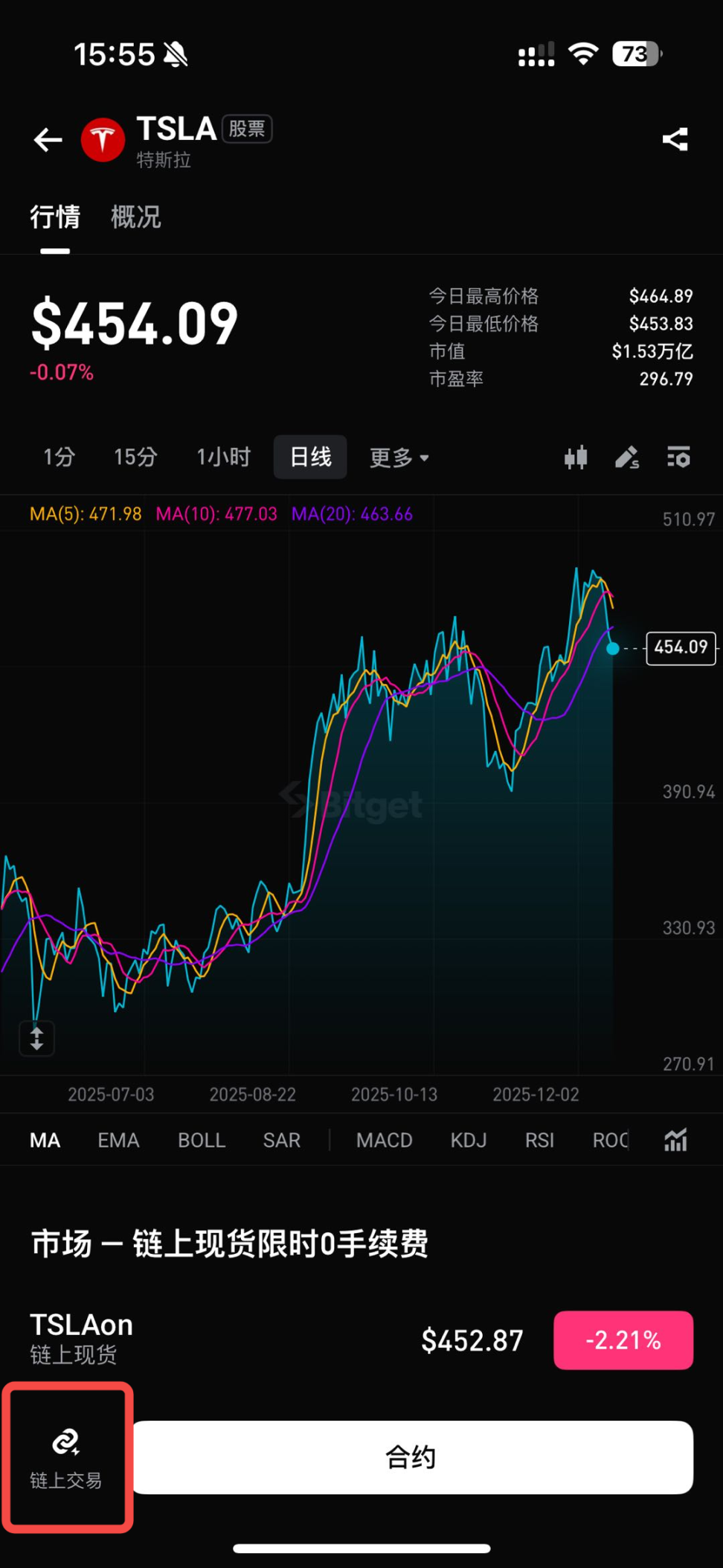
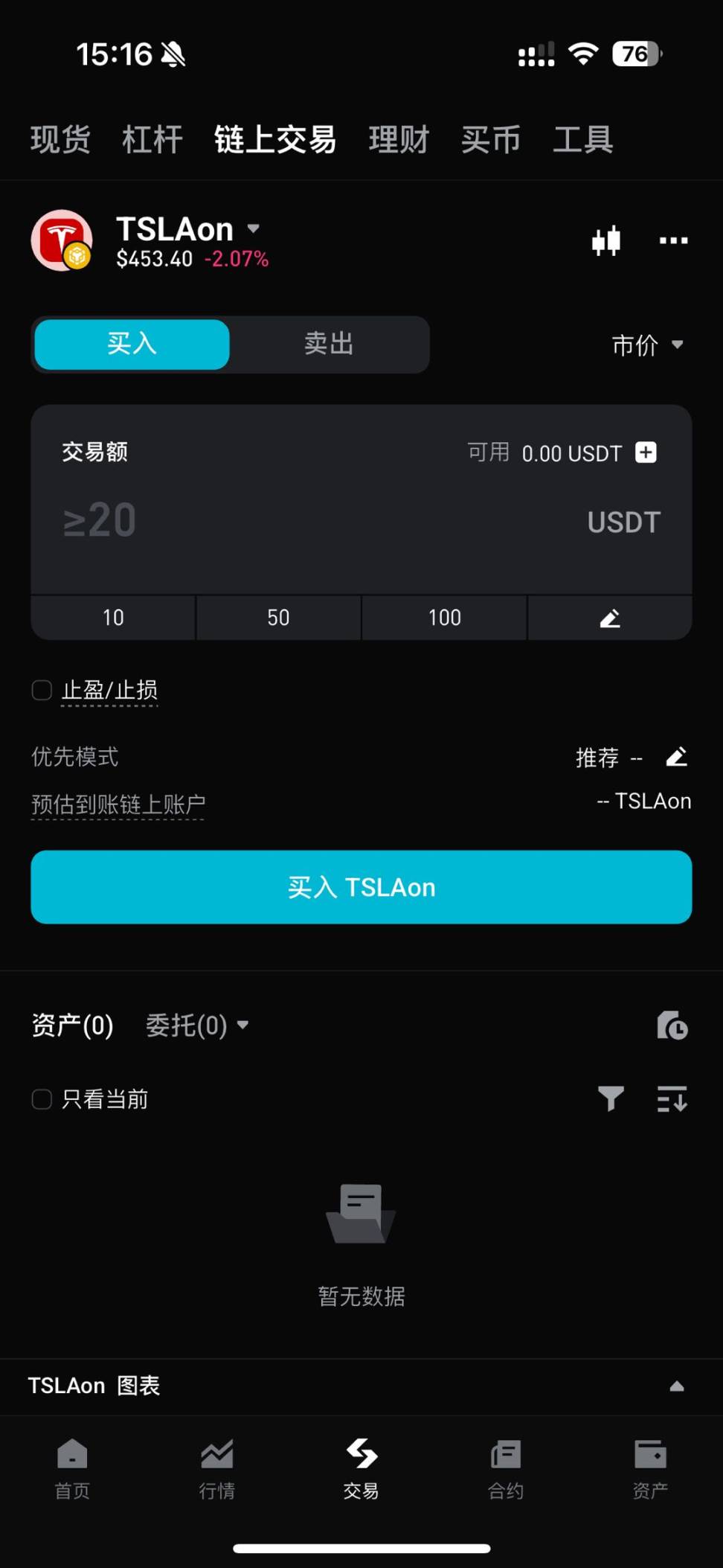
2. After selecting the target trading pair, you can begin trading and managing orders.
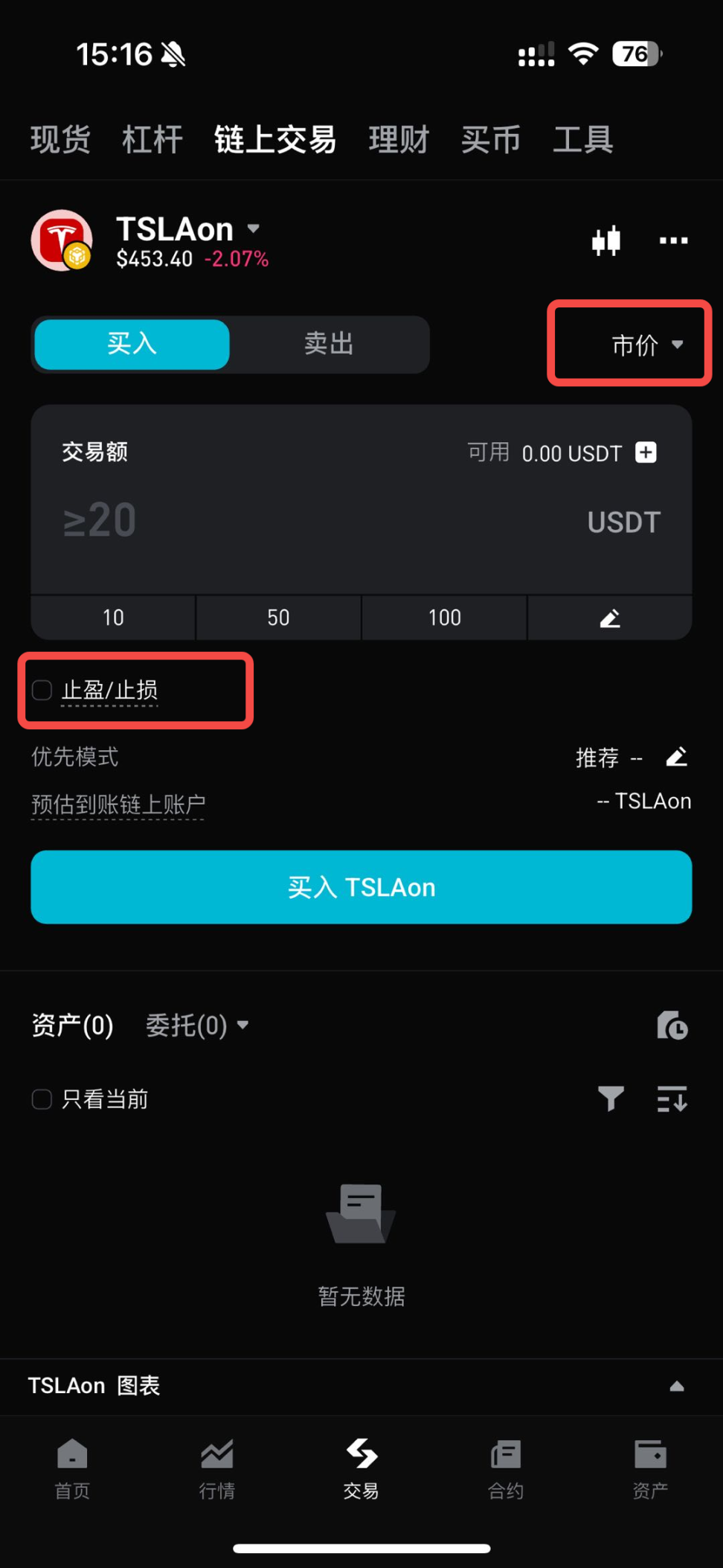
3. Choose the appropriate order type:
- Market Order: Immediate execution, ideal for fast entry
- Limit Order: Set a specific price and quantity; the order enters the order book and executes when the market reaches your price. Bitget supports 0 Gas limit orders
- Enter amount: Calculate position size based on your capital
- Set Take Profit / Stop Loss (TP/SL): Strongly recommended to manage risk. For example, set stop loss below entry price when going long to prevent excessive losses
- Click “Buy” or “Sell” to confirm: After execution, view details under the “Positions” or “Holdings” tab, including unrealized PnL
- Close position: Go to the “Holdings” page and choose “Market Close” or set a limit close
2.3 How to Place Your First Stock Contract Trade
How to Access the Bitget Stock Contract Trading Interface?
On an individual stock行情 page, select “Contract” trading—for example, TSLA (Tesla)—then tap to enter the TSLAUSDT (Perpetual) interface.
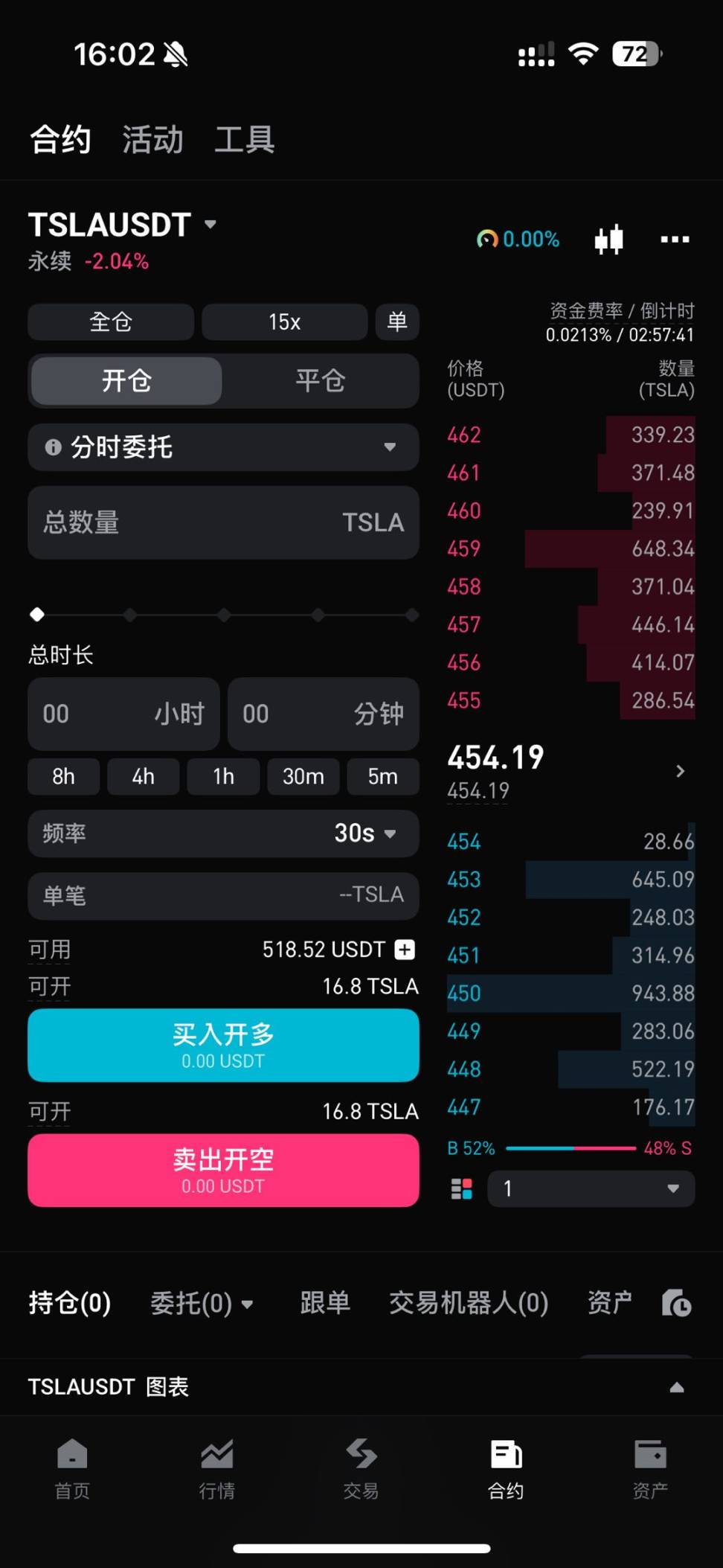
1. Set leverage and margin mode:
- Tap the leverage icon (default might be 10x) and adjust to desired level (beginners recommended to start with 1x–5x; maximum up to 25x, but risk increases accordingly)
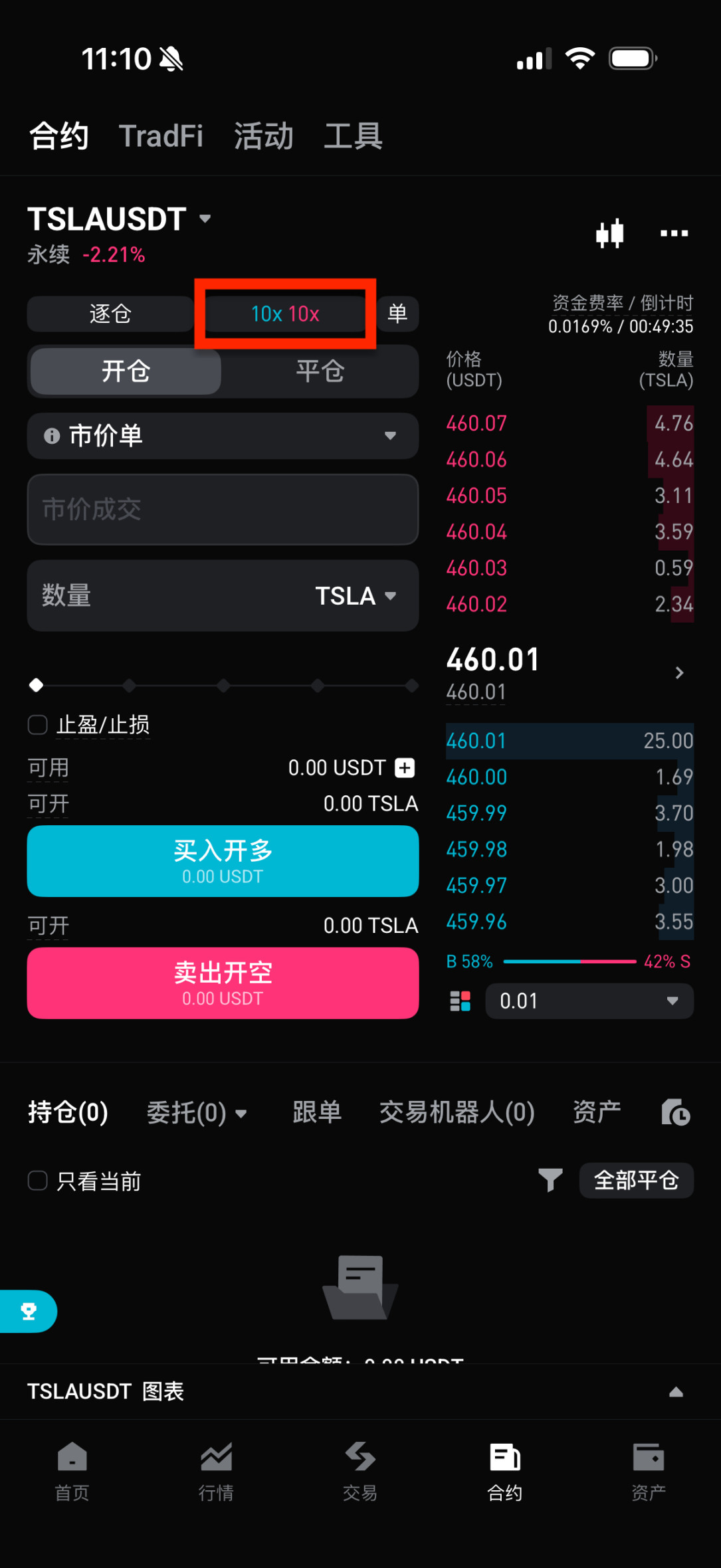
- Margin mode: Supports Cross, Isolated, and Unified Account modes

2. Select the appropriate order type:
- Market Order: Immediate execution, suitable for rapid entry
- Limit Order: Specify price for precise placement
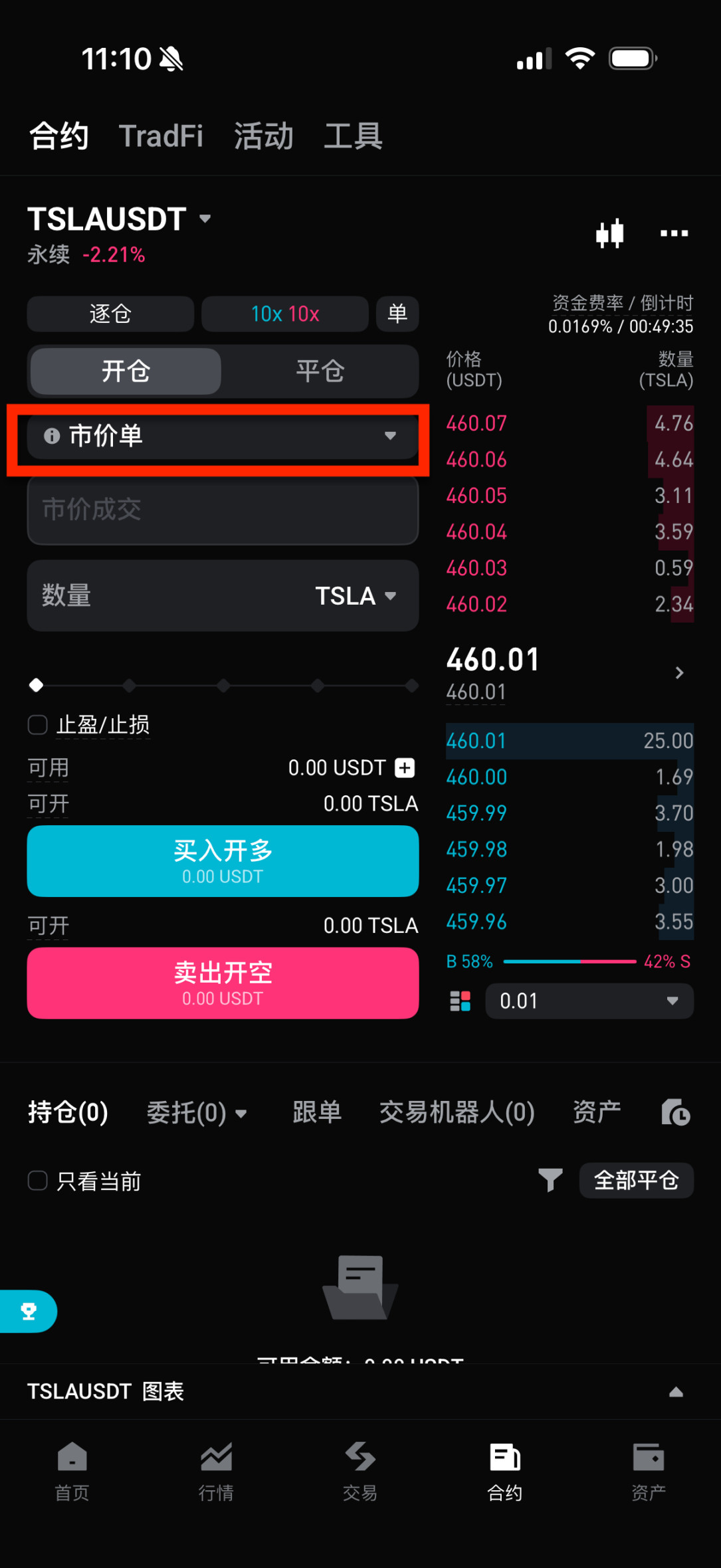
3. Direction and quantity:
- Long (Buy): Bullish on the stock index
- Short (Sell): Bearish on the stock index
Enter contract quantity (system automatically calculates position value, e.g., 100 USDT margin × 5x leverage = 500 USDT position value)
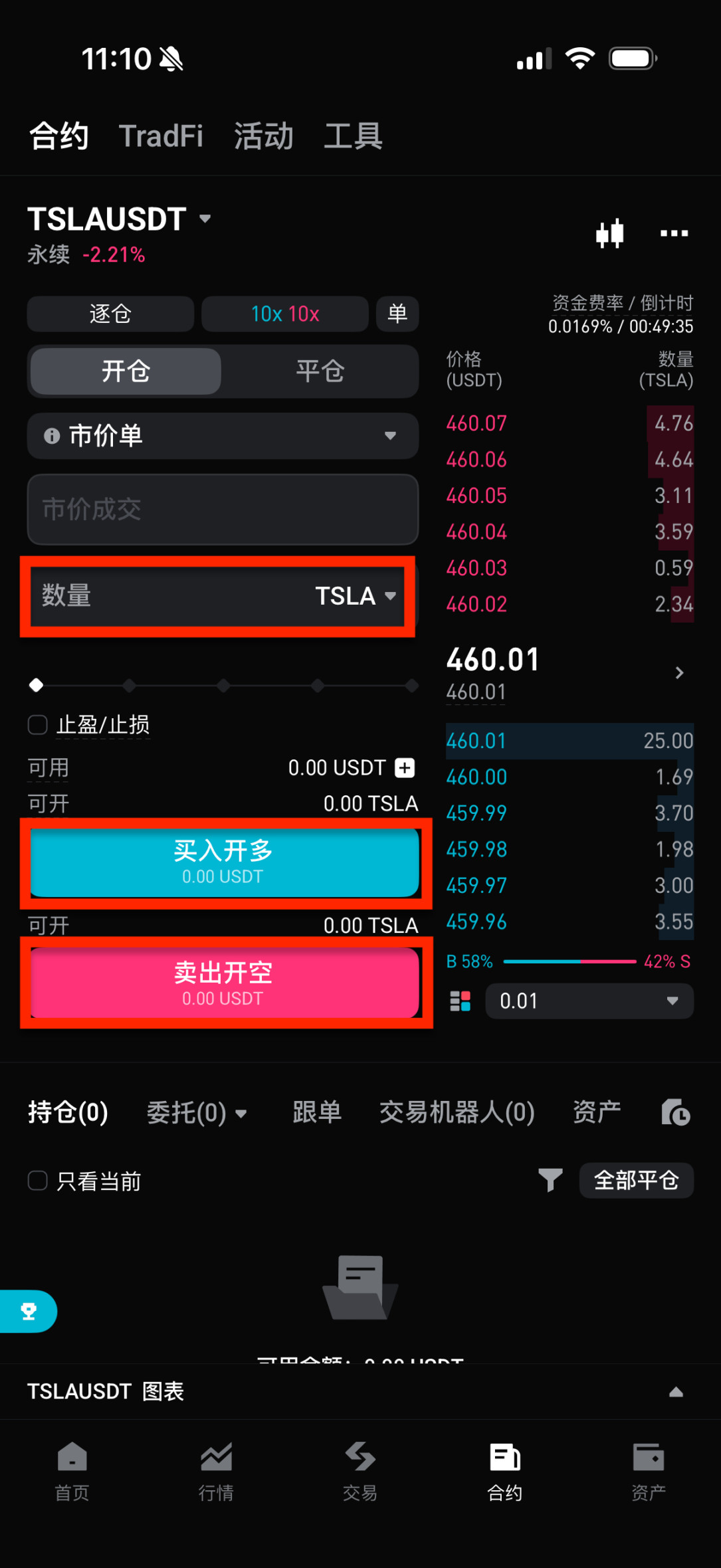
4. Set Take Profit and Stop Loss (Highly recommended for beginners!):
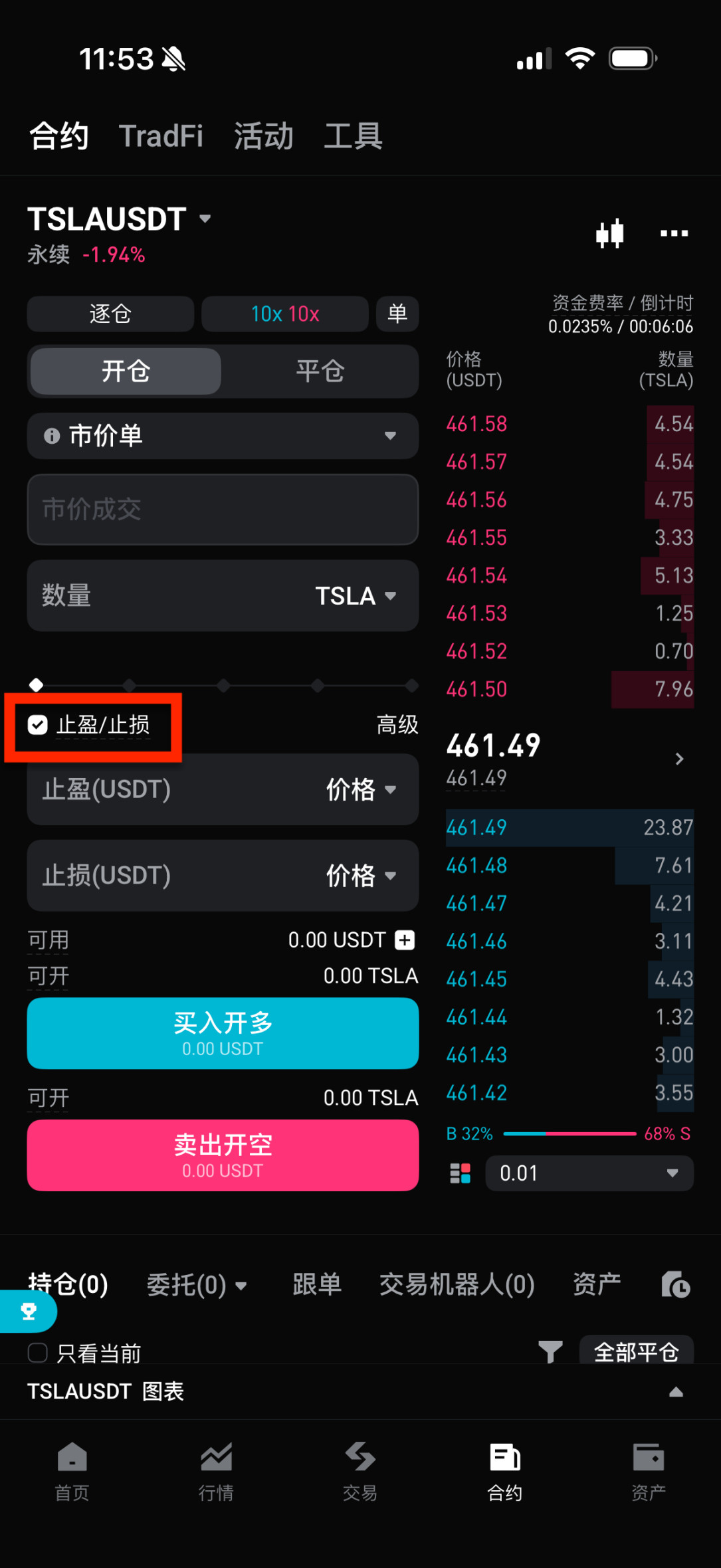
- Check TP/SL in the order panel and input take profit and stop loss prices
- Enable trailing stop to lock in profits as price moves favorably
5. Confirm order:
- Review all parameters → Click 【Long】 or 【Short】 → Confirm
- After successful placement, go to the 【Positions】 page to monitor: unrealized PnL, liquidation price, funding rate, etc.
Practical Tips:
- Start small (50–100 USDT) to practice
- Use demo trading first to get familiar
- Always set stop loss; keep single trade risk below 1–2% of account
- Monitor Bitget announcements: Leverage tiers, maintenance margins may adjust dynamically based on market risk
- Utilize contract grid bots or copy trading to reduce manual workload
Unit 3: Beginner Strategies
3.1 Earnings Season Strategy
With up to 25x leverage and 5×24 trading, Bitget stock contracts allow users to execute event-based trades around earnings releases. If you understand a company’s fundamentals, you can place directional bets ahead of earnings, setting take-profit and stop-loss orders to keep risk controlled. Most U.S. public companies release quarterly reports 2–5 weeks after quarter-end.
Strategy Example: Trader A understands NVDA’s fundamentals and expects an upside surprise in its Q3 earnings on October 19 at 5 PM New York time:
- Strategy: At 4 PM on Oct 19, NVDA at $185, open long with 25x leverage, $1,000 capital, 2% stop loss, 6% take profit
- Order parameters: Entry 185; SL 181.3; TP 196.1
- Outcome: Post-earnings rally triggered TP ~5 hours later, yielding ~$1,500 profit
3.2 Fundamental Analysis Strategy
Beginners don’t need complex valuation models—just focus on three things:
1) Expectations: Is market consensus overly optimistic?
2) Trend: Is the company’s growth narrative still favorable?
3) Position: Is price in a pullback phase or emotional peak?
Strategy Example: Trader B monitors TSLA and notices high market expectations for delivery numbers and margins—historically, this leads to “sell the news” reactions post-earnings. Trader C avoids knee-jerk reactions and waits for confirmation:
- If price breaks and holds above key resistance after earnings → go long
- If price breaks below key support and fails to recover → go short
The core is turning expectation gaps into conditional trade triggers.
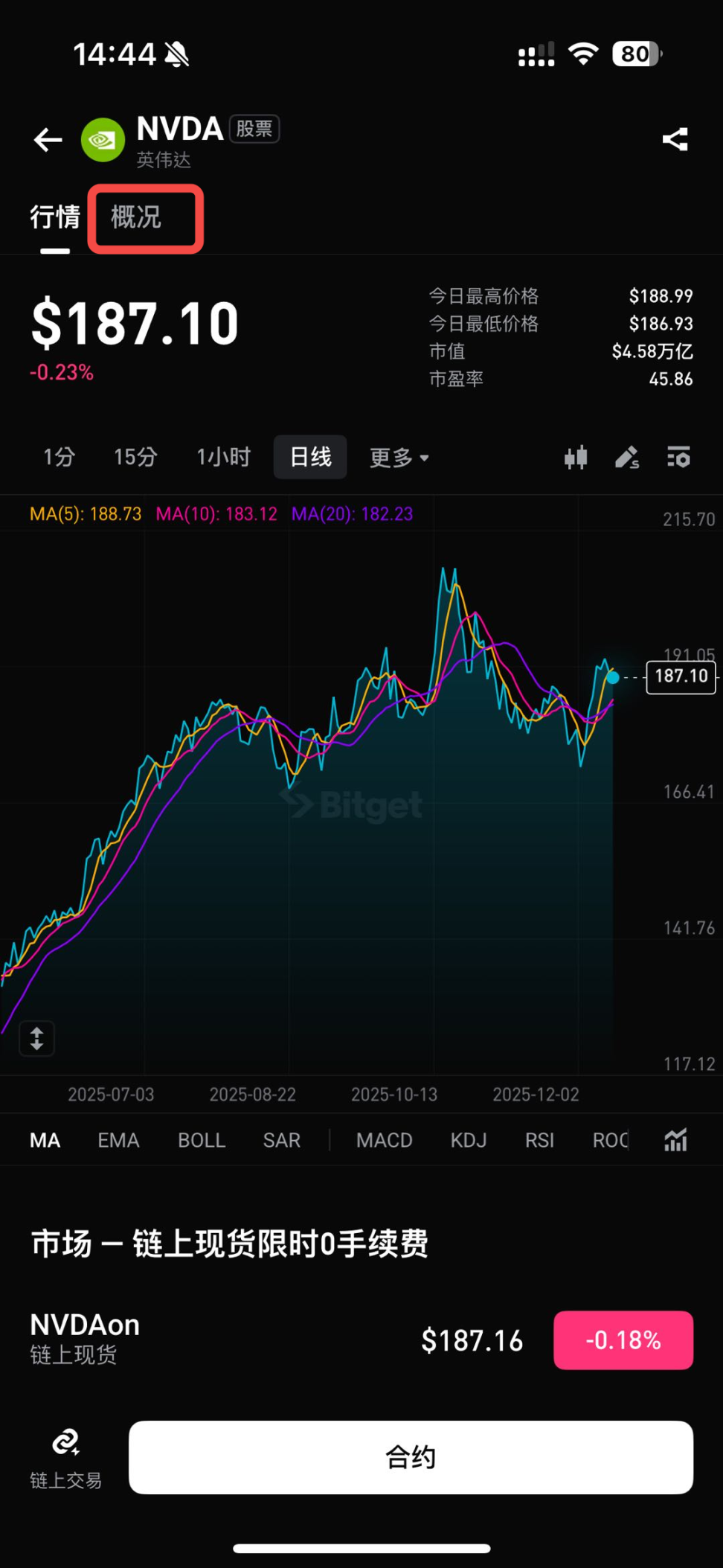
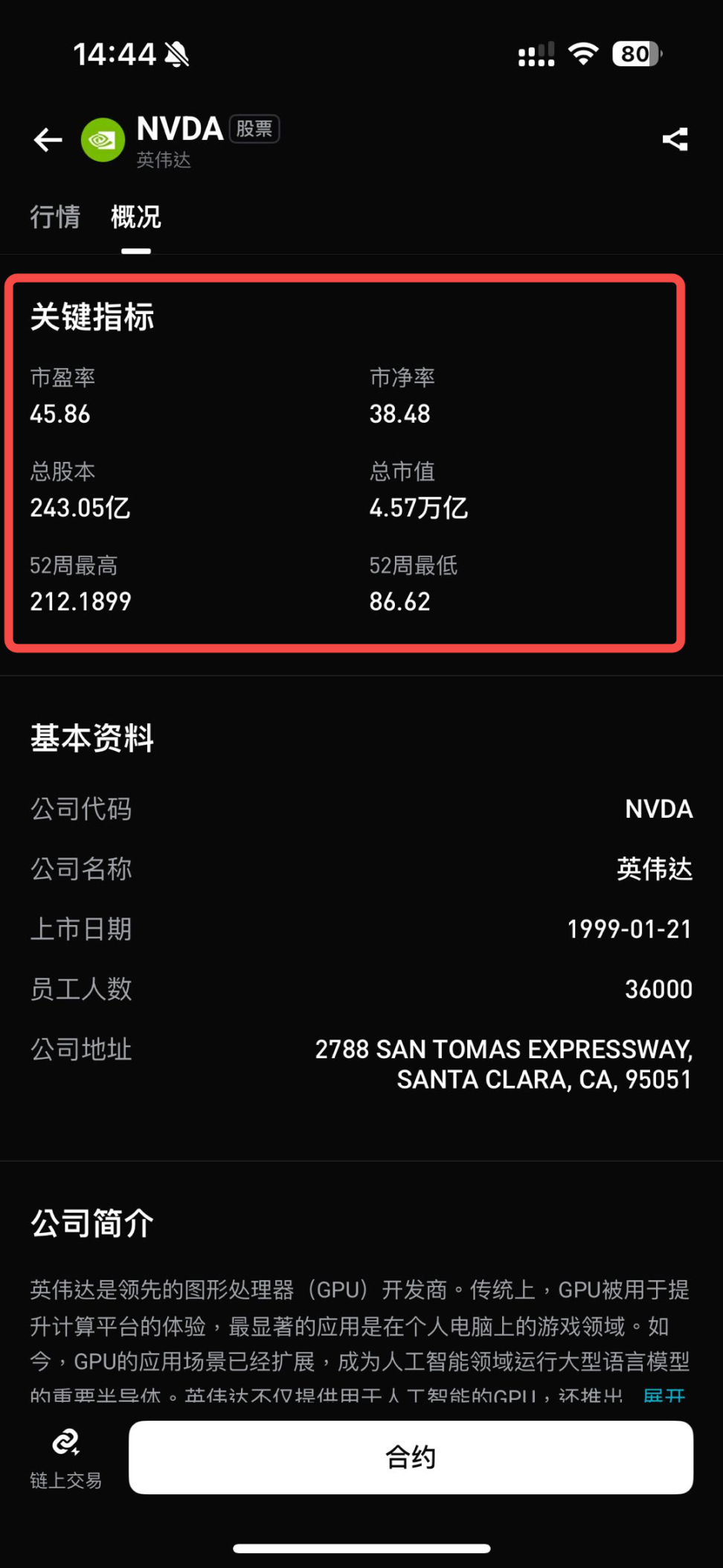
To explore full valuation metrics, use Bitget’s “Company Valuation” feature.
- Search for a stock (e.g., NVIDIA)
- Go to its trading page and click 【Overview】 to see key indicators like P/E and P/B ratios, calculated as follows:
- PE (TTM) = Share Price / EPS (EPS = Net Income attributable to parent shareholders over last 12 months / Total Shares Outstanding)
- PB = Share Price / Book Value per Share (Book Value per Share = Shareholders’ Equity / Total Shares Outstanding)
3.3 Beginner Technical Indicators
Candlestick patterns are among the most practical tools for entry-level price analysis. By studying candle shapes and formations, traders can interpret current market sentiment. When similar patterns recur, they often signal potential repetition of past price action. Note: Candlestick patterns only suggest possible future movements—not guaranteed predictions—and should serve as auxiliary references.
Below are common candlestick patterns:
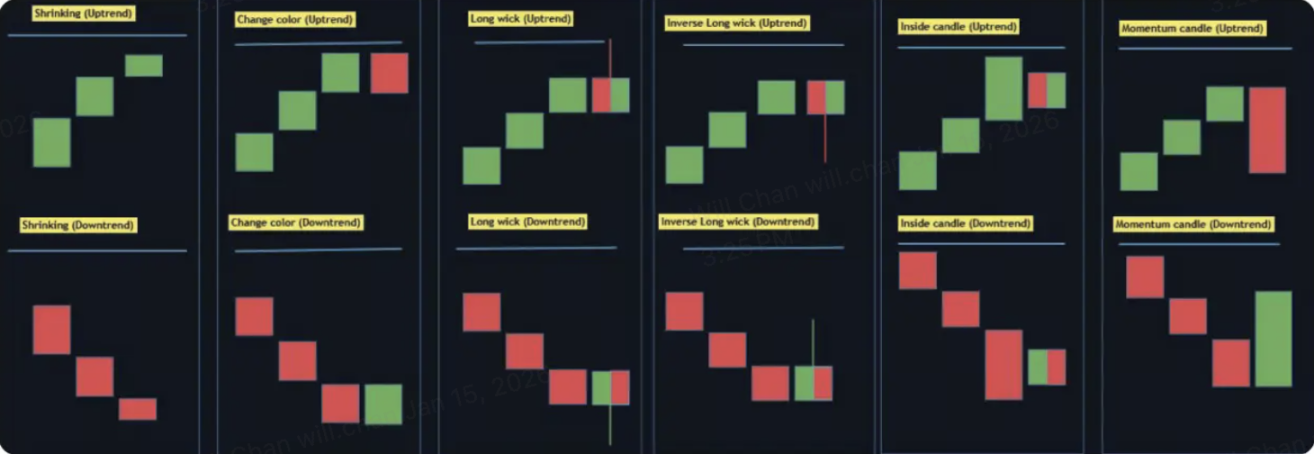

Shrinking body (smaller candles)
- Uptrend: Momentum fading, often followed by consolidation or deeper pullback
- Downtrend: Selling pressure weakening, often followed by consolidation or rebound
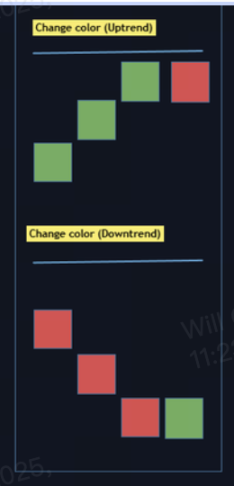
Color change
- Red candle in uptrend: Often normal retracement, not necessarily reversal
- Green candle in downtrend: Often a bounce, not trend end
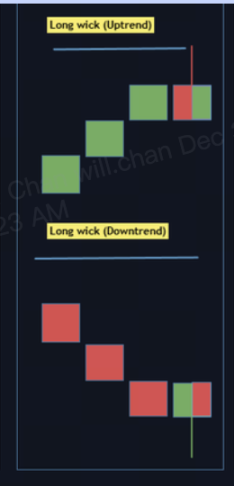
Long wick
- Long upper wick in uptrend: Rejection at highs, heavy selling pressure above
- Long lower wick in downtrend: Dip bought up, strong support below

Inverse long wick
- Long lower wick in uptrend: Pullback strongly bought back, bulls defending
- Long upper wick in downtrend: Rally aggressively rejected, bears in control
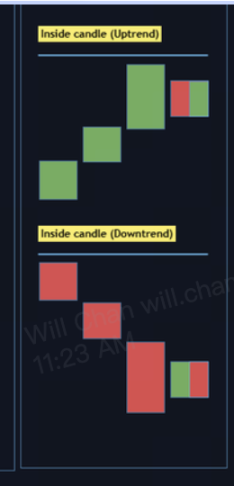
Inside candle (Harami)
- In uptrend: Pause during rally, likely to resume upward
- In downtrend: Pause during decline, likely to continue downward
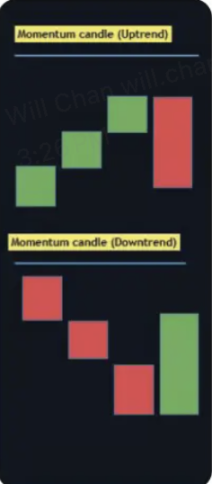
Momentum candle
- Bullish momentum candle in uptrend: Higher probability of continuation
- Bearish momentum candle in downtrend: Higher probability of acceleration
The key with momentum candles is confirming breakout quality—not blindly chasing moves.
Unit 4: Intermediate Strategies
4.1 Stock Contract Carry Trade Strategy
Under a shared margin system, stock tokens cannot be used as margin, so intermediate carry strategies work better as structured trades within the same margin framework—generating returns from funding rate spreads or price differentials rather than pure directional bets.
Strategy Example: Trader C sees a period of dense risk events and uncertain direction but wants structural yield:
- Identify stock tokens with high funding rates—e.g., TSLA at +0.0135% every 6 hours (~29.565% annualized)
- Build a portfolio: Buy TSLA stock token on-chain and short an equal-value TSLA contract to earn a “stablecoin-like” yield

4.2 Crypto + Stock Correlation Trading
With shared margin, you can simultaneously hold BTC and U.S. stock contracts, managing both legs under one margin system—ideal for correlation and relative strength trades.
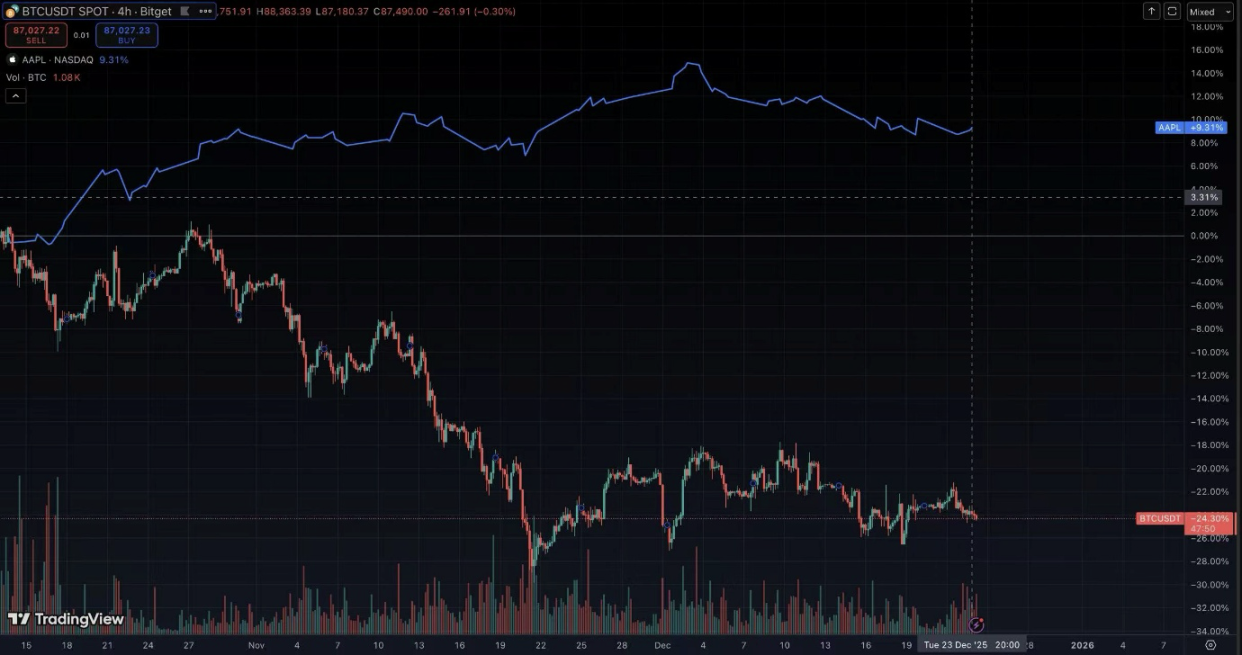
Strategy Example: On October 10, Trader D observes a historic wave of crypto liquidations, suggesting increased downside pressure. Seeking tech stock hedges, he opens positions on October 13 with $1,000 capital:
- Strategy: 10x short BTC, 10x long AAPL
- Execution: Short BTC at 115,000 (now ~87,000, unrealized +~$2,434); Long AAPL at 247 (now ~272, unrealized +~$1,012)
- Result: Total unrealized profit ~$3,446
4.3 Intermediate Technical Indicators
Technical indicators are quantitative tools based on mathematical models and formulas used to assess market trends.
They analyze historical price and volume data to help traders interpret current market conditions and price momentum. While indicators help reduce impulsive entries and inefficient trades, there are hundreds of them—mastering the most essential ones is the first step toward integrating them into your strategy.
Common technical indicators include:
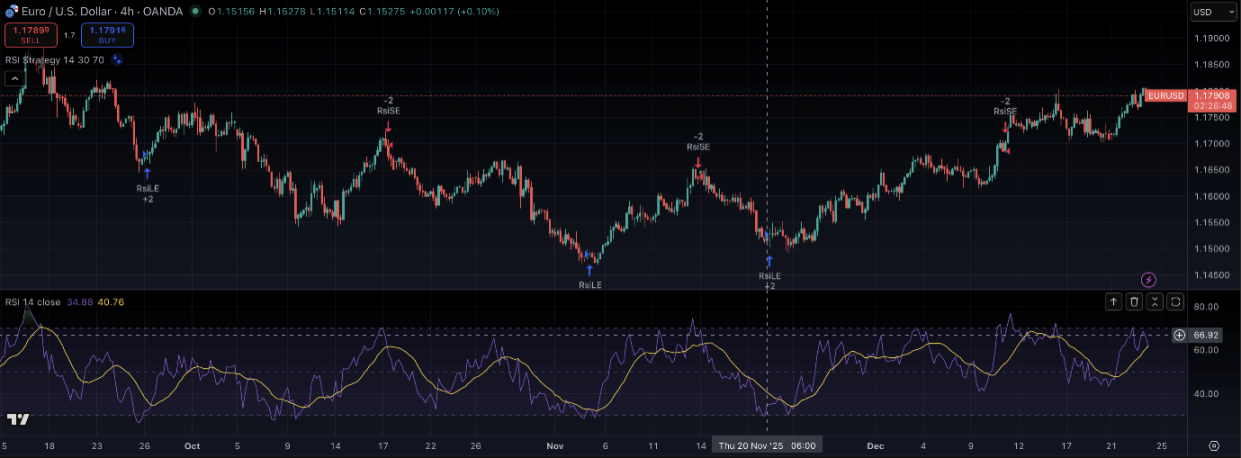
RSI 14
- Trending markets: In uptrends, RSI stabilizing near 40–50 often signals end of pullback; in downtrends, RSI stalling at 50–60 often marks end of bounce
- Ranging markets: RSI >70 suggests pullback risk; RSI <30 suggests rebound opportunity
- Practical use: RSI helps judge timing rhythm—don’t use alone; always combine with key price levels
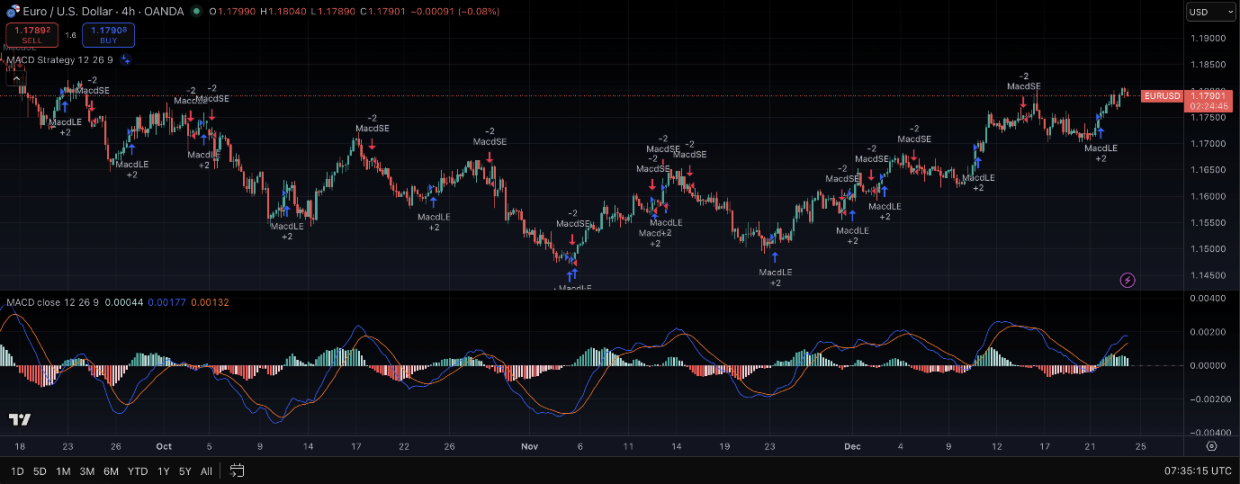
MACD 12,26,9
- Zero-line filter: Golden cross above zero line is more bullish; death cross below is more bearish
- Momentum confirmation: Expanding histogram after crossover is stronger than weakening
- Divergence handling: Price makes new high but MACD doesn’t → caution; price makes new low but MACD doesn’t → caution
- Practical use: MACD confirms whether momentum truly supports the trend
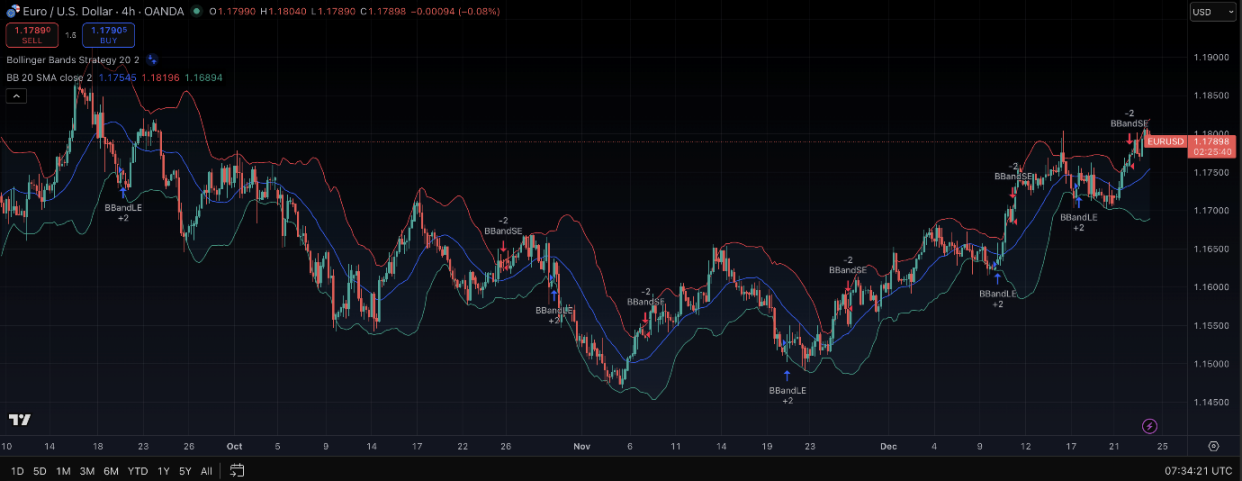
Bollinger Bands 20,2
- Squeeze to expansion: After narrow bands, breakout above/below band signals rising trend probability
- Midline as divider: Price above midline = bullish bias; below = bearish bias
- Practical use: Retest of midline without break confirms long; rejection at midline confirms short
Three-Indicator Combo Conditions
- Go long: Break and hold above BB midline; MACD golden cross + expanding; RSI >50
- Go short: Break and stay below BB midline; MACD death cross + expanding; RSI <50
Unit 5: Advanced Strategies
5.1 Macro Trading Strategy
Macro trading is fundamentally about scenario planning: Different data outcomes lead to different paths. Using stock index or U.S. stock contracts offers the highest execution efficiency, with crypto contracts serving as correlated legs.
CPI Data
- Higher than expected: Rate hike expectations rise, pressuring growth stocks and Nasdaq
- Lower than expected: Rate cut expectations grow, boosting risk appetite
- In line with forecast: Market likely remains range-bound or shifts focus to earnings narratives
Unemployment Rate
- Significant increase: Signals economic slowdown, dampening risk appetite
- Remains low: Suggests resilient growth—but could imply prolonged higher interest rates
Strategy Example: Trader E captures post-CPI move using Bitget QQQ contract
Trading logic:
- Pre-data: Market cautious—take small “hedge leg” position
- Post-release: Confirm “lower-than-expected” → execute long bias, ride recovery
Execution:
- Step 1 (short before data—capture hedge drop)
- Short QQQ at ~613.06 on Dec 17, 10x, $1,000 capital
- Cover at ~600.41 near close
- Price drop: (613.06 - 600.41)/613.06 ≈ 2.06%
- PnL (approx linear): 1,000 × 10 × 2.06% ≈ $206
- Step 2 (go long post-CPI—ride intraday surge)
- After CPI beat, QQQ traded between 606.92 (low) and 612.93 (high)
- Trader E went long at ~607, 20x, $1,000 capital
- Took profit at ~612
- Price gain: (612 - 607)/607 ≈ 0.824%
- PnL (approx linear): 1,000 × 20 × 0.824% ≈ $165
- Total profit (both legs): ~$206 + $165 = $371
5.2 Contract Risk Management
Shared margin boosts capital efficiency but demands strict account-level discipline.
Advanced Risk Management Rules:
- Account-level: Halt trading if daily max loss threshold is hit; reduce leverage and position size if max drawdown threshold is breached
- Strategy-level: Assign loss quotas per strategy to avoid multi-strategy blowups on same day
- Trade-level: Define max loss first, then calculate position size based on stop distance
Example: Trader F uses Bitget QQQ contract with $10,000 account, capping max loss per trade at 1% ($100).
He goes long QQQ at 610, placing structural stop at 605.12 (~-0.8%). He calculates position size based on max loss: Notional size = $100 / 0.8% = $12,500; using 20x leverage, margin used ≈ $625.
Set profit targets based on risk-reward ratio:
- 2R target: $200 profit → TP at **619.76 (+1.6%)
- 3R target: $300 profit → TP at **624.64 (+2.4%)
Thus, worst-case loss is capped at $100, while successful trades yield $200–$300—locking in a 1:2 or 1:3 risk-reward ratio.
Content is structured by difficulty level, allowing readers to progress from beginner strategies to advanced combination and macro-driven methods, building a reviewable, iterative trading skillset. Each strategy emphasizes context and execution logic—avoiding “opinion-only” advice—so users can turn concepts into actionable trading plans.
Conclusion
In the volatile U.S. stock market, you need a trading system that can endure both bull and bear cycles.
This guide aims to equip you with Bitget’s professional insights to build long-term competitive advantage in the U.S. equity markets. Whether you’re a newcomer or an advanced trader seeking breakthroughs, here lies your path forward.
- Core concepts and basic operations
- Portfolio and macro-driven methodologies
- Strategy execution logic and analysis
Bitget Academy
Join TechFlow official community to stay tuned
Telegram:https://t.me/TechFlowDaily
X (Twitter):https://x.com/TechFlowPost
X (Twitter) EN:https://x.com/BlockFlow_News