The Real-Life Inspiration Behind “The Big Short”: Trillion-Dollar AI Investments Went Astray from the Start
TechFlow Selected TechFlow Selected
The Real-Life Inspiration Behind “The Big Short”: Trillion-Dollar AI Investments Went Astray from the Start
Large language models place language before genuine reasoning capabilities and can never achieve true understanding.
 Navigating Web3 tides with focused insights
Author: Michael Burry
Translated and edited by TechFlow
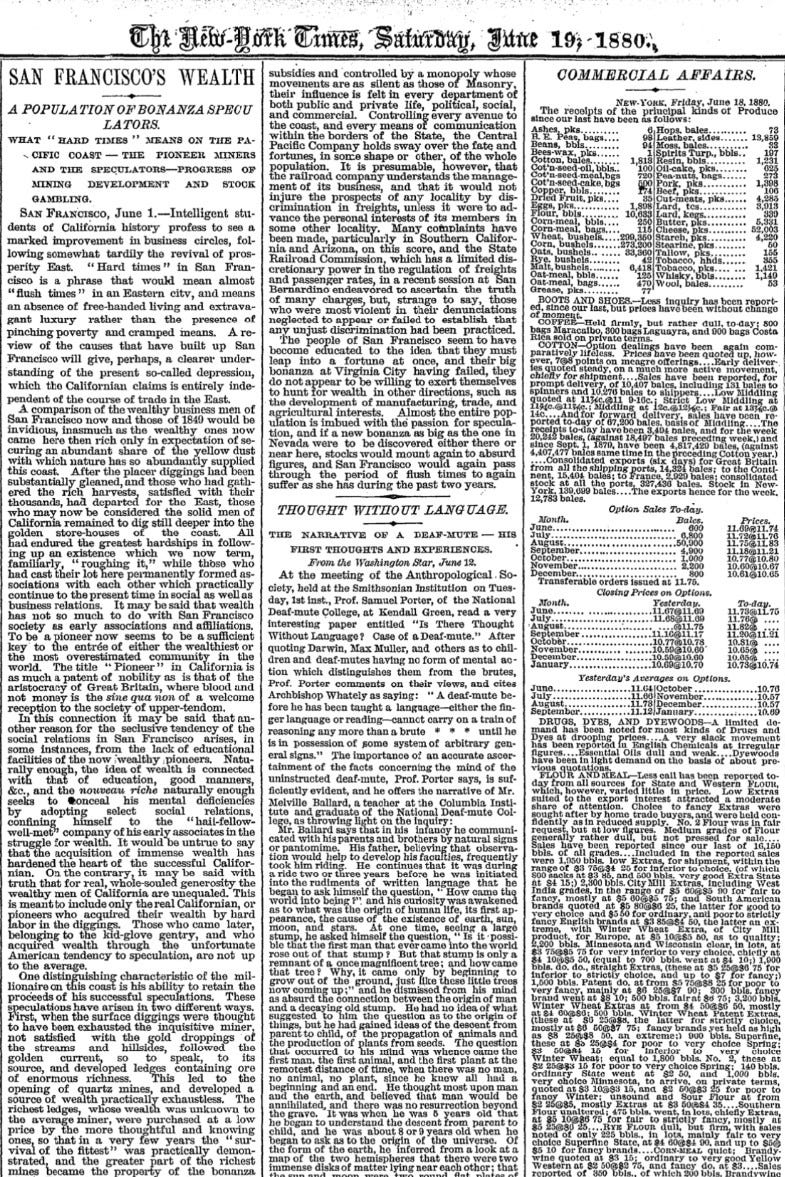
The New York Times, Saturday, June 19, 1880
Welcome to the “History Rhymes” series. In this series, I illuminate current events through pivotal perspectives drawn from the distant past.
One quiet Saturday, as I habitually browsed old newspapers—a personal hobby—I stumbled upon a report dated June 19, 1880, whose uncanny resonance with today’s anxieties about AI struck me profoundly.
This is the story of Melville Ballard. Born without language, he stared at a tree stump and asked himself: Could the first human have grown from this?
This case—documented formally by the Smithsonian Institution 144 years ago—poses a potentially fatal challenge to today’s large language models (LLMs) and the massive investments powering them. Through the lens of an ordinary person’s life, it boldly declares: complex thought emerges from silence, prior to language.
Today, deep into the 21st century, we place language before rational capacity—not building intelligence, but merely crafting an ever more polished mirror.
Two articles in that old newspaper merit attention. Let’s begin with the one centered on page three, titled: “Thought Without Language.”
Of course, large language models, small language models, and reasoning ability are precisely the hottest topics today.
The full title of that article reads: “Thought Without Language—An Autobiographical Account by a Deaf-Mute: His Earliest Thoughts and Experiences.” It first appeared in The Washington Star on June 12, 1880.
The protagonist is Professor Samuel Porter of Gallaudet College—the National Deaf-Mute College—and the article reports on his paper delivered at the Smithsonian Institution, titled “Can Thought Exist Without Language? A Case Study of a Deaf-Mute.”
The paper opens with discussion of mental activity among deaf-mutes and children lacking linguistic forms—an outdated framing far removed from contemporary understanding, which I initially intended to skip.
But the subject of the case study was Melville Ballard, a teacher at the Columbia Institution for the Instruction of the Deaf and Dumb—and himself a deaf-mute, and also a graduate of the National Deaf-Mute College.
Ballard recounted that in early childhood, he communicated with his parents and siblings via natural gestures or pantomime. His father believed observation cultivated intellectual development and frequently took him on bicycle rides.
He continued: “Two or three years before I was formally introduced to the fundamentals of written language, during one such ride, I began asking myself: ‘How did the world come to be?’ I felt intense curiosity about the origin of human life, the first appearance of people, and why the Earth, Sun, Moon, and stars exist.”
Once, seeing a large tree stump, he wondered: “Could the first human to appear in this world have grown out of that stump?” Yet he immediately reasoned that the stump was merely the remnant of a once-mighty tree—and how, then, had that tree itself originated? It must have grown slowly from the soil, just like the young saplings around him. He thus dismissed the idea as absurd, rejecting any link between human origins and a decaying stump.
He did not know what triggered his inquiry into origins—but he had already formed concepts of parent-child inheritance, animal reproduction, and plant growth from seeds.
The question truly haunting him was: At the most remote beginning of time—when no humans, animals, or plants yet existed—where did the first human, the first animal, and the first plant come from? He pondered humans and Earth most deeply, believing humans would ultimately perish, with no resurrection after death.
At around age five, he grasped the concept of parent-child inheritance; between ages eight and nine, he began questioning the origin of the universe. Regarding Earth’s shape, he inferred from a map showing two hemispheres that it consisted of two enormous circular discs placed side by side; he imagined the Sun and Moon as flat, luminous discs, held in awe of them, and deduced from their rising and setting that some powerful force must govern their motion.
He believed the Sun plunged into a hole in the west, traveled through a vast subterranean channel inside the Earth, and emerged from another hole in the east—tracing the same arc across the sky. To him, stars were tiny points of light embedded in the firmament. He described his fruitless contemplation of all this until entering school at age eleven.
Prior to enrollment, his mother had told him of a mysterious being in the heavens—but when she could not answer his questions, he abandoned the pursuit in despair, filled with sorrow because he could form no definite conception of that celestial being.
In his first year of school, he learned only a few sentences each Sunday. Though he studied these simple words, he never truly grasped their meaning. He attended worship services, but due to limited sign-language proficiency, understood almost nothing. In his second year, he received a small catechism containing a series of questions and answers.
The fusion of language and rational capacity thus propelled the development of understanding.
Thereafter, he could comprehend the sign language used by teachers. One might assume his inquisitive nature was now satisfied. But that was not the case—upon learning the universe was created by a great sovereign spirit, he immediately asked: “Where did the Creator come from?” He continued probing the nature and origin of that sovereign being. Reflecting on this, he asked himself: “After entering the Lord’s kingdom, shall we comprehend God’s essence and grasp His infinity?” Should he echo the ancient patriarch: “Can you fathom God by searching?”
Professor Porter then presented his core thesis to the Smithsonian audience of 1880.
He said animals might understand certain words or distinguish specific objects. Yet he pointed out:
“Even granting every conceivable possibility possessed by animals, is it not self-evident—that humans possess capacities we cannot conceive as having evolved from anything shared between humans and lower animals, nor as mere quantitative enhancements of those shared traits?”
“…However similar the modes of impression formation or organ structure may be, however closely tied to organic activity—i.e., however intimate the physiological connection—visual perception as sensation or perception is inherently distinct from auditory, cephalic, or gustatory perception, implying a unique faculty or capacity not contained within the latter. Rational action and the operations of lower faculties are not analogous in this way.”
“…The fact that both share certain elements does not prove they belong to the same order, nor render the evolution of one from the other possible. If the soul’s eye—the higher reason enabling us to perceive the cosmos—cannot turn inward to clearly discern its own essence and operations, we must not therefore forget its function, deny its essential superiority, or equate it with those subordinate faculties we examine using it. That which enables us to comprehend all things must, by its very nature, surpass anything it comprehends.”
An attendee noted especially how Ballard’s gaze conveyed meaning perfectly, beyond any ambiguity:
“The most fascinating moment of the meeting was Mr. Ballard using gesture to describe how his mother told him he would soon attend a distant school where he would read books and write letters folded neatly for her—and how, in pantomime, he portrayed a hunter who killed a squirrel, then accidentally shot himself. Mr. Ballard’s gestures and movements, combined with his gaze and facial expression, conveyed his meaning flawlessly to the audience. As one member put it, ‘The language of the eyes is one that cannot be misunderstood.’”
Consider these two statements:
- “That which enables us to comprehend all things must, by its very nature, surpass anything it comprehends.”
- “The language of the eyes is one that cannot be misunderstood.”
In summary:
- Language without rational capacity cannot achieve understanding.
- Only when rational capacity exists can language unlock understanding.
- Fully realized understanding transcends language itself.
Large language models prioritize language, constructing a primitive form of rationality purely through logical inference. Yet this rationality has proven flawed—prone to hallucination at the rough edges of knowledge.
True rational capacity has never genuinely existed. Therefore, language cannot be elevated by rationality into understanding.
The professor discovered through his work with deaf-mutes: authentic rational capacity must precede language for language to unlock understanding—understanding arises only from the joint operation of true rational capacity and language.
“The language of the eyes is one that cannot be misunderstood.”
In other words, the language of the eyes embodies perfect understanding—requiring no linguistic mediation.
By placing language before genuine rational capacity, large language models can never reach understanding.
If understanding truly transcends language—as revealed in that Smithsonian lecture 144 years ago—we should readily find corroboration today.
I personally experience this in medical education and practice. Throughout undergraduate pre-medical studies and much of medical school, deductive logic serves students as the tool for organizing vast medical knowledge. Only upon entering clinical training does the artistry of medicine—physical signs, emotion, humanistic expertise—begin to develop. Then, at some point during residency or early practice, after accumulating substantial experience across these domains, understanding finally arrives. All components interconnect within a vast, intricate network, enabling experienced physicians to deliver comprehensive patient care.
When two surgeons handle a complex head-and-neck cancer surgery or trauma—or when nurses working alongside them—sometimes a glance alone suffices for communication: complete understanding is conveyed, action is triggered, because everyone present has attained understanding—transcending logical inference and the rudimentary, puzzle-like reasoning rooted in memorization that characterizes early medical education.
Thus, the gaze delivers intuitive apprehension of reality—grounded in shared understanding, which itself springs from rational capacity operating in the presence of language.
Large language models—and small language models—remain permanently stuck in the middle ground. They simulate reasoning but lack true rational capacity, lack eyes, lack understanding.
The Ballard Test: An entity must demonstrate rationality without language to qualify as possessing genuine understanding.
This is a known deficiency—a poor starting point. AI research originally aimed to first generate authentic rational capacity, but this goal was never achieved; the field thus pivoted to language-first approaches—because they were easier.
This “poor starting point” led to a “parameter trap”: brute-force language processing powered by countless energy-hungry chips has become an ironically severe bottleneck.
As emphasized in my conversation with Klarna founder Sebastian Siemiatkowski, the path forward lies in compression—prioritizing “System 2” reasoning to digest information redundancy and the relatively limited set of queries generated by humans, thereby drastically reducing computational demand.
This new route rejects the infinite mirroring path—language models conversing endlessly with one another in pursuit of singularity—a directionless waste of resources doomed to fail due to its detachment from economic reality.
Frontier research such as Google’s AlphaGeometry and Meta’s Coconut is shifting toward this “reasoning-first” architecture—but fundamentally, they are merely rediscovering what the Smithsonian presented 144 years ago: language is the output of understanding, not the engine of rationality.
This multi-trillion-dollar “computational myth” may well be shattered by a return—to the silence preceding language, to pre-linguistic rationality. It is the return of the full-bandwidth rationality of deaf-mutes, whose silent thoughts, long before finding words to express them, already reached for the stars.
Silicon Valley
Earlier, I mentioned another noteworthy article on the same page—its relevance to today likely exceeds the imagination of anyone in the 1880s.
This article is titled: “San Francisco’s Wealth: A City of Sudden Riches and Speculators.”
Written in San Francisco on June 1, 1880, it appeared in The New York Times on June 19.
A French saying comes to mind: “The more things change, the more they stay the same.” It feels apt here.
“What San Francisco calls ‘hard times’ might elsewhere be termed ‘quite comfortable days’—meaning absence of extravagance and luxury, not poverty or destitution.”
California then was a playground for small-capital players. To satisfy speculative appetites, a unique public bidding system emerged: for just $50, one could buy shares in a mine—at $1 per share, or two shares for 50 cents, or any quantity at varying prices.
When a stock “boomed,” it seemed to ignite only the impulse to “try again.” It ignited the same speculative fervor in San Francisco, as people rushed to seize opportunities missed by the sudden-rich crowd; “booms” arrived hand-in-hand with market losses, and when the boom faded, prices reverted to normal.
The article’s conclusion strikes today’s reality with remarkable force:
“San Franciscans seem to have grown accustomed to the notion that wealth must arrive in one fell swoop; and having seen their great bonanza in Virginia City collapse, they appear unwilling to rally and seek prosperity in manufacturing, trade, or agriculture. Almost the entire city burns with speculative fever—if a new bonanza equal in scale to Nevada’s were discovered here or nearby, stock prices would once again soar to absurd heights, San Francisco would relive those days of sudden riches, and then suffer anew all it endured over the past two years.”
In my article “Core Signs of a Bubble: Supply-Side Greed,” I traced this astonishing tendency originating in the San Francisco Bay Area: speculation continually intensifies, driving investment far beyond any terminal demand reasonably foreseeable within any plausible timeframe.
Reading such old newspapers offers a uniquely illuminating lens for interpreting today’s events. Will Silicon Valley “relive those days of sudden riches, and then suffer anew”—as it has repeatedly done—or break the pattern? No one can say for sure. I hope this piece proves insightful to you.
Finally, I recommend Midjourney, a tool for generating images and videos.
It’s incredibly fun—and deeply thought-provoking. Get creative!

See you next time!
Join TechFlow official community to stay tuned
Telegram:https://t.me/TechFlowDaily
X (Twitter):https://x.com/TechFlowPost
X (Twitter) EN:https://x.com/BlockFlow_News
 @michaeljburry