








A Deep Dive into the Hooked Project's Economic Model and Product Mechanics on Binance Launchpad
TechFlow Selected TechFlow Selected
A Deep Dive into the Hooked Project's Economic Model and Product Mechanics on Binance Launchpad
This article will provide you with a detailed explanation of Hooked Protocol's team, economic model, product experience, and token earning gameplay.
 Navigating Web3 tides with focused insights
By: Mist Sea
On November 23, Binance announced the upcoming launch of its 29th Launchpad project, Hooked Protocol (HOOK). This Launchpad event will be exclusively for BNB holders. Participation quotas will be determined based on users' average daily BNB holdings over a 7-day period. The BNB holding snapshot period runs from 08:00 on November 24 to 08:00 on December 1, 2022 (UTC+8).
Hooked Protocol is a community-driven social network featuring token economic design, offering gamified user experiences. The team is currently integrating wallets and decentralized identities (DID). Previously, Binance revealed that Binance Labs and Sequoia Capital’s Seed Fund co-led the seed round financing for Hooked Protocol, with participation from A&T Capital and others; the funding amount was not disclosed.
Hooked Protocol aims to build an entry point into Web3 by providing customized Learn&Earn products and infrastructure for users and enterprises to access the Web3 world. Hooked has already launched a quiz-to-earn app called Wild Cash in Indonesia and Brazil, which currently boasts over 2 million monthly active users. The application features gamified learning and has achieved exponential growth through its built-in social referral mechanism.
This article provides a detailed analysis of Hooked Protocol’s team, economic model, product experience, and earning mechanisms.
Team
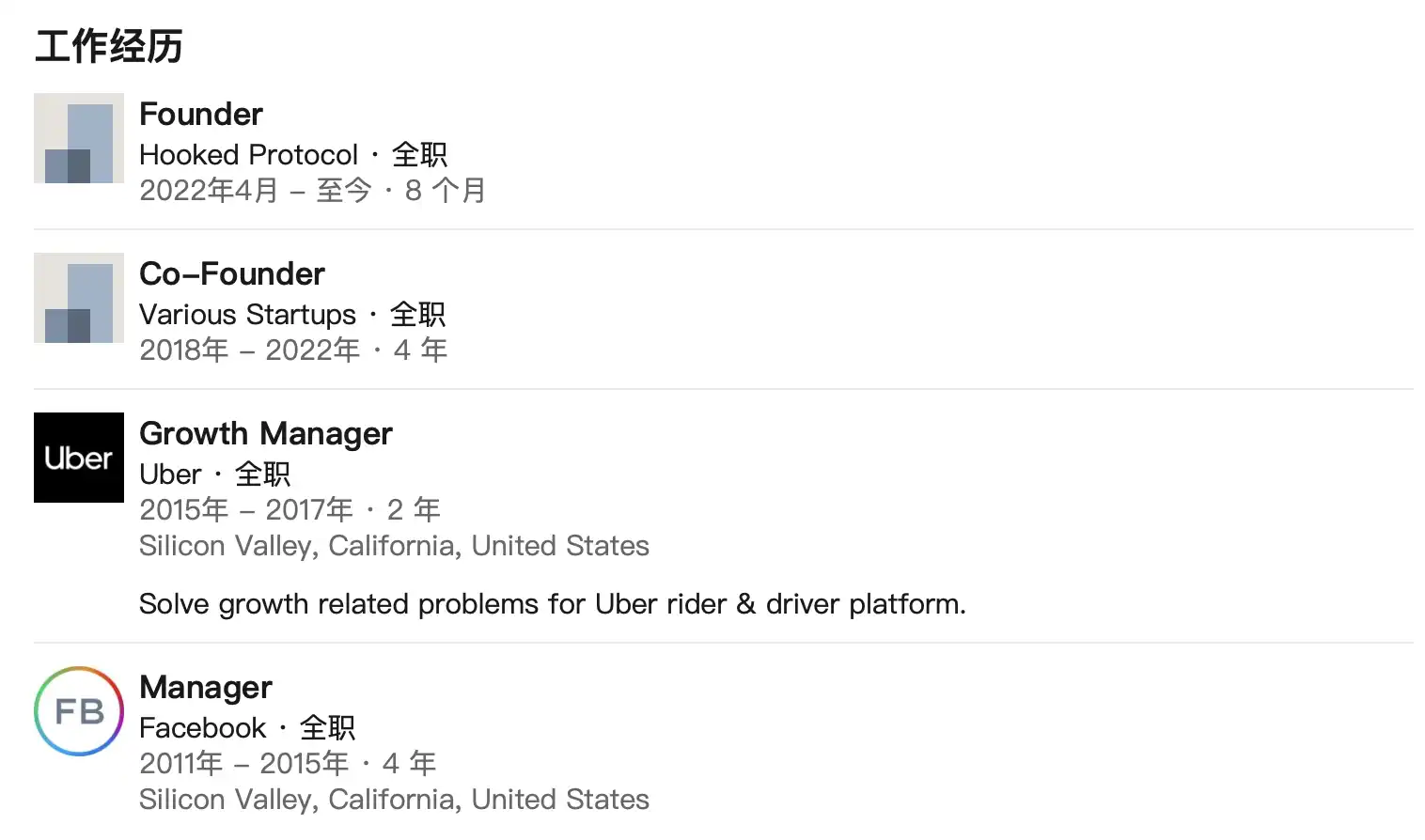
Jason Y is the CEO of Hooked Protocol, previously working at Uber and Meta (formerly Facebook) for over a decade in consumer internet and strategic growth. He has launched multiple successful products and has extensive experience managing web2 platforms with over a billion users.
According to disclosures by A&T Capital, members of the Hooked Protocol team come from MiDu, a text-based growth platform formerly invested in by Tencent (under the阅文group), with the core team possessing strong 2C marketing expertise and exceptional product capabilities.
Jason Y's LinkedIn profile hides his work history between 2018 and 2022, but multiple media reports indicate that Yang Ji, former CEO of MiDu, worked at Facebook and Uber during the same timeframe as Jason. In October this year, rumors also circulated that Yang Ji had left MiDu.
Jess L serves as Chief Marketing Officer, having previously worked at Uber and Google. According to their LinkedIn profiles, they were colleagues at Uber.
Dual-Token Economic Model
Hooked Protocol employs a dual-token model: HOOK Token represents governance rights reflecting the ecosystem’s value, while HGT (Hooked Gold Token) functions as the sole utility token within the ecosystem, dynamically incentivizing ongoing community contributions.
HOOK Token is primarily used for community governance, gas fees for on-chain activities within the protocol, staking incentives, social elements, and long-term strategic goals. Governance rights allow HOOK holders to participate in and vote on proposals within the Hooked ecosystem. Participants engaging in beneficial platform behaviors may receive initial airdrops. Social privileges include exclusive access to limited-edition NFTs (such as gaming tools and mystery boxes) and special community events. The platform commits to burning all revenue generated from these NFT sales. Overall, the economic structure resembles that of StepN.
Additionally, HOOK Token will be deployed in innovative initiatives designed to benefit both individual participants and enterprise partners, ensuring sustainable liquidity and aligning token value proportionally with overall community growth.
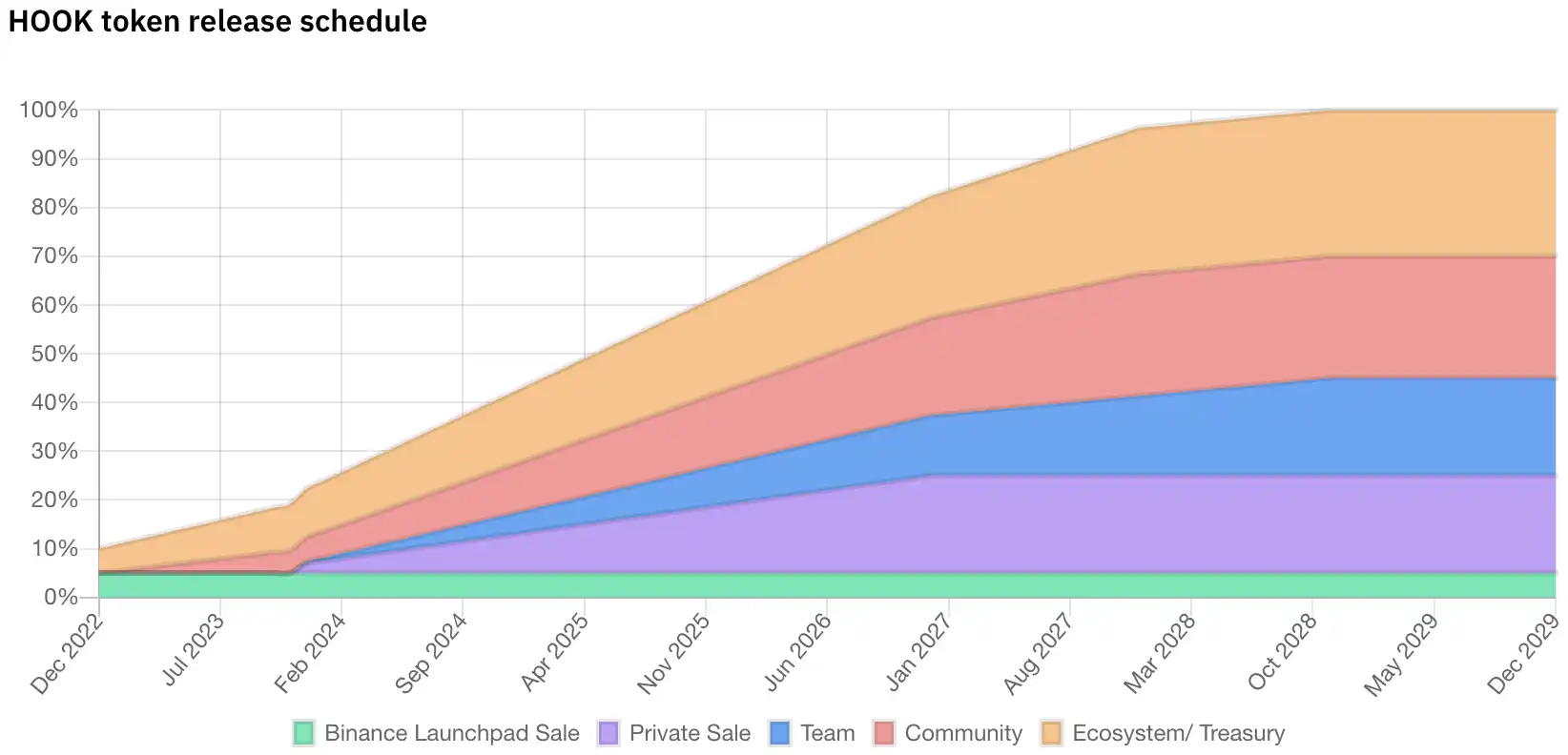
The HOOK Token is built on the BNB Chain with a total supply of 500 million tokens: 20% allocated to private sale, 20% to the team, 30% to ecosystem and treasury, 25% to the community, and 5% reserved for Binance Launchpad. The private sale price ranged from $0.06 to $0.12, while the Binance Launchpad price is set at $0.10, implying a $50 million fully diluted valuation.
Initial circulating supply of HOOK Token is 50 million tokens, representing 19.16% circulation after one year, with full release completed by 2029. Based on the Launchpad price, the initial market cap at listing will be $5 million, reaching a fully diluted market cap of $50 million. According to CoinMarketCap data, this would place it around rank #320 globally by fully diluted market cap.
HGT Token has no supply cap—the issuance volume depends entirely on users completing in-app tasks. Users earn HGT exclusively by completing designated activities such as answering quizzes, inviting friends, or POWT mining, thereby being incentivized to experience Web3 through gameplay.
HGT earned through various in-app tasks can be unlocked and converted into uHGT (unlocked HGT). Since HGT itself is non-transferable, the uHGT mechanism manages its liquidity. uHGT uses a community-driven, algorithmically adjusted unlocking system to ensure sustainability—reward amounts, frequency, and unlock caps are dynamically adjusted based on proof-of-participation and community contribution, reducing speculative risks to token reputation and value during price volatility.
HGT can be spent within the app to purchase NFTs, enhance gaming experiences, and unlock premium rewards. Earned HGT can also be exchanged for HOOK Token. The current uHGT token price is $0.00000065, with a USDT liquidity pool amounting to 9,900.
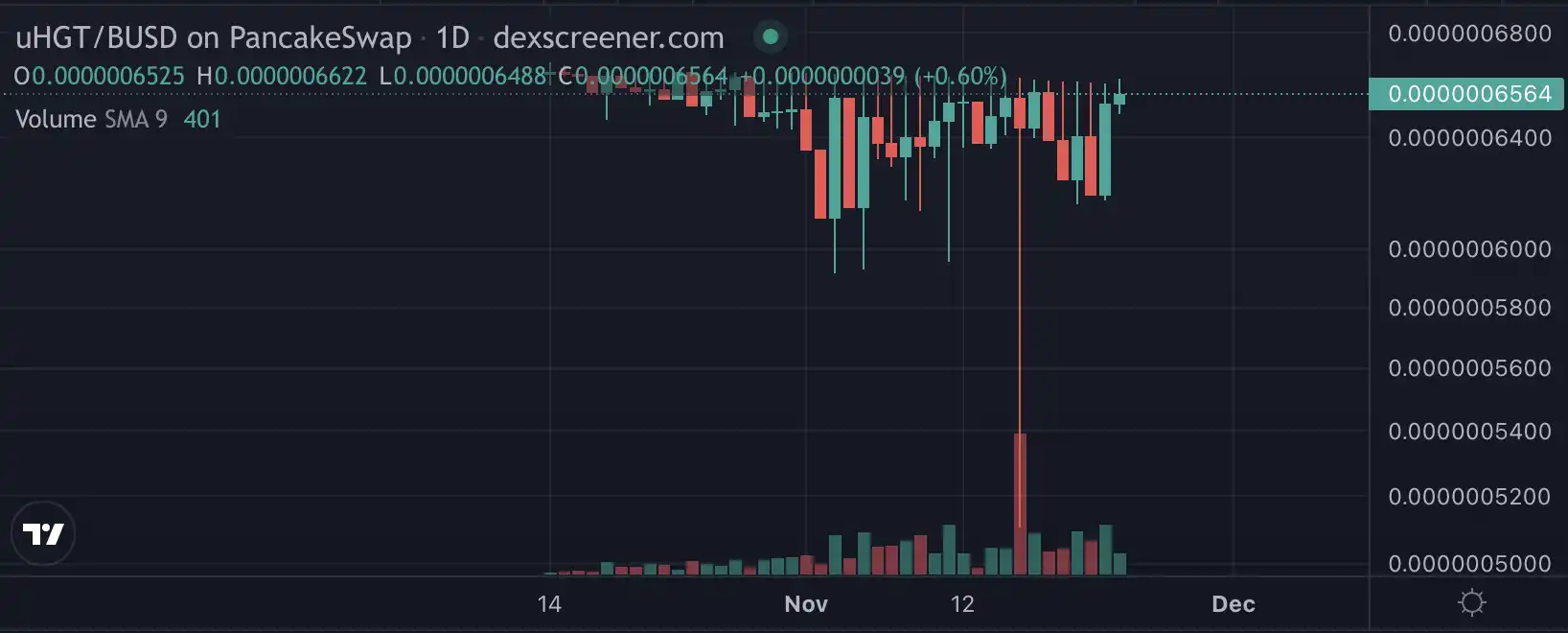
Screenshots above sourced from Dexscreener
Product Experience
Hooked Protocol has already launched its first pilot application, Wild Cash.
According to Binance Research, shortly after launch, Wild Cash became the first and only Web3 application in Indonesia to dominate the Google Play rankings for nine consecutive days, now boasting over 2 million monthly active users.
Wild Cash is currently available only via the Google Play Store and supports login via Google or Facebook accounts. After logging in, users select their preferred in-app language and begin playing to earn. Note that once selected, the language cannot be changed. Upon successful registration, the app automatically generates a cryptocurrency wallet address for the user. However, there is currently no option to export the private key or import an external wallet.
Wild Cash reduces the risk of bots farming tokens at zero cost through its question bank and accuracy-based reward system. Community feedback suggests that using emulators or scripts across multiple accounts yields very low efficiency. Honest participation results in higher rewards. However, the referral rewards are extremely high, enabling potential Sybil attacks where users create multiple accounts to claim large quantities of tokens.
Earning Mechanisms
Currently, users can earn tokens in Wild Cash through quiz participation, referrals, POWT mining, and staking. The earned token is called Gold, usable only within the app—for upgrading in-game items like more efficient mining tools (e.g., pickaxes, minecarts).
Quiz-to-Earn
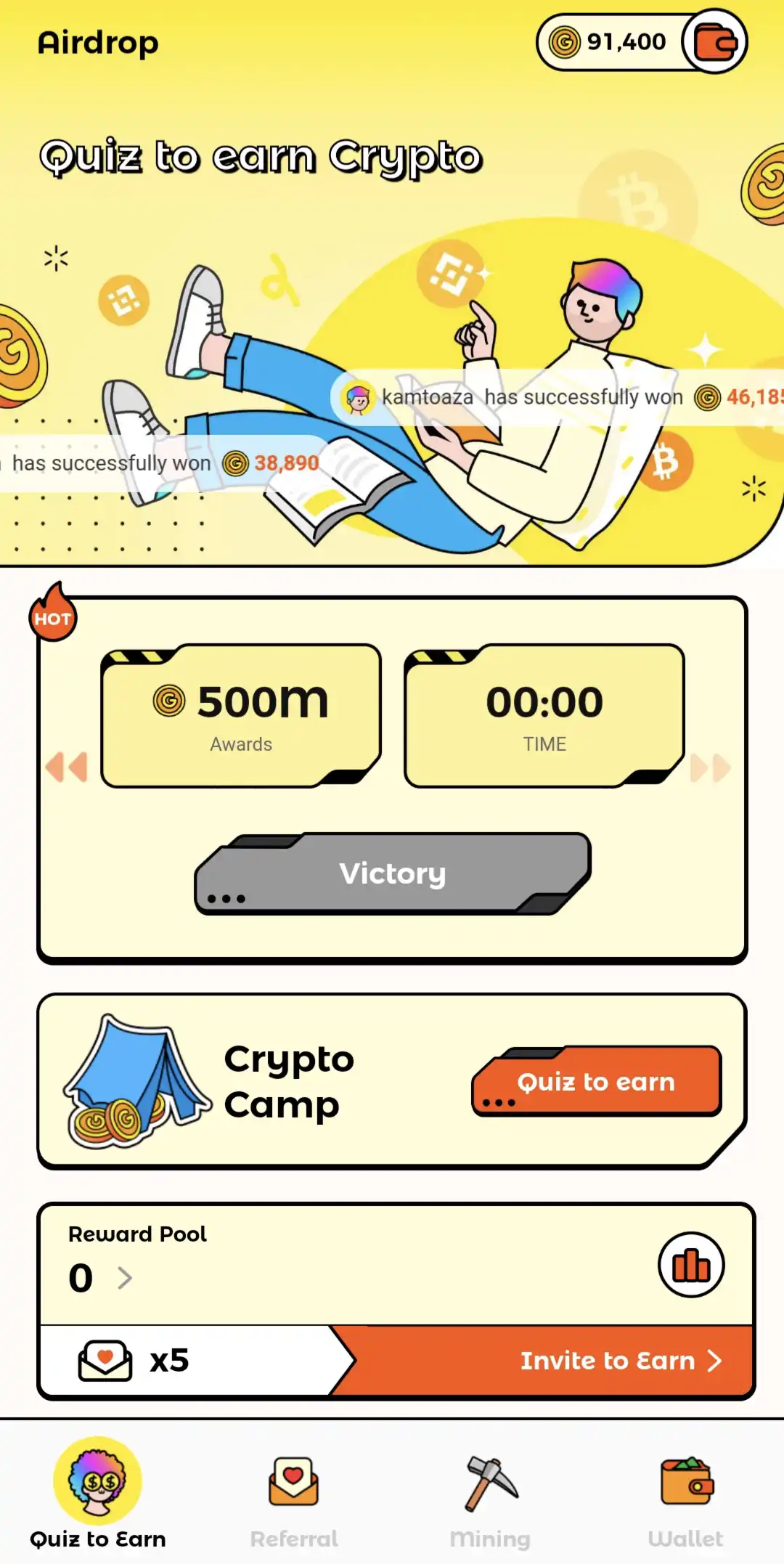
Quiz-to-earn includes two formats: prize guessing and quiz training camp. Both offer chances to win Gold Token rewards.
Users can start with prize guessing to familiarize themselves with the format and prepare for special quiz sessions. Two modes are available: one offering a time-limited share of 500 million Gold Tokens, the other 1 billion. Users may join any session from their first attempt until 24:00 each day.
Participation involves timed quick-response questions, with rewards distributed the following day. Each quiz consists of 10 questions. Answering incorrectly or failing to respond in time counts as failure. Users can revive using revival cards, with up to three revivals allowed per day. For every successful referral who downloads and registers, users receive five revival cards—there is no limit on the number of revival cards.
The quiz training camp has three difficulty zones, each offering different challenge levels and token rewards. It features a set of 10 basic crypto-related questions, with 60 seconds per question. If all 10 are answered correctly, the user earns a chance to receive Gold Tokens. If not all correct, the quiz loops until perfect completion. Exiting mid-way forfeits the reward.
The number of questions a user can attempt daily depends on their historical accuracy rate—higher accuracy unlocks more questions and greater rewards. According to PANews testing, each session yields between 1,100 and 1,800 Gold Tokens.
Referral Earnings
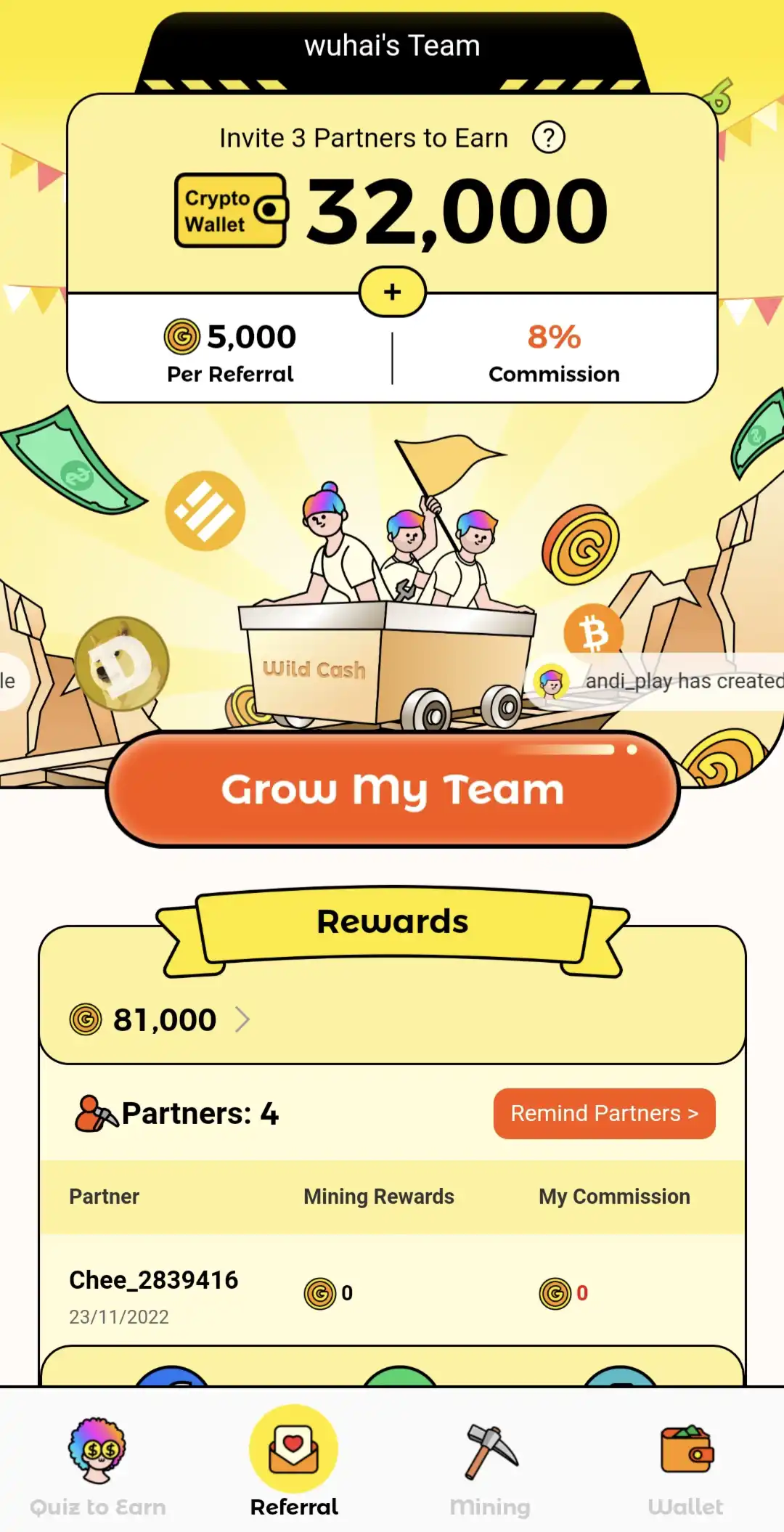
In the referral section, users copy their personal link to invite friends. Successfully referring one user earns 5,000 Gold Tokens. Tiered rewards are also offered: first referral grants 30,000 Gold, three successful referrals yield 31,000 Gold, increasing incrementally.
When invited users begin mining, referrers receive 5% of their mining rewards. This bonus comes from the platform and does not reduce the referred user’s earnings. In the referral interface, users can send reminders to their referrals to start mining, once every 24 hours.
POWT Mining
POWT stands for Proof-of-Work Time mining, simulating Bitcoin mining. Users engage in mini-games (e.g., token mining games) to mine limited quantities of Gold Tokens, enhancing daily Web3 engagement.
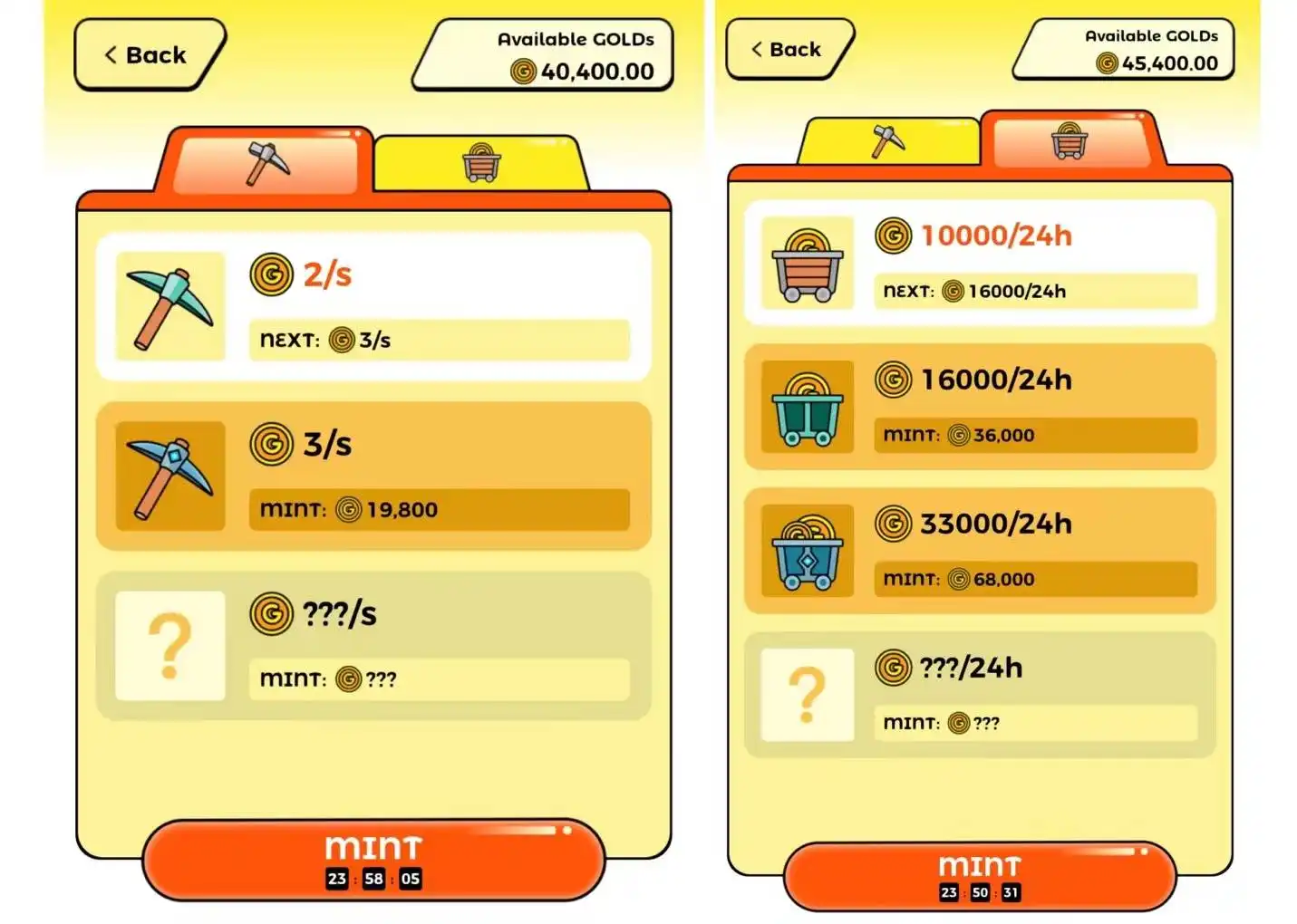
The default mining speed is 1 Gold per second, with a 1-hour mining window and a daily cap of 10,000 Gold per account. Users can increase efficiency by tapping the "Tap" button or forging higher-efficiency pickaxes. A 2 Gold/s pickaxe costs 9,600 Gold, while a 3/s version costs 19,800 Gold. Minecart capacity can also be upgraded to increase daily output: a 16,000/24h cart costs 36,000 Gold, and a 33,000/24h cart costs 68,000 Gold.
According to system logic, priority should be given to upgrading pickaxe efficiency and minecart capacity to maximize daily token output.
Upgrading the pickaxe to level 3 increases mining speed to 3/s. At normal speed, mining for 1 hour yields 10,800 Gold, sufficient for a level 1 minecart. If additional tapping boosts efficiency, a level 2 minecart becomes necessary. Therefore, after starting, users should first upgrade the pickaxe, then after 24 hours upgrade it again to level 3, followed by upgrading the minecart capacity another 24 hours later. After another 24 hours, further pickaxe upgrades occur—but subsequent efficiencies are delivered in blind box form, so future actions depend on the outcome.
Staking Rewards
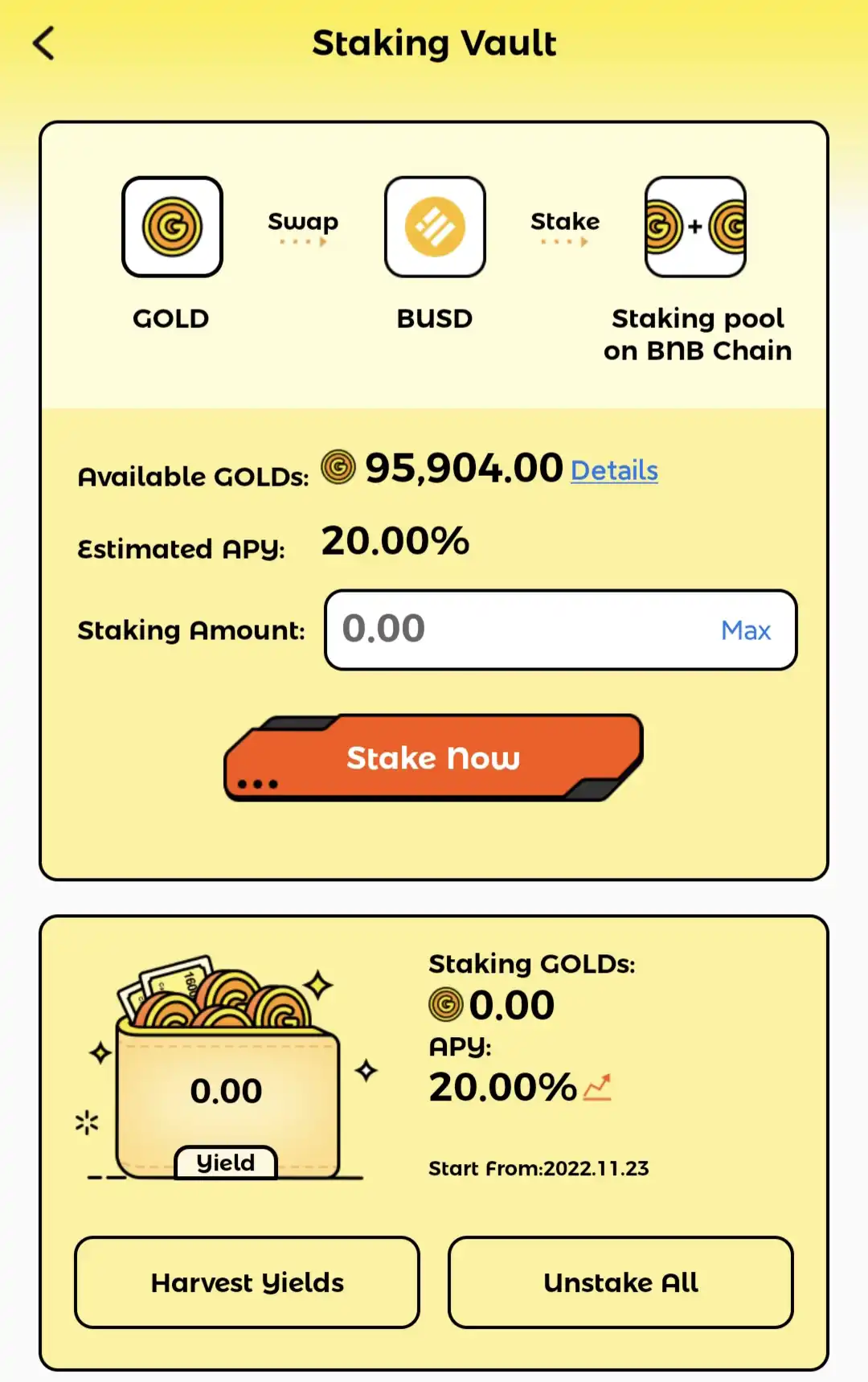
HGT earned through the above methods can generate additional returns via staking, offering a 20% annual yield, with flexible deposit and withdrawal options. Once users accumulate 800,000 Gold Tokens, they can exchange them for uHGT within the app, then convert to BUSD.
According to Wild Cash, the exchange ratio between Gold and uHGT is 1:1. Given the current secondary market price of uHGT, 800,000 Gold Tokens are worth approximately $0.50.
Future Roadmap
Hooked Protocol announced its mainnet launch on BNB Chain on October 24, with plans to expand to other Layer 1 networks (e.g., Solana, Avalanche) in Q4 2022, alongside global market expansion and broader rollout of quiz experiences.
In the first half of 2023, the team plans to introduce more diverse gamified learning experiences, establish ongoing partnerships with additional Web3 projects, and launch a wallet solution for Hooked community users.
In the second half of 2023, Hooked aims to become one of the largest Web3 explorer communities, exploring DAO governance models for the protocol. It will leverage its ecosystem infrastructure to launch additional applications and middleware solutions (wallets, DID, etc.) for developers, while experimenting with new business models.
According to Binance, Hooked Protocol and BNB Chain will maintain a long-term strategic partnership, incentivizing the Hooked community to explore the BNB Chain ecosystem through attractive benefits and diversified experiences.
Conclusion
In summary, from a product perspective, the app demonstrates high completeness. The official team has implemented quiz rules to reduce the risk of bots mass-farming HGT tokens, and limits on time-limited, quota-based purchases of mining efficiency tools help slow down token emission, requiring greater user time and effort. However, the referral reward mechanism presents a major vulnerability, allowing cost-free Sybil attacks. Additionally, the in-app economic cycle remains extremely simplistic, with demand far below supply. This model leaves HGT Token without short-term value support. Close attention should be paid to whether Hooked improves its referral system and builds a richer internal economic loop.
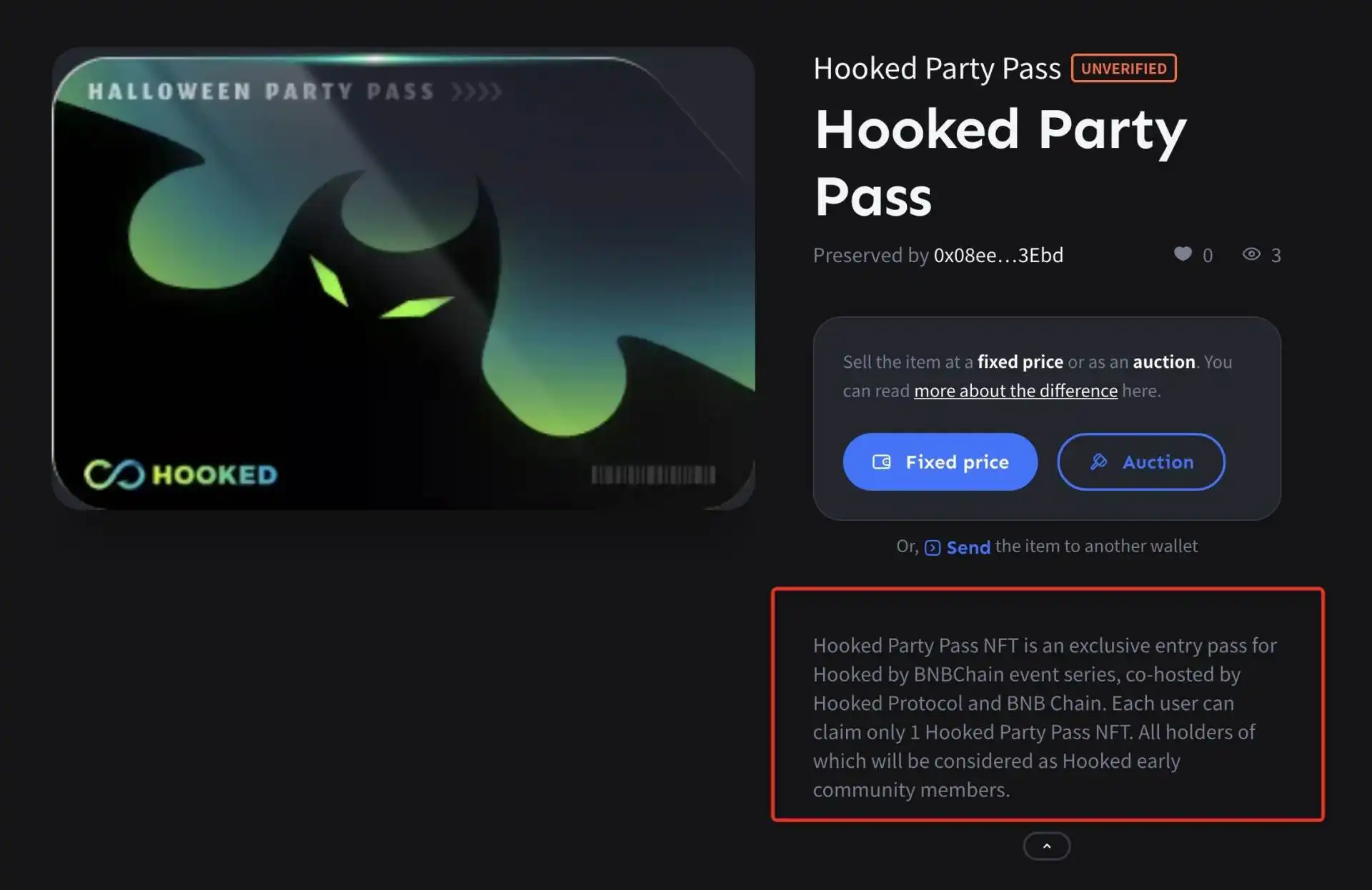
From an economic model standpoint, the circulation of the primary token HOOK is extremely low initially, with a fully diluted market cap of just $50 million—potentially indicating strong market maker control. Moreover, Hooked previously ran a Halloween campaign distributing over 40,000 Hooked Party Passes (SBT format, non-transferable) to the community.According to official statements, these passes serve as early-user credentials. If the team airdrops HOOK tokens to these pass holders to generate market hype, a large volume of zero-cost tokens could flood the market in the short term—official announcements must be closely monitored.
In terms of ecosystem needs, apart from StepN briefly triggering FOMO and driving intense activity on the BNB Chain, no other breakout products have emerged in the Binance ecosystem recently. Hooked Protocol has the potential to attract more users onto the BNB Chain. However, this depends on building a sufficiently diverse internal economy—if not, it may simply result in another wave of short-lived excitement followed by silence.
Original Link
Join TechFlow official community to stay tuned
Telegram:https://t.me/TechFlowDaily
X (Twitter):https://x.com/TechFlowPost
X (Twitter) EN:https://x.com/BlockFlow_News


