








Eight Years of Industry Retrospect: The Crypto Revolution Has Already Happened—Just Not According to the Script We Envisioned
TechFlow Selected TechFlow Selected
Eight Years of Industry Retrospect: The Crypto Revolution Has Already Happened—Just Not According to the Script We Envisioned
This is not the ideal world originally envisioned by the cypherpunks, yet it remains a monumental undertaking worthy of being recorded in history.
 Navigating Web3 tides with focused insights
By Connor Dempsey
Translated by Chopper, Foresight News
I start my new job this Monday. Before embarking on my fifth career role in the industry, I want to write this piece to reflect on my eight-year journey through crypto.
When I entered crypto in 2017, I believed this technology would change everything.
Government-issued fiat currencies would be replaced by decentralized tokens; blockchains would eliminate all rent-seeking intermediaries from transaction chains; and power would shift back from large corporations to ordinary users.
Looking back today, nearly none of those early visions have materialized—but the industry has forged an entirely different path.
Over eight years, I’ve worked at four crypto companies, witnessed the industry’s market cap grow from under $1 billion to over $4 trillion, endured multiple speculative bubbles, and survived one systemic collapse. Gradually, I realized that what the industry is actually building is far more valuable than my original conception.
Before starting my next role, I want to document what I’ve seen—and outline where I believe the industry is headed.
The Illusory Wealth Boom: The 2017–2018 ICO Craze
In early 2017, I stumbled upon a book introducing Bitcoin—and was instantly hooked. Soon after, I devoured every Bitcoin-related book I could find and began dreaming of moving to Singapore to blog and dive deep into this new technology.
At the time, I didn’t realize I’d landed right at the tail end of the ICO (Initial Coin Offering) super-speculative bubble. ICOs enabled anyone to raise funds globally—simply by selling cryptocurrency—to finance creative projects.
Ethereum was the undisputed star of that frenzy.
In November 2017, I published a beginner-friendly introduction to Ethereum on Reddit—and it went viral. That also happened to be the peak of the bubble; just one month later, the market crashed completely.
Rereading that article today feels like reviewing a historical archive: it captures the era’s universal optimism—and forecasts a future that ultimately never came to pass.

My core argument was that blockchain networks like Ethereum could power entirely new consumer-facing applications.
Traditional internet platforms (e.g., Facebook, Uber) capture most of the value they create for themselves and a handful of investors—whereas value generated by blockchain applications would be shared among early participants and ICO investors.
The article even imagined a decentralized Uber: early users and drivers would earn tokens for each completed ride, thereby gaining ownership of the network—and ensuring fairer value distribution for those who helped build it.
On paper, the vision looked perfect—but this decentralization revolution failed utterly.
It was simply a crypto reenactment of the 2001 dot-com bubble.

Ethereum became history’s most powerful fundraising platform: over 3,000 ICOs raised a combined $22 billion globally.
But—as with the dot-com bubble—the underlying technology wasn’t mature enough to support sky-high valuations.
Even more damaging: ICOs completely distorted the incentive alignment between founders and investors. Teams could raise millions overnight based solely on an idea; investors held only tokens, hoping the project would deliver and drive up token prices. Meanwhile, founding teams held massive allocations of native tokens—and could cash out immediately upon listing, eliminating any motivation to build real products.
During bull markets, founders and early investors profited handsomely; during bear markets, retail investors were left holding the bag. While many well-intentioned builders existed, ICOs ultimately became breeding grounds for greed, hype, and fraud.
Across centuries of financial history, every speculative bubble follows this same script.
Rebuilding from the Rubble: Circle’s Hibernation Period (2018–2019)
As the market cooled, I leveraged my modest Reddit fame to join Circle in early 2018 as an entry-level marketing hire.
By then, Circle had been operating for four years. Its suite of consumer-facing products—investment, payments, and exchange—were all unprofitable. But its over-the-counter (OTC) trading desk quietly generated steady revenue, keeping the entire company afloat.
For the next two years, the industry remained mired in post-ICO depression. Most ICO projects faded into obscurity or shut down entirely; countless tokens collapsed to zero; sentiment hit rock bottom.
Yet precisely during this darkest period, the seeds of crypto’s next revival were sown.
Industry focus shifted away from consumer apps and toward rebuilding traditional finance on the internet.
USD-pegged stablecoins were originally created to let traders quickly move in and out of crypto positions. Backed 1:1 by U.S. dollars and Treasury bonds, their price remained tightly anchored to $1.
Tether’s USDT rose rapidly during the ICO boom, with much of its dollar reserves held in offshore U.S. bank accounts. Initially used mostly for trading, stablecoins soon benefited another group: people excluded from traditional banking systems but eager to hold dollar-denominated assets.
Examples include citizens evading capital controls, Chinese high-net-worth individuals diversifying overseas, and Argentinians and Turks protecting savings against hyperinflation.
In 2018, Circle partnered with Coinbase to launch the compliant USD stablecoin USDC. Its early use cases remained primarily trading-focused—but people began envisioning a broader possibility: an internet-native currency enabling anyone with connectivity to access dollar assets, anytime, anywhere, without barriers.
Meanwhile, high-quality projects surviving the ICO era mostly clustered in finance. Ethereum proved itself not just a fundraising tool—but foundational infrastructure for rebuilding financial markets: Uniswap (trading), Aave and Compound (lending) collectively formed the DeFi ecosystem.
Stablecoins and DeFi thus became deeply intertwined—and a once-in-a-century global pandemic propelled both to unprecedented heights.
Back to the Internet’s Wild West: Messari Era (2019–2021)
At the end of 2019, I joined Messari—a 13-person data research startup—as its first full-time marketer.
The company employed only four analysts, all deeply immersed in frontier DeFi research—at a time when DeFi’s total market cap stood at just $665 million.
In early 2020, the COVID-19 pandemic erupted, pushing the global economy to the brink of collapse—and triggering across-the-board asset crashes.
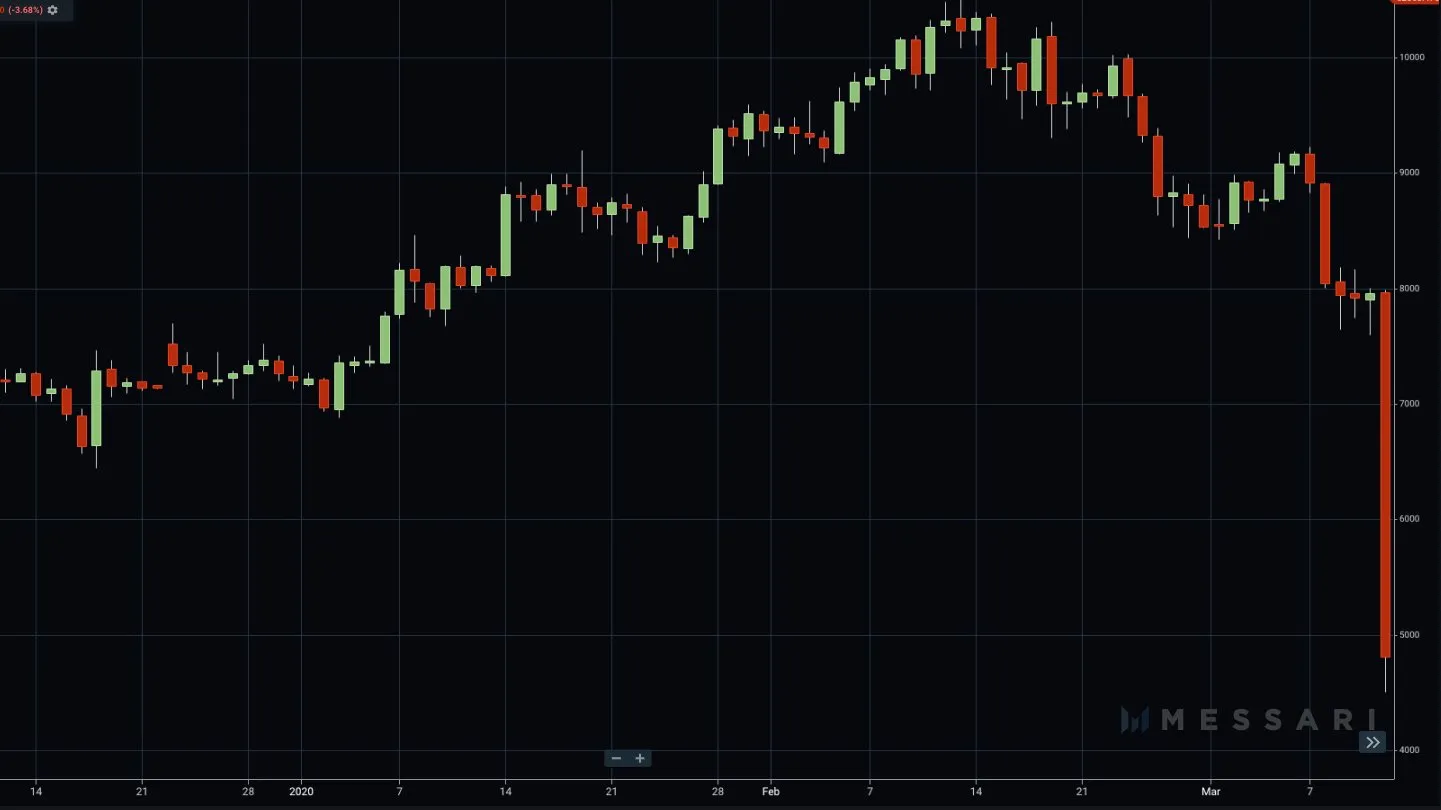
To prevent economic meltdown, central banks worldwide launched massive liquidity injections—$9 trillion alone in 2020.
This flood of capital needed outlets—and with lockdowns forcing people indoors, vast sums flowed into Bitcoin, Ethereum, DeFi, and other speculative assets.
Bitcoin surged from under $4,000 to nearly $70,000; backed by institutional inflows, its market cap surpassed $1 trillion—outperforming gold and other macro asset classes.
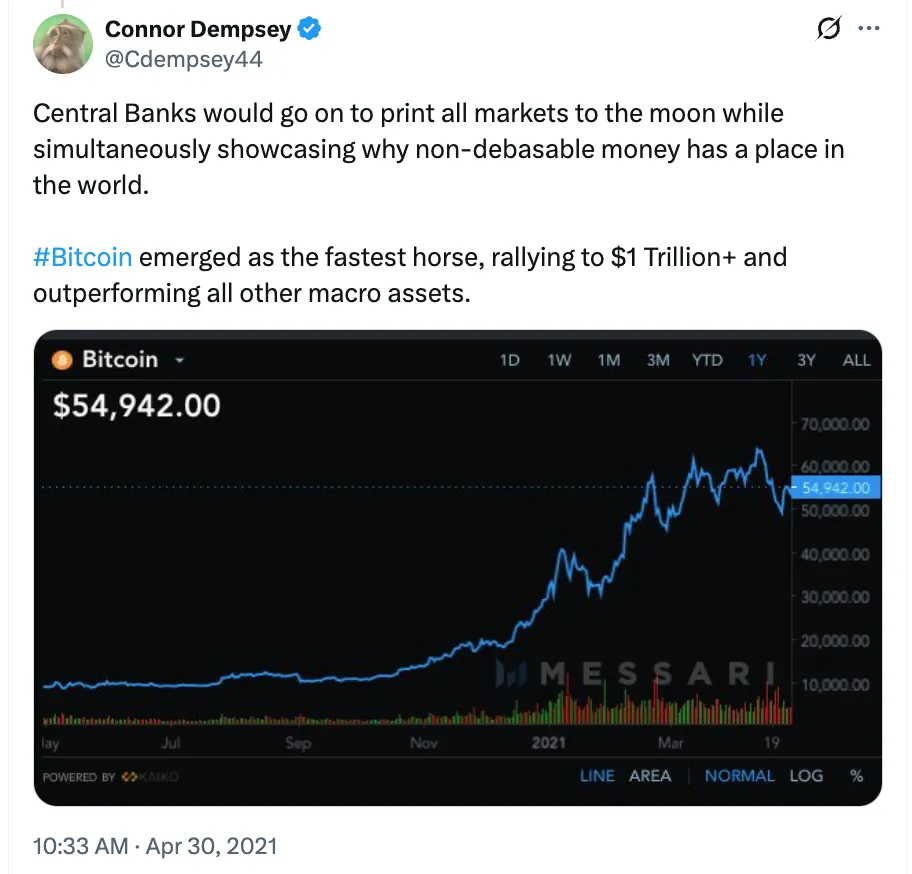
Loose monetary conditions also ignited the legendary “DeFi Summer”: DeFi protocol market caps exploded 250-fold—to $18 billion.
Originally envisioned as a tool to rebuild traditional finance, DeFi Summer instead resembled a massive online game dominated by profit-seeking traders—drawing in billions of real dollars for high-stakes play.
The core mechanic was liquidity mining. Anonymous developers rolled out new protocols with absurdly food-themed names: YAM Finance, Spaghetti Money, SushiSwap. Traders deposited ETH, USDC, or USDT—and received newly minted tokens (YAM, SPAGHETTI, SUSHI) in return.
The spectacle was surreal and manic: brand-new food-themed tokens achieved $1 billion market caps within days of launch. Early players cashed out at peaks—then tokens plunged off cliffs.
This was truly the internet’s Wild West.
Like the earlier ICO craze, DeFi Summer minted countless new millionaires—only to see them wiped out when the bubble burst. This wave also elevated Sam Bankman-Fried to crypto billionaire status—and set him up to become the central figure in crypto’s next disaster.
Peak of the Bubble: Coinbase Era (2021)
In April 2021—shortly after Coinbase’s $100 billion IPO—I joined its corporate development and venture team.
My responsibilities included evaluating M&A opportunities, assessing early-stage crypto ventures, writing industry trend analyses, and co-producing Coinbase’s short-lived podcast series. To this day, it remains one of the most elite teams I’ve ever worked with.

It was also during this period that another speculative bubble quietly formed—the NFT (non-fungible token) boom, centered on digital art.
If DeFi was the domain of professional traders, NFTs broke into mainstream consciousness. They offered artists a new online monetization channel—and laid the groundwork for authenticating ownership of digital assets on the internet.
But—as with ICOs and DeFi Summer—NFT speculation quickly spiraled out of control. Cartoon apes, punks, and penguins sold for $1 million apiece; artist Beeple’s digital collage fetched a staggering $69 million at Christie’s.
Crypto fully invaded the mainstream: Larry David mocked crypto skeptics in a Super Bowl ad; Sam Bankman-Fried’s exchange FTX paid $135 million for naming rights to the Miami Heat arena. Everyone got rich—from tokens, NFTs, and meme stocks.
The 2017 mania returned—with unprecedented monetary expansion amplifying the bubble’s scale by fourfold.
The Reckoning: Industry Collapse in 2022
But soon, the party ended—and the industry imploded.
The tailwind that had inflated all asset prices—interest rate cuts, quantitative easing, and fiscal stimulus—eventually spilled over into consumer inflation. By late 2021, Bitcoin, Ethereum, the Nasdaq, and the S&P 500 all peaked simultaneously; runaway inflation was inevitable, forcing central banks to tighten policy—and it was precisely that prior easy-money policy that had pushed equities and crypto to historic highs.
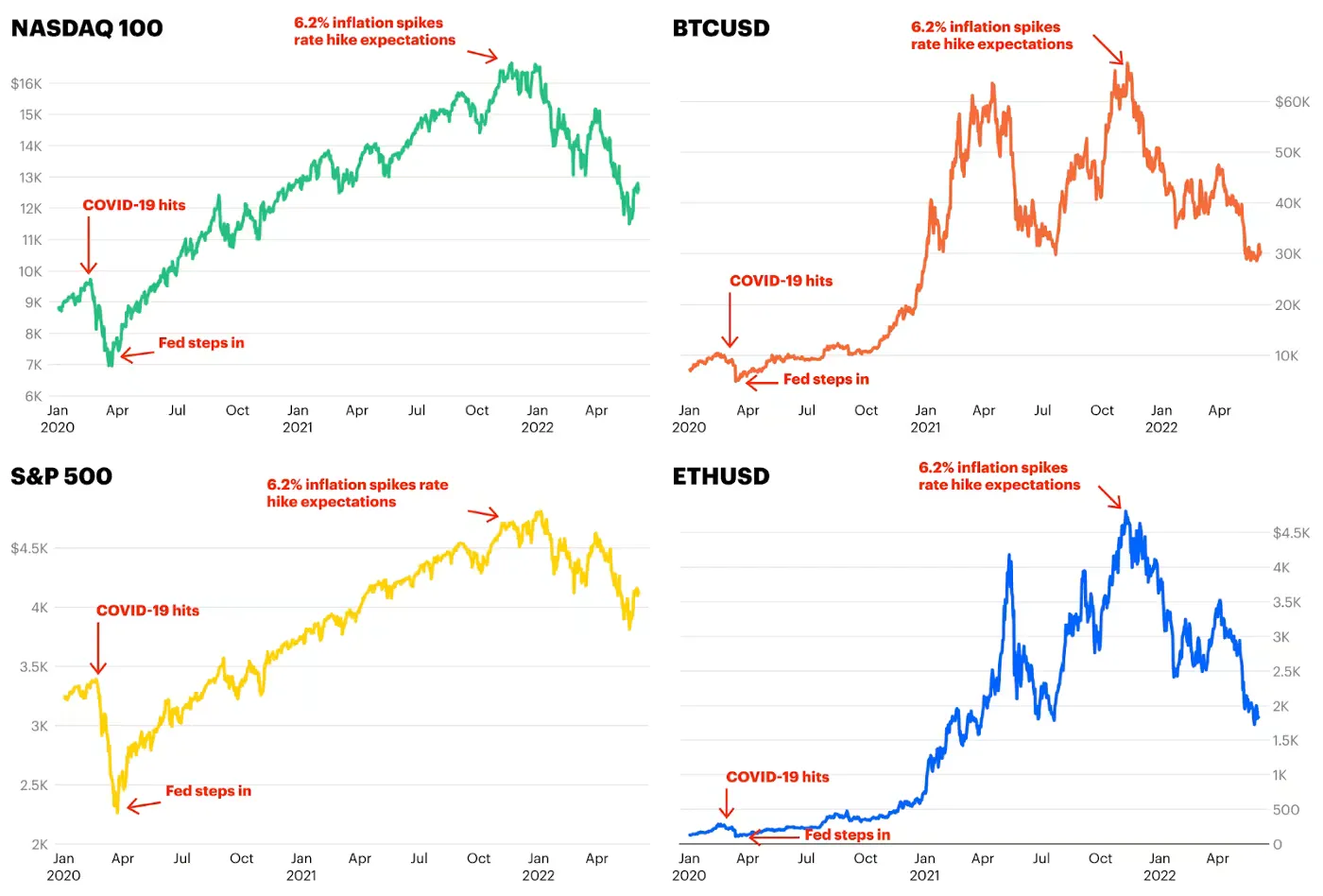
Once interest-rate hikes and fiscal tightening began, investors reassessed their overvalued holdings: Was a cartoon ape really worth $1 million? Did a sushi-themed token deserve a $3 billion valuation? How could Dogecoin sustain a $90 billion market cap?
Pessimism spread—and the domino effect of failures began in earnest.
If the ICO crash mirrored the 2001 dot-com bust, 2022’s collapse resembled the 2008 global financial crisis: a few toxic assets, amplified by excessive leverage, nearly brought down the entire industry.
The first to fail was Terra’s algorithmic stablecoin UST.
Mainstream stablecoins like USDC and USDT are backed 1:1 by cash and U.S. Treasuries. UST relied instead on complex algorithmic mechanisms to maintain its $1 peg. Those mechanisms functioned during calm markets—but collapsed entirely amid sell-off pressure.
Within days, $3.2 billion in market cap vanished—and countless holders saw their assets reduced to zero.
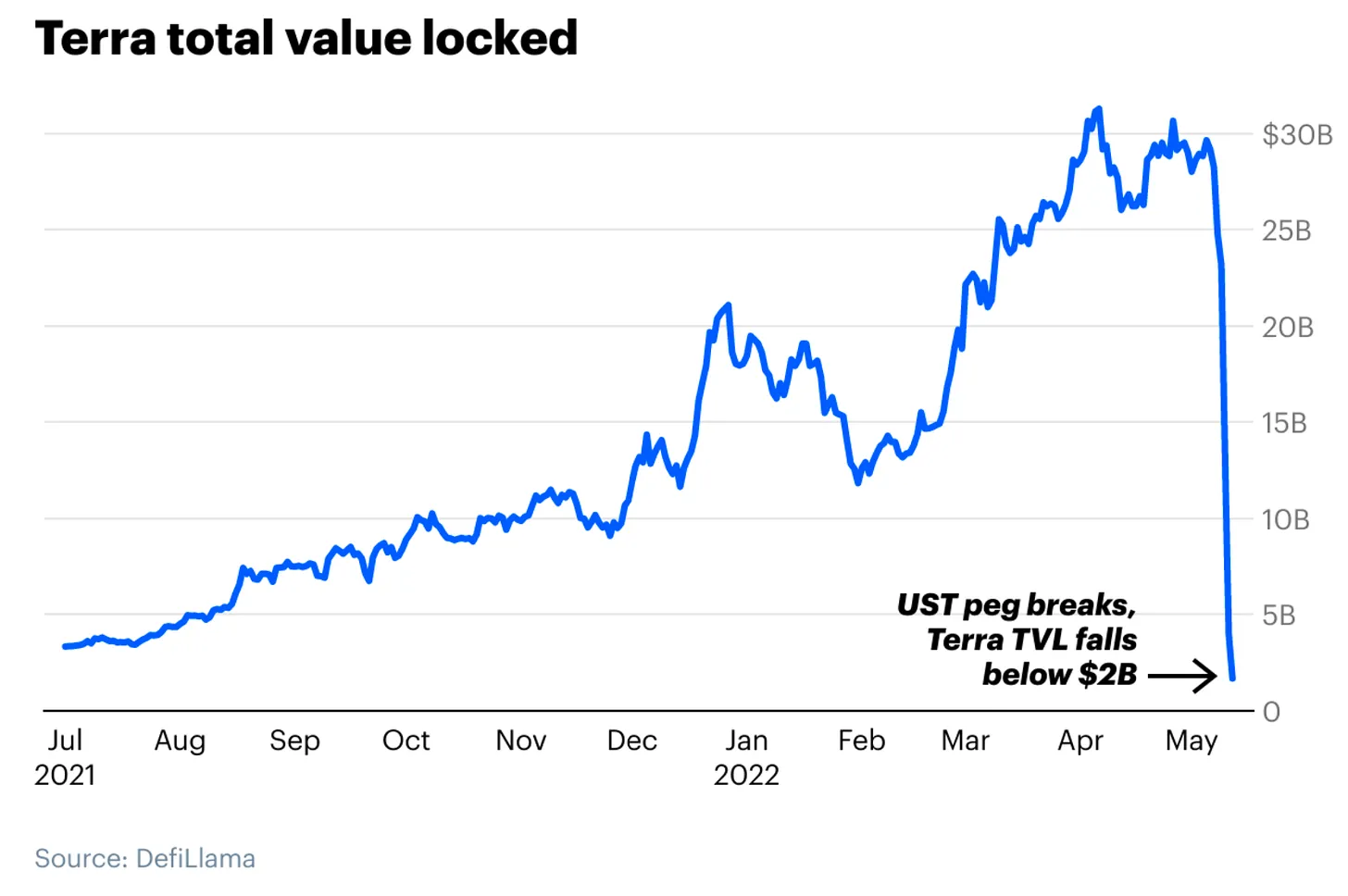
Hot on its heels, the $10 billion hedge fund Three Arrows Capital (3AC) collapsed—deeply overexposed to Terra and highly leveraged. 3AC had borrowed heavily from crypto lending platforms like Celsius and Voyager; those platforms had deployed user deposits chasing seemingly safe 8% annual yields. After 3AC’s failure, lenders froze withdrawals and filed for bankruptcy—leaving ordinary users’ deposits unrecoverable.
While working at Coinbase, we watched FTX and Sam Bankman-Fried step in to rescue multiple failing crypto lenders—including BlockFi. He was hailed as “crypto’s J.P. Morgan” and the industry’s white knight.
But the truth eventually surfaced: SBF and FTX were the riskiest parties of all.
Remember FTX’s $135 million arena naming-rights deal? That expense—and indeed SBF’s entire business empire—was funded by the platform’s native token, FTT. SBF borrowed massively against FTT as collateral; when FTT’s price crashed, margin calls forced liquidations—and FTX declared bankruptcy.
Worse still, FTX had secretly misappropriated user funds for investments and to plug financial holes. This once-$32 billion giant collapsed in a week—$8 billion in user deposits vanished.
SBF violated the cardinal rule of exchange operations: never touch user funds.
This was crypto’s “Lehman Moment.”
Gambling & Casinos: The 2023–2025 Memecoin Frenzy
After FTX’s collapse, SBF was imprisoned. Within just 12 months, crypto’s total market cap shrank from $3 trillion to under $1 trillion.
Next, the Biden administration launched a comprehensive crackdown on U.S. crypto.
SEC Chair Gary Gensler sued nearly all major compliant U.S. crypto firms—including Coinbase, Kraken, Uniswap, and Robinhood—for alleged securities violations. Companies that had spent years operating legally became the SEC’s primary enforcement targets.
Meanwhile, Senator Elizabeth Warren quietly pressured traditional banks to cut off crypto clients—effectively isolating crypto firms from the banking system and forcing numerous teams to relocate overseas.
This regulatory approach triggered several unintended consequences.
First, any crypto project with a business model—including DeFi protocols—was deemed a securities violation, exposing it to legal risk. The legally safest option, paradoxically, became memecoins: pure-narrative tokens with no utility or clear vision.
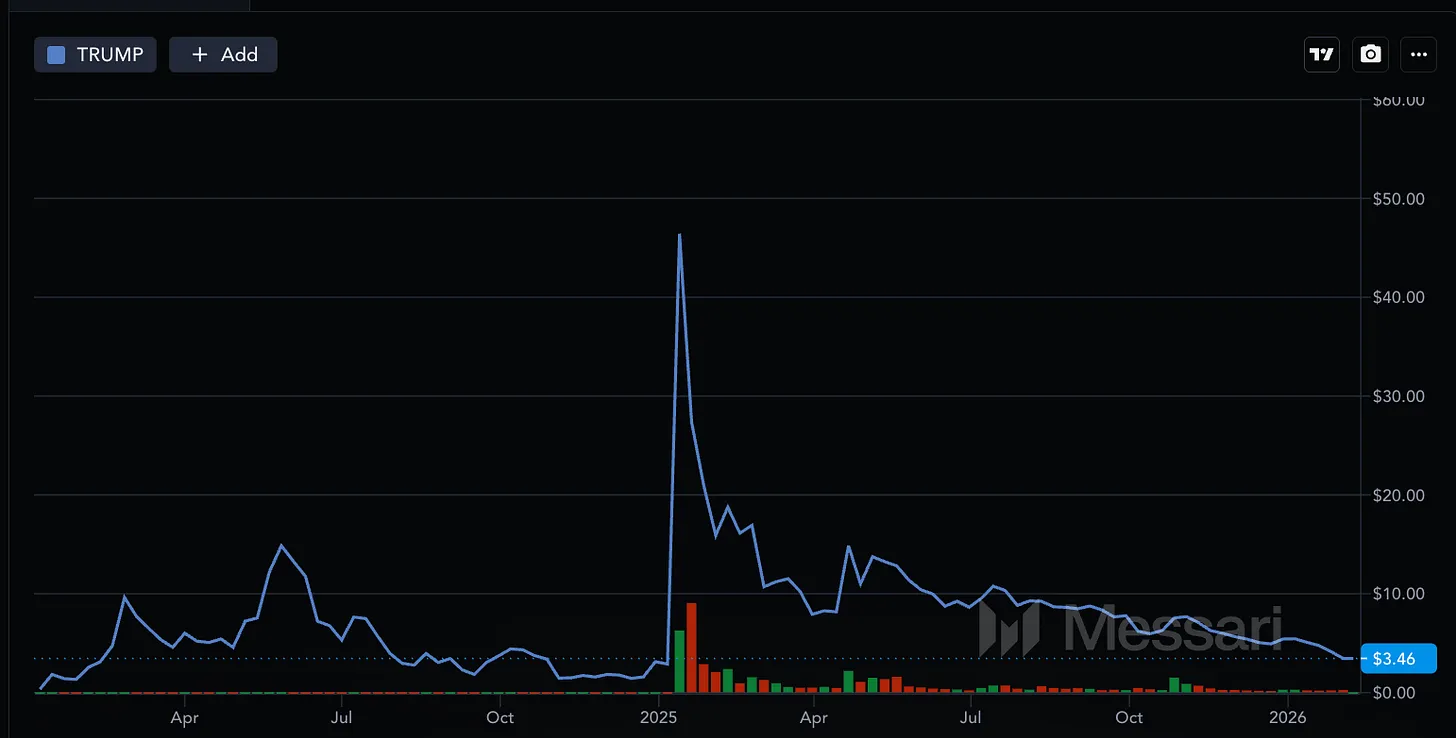
Millions of memecoins launched on Pump.fun; celebrities including Iggy Azalea, Caitlyn Jenner, and social media sensation “Hawk Tuah Girl” all issued personal memecoins—most ending in farce.
Crypto once again devolved into a colossal casino—larger than ever before. Over 6 million memecoins launched; the sector’s market cap peaked at $150 billion by end-2024—surpassing even the NFT boom’s scale.
Institutionalization: Crossmint Era (2025–2026)
Setting aside this industry circus, crypto’s bet on Trump’s election paid off.
Once Trump’s victory became certain, Bitcoin surged to new highs. Market logic was clear: the world’s largest economy would pivot from hostile regulation to active support. Gary Gensler resigned; the new SEC dropped lawsuits against U.S. crypto firms; traditional banks reopened crypto partnerships.
Most importantly, the GENIUS Act passed in July 2025—the first U.S. federal legislation dedicated to crypto—establishing clear regulatory rules for stablecoins.
Washington sent an unambiguous signal to Wall Street: crypto—and especially stablecoins—had become a major commercial sector. Stablecoin firms Bridge and BVNK were acquired by Stripe and Mastercard for over $1 billion each; Rain raised nearly $2 billion in its Series C round; my former employer Circle—the issuer of USDC—went public, reaching a $60 billion peak valuation in June 2025.
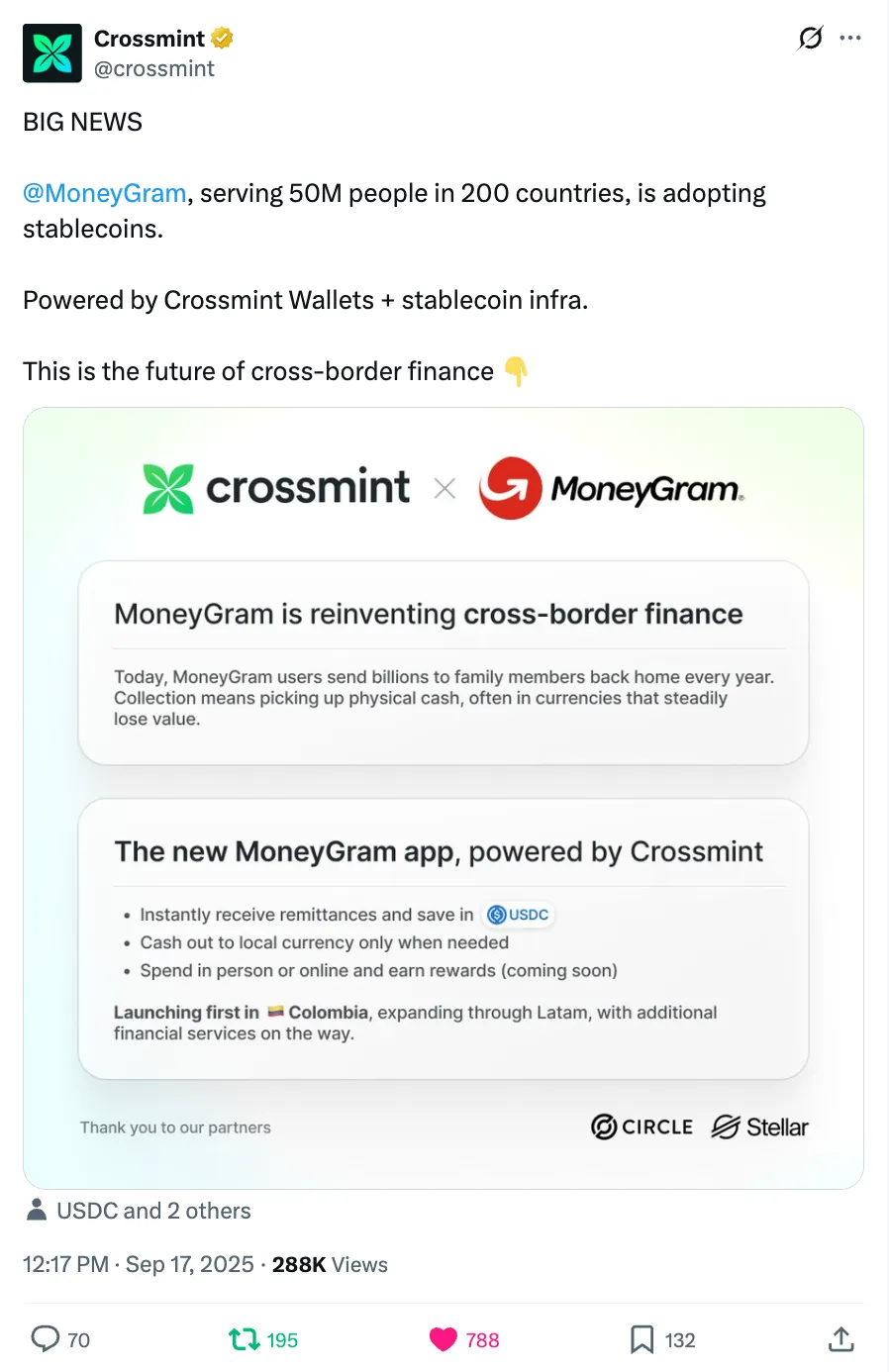
By then, I was heading marketing at Crossmint, which partnered with MoneyGram to help the century-old cross-border remittance giant use stablecoins for global fund transfers.
As the value of dollar tokenization became increasingly evident, Wall Street began seriously exploring tokenization of other assets. Even Larry Fink—BlackRock CEO, who once derided Bitcoin as the “money laundering index”—reversed course: “Tokenization is the next evolution of financial markets. Stocks, bonds, and every other asset class will eventually live on blockchains.”
An Unforeseen Revolution: The Industry Today
Eight years have passed since I posted that Reddit explainer—and we still don’t have a decentralized Uber.
Blockchains haven’t eliminated all intermediaries, nor have decentralized tokens replaced sovereign fiat currencies.
Yet I believe history will view this turbulent era as the chaotic, formative stage of a new internet-native financial system. Each boom-and-bust cycle has strengthened foundational infrastructure and reshaped global finance—enabling anyone with a smartphone to access financial services on equal footing.
ICOs proved companies could raise capital globally, frictionlessly; DeFi proved financial services like trading and lending can run autonomously via code; NFTs built the foundational framework for digital asset ownership on the internet; and even the seemingly worthless memecoin cycle validated that this infrastructure can handle massive global traffic.
The next step is simple: tokenize traditional assets—stocks, bonds, real estate—while regulatory frameworks solidify. Then, the entire legacy financial system will migrate on-chain.
Critics can still easily dismiss all of this—but stablecoin data is irrefutable.
Stablecoin supply now exceeds $300 billion; settlement volume hit $33 trillion in 2025 alone; transaction volume has already surpassed $40 trillion this year—with $100 trillion projected for full-year 2025.
Skeptics rightly note much of this volume stems from crypto trading and bot activity—that’s true. But the sheer scale is undeniable—and the U.S. government’s stance has already signaled the industry’s future direction.
Here’s a subtle yet critical point: stablecoins are backed by U.S. Treasuries—the debt instruments the U.S. government issues to finance its spending. Every stablecoin minted creates incremental demand for Treasuries—aligning perfectly with America’s current fiscal financing needs. For this reason, the U.S. Treasury Secretary has elevated stablecoin development to a national strategic priority.
This isn’t the cypherpunk utopia originally imagined. But upgrading the dollar for the internet age—and delivering equitable financial access to everyday people worldwide—is itself a historic, transformative mission.
Where the Industry Is Headed
Artificial intelligence is disrupting every industry—including crypto.
Crypto-AI convergence is already underway. Millions of AI agents will soon engage in real-world commerce: linked to bank accounts via stablecoins, connecting to merchant networks across 200+ countries; transacting peer-to-peer automatically using crypto wallets and stablecoins.
AI agents will soon shop for us, manage our personal finances, and even execute transactions on behalf of large enterprises—this is now highly probable. Further ahead, fully autonomous, agent-driven businesses will emerge: quant hedge funds requiring no analysts or portfolio managers—reading earnings reports, building models, and executing trades independently.
In bringing this sci-fi future to life, crypto won’t replace traditional finance—it will fuse with it and go fully mainstream: blockchain will power the backend infrastructure, while frontend interfaces retain familiar, traditional forms—so most users won’t even notice the underlying crypto tech.
Legacy institutions will retire decades-old financial systems; startups will build the next generation of financial giants. The result will be a financial system operating 24/7, delivering identical, fair service globally—Nigerian users enjoying exactly the same financial access as New Yorkers—and spawning millions of new financial innovations atop that foundation.
Eight years from now, my predictions here may look as flawed as that Reddit article did back then.
But regardless—I’ll begin my fifth crypto career next week, diving headfirst into this ongoing transformation.
Join TechFlow official community to stay tuned
Telegram:https://t.me/TechFlowDaily
X (Twitter):https://x.com/TechFlowPost
X (Twitter) EN:https://x.com/BlockFlow_News
 @Cdempsey44


