








Reviewing the History of China’s Cryptocurrency Exchanges: Rise of the Unregulated, Offshore Relocation, and Compliance-Driven Restructuring
TechFlow Selected TechFlow Selected
Reviewing the History of China’s Cryptocurrency Exchanges: Rise of the Unregulated, Offshore Relocation, and Compliance-Driven Restructuring
An industry chronicle interwoven with technological idealism, wealth frenzy, regulatory shifts, and global migration.
 Navigating Web3 tides with focused insights
By: Black Mario
This article is the result of five days of intensive research and synthesis, tracing the evolution of China’s cryptocurrency exchanges. It aims to revisit the industry’s transformation—from its chaotic, grassroots origins to its global reconfiguration—and, in my view, also chronicles a broader saga interwoven with technological idealism, wealth mania, regulatory shifts, and cross-border migration.
From BTC China’s humble inception in a Shanghai apartment in 2011, to the “Triumvirate War” ignited in 2013 by Huobi and OKCoin; from RMB-based trading once dominating global Bitcoin markets, to the abrupt end of domestic exchanges’ golden era following the “September 4th” regulatory crackdown in 2017; from platforms like Binance, HTX, and OKX pivoting offshore, to the compliance-driven reshaping under intensified regulation—the story of Chinese exchanges encapsulates the entire crypto industry’s journey from lawlessness to order.
Over this more than decade-long path, some founders rose from internet cafés and residential apartments to the world stage; others scaled global rankings across bull and bear cycles; some sold their stakes and exited; others retreated behind the scenes; and still others, under mounting regulatory pressure, continue searching for a ticket into the mainstream financial system.
Ready? Let’s begin in that unmarked Shanghai apartment and retrace the wild, feverish, outbound, and compliance-oriented journey of China’s exchanges.
01 The Wild Beginnings
In the humid, suffocating plum-rain season of Shanghai in 2011, two rickety computer desks and a jam-prone second-hand printer comprised the entire operational setup of China’s first cryptocurrency exchange—housed in a 20-square-meter apartment in Jing’an District, with no signboard whatsoever.
Yang Linke puffed on a cigarette while staring at flickering characters on his screen; Huang Xiaoyu typed the final line of matching engine code. Two young men who had scrabbled around the fringes of the internet had no idea they were opening a door capable of sweeping across the globe.
Back then, nobody in China treated Bitcoin as a legitimate business. This foreign-coded virtual asset lingered only in corners of hacker forums. And thus, the story of China’s cryptocurrency exchanges quietly began with these two young men—diametrically different in background and temperament.
Yang Linke, a native of Wenzhou born in 1985, never followed the conventional academic path. He dropped out of school in his teens and worked as an internet café manager in Wenzhou and Shanghai—spending his youth surrounded by cigarette smoke, repairing computers, troubleshooting, and watching gamers play. Later, he dabbled in virtual item trading and built small websites—not earning big money, but honing an instinct for spotting niche market demands.
He knew nothing about cryptography nor had he ever engaged with overseas hacker circles. When he first encountered “Bitcoin” on a tech forum in 2010, he immediately recognized it as a censorship-resistant, online transferable digital token. A simple idea flashed through his mind: where there’s demand, there’s need for buying and selling; where there’s buying and selling, there must be a marketplace.
At the time, even over-the-counter (OTC) Bitcoin trading was rare in China. Buyers and sellers posted ads on forums, transferred funds privately, and manually sent coins—a cumbersome and risky process reminiscent of informal roadside vegetable swaps before formal markets existed. Yang saw this untapped void clearly—but lacking technical expertise or a team, his only option was to find someone who could code.
That person was Huang Xiaoyu.
Unlike the grassroots Yang Linke, Huang Xiaoyu was a well-known technical hacker within the community—deeply experienced in programming, website development, and backend architecture. He was among the earliest in China to grasp Bitcoin’s underlying logic. Reserved and publicity-averse, he was obsessed solely with code and decentralized technology. When Yang approached him on the forum and bluntly proposed, “I’ll handle operations—you write the code; let’s build a Bitcoin trading site,” Huang agreed almost instantly.
Perhaps not driven by profit, but by a hacker’s stubborn conviction—that such a pioneering endeavor deserved a platform built by Chinese hands.
The two pooled several ten-thousand RMB in startup capital, rented the apartment office, secured no investors, hired no full-time staff, and obtained no regulatory approvals. By day, they coded and refined UIs; by night, they drove traffic on forums. They survived on instant noodles and napped at their desks. In June 2011, Bitcoin China (BTCC) officially launched—China’s first cryptocurrency exchange and one of the world’s earliest.
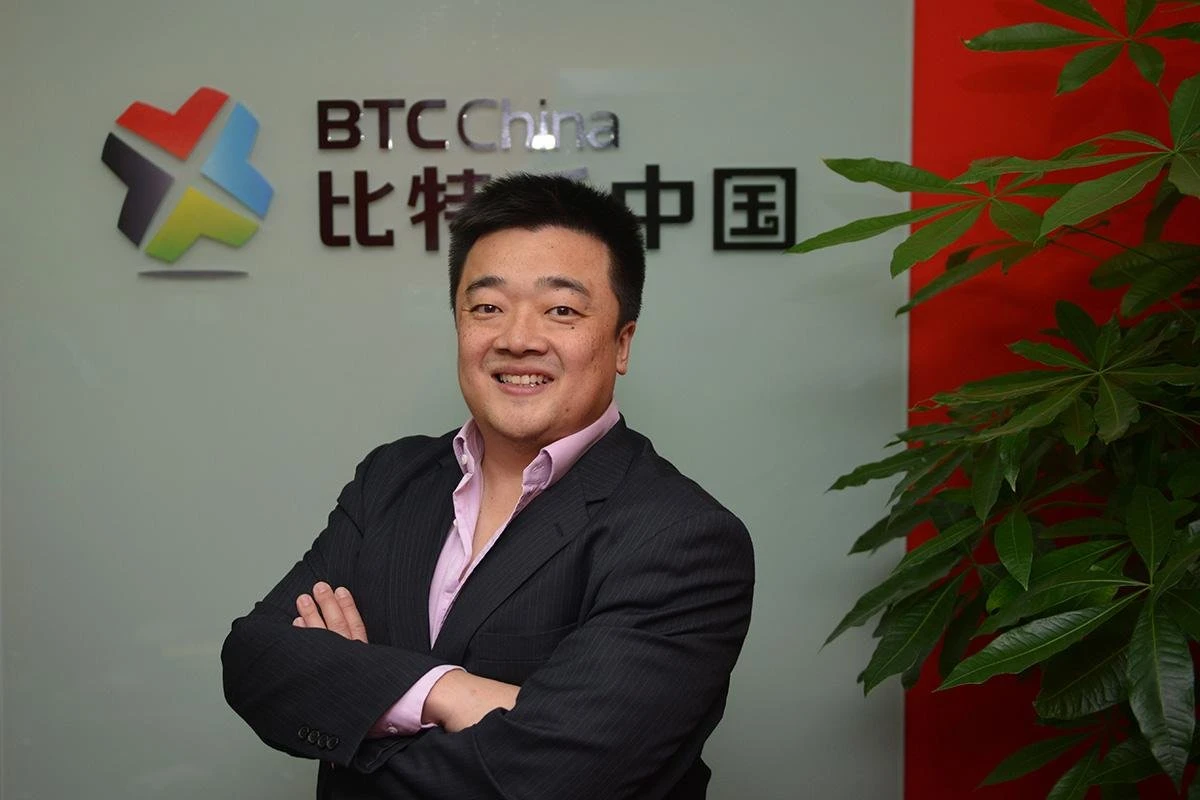
BTCC’s early webpage was extremely rudimentary—featuring only basic order books and price charts, without even candlestick charts, and supporting Bitcoin-only trading. Deposits and withdrawals were fully manual: users wired money to Yang Linke’s personal bank account, and he manually verified each transaction before crediting users’ accounts. Withdrawals required users to submit requests, which Huang Xiaoyu processed individually.
Its first few hundred users were all programmers, hackers, and overseas students, with daily trading volumes barely reaching tens of thousands of RMB. Yang later recalled having no intention of profit—only the exhilaration of doing something cool, like carving the first trail through an uninhabited wilderness.
Two ordinary individuals—one daring to imagine, the other ready to act—erected the first tent of China’s exchange industry amid the wilds.
Yet this grassroots hacker outpost remained lukewarm for two full years after launch, never escaping its narrow circle. Then, in 2013, an elite newcomer from overseas completely rewrote BTCC’s fate: Li Qiyuan.
Li Qiyuan’s life trajectory stood in stark contrast to those of Yang Linke and Huang Xiaoyu.
He studied abroad in the U.S., graduating from Stanford University, and worked at Silicon Valley tech firms and Wall Street institutions. Familiar with overseas financial markets, media operations, and commercial strategies, he was a staunch Bitcoin believer—and among the earliest to introduce Bitcoin into China’s commercial sphere.
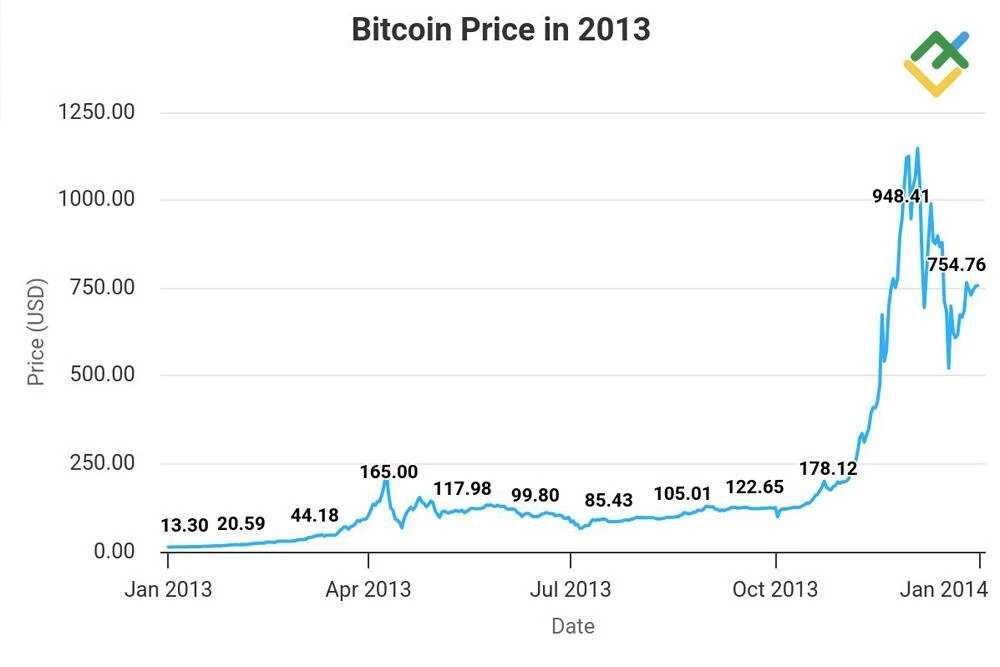
In 2013, Bitcoin’s price surged from $13 at year-start to $1,100 by year-end, triggering the industry’s first global bull run. Domestic demand exploded—and BTCC’s grassroots model could no longer accommodate the surging user influx. Spotting BTCC’s first-mover advantage, Li Qiyuan joined decisively to lead operations, igniting the hacker site into an industry benchmark with three strategic moves.
First, he ended the “apartment workshop” mode, incorporated a formal company, and assembled complete technical, operations, and customer service teams. Second, he engaged domestic and international financial media to bring Bitcoin and BTCC into the public eye—making ordinary people aware of both Bitcoin and Bitcoin trading. Third, he optimized deposit/withdrawal processes, enhanced system stability, and established initial security mechanisms—successfully absorbing the explosive growth.
BTCC peaked in 2013: daily trading volume surpassed 100 million RMB, user numbers skyrocketed, and it became the most influential exchange in China—and globally. The founding “Iron Triangle” of Yang Linke, Huang Xiaoyu, and Li Qiyuan cemented their status as pioneers of China’s exchange industry.
That period marked the absolute frontier era of China’s crypto exchanges: no regulatory policies, no industry standards, no risk-control requirements, no formal payment channels, no fund custody—and user assets resided entirely in founders’ personal accounts.
This wild phase achieved the industry’s core foundational accumulation:
BTCC proved the viability of the early RMB + Bitcoin matching business model, expanded users beyond hacker circles to mainstream investors, and provided the clearest entrepreneurial blueprint for successors.
Of course, the wild celebration inevitably rang its first alarm bell.
In December 2013, the People’s Bank of China (PBOC) and four other ministries jointly issued the “Notice on Preventing Bitcoin Risks,” explicitly defining Bitcoin—not as currency, but as a virtual commodity—and drawing red lines: prohibiting financial institutions and payment entities from engaging in related businesses, and directly highlighting exchanges’ fatal risks: unregistered operation, poor security, vulnerability to attacks, and potential operator fraud.
Though the notice did not shut down exchanges outright, it imposed the industry’s first regulatory bridle.
Yang Linke read the notice and knew instinctively: the days of grassroots workshops and gray-zone operations were coming to an end. He couldn’t foresee that a titanic battle among industry giants was already imminent.
That winter of 2013, BTCC moved out of the apartment into a formal office building. As its logo lit up, the three pioneers stood by the window—eyes gleaming.
From internet café managers, technical hackers, and overseas elites, they had become the founding generation of China’s exchange industry—having completed the crucial leap from zero to one in the most straightforward way possible. Yet they didn’t anticipate that two even more aggressive entrepreneurs would soon shatter their established order and propel China’s exchanges to global supremacy.
Li Lin and Xu Mingxing were already sharpening their knives.
02 The Rise of the Triumvirate and China’s Global Dominance
Also in Beijing’s Zhongguancun district in 2013, startup café lights burned until the wee hours.
Li Lin scrutinized Bitcoin candlestick charts on his laptop, sensing an unprecedented opportunity—fresh off his failed group-buying venture.
Meanwhile, just a few streets away in an apartment, Xu Mingxing’s fingers flew across the keyboard. This technical expert in high-concurrency trading systems was building his own matching engine.
Two young men—different in origin, mindset, and methodology—targeted the Bitcoin trading space in the same year. Rather than replicating BTCC’s grassroots pioneering path, they deployed mature internet business models to break the foundational structure established by Yang Linke and Li Qiyuan—propelling China’s crypto exchanges from hacker enclaves to global dominance.
Li Lin, born in 1986 in Shaoyang, Hunan, was a seasoned internet product veteran. A top-tier computer science student, he joined major companies like Renren and Oracle post-graduation, mastering product design and user operations. In 2010, he rode the group-buying wave, launching Mengmai.com—ranking among China’s top ten—before collapsing amid the brutal “Thousand Groups War.”
That failure crystallized his insight: small startups can only break through via vertical niches, urgent pain points, and light-asset operations.
In 2013, Bitcoin surged from $13 to $1,000, unleashing massive domestic trading demand. Li Lin tried BTCC firsthand—and was left speechless by its terrible UX: sluggish pages, cumbersome deposits, and nonexistent customer support. He instantly grasped the industry’s Achilles’ heel: China wasn’t short of speculators—it lacked usable, fast, and reliable trading platforms.
BTCC, riding its first-mover advantage, remained rough around the edges—still resembling a hacker website. In September 2013, Li Lin launched Huobi, touting “usability, free services, speed.” Within three months, trading volume exceeded one million RMB—challenging BTCC’s dominance.
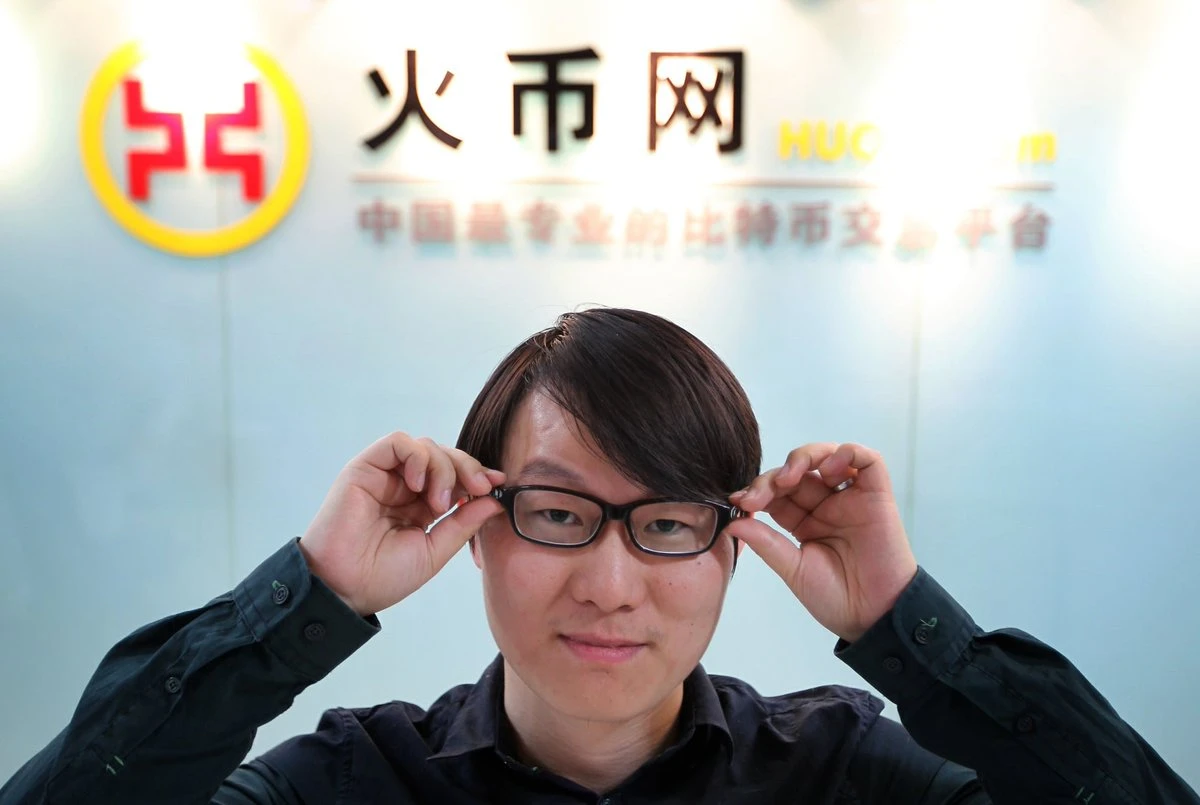
Li Lin’s breakout strategy centered on user experience: instant deposits/withdrawals, 24/7 customer service, smooth interfaces, and—his killer move—permanently free trading, directly undercutting first-generation fee-dependent platforms.
While Li Lin aggressively captured market share through UX, Xu Mingxing—also aiming to profit in this space—chose a diametrically opposite path.
Born in 1985 in Suzhou, Jiangsu, Xu Mingxing was a technical hacker who mastered distributed systems and high-concurrency architecture at Beijing University of Posts and Telecommunications. After working at Yahoo China on world-class trading systems, and later serving as CTO at Docin.com—where he ensured stability for millions of users—he understood scalability inside-out.
Upon encountering Bitcoin, he ignored retail UX entirely and focused instead on the core technical barrier: matching engines. At the time, no domestic platform could handle massive trading volumes or high-frequency quantitative trading—leaving institutional users with nowhere to land. Xu’s goal was clear: build China’s most stable, fastest exchange—exclusively for institutions.
In October 2013, OKCoin officially launched, branding itself “technologically superior, professionally oriented”—directly challenging Huobi.
Xu personally led coding efforts to develop a millisecond-level matching engine supporting tens of thousands of concurrent transactions—decisively outperforming BTCC’s outdated architecture. Focusing squarely on quant and high-frequency trading, OKCoin tightly captured professional investors and institutional teams—creating a sharp contrast to Li Lin’s retail-focused strategy.
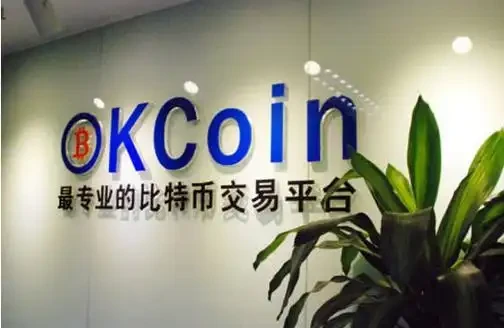
One understood users and targeted retail traders; the other mastered technology and served institutions.
In the same year and on the same track, Li Lin and Xu Mingxing forged two complementary yet competitive paths to prominence.
By year-end 2013, Huobi and OKCoin had both risen—shattering BTCC’s monopoly and formally establishing China’s tripartite exchange landscape.
BTCC held onto its founding pioneer brand, leveraging overseas resources and reputation to retain loyal users; Huobi dominated user scale with extreme UX and aggressive operations; OKCoin monopolized institutional and quant markets with cutting-edge technology.
Rather than vicious competition, the three collaborated to expand the overall pie. With RMB on/off-ramps established and standardized trading procedures, entry into crypto became vastly easier—transforming exchanges from fringe ventures into the most profitable startup sector of the time.
China’s exchanges began exhibiting global influence—and an unexpected black swan event propelled them to world leadership.
In February 2014, global crypto markets were rocked when Mt. Gox—the Japanese exchange commanding over 70% of global Bitcoin trading volume—collapsed due to hacking and internal mismanagement, losing 850,000 Bitcoins and declaring bankruptcy.
Global crypto trading infrastructure instantly collapsed: users panicked and fled, liquidity dried up, prices plummeted, and Western exchanges suffered total collapse—leaving a massive vacuum.
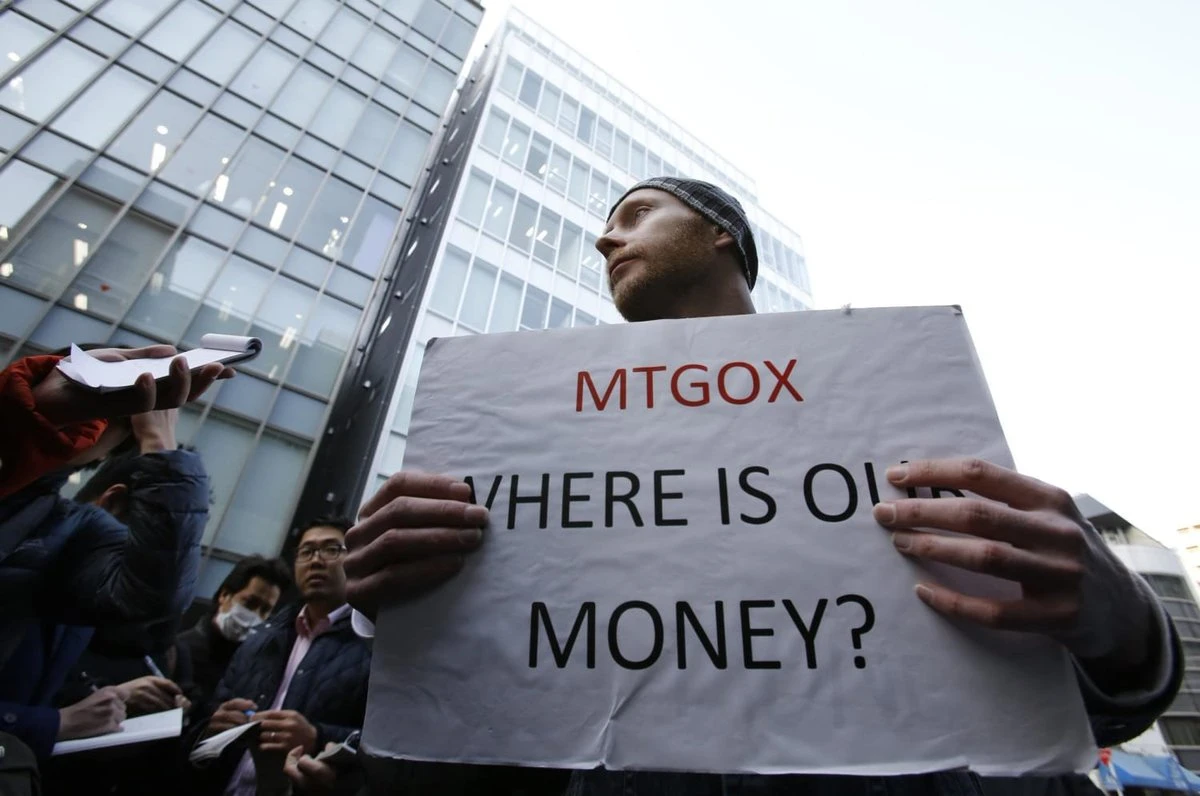
China’s three major platforms seized the historic opportunity: mature RMB trading infrastructure, large user bases, abundant liquidity, and robust systems capable of absorbing global overflow traffic—while BTCC leveraged overseas resources to onboard international users.
Within three months, Bitcoin trading’s global epicenter shifted from Tokyo to Beijing and Shanghai.
From 2014 to 2016, BTCC, Huobi, and OKCoin collectively accounted for over 80% of global Bitcoin trading volume—peaking above 90%. The RMB became Bitcoin’s primary pricing currency; China’s trading hours, policy signals, and user sentiment directly dictated global Bitcoin prices.
Huobi’s Beijing-based customer service handled orders deep into the night; BTCC’s Shanghai matching system ran nonstop; Shenzhen-based quant teams executed high-frequency trades on OKCoin’s order book—and China became the undisputed center of global cryptocurrency.
These were the three most glorious years for China’s exchanges: no heavy-handed regulation, no cutthroat infighting, no catastrophic blow-ups—just three giants cooperating to dominate the globe and reap enormous profits. Li Lin, Xu Mingxing, and Li Qiyuan stood atop the industry—globally renowned Chinese faces in crypto.
As giants ruled, smaller platforms mushroomed—ushering in a flourishing era of “a hundred schools contending.” Platforms like China Bitcoin competed on low fees to capture mass-market users; BTC Trade focused on spot trading; BitEra pioneered niche altcoins. By 2016, over 30 licensed exchanges operated domestically—from tier-one cities to small towns—establishing a substantial base of Bitcoin traders.
This phase featured pure spot trading only—everyone assumed the golden era would last indefinitely.
Yet beneath the prosperity, dark currents had long been gathering.
Competition among the triad intensified; smaller platforms chased new profit streams via futures, leverage, and altcoins; and regulators’ focus shifted from “virtual commodity classification” to rapidly escalating financial risks.
Bitcoin’s price steadily climbed through volatility in 2016. The three exchanges sat firmly atop global trading volume—reaping rewards as pioneers.
They didn’t foresee that the next phase—a fierce, self-destructive race over futures, altcoins, and high leverage—was about to begin, alongside the regulatory guillotine silently descending.
03 The Frenzied Gambit: Futures, Altcoins, and Leverage
In the deep winter of 2016, Huobi’s offices glowed all night. Bitcoin candlestick charts on screens lurched violently under leverage and hot money. In the corner of a 24-hour convenience store downstairs, exhausted traders rubbed bloodshot eyes: one clutched his phone, shouting ecstatically after doubling his annual salary on a single altcoin; another crouched silently, face buried in hands—minutes earlier wiped out by high-leverage liquidation, his life savings gone.
This was the most frenzied era for China’s crypto exchanges. Spot-trading profits were exhausted; the triad shed their polite masks and engaged in bare-knuckle combat; newcomers exploited regulatory blind spots recklessly.
Futures leverage, altcoin ICOs, and OTC margin lending burned like three wildfires—distorting the entire industry beyond recognition. “Air coins” proliferated, margin lenders bled users dry, volume manipulation became rampant, and backroom manipulations flourished—every financial market vice erupted simultaneously.
High-leverage futures were the first to breach industry boundaries.
Even during the spot-trading boom, a group of traders steeped in overseas derivatives markets sensed survival opportunities in bear markets.
Lacking big-tech engineering chops or sophisticated operations, they deeply understood retail traders’ gambling instincts: spot trading only profited from upward moves—bear markets meant waiting helplessly; with leverage and short-selling, profits came from both directions.
In June 2013, China’s first Bitcoin futures platform, 796, launched—offering up to 10x leverage despite its high-risk label, instantly opening a new battlefield.
Then, the shocking “March 21 LTC Crash” of 2014 catapulted 796 to legendary status.
On the night of March 21, Litecoin’s price on Huobi inexplicably halved—from 180 RMB to 90 RMB. No warning, no circuit breaker, no risk controls—millions of spot traders were “ambushed,” their accounts evaporating instantly.
Customer service lines jammed; offices filled with aggrieved retail traders—some slammed tables yelling, others collapsed sobbing. This incident exposed spot trading’s fatal weakness—and overnight made 796 famous.
Within a month, 796’s trading volume surged tenfold—becoming the sole winner in the bear market.
Xu Mingxing and Li Lin could no longer sit idle—they knew derivatives were the real cash-printing machines.
Huobi rushed to launch BitVC futures; OKCoin rolled out its contract module overnight; BTCC joined the fray—engaging 796 in a ruthless, boundary-less futures war.
Trading fees plunged from 0.1% to 0.03%—nearly free to lure users; leverage jumped from 5x to 20x, with private 30x margin for VIPs; platforms secretly “spiked” prices, delayed executions, and triggered targeted liquidations—quietly confiscating retail traders’ margin.
In May 2014, five platforms jointly announced suspension of leverage services—but within a month, high leverage returned full force. Profit blinded everyone to the brakes.
796 became the first sacrificial victim of this infighting.
On the evening of November 3, 2014, 796 suddenly crashed platform-wide: login failures, inability to place orders or withdraw funds—user assets locked in place. Founders scrambled overnight but couldn’t recover. Three days later, reopening brought zero volume and shattered trust—within weeks, the former futures leader vanished.
796’s demise delivered the starkest warning: uncontrolled high leverage is a money-sucking black hole—yet the market, gripped by gambling fever, ignored the signal.
While the futures battlefield bled, the altcoin and ICO arena ignited an even wilder wealth bubble—and bred the worst chaos.
Bitcoin and Litecoin were firmly controlled by the triad—leaving no room for smaller platforms. Former Alibaba Security engineer Zhang Shousong quickly found his niche: relaxing listing criteria to focus on long-tail altcoins. Any project paying a listing fee got approved on Jubi Network.
When the 2017 ICO boom hit, Jubi…
Hundreds of altcoins flooded listings. Projects and platforms split proceeds—launching pumps of 10x–100x, luring retail traders to chase highs before dumping and cashing out—leaving chaos in their wake. Retailers ignored whitepapers, chasing “insider tips” regardless of project quality—even worthless junk coins attracted life savings.
Jubi Network briefly topped global daily volume in 2017, serving 23 million users—becoming an altcoin wealth factory and, frankly, a “rampant韭菜 (scallion) harvesting base.”
Almost simultaneously, Yunbi Network perfected the “influencer scallion harvesting” model.
Early Bitcoin evangelist Li Xiaolai held 25% equity—bringing millions of fans’ traffic. Yunbi wasn’t just China’s first Ethereum-listing platform—it became the go-to launchpad for ICO projects.
In 2017, one ICO after another launched on Yunbi—exploding at launch, spawning “100x coin” and “1000x coin” myths across the web.
Jubi and Yunbi led the frenzy—Yuanbao Network, BitTimes, and others followed suit—flooding markets with platform tokens, altcoins, and ICO tokens. The entire market turned into a casino—bad money driving out good, drowning genuine tech projects.
The frenzy around futures and altcoins completely derailed the industry—from giants to small platforms—laying bare every unwritten rule, with chaos everywhere.
Huobi and OKCoin fully opened margin trading—letting users borrow 5–10x funds using just 1x capital (i.e., leverage), effectively offering official margin loans at exorbitant interest rates. Third-party OTC margin lenders offered up to 50x leverage at 1% daily interest—borrowing 100,000 RMB cost 1,000 RMB per day. Countless retail traders borrowed high-interest loans to trade—facing instant insolvency upon market reversals.
To claim the title of “world’s largest trading volume,” all platforms engaged in rampant volume inflation.
Bot-driven wash trading inflated real volume (e.g., 100 million RMB reported as 1 billion RMB), fake orders flooded order books to simulate liquidity, and media-reported volumes became meaningless. An open secret in the industry: actual trading volume at Chinese exchanges was merely ~1% of what they claimed.
Moreover, no exchange used third-party fund custody—RMB and crypto assets resided entirely in founders’ personal bank accounts and wallets. Platforms freely diverted user funds for trading, investments, or personal spending; small platforms routinely absconded with funds. From 2016–2017, hundreds of small exchanges abruptly shut down—founders vanished, user assets vaporized.
No regulation, no insurance—user asset security relied entirely on founders’ integrity.
Similarly, exchanges lacked KYC—deposits occurred via private transfers—allowing gambling proceeds, illicit funds, and dirty money to be laundered swiftly through exchanges, while underground banks used crypto for cross-border fund transfers evading forex controls.
Hacking incidents multiplied: BitEra’s cold wallet was hacked for 7,170 BTC—barely covered by the platform; small platforms, once breached, simply fled—leaving users holding the bag. Private key mismanagement and insider theft were commonplace.
In the first half of 2017, China’s exchange frenzy peaked: over 90% of global Bitcoin trading volume originated in China; ICO projects raised hundreds of millions overnight; Bitcoin speculation dominated street conversations.
June 2017—Beijing’s summer air hung thick and oppressive. Exchange offices buzzed with nocturnal euphoria: bots churned nonstop, ICO listing applications queued endlessly, and futures leverage liquidations drowned in bull-market noise.
Nobody believed the four-year wild ride was nearing its end.
On September 4, 2017, a joint announcement by seven ministries brought all madness to an abrupt halt—ending the golden era of domestic exchanges.
04 The “September 4th” Regulatory Crackdown and Domestic Trading’s First “Letting Go”
In early 2017, the PBOC Beijing Branch and Shanghai Head Office summoned leaders of Huobi, OKCoin, and BTCC—the three top platforms—for face-to-face meetings, reiterating the core red line of PBOC Document [2013] No. 289: Bitcoin is a virtual commodity—not legal tender—and financial institutions must not engage in related activities.
Five days later, a joint inspection team comprising the PBOC and local financial bureaus conducted on-site inspections at all three platforms—reviewing backend trading data, auditing every fund flow, and examining every user agreement: operating unlicensed quasi-financial businesses, violating margin trading rules to amplify leverage, zero anti-money laundering (AML) systems, and no third-party fund custody…
On January 18, the PBOC issued its official inspection report and mandatory rectification order: immediately suspend all margin trading, reinstate trading fees (ending zero-fee policies), implement KYC and AML systems, enforce third-party fund custody within deadlines, and ban volume inflation.
This blow instantly bled the industry dry.
Daily Bitcoin trading volume—previously inflated to 13.6 million coins via “zero fees + leverage + volume inflation”—plummeted to 120,000 coins within a month: a >99% crash.
Li Lin stood before Huobi’s big-data dashboard, watching the vertical plunge—chain-smoking, fingertips burning; Xu Mingxing convened an emergency tech meeting overnight, ordering all leverage interfaces shut down and teams pulling all-nighters to rewrite system code; Li Qiyuan in Shanghai adjusted BTCC’s business per regulations, scaling back all high-risk modules. For the first time, the industry truly felt the regulatory blade descending.
Yet simultaneously, ICO listing applications remained queued, altcoin speculation raged, and underground margin lenders simply rebranded to continue soliciting clients.
Until 3 PM on September 4, 2017—a government announcement flooded the internet, detonating the entire crypto community.
The PBOC, Cyberspace Administration of China, Ministry of Industry and Information Technology, State Administration for Market Regulation, China Banking and Insurance Regulatory Commission (CBIRC), China Securities Regulatory Commission (CSRC), and China Insurance Regulatory Commission (CIRC) jointly issued the “Notice on Preventing Risks Related to Token Issuance Financing”—the infamous “September 4th Notice.” Citing laws including the PBOC Law and Securities Law, it delivered the harshest possible verdict: banning all domestic cryptocurrency trading.
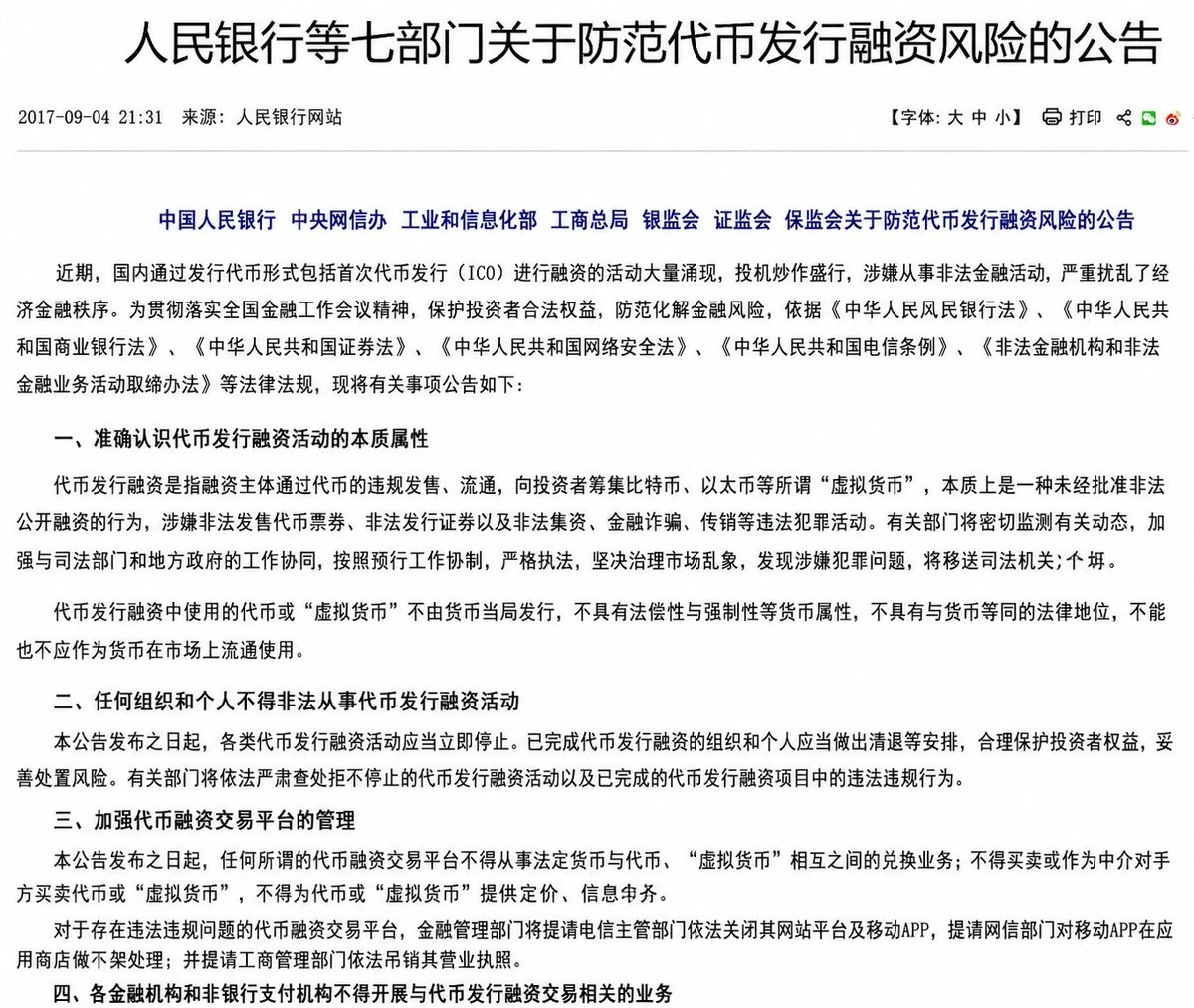
Source: PBOC website
Token issuance financing is essentially illegal, unapproved public fundraising—suspected of illegal fundraising, financial fraud, and pyramid schemes—henceforth banned entirely. No trading platform may offer fiat-crypto exchanges, token-token exchanges, pricing, or information intermediary services. Banks and payment institutions must sever all fund channels—non-compliant platforms will have websites closed, apps removed, and licenses revoked. All funded projects must refund raised capital within deadlines.
This legally terminated domestic exchange operations de facto.
The moment the news broke, the industry fell silent—then erupted into panic.
Industry chat groups overflowed with 999+ messages—“It’s over,” “What about our money?” filled the screens; Bitcoin and altcoins crashed—plunging >30% in minutes; exchange customer service systems overloaded—phone lines and live chats flooded with withdrawal and redemption requests, the noise nearly blowing off roofs.
Li Lin printed the full notice, reading it word-by-word—crumpling the paper in his grip, remaining silent for half an hour before telling his team: “Execute—execute everything strictly.”
Xu Mingxing meticulously reviewed the notice’s prohibitions on “fiat exchanges” and “information intermediaries,” his expression grim—immediately ordering all fiat trading channels shut and initiating user asset refunds;
Li Qiyuan convened a global emergency meeting overnight, declaring BTCC must be the first to shut domestic operations—leveraging its established reputation to safeguard users’ final line of defense.
The week after the September 4th Notice was the darkest hour for all exchanges.
An unprecedented user run erupted—more terrifying than any hack or market crash.
Online, withdrawal requests surged thousands per second—servers repeatedly neared collapse; engineers pulled three-day no-sleep shifts, guarding channels nonstop;
Offline, crowds gathered outside exchange offices—brandishing phones, demanding immediate cashouts, tensions running high;
Customer service reps—mostly young women—were besieged by accusations and complaints, apologizing tearfully while manually reviewing each withdrawal—voices hoarse by day’s end;
Finance staff stared at wildly fluctuating bank statements, verifying transfers constantly—large personal-account movements repeatedly triggered bank risk alerts, making every step arduous.
From late September to early October, BTCC, Huobi, and OKCoin successively issued final announcements—each word precisely aligned with the September 4th Notice: effective immediately, all domestic RMB-crypto trading services ceased, with orderly user asset refunds completed.
At that moment, domestic exchanges’ core lifeline was severed.
Domestic operations zeroed—not the industry’s end, but a forced mass exodus.
All platforms understood: staying domestic meant certain death; going global offered a sliver of hope.
05 Offshore Emergence, Madness & Illusion, and Ultimate Zeroing
Three months after the September 4th Notice took effect in 2017, mainland China’s crypto trading was completely halted—yet these entrepreneurs, forged in the internet’s wild frontier, seemed to have truly departed nowhere.
The September 4th ban only stopped domestic RMB trading—not Chinese people’s addiction to crypto speculation. The first to react were old rivals Li Lin and Xu Mingxing.
Li Lin cleanly severed Huobi’s domestic operations—then immediately set up Huobi.Pro in Singapore. His entire business philosophy prioritized stability: whether group-buying or exchanges, he advanced step-by-step. This time was no different—he avoided non-compliant fiat channels entirely, listing only USDT stablecoins. Mainland users accessing via VPN weren’t actively blocked nor openly promoted—like a shopkeeper guarding his stall, seeking only to stabilize overseas operations. Watching his team swap domestic ID badges for overseas ones, he knew Huobi would never return to its golden era in Beijing’s Wangjing SOHO.
Radically different from Li Lin’s conservatism, Xu Mingxing never considered “guarding the stall.” Immediately after the September 4th document dropped, he rebranded OKCoin as OKEx and dove headfirst into futures contracts. Domestically, he’d competed with Li Lin on technology and high-frequency trading; now freed from domestic regulation, he maximized leverage and relocated operations to Malta—a jurisdiction with lax oversight. In his view, spot trading was no longer profitable—only derivatives like contracts and leverage could let OKEx surpass Huobi. Five years of rivalry continued overseas—one defending, one attacking—neither yielding.
Just as Li Lin stabilized spot trading, Xu Mingxing went all-in on contracts—and the two fiercely contested the #2 position, a classic standoff emerged: a veteran technologist, stepping out from OKCoin’s inner circle, quietly laid the groundwork for a strategic chessboard neither giant had yet envisioned.
His name: Zhao Changpeng.
Zhao’s background was distinctly international—far more solid than most grassroots entrepreneurs in the space.
Born in Jiangsu in the 1970s, he immigrated to Canada with his family as a child, receiving rigorous Western STEM education. Post-graduation, he spent years refining high-concurrency, zero-lag matching engine architectures at top-tier financial institutions—including Tokyo Stock Exchange’s core data centers and Bloomberg’s cross-border trading systems—mastering traditional finance’s core trading logic, unlike many “self-taught” insiders.
In 2014, spotting crypto’s emergence, he returned to China—introduced by He Yi—to join OKCoin as CTO, assuming full control of platform core technologies.
At the time, Xu Mingxing oversaw overall strategy and fund management; Zhao Changpeng owned the full-stack trading system and asset security; He Yi managed global marketing and PR. Bound tightly together, they formed the crypto industry’s earliest, highest-caliber, most execution-capable “OK Iron Triangle”—propelling OKCoin to dual-oligopoly status with Huobi.
After years of collaboration, ideological rifts gradually widened—internal power struggles and strategic disagreements intensified—until the Iron Triangle fractured irreparably. Zhao, unwilling to accept this, decided to leave—biding his time with a fierce determination to overturn his former employer.
In 2017, as crypto markets surged and chaos mounted, regulatory tightening signals emerged early. While most insiders blindly doubled down on domestic fiat trading and short-term traffic harvesting, Zhao precisely detected the regulatory threat—and went “all-in,” betting his entire fortune.
He sold his core Shanghai property, consolidated all cash flow, and—with no hesitation—founded Binance.
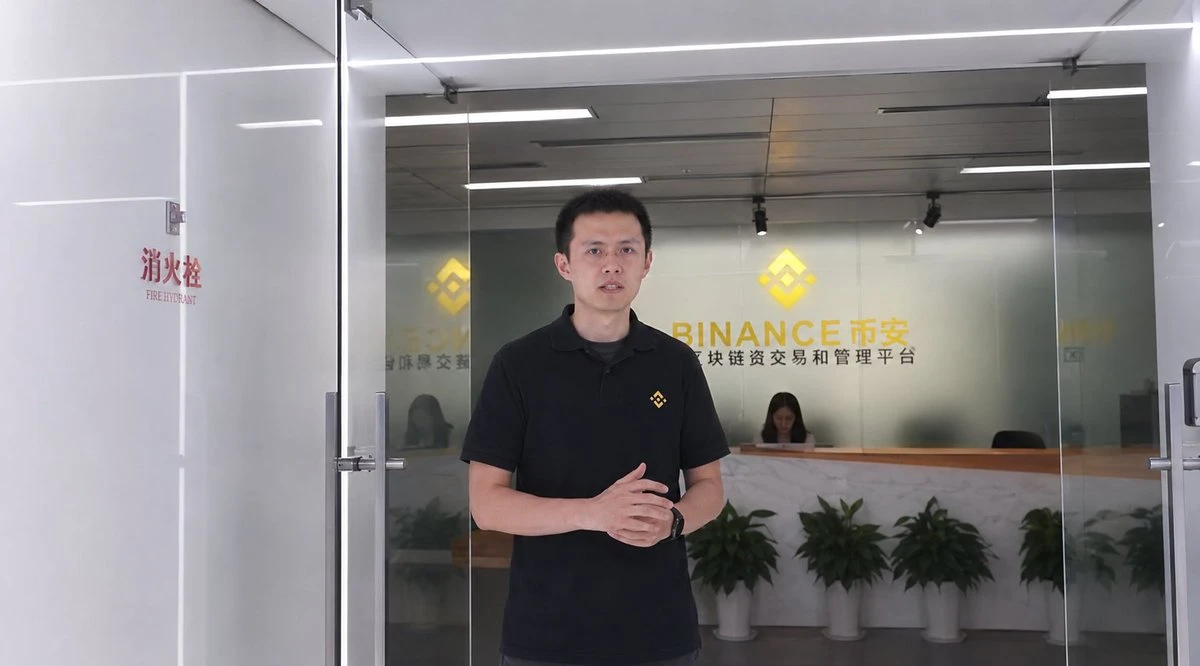
Early photo of CZ founding Binance
From day one, he deliberately avoided the compliance red lines crowded by others—eschewing all domestic RMB-fiat integration, offering only pure crypto-to-crypto trading. From architecture and business flows to jurisdictional registration, he fully sidestepped the September 4th Notice’s regulatory bans—positioning himself safely ahead of time.
When the September 4th policy landed, Huobi and OKEx scrambled to shut domestic channels and hastily refund mainland users—juggling business separation, stability maintenance, and regulatory audits—Binance had already prepared overseas infrastructure and opened global access, silently absorbing all fleeing retail users, capital, and traffic spilling from the two giants.
Unburdened by legacy baggage, operational entanglements, or compliance overhead, Binance rode the era’s tailwind—surging past Huobi and OKEx, both veterans of the industry, to seize global #1 trading volume. From an ex-CTO, Zhao became the industry’s new hegemon.
Xu Mingxing watched his former subordinate crush him—bitterly; Li Lin observed Binance’s explosive growth—sticking to his core business. These three old acquaintances reverted to the familiar tripartite balance—on foreign soil.
As giants battled overseas, two quiet technologists survived in the cracks between them.
Gan Chun, a security expert from Ant Financial, knew he couldn’t compete with Li Lin, Xu Mingxing, or Zhao Changpeng—so he bypassed mainstream coins entirely, focusing solely on overlooked niche altcoins. Registered in Seychelles, his platform KuCoin avoided ads and headlines—growing millions of users purely on security and reliability.
Han Lin was even lower-key: a Canadian PhD in optoelectronics, he founded BitEra after being scammed buying Bitcoin—later rebranding as Gate.io post-September 4th. One of the industry’s rare genuinely honest figures, he personally reimbursed users for 7,000+ stolen Bitcoins years earlier—building a reputation that allowed him to survive stably amidst giants’ pressures.
These four individuals—conservative, aggressive, speculative, pragmatic—thrived overseas. Yet none anticipated that a technologist from Huobi would use an absurd model to upend the entire industry.
His name: Zhang Jian.
Zhang Jian, former Huobi CTO and author of China’s first blockchain bestseller, was widely regarded as a technical idealist. After leaving Huobi, he sought genuine innovation—disdaining exchanges’ fee-charging and “scallion-harvesting” models. In 2018’s bear market, he unveiled a radical concept: “Trade-to-Mine.”
Simply put: all trading fees were refunded as platform tokens—holders earned dividends. Sounding like a perk, it was fundamentally a Ponzi scheme—robbing Peter to pay Paul. But the industry was already insane: FCoin’s trading volume surpassed Huobi, OKEx, and Binance combined within 12 days of launch.
Zhang transformed overnight from industry role model to “disruptor”—yet he knew this bubble would burst.
Indeed, within two years, FCoin collapsed. Unable to redeem 7,000+ Bitcoins, Zhang disappeared overnight—leaving hundreds of thousands of users bankrupt. The former technical idealist became the industry’s biggest fraudster—this farce, the most glaring scar on four years of gray-market chaos.
FCoin collapsed—but industry frenzy showed no signs of slowing.
Domestically, related activities didn’t vanish—they migrated deeper into hidden, fragmented gray zones.
Mining clusters formed significantly in Sichuan, Yunnan, and Inner Mongolia—massive mining rigs running continuously on cheap electricity, giving China a major global hash rate share. Yet rapid expansion accumulated energy consumption, local regulatory arbitrage, and electricity compliance issues.
Simultaneously, USDT-based OTC trading quietly spread through WeChat, Alipay, and bank transfers—becoming many users’ alternative gateway into crypto markets. It sustained market liquidity—but also enabled illicit uses like fraud, gambling, and capital flight—making it difficult to regulate.
2019 marked another domestic golden era for exchanges.
After prior bull/bear cycles, industry influence consolidated among three players—colloquially termed the “HBO Iron Triangle”: Huobi, Binance, and OKEx divided over 80% of Chinese-speaking traffic, dominating both spot and derivatives—leaving second-tier platforms unable to compete head-on, and third-tier ones relegated to peripheral roles.
Binance pioneered IEOs via Launchpad—its debut BTT token doubled instantly, igniting a network-wide subscription craze. Subsequent high-quality projects followed—securing first-mover traffic advantages. In July, it launched perpetual futures—simultaneously strengthening spot and derivatives, maintaining >30% global trading volume year-round, transforming from dark horse to undisputed global leader.
Huobi closely followed with Huobi Prime IEO—solid in defense but lacking offensive breakthroughs—holding firm at #2.
OKEx launched OK Jumpstart—differentiating against IEOs, jointly anchoring the second tier with Huobi. Daily cross-platform copying intensified—new listings, campaign formats, and product models grew increasingly similar—as Chinese-speaking retail traders migrated fluidly between platforms.
IEOs were 2019’s definitive traffic catalyst—serving as universal tools for revenue growth, market pumping, and user acquisition. Projects skipped complex private fundraising—listing directly on top exchanges with compliant token launches. Users pledged platform tokens to enter lotteries—platforms effortlessly earned listing fees and secondary-market trading commissions—short-term win-win-win.
Amid soaring hype, retail FOMO spiked—platform tokens collectively doubled, industry valuations surged. Yet hidden dangers loomed: countless unqualified “air projects” exploited the frenzy—leading to subsequent market collapses and mass user protests. Unordered, speculative infighting planted concrete grounds for future global regulatory crackdowns.
Headliners fought over core profits; second/third-tier platforms avoided direct confrontation—opting for differentiated,下沉 (lower-tier) strategies to profit quietly.
KuCoin, Gate.io, BitMax, ZB, LBank, Bibox, CoinEx, Bitforex, EXX, CoinBene, MXC, BiKi, Hotbit, BigONE, DigiFinex, BitZ, IDAX, and others carved out shares—each claiming residual fragmented traffic.
Overall, 2019 was crypto exchanges’ final frontier feast.
Clear hierarchies, vibrant mechanics, abundant traffic, and frequent get-rich-quick stories—HBO’s triad monopolized core benefits; second-tier platforms developed quietly via differentiation; third-tier ones survived by riding coattails—entire industry prospered collectively via gray-market mainland traffic, bear-market rebounds, and IEO speculation.
Precisely during this phase, crypto’s image in China sharply bifurcated: one side showcased massive commercial opportunities from mining, trading, and global liquidity; the other revealed social risks from regulatory blind spots, gray funds, and scams. The industry wasn’t rejected overnight—but accumulated justification for strict regulatory intervention through prolonged disorder.
Everyone knew these gray-market good times couldn’t last forever.
First, regulators blocked WeChat and Alipay OTC channels; then cleared mining farms in Inner Mongolia and Sichuan; finally severed all exchange VPN access.
Until September 24, 2021—when a ten-department notice delivered the final verdict: all domestic crypto-related activities are illegal finance; foreign platforms serving mainland users are equally illegal.
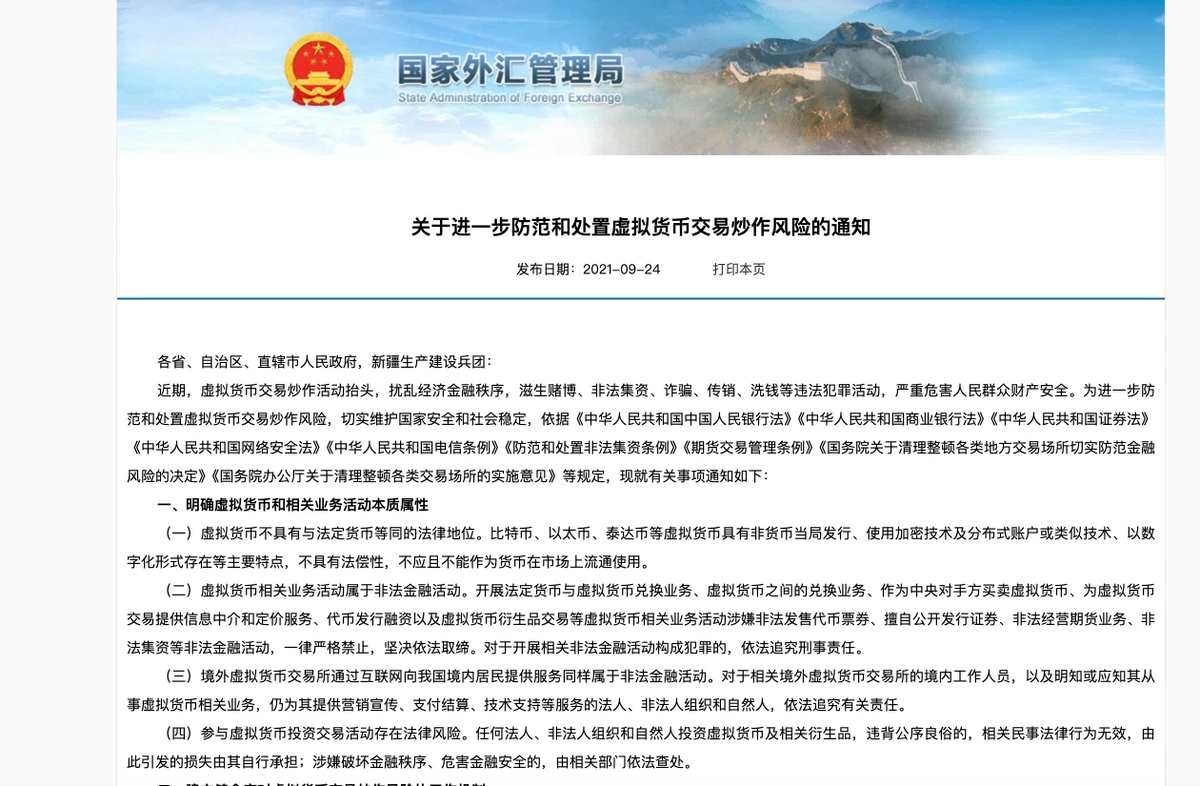
Source: https://www.safe.gov.cn/safe/2021/0924/19915.html
This time, no one dared gamble.
Li Lin fully withdrew mainland users from Huobi; Xu Mingxing blocked OKEx’s mainland IPs—shifting entirely to Europe; Zhao Changpeng severed Binance’s VPN access—abandoning its largest invisible traffic pool; Gan Chun and Han Lin compliantly restricted mainland users—ending their gray-market business. Meanwhile, mid- and long-tail platforms dependent on mainland markets vanished entirely from history in this purge.
The mainland Chinese market—once capturing 90% of global trading volume—was utterly zeroed.
06 Giant Fragmentation, Exit Sales, and a New Global Compliance Landscape
With the September 24, 2021, official document classifying all crypto-related activities as non-compliant financial operations—banning foreign platforms from serving mainland users, prohibiting domestic merchants and individuals from providing exchanges with payments, communities, or technical support, and even phasing out mining hash power—the indigenous crypto ecosystem was instantly suspended.
Overnight, the three giants’ paths diverged sharply.
Before tightened regulation, Huobi thrived on early entry and brand reputation—steady retail cashflows and fee income, avoiding risky derivatives or obscure altcoins to sustain revenue.
But new rules erased these advantages—problems cascaded:
U.S./EU licenses remained out of reach; Southeast Asian regulators repeatedly summoned executives; cross-border users faced frequent throttling and IP blocks. Renting overseas offices, hiring local teams, and retaining compliance lawyers drained cash—while daily active users and trading volumes declined steadily. Huobi’s previously stable operational foundation suddenly leaked from all sides—charging forward invited compliance risks; retreating meant abandoning years of hard-won market position.
Li Lin saw this clearly—knowing intuitively that early loose regulation allowed stable operations via networks and soft referrals.
Post-2021 demanded hard requirements: user fund custody, physical office registration, fund-source tracing, risk controls, and executive compliance endorsements—any missing piece invalidated operations.
His domestic networks were strong—but overseas compliance foundations and cross-border government/corporate resources were weak. Increasing regulatory pressure clashed with rising operational costs—and unclear vicarious liability risks. After careful thought, the optimal solution emerged: sell while the platform retained value—exit gracefully rather than endure future turbulence.
2022 coincided with a bear market—industry assets shrank, exchange valuations dipped—creating a perfect window for low-risk, stable ownership transfer. Li Lin quietly engaged Hong Kong capital through formal institutional M&A processes—publicly disclosing Hong Kong-based About Capital Management as the acquirer. Sun Yuchen then joined the Global Advisory Committee, becoming the most visible public figure for branding, operations, and ecosystem development.
In October that year, all transfer procedures concluded. Li Lin divested all shares, resigned all positions, and cleanly severed ties with Huobi. Superficially, this appeared as a founder’s graceful retirement—but strategically, it was precise bear-market exit timing for risk mitigation and profit realization. From this point, the iron-clad triad structure cracked—initiating the industry’s comprehensive compliance reshuffle.
Li Lin stepped away—no longer involved in platform operations—and laid groundwork for the new Huobi’s compliant institutional custody business.
Sun Yuchen assumed full operational control—not clinging to old methods, but adapting to current overseas compliance realities—gradually adjusting the platform’s original rhythm to fit offshore user needs, subtly rewriting the Chinese-speaking exchange’s formerly stable competitive landscape.
His first move was rebranding—diluting domestic associations to ease overseas registration.
Initially renamed “Huobi” (phonetically similar but distinct), lowering mainland identification for multi-country basic compliance alignment; then, at the 2023 Singapore TOKEN2049 conference—the industry’s largest global gathering—officially rebranded globally as HTX.
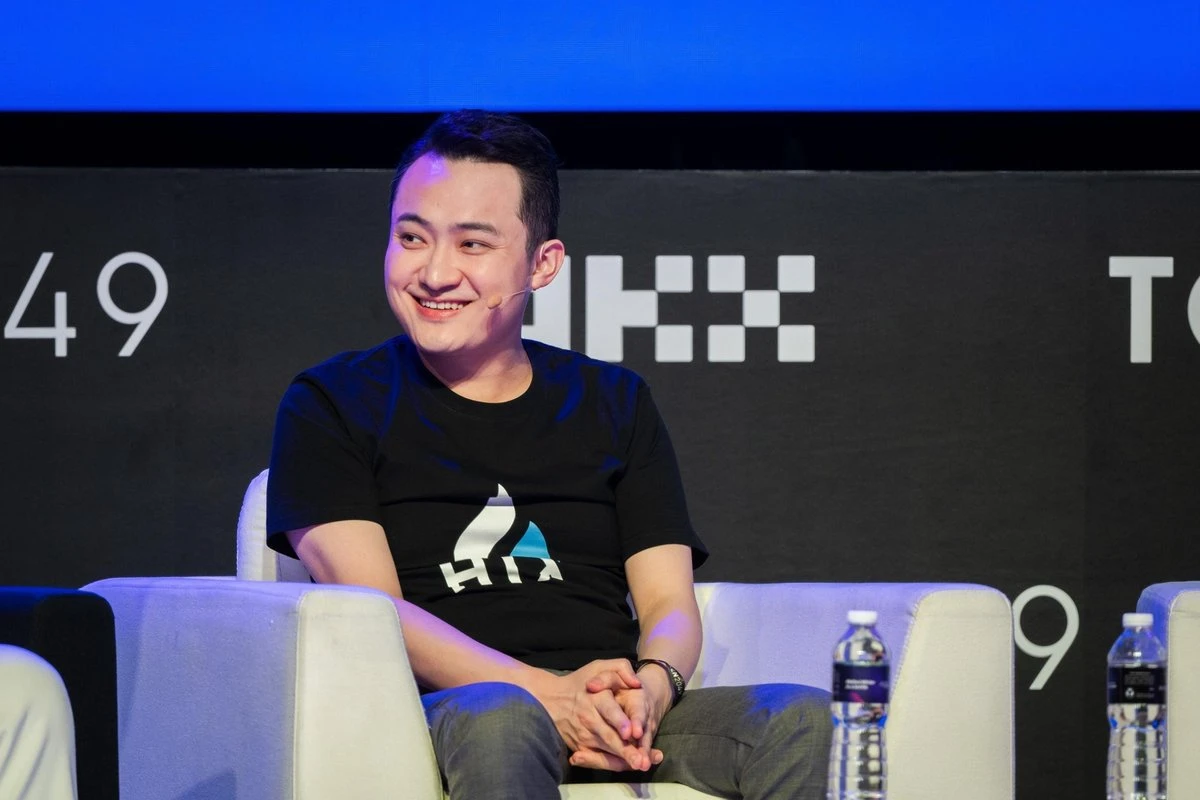
TOKEN2049 / HTX DAO x TRON Afterparty scene
Leveraging Huobi’s decade-old user base while integrating TRON’s ecosystem, HTX smoothly transitioned operational nodes—completing brand upgrades seamlessly, concurrently fulfilling overseas compliance disclosures to meet fundamental global operational requirements.
With branding resolved, the platform adjusted its operational strategy—aligning with retail trading preferences: expanding high-liquidity trading pairs, moderately widening derivatives tiers, listing compliant niche altcoins—rapidly boosting trading volume and securing industry rankings. Simultaneously, it refined community operations—segmenting and nurturing diverse user needs, inviting senior overseas industry experts to form external advisory boards—ensuring outward-facing compliance credibility.
Short-term trading metrics visibly rebounded—but underlying security, risk controls, and full-chain fund custody hadn’t kept pace. Existing fund allocation and real-time liquidity management still needed optimization—behind the traffic buzz lay latent long-term operational pressure.
In fact, minor issues from the equity transfer gradually surfaced.
In 2025, Li Lin and Sun Yuchen publicly communicated multiple rounds regarding pre/post-transfer fund reconciliation, position handovers, and ecosystem token transfers.
Both parties rationally clarified responsibility boundaries—detailing existing fund gaps, margin replenishment progress, and compliant token transfers—properly resolving all outstanding transfer matters per regulations.
Meanwhile, volatile market conditions from 2023–2025 prompted user feedback on system lag, abnormal price movements, and inconsistent order matching during extreme events—prompting ongoing backend optimization. Normal technical staff turnover occurred, with backend service efficiency steadily upgraded. By 2026, HTX focused on its core Chinese-speaking user base—steadily maintaining its niche market without disruptions.
While HTX steadily adjusted operations and cultivated community reputation, Xu Mingxing—the contract-tech titan—had long seen the industry’s trajectory clearly.
Anticipating ever-tightening global regulation, he gradually reduced public appearances—delegating day-to-day operations while retreating to oversee only core strategy and risk management—stepping away from the spotlight.
Following the 2021 global wind-down, OKEx leveraged its battle-tested contract matching engine and long-standing partnerships with top quant institutions—maintaining steady baseline volume without operational instability or funding stress.
But macro-environmental pressures never eased: cross-border leverage controls grew stricter; trading compliance checks intensified; overseas regulators regularly sent inquiry letters; and closed-loop handling of user experience requests plus localized special inspections added constant overhead. Revenue appeared stable—but compliance pressure loomed perpetually—fearing any misstep might trigger traffic throttling or cross-border penalties.
Xu Mingxing knew the wild, lucrative days of contract trading were over. Future competition wouldn’t favor aggressive tactics—but compliance licenses, robust risk controls, and institutional networks. Remaining front-and-center increased personal vicarious risks exponentially.
To isolate risk and simplify governance, he proactively faded from public view—entrusting daily operations to professional teams—while splitting multi-layer offshore operating entities to delegate compliance liaison, user operations, and fund reconciliation—assigning all burdensome, liability-heavy tasks.
On January 18, 2022, OKEx officially rebranded as OKX—expanding into Web3’s full ecosystem and on-chain custody services, transcending the single-exchange framework while downplaying its legacy contract branding—standardizing historical compliance records and reducing cross-border traceability risks.
The former frontline warrior who once battled Li Lin stepped back quietly—OKX fully transformed into a professional, compliance-first platform—the second pillar of the old triad, landing steadily.
After stepping back, OKX adopted a pragmatic approach—concentrating all resources on two goals: obtaining global compliance licenses and serving major institutional clients.
Starting in 2023, OKX accelerated global compliance transformation—deploying local teams and securing compliance credentials in Middle Eastern and Southeast Asian markets—evolving from an offshore platform to a multi-regional, licensed global operator.
In 2025, OKX achieved key European compliance milestones: obtaining Malta’s MiCA license in January and expanding services across the European Economic Area via passporting; in February, OKX settled historical compliance issues with the U.S. Department of Justice—paying over $504 million in fines to address AML, KYC, and cross-border operation deficiencies.
Subsequently, OKX strengthened proof-of-reserves, fund transparency, and AML risk controls—transitioning its image from a “contract-tech exchange” to a mainstream platform emphasizing compliance, custody, institutional services, and global licensing.
By 2026, OKX secured minority investment from ICE—the New York Stock Exchange’s parent company—at an implied valuation of ~$25 billion. This signaled deeper integration of traditional financial infrastructure into crypto trading—and reinforced OKX’s convergence with mainstream finance.
Three years of quiet, steady work allowed OKX to absorb Binance’s departing stable funds and HTX’s cautious users—silently securing global #2 ranking, becoming the industry’s true “invisible winner.”
While some cashed out and exited, others retreated to manage behind the scenes—industry structure quietly loosened.
Only Zhao Changpeng—the former industry-topper who’d surged globally—now faced layered regulatory encirclement across multiple countries, forcing his peak-scale operations back to normal rhythms.
Binance’s glory years featured headquarters-free, offshore, lightweight distribution—drawing global retail traffic indiscriminately, sustaining dominant trading volumes.
During early land-grabbing phases, priorities were maximizing global traffic and user acquisition—compliance systems and regional risk controls were incrementally built—flexibly aligning with the industry’s early lax growth pace. Yet regulators soon targeted Binance.
The November 2022 FTX liquidity crisis may have been one catalyst.
Before the crisis escalated, CZ recognized risks—complying with regulations to divest FTX equity and disclose subsequent portfolio adjustments. Coincidentally, FTT’s inherent illiquidity triggered concentrated withdrawals—briefly impacting FTX’s capital base. Binance then expressed acquisition interest—conducting swift due diligence before rationally terminating negotiations.
SBF was convicted of defrauding customers of billions of dollars—facing lengthy imprisonment for failing to repay FTX user funds.
FTX’s collapse redirected global regulatory scrutiny toward top-platform compliance.
As FTX’s aftershocks subsided, March 2023 saw multiple crypto-partner banks undergo liquidity adjustments: Silvergate wound down orderly; Signature Bank came under local financial authority supervision; Silicon Valley Bank saw minor crypto-linked fund flow impacts. Traditional banks tightened crypto partnership quotas—industry liquidity returned to rationality, and regulatory layering, routine inspections intensified.
Compounded by historical compliance items and industry volatility, in November 2023, Binance and Zhao
Join TechFlow official community to stay tuned
Telegram:https://t.me/TechFlowDaily
X (Twitter):https://x.com/TechFlowPost
X (Twitter) EN:https://x.com/BlockFlow_News


