









Building Application-Specific Rollups: Finding the Balance Between Connectivity and Control
TechFlow Selected TechFlow Selected
Building Application-Specific Rollups: Finding the Balance Between Connectivity and Control
Are application-specific Rollups really the trend of the future?
 Navigating Web3 tides with focused insights
Written by: Alana Levin
Compiled by: TechFlow
Introduction
In the blockchain world, dApp developers face a critical decision: which chain to deploy their application on.
With technological advancements, they now have more options than ever—even building their own application-specific rollups. This article dives deep into that decision-making process, particularly the factors to consider when deciding whether to launch an application-specific rollup.
At the heart of this decision lies a fundamental trade-off: connectivity versus control.
The former refers to how many users and ecosystems your app can connect to, while the latter relates to your control over aspects such as your app’s token, gas fees, execution environment, and more.
So, how can developers strike a balance between these two? Are application-specific rollups truly the future? Let’s explore the answers through this article.
Two years ago, application developers faced a relatively straightforward choice when deciding where to deploy: Ethereum, Solana, Cosmos, or perhaps a few other Layer 1 blockchains. Rollups weren’t yet in use, and few had heard of the term “modular tech stack.” Differences between Layer 2s—such as throughput and fees—were stark and relatively easy to understand.
Today, the landscape is vastly different. Developers now face a growing list of options: Layer 1 chains, general-purpose rollups (both Optimistic and zk), advanced IBC infrastructure, rollup-as-a-service providers, app-chains, and more. With greater choice comes greater complexity: Should the team deploy on a general-purpose rollup or build an application-specific rollup? If opting for a general rollup, which one? If going the app-rollup route, which SDK or rollup-as-a-service provider should be used? Which data availability layer? Is EigenLayer helpful? How should sequencing be approached? The sheer number of decisions can feel overwhelming.
To narrow the scope, this article will focus on applications already deployed on Ethereum, centering on the decision tree teams face when considering launching their own rollup, my assumptions about which types of applications are best suited for such infrastructure, and when I believe we might reach a critical adoption threshold.
High-Level Framework
When deciding whether to deploy their own app-chain, the core question is actually quite simple: would users still use the application if it were on its own chain?
-
Are users more likely to use the app if it's on its own chain?
-
Are users just as likely to use the app on its own chain as they would on another shared chain?
The benefits of application-specific rollups stem from increased control: abstracting away gas costs, reducing on-chain congestion caused by other apps, experimenting with token utility, exploring novel economic models (e.g., offering gas rebates for integrations), building custom execution environments, implementing access controls (e.g., permissioned deployments), and more.
However, this additional control comes at the cost of connectivity to the broader ecosystem. Applications on shared/general chains benefit from existing liquidity (e.g., no need for extra bridging), composability with other apps, and user attention already focused on that chain. Building on a general chain also requires less internal engineering effort and overhead compared to running your own chain.
If there were no cost, greater control could enhance user experience. Therefore, the answer to the core question—would users still use the app if it were on its own chain—ultimately depends on how severe this trade-off between control and connectivity really is.
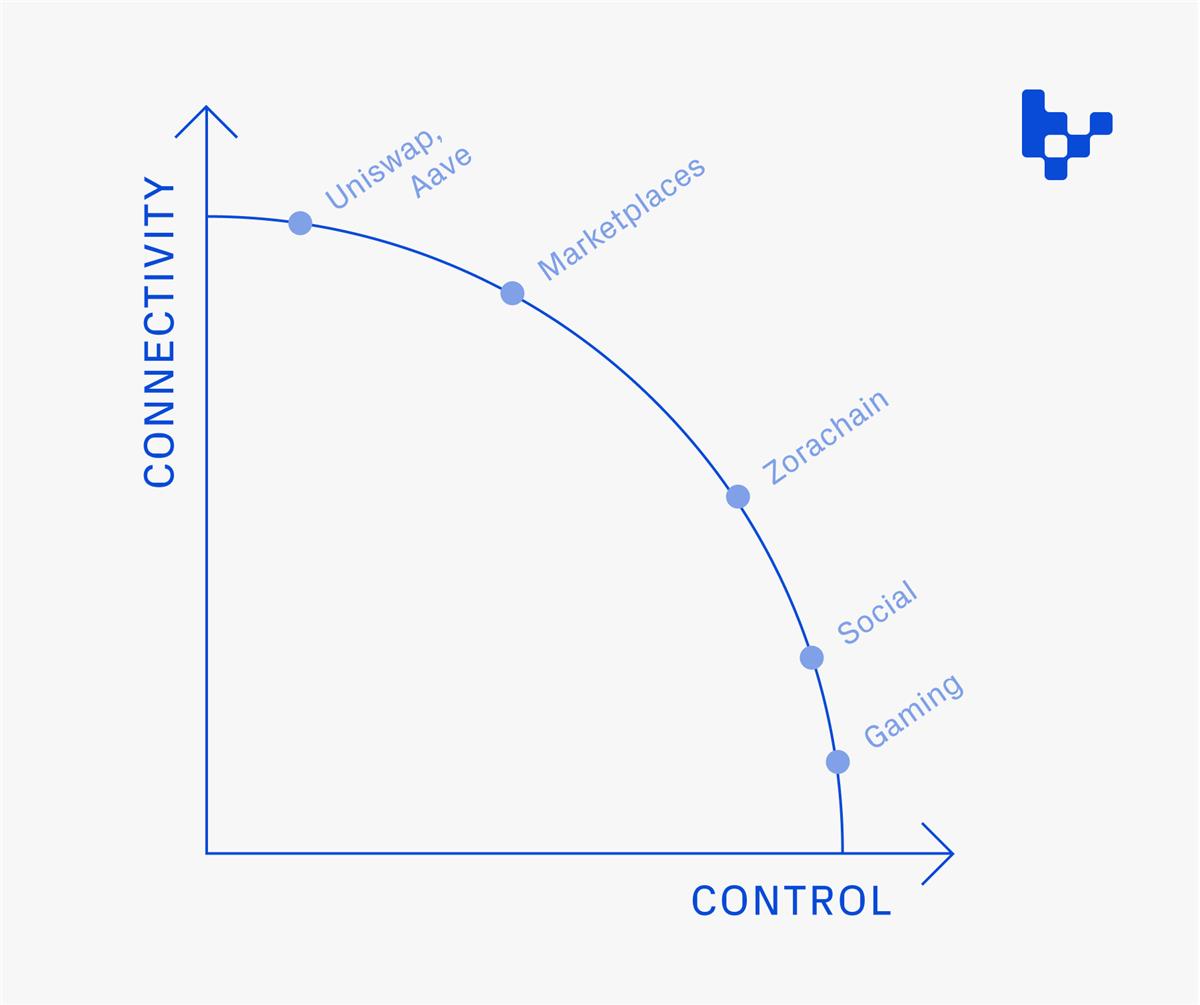
How Much Connectivity Can an Application Afford to Lose?
Connectivity takes many forms, but the two most important are: attention and capital.
Attention relates to native distribution. In my view, applications with strong native distribution today include Mirror, Zora, Manifold, sound.xyz, and OnCyber. There’s also an argument that apps without strong distribution might choose to launch their own chain to generate interest (though I find this less compelling if many chains pursue this strategy simultaneously).
The second component is capital. Typically, funds users deploy for an application are recycled from another application within the same ecosystem. I call this “shared liquidity,” and its impact is real. We’ve seen new applications choose one general rollup over another due to higher amounts of ETH bridged into that ecosystem; existing capital within an ecosystem can help lower adoption barriers (rather than trying to convince users to enter a new one). These considerations apply to any application that embeds some form of financialization into its product. Examples beyond DeFi could include collecting NFT articles via Mirror, paying to “steal” images on Stealcam, or any app with in-product tipping functionality.
Losing this “capital connectivity” means the application must attract users in other ways—through better UX, higher yields (like Blur’s lending protocol), or other incentives.
These two reasons—attention and capital—are why many believe on-chain gaming is an ideal candidate for application-specific rollups: games function as relatively self-contained economies, capable of controlling consumer behavior with minimal external disruption. Other suitable candidates may reduce users’ initial capital requirements by subsidizing transactions (e.g., first few transactions free) or not requiring payments upon signup (e.g., user-generated on-chain content, certain social apps). Some rollups may introduce permissioned deployments or user screening (e.g., KYC for the chain-operated sequencer), blurring the line between rollups and centralized databases.
Thus, how much connectivity loss an application can tolerate depends on the app’s nature and its target users’ needs. For some apps, losing some connectivity may be acceptable if they can compensate through superior value delivery. For others, connectivity is essential, as they rely heavily on interactions with other apps and users. Therefore, when deciding on an application-specific rollup, teams must carefully weigh the costs of reduced connectivity against the benefits of greater control.
Reducing Connectivity Loss
As interoperability solutions improve, the trade-off between connectivity and control becomes less severe. Cross-chain bridges and sequencers are often central to this discussion. Bridges enable message passing or asset transfers. Shared sequencers ingest and order transactions across multiple chains, creating a coordination mechanism that allows actions on one chain to influence those on another. Both shared sequencers and bridges are essential for atomic composability—sequencers ensure multiple (cross-domain) transactions are included in a single block, while actual execution typically relies on bridges.
Unit economics of rollups represent another area where “connectivity” matters. L2 transaction fees consist of two components: 1) the cost of publishing data to L1, and 2) the fee users pay for inclusion. Rollup operators batch transaction calldata, spreading publishing costs across users—the more transactions, the lower the average cost per user. This also means less active rollups may delay publishing transactions to L1 until batch sizes are large enough, resulting in slower finality and worse UX. Shared sequencers are increasingly acting as aggregation layers, where batching transactions from multiple smaller rollups helps create viable unit economics for long-tail applications.
Are We at a Turning Point?
The concept of app-chains and app-rollups isn’t new. For a long time, however, they resembled a developing residential area: extensive infrastructure built, but no residents. But in recent months, we’re starting to see the first inhabitants arrive. Lattice launched OpCraft, an on-chain autonomous world powered by its own rollup. Projects like Lit Protocol and Synapse have announced their own rollups (though both are more infrastructure-focused than application-facing). Zora introduced Zorachain.
My hypothesis is that the real inflection point will come in at least 6–12 months. Gaming and social apps show the clearest product-market fit for application-specific rollups: both rely heavily on indexing (and gain significant advantages by avoiding competition for shared state), sequencing is crucial in gameplay, and custom features like gasless transactions are especially useful for entertainment-oriented consumer products. Many of these application teams are still in development. Games, in particular, may take years to fully build and launch.
Another thought: for non-financialized applications, capturing user attention is paramount. So far, this article has framed app-rollups as “one app, one rollup.” But that view may be too narrow. Perhaps multiple apps will decide to form a collective, pool their “attention,” and launch a chain together. Alternatively, we might see a dominant app build its own chain and encourage other apps to deploy on it—effectively leveraging its user base to drive adoption of the infrastructure it wants to control.
Finally, I strongly believe we’ll see more rollups emerge. A growing number of projects are building infrastructure services for app-rollups. Caldera, Sovereign SDK, Eclipse, Dymension, Conduit, AltLayer, and others offer low-cost solutions for teams to quickly spin up their own rollups. Espresso, Astria, and Flashbots’ SUAVE are early players in the sequencer space. Setup costs are falling, and the “connectivity” trade-off is diminishing. Both factors strengthen the case for adoption. However, the abundance of infrastructure providers also means application teams may spend time evaluating options and testing these platforms in production before settling on a winner. So once again, while signs point toward adoption, I believe the turning point is still several months away.
Join TechFlow official community to stay tuned
Telegram:https://t.me/TechFlowDaily
X (Twitter):https://x.com/TechFlowPost
X (Twitter) EN:https://x.com/BlockFlow_News
 Variant






