








One Article to Understand Taiko, the Rising Type 1 zkEVM Star with Tens of Millions in Funding
TechFlow Selected TechFlow Selected
One Article to Understand Taiko, the Rising Type 1 zkEVM Star with Tens of Millions in Funding
Why has Taiko garnered such strong interest from VCs, and what aspects of it are worth paying attention to? In this article, we will explore Taiko's technical features and advantages.
 Navigating Web3 tides with focused insights
Author | [email protected]
Recently, Taiko, a new Ethereum Layer 2 project based on zkRollup, has gradually emerged. Built as a Type 1 zkEVM, Taiko aims to become a fully decentralized, Ethereum-equivalent zero-knowledge scaling solution that allows developers and users to securely experience Ethereum with lower transaction fees—without making any changes to Ethereum itself. Taiko is one of the most promising projects in the current zkEVM space and is also a Type 1 zkEVM recognized by Vitalik.
On June 8, Taiko announced it raised $22 million across two seed funding rounds—$10 million in the first round led by Sequoia Capital China, followed by $12 million in the second round led by Generative Ventures. On June 7, Taiko launched its Alpha-3 incentivized testnet. According to Taiko’s official announcement, this testnet focuses on decentralization and Ethereum-equivalent zkEVM functionality.
Why has Taiko attracted so much attention from VCs, and what makes it worth watching? In this article, we’ll explore Taiko’s technical features and advantages.
What is Taiko?
Taiko is an Ethereum-equivalent ZK-Rollup that scales Ethereum by supporting all EVM opcodes within a decentralized, permissionless, and secure Layer 2 architecture. In other words, Taiko scales Ethereum at both the technical and protocol layers by mirroring Ethereum’s native execution model.
ZK-Rollups scale computation by executing, aggregating, and proving transactions off-chain, while relying on Ethereum for data availability and validity proof verification. The biggest drawback of current production ZK-Rollups is their inability to fully support EVM's general-purpose computation—most are application-specific. This breaks compatibility with existing Ethereum L1 smart contracts and dApps, making it difficult to build new contracts that offer the same level of composability and expressive flexibility.
zkEVMs are considered key to Layer 2 scaling because they do not compromise on security or compatibility. Taiko aims to be a Type 1 zkEVM, prioritizing perfect Ethereum equivalence over the speed of ZK proof generation.
Taiko’s mission is to create an accessible, censorship-resistant, and decentralized Type 1 zkEVM.
Taiko Technical Features
Taiko consists of three main components: the zkEVM circuit (for proof generation), the L2 rollup node (for managing the rollup chain), and the Taiko Protocol (to connect these two parts for rollup protocol validation).
zkEVM Circuit
The zkEVM proves the correctness of EVM computations on the rollup via validity proofs.
Taiko can run Ethereum smart contract code natively without any modifications. Developers can easily migrate their existing Ethereum smart contracts and full dApps to Taiko, or deploy new Solidity code directly on Taiko as their primary or sole environment. Taiko implements a ZK-EVM that supports every EVM opcode and generates validity proofs through its ZK-EVM circuitry. Beyond perfect compatibility with Ethereum L1 smart contracts and dApps, all Ethereum and Solidity tools work seamlessly with Taiko, without disrupting developer workflows. This brings two major benefits:
1. Smart contract developers can use Solidity on Taiko without barriers, avoiding the need to learn a new development environment.
2. Smart contracts already running on Ethereum can be directly ported to Taiko, avoiding risks associated with different compilation languages and ensuring accurate adoption of dApp or smart contract development patterns.
Beyond application-layer EVM equivalence, Taiko also strives for full Ethereum equivalence, enabling it to leverage existing Ethereum infrastructure for development. Taiko nodes use the same hash algorithms, signature schemes, and storage data structures as Ethereum, ensuring compatibility not only with the virtual machine but also with underlying protocols. Importantly, whenever there is an Ethereum protocol upgrade, Taiko will implement it within its zkEVM to remain synchronized. Conversely, if Taiko pioneers innovations during its own R&D, it may seek to integrate them back into Ethereum. For example, Taiko leverages the Go-Ethereum client, which can be easily repurposed as a Taiko node.
In terms of compatibility, developers and infrastructure providers can smoothly adopt Taiko rollups, while users remain familiar with usage patterns and related products. As a general-purpose L2, Taiko’s goal is to empower builders—and ultimately, users.
Leveraging Ethereum’s strength—the EVM, well-defined infrastructure and tooling, critical mass of smart contracts, and developer expertise—is precisely why Taiko stands out as a Type 1 zkEVM.
Taiko L2 Rollup Node
Taiko nodes retrieve transaction data from Ethereum and execute transactions on L2, advancing the state accordingly—thus managing the rollup chain. Currently, Taiko nodes are forks of the Ethereum Geth client.
Taiko Protocol
The Taiko Protocol adheres to core principles of security, decentralization, and permissionlessness, defining and enforcing rollup rules and participant roles. Smart contracts deployed on Ethereum L1 serve as data availability mechanisms and verifiers for ZK-SNARK proofs, while contracts on Taiko L2 execute key protocol functions. The Taiko Protocol operates in three stages:
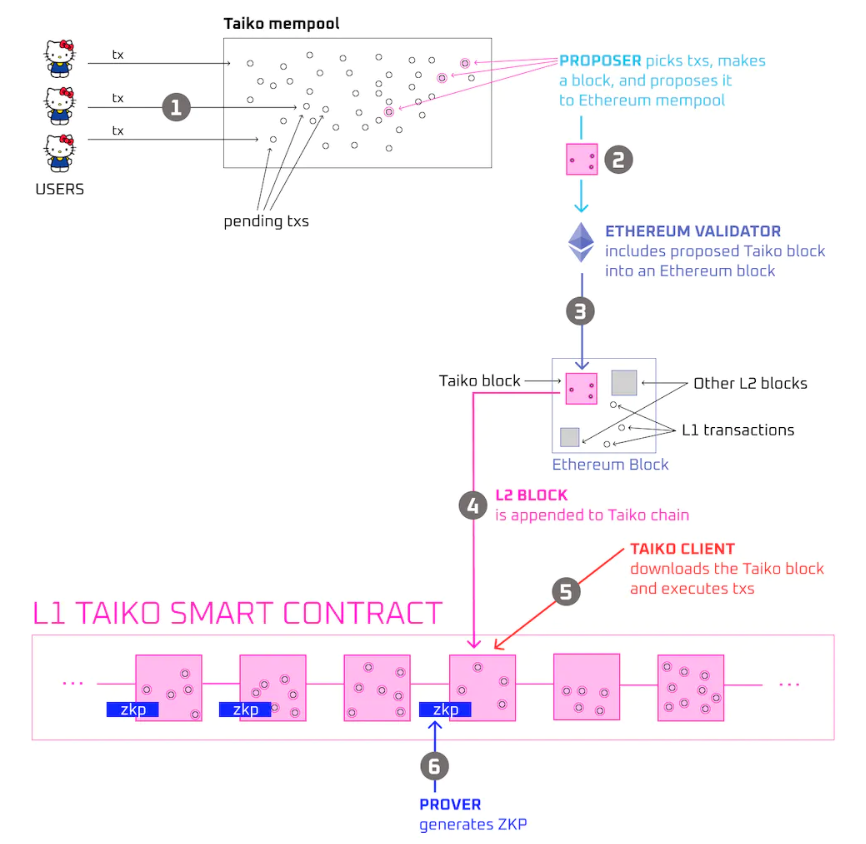
In the block proposal phase, proposers construct rollup blocks from user L2 transactions and submit them to L1. Anyone can act as a proposer and perform this block creation function. The proposer bundles and orders transactions into a block, publishes the block data on Ethereum, and appends it to the proposed block list in the Taiko L1 contract. The protocol ensures block properties are immutable at this point, meaning execution is deterministic—anyone can compute the resulting chain state after execution.
All Taiko nodes are connected to Ethereum nodes and subscribe to Ethereum block events. Once a Taiko block proposal is confirmed, it is appended to the queue on L1 within the Taiko L1 contract, allowing Taiko nodes to download these blocks and execute valid transactions within each.
In the block verification phase, provers take the proposed block. At this stage, the block consists of a transaction list (txList) and metadata. The txList of an L2 block will eventually (when EIP-4844 is active) become part of a blob in the L1 consensus layer. However, the L1 contract cannot directly access the txList. Therefore, the ZKP must prove that the selected txList is part of the given blob data. Once a block is proposed, the Taiko client checks whether the block decodes into a transaction list, validates each enclosed transaction, and generates a trace log for each transaction—used by provers as verification data.
In the block proving phase, ZK-SNARK proofs are generated to verify the validity of L2 transactions. Any participant can perform this proving function. Since all proposed blocks are deterministic and all intermediate states between blocks are known, blocks can be proven in parallel. Once all enclosed valid transactions within a block have been executed, the block’s proof is verified, and its correctly linked parent block has been finalized on-chain, the block is marked as finalized on-chain.
A fundamental requirement of the protocol is that all data necessary to reconstruct the current state—and to create and append new blocks—must be publicly available on Ethereum. Moreover, provers can generate proofs for blocks using only public data from Ethereum. These facts, built upon Ethereum’s public data, create a fair competitive environment for all potential participants, making Taiko’s L2 more decentralized.
Taiko Team
Taiko was co-founded by Daniel Wang, founder of Loopring, and Brecht Devo, Chief Architect. COO Matthew Finestone, CSO Terence Lam, and most other team members previously worked in the zkRollup field.
Currently, Taiko comprises around 20 employees from countries including the United States, the United Kingdom, Germany, Canada, Japan, and Ukraine.
Project Progress and Roadmap
Current Progress
Taiko recently launched its alpha-3 testnet, Grímsvötn, which focuses on the decentralized aspects of a decentralized, Ethereum-equivalent ZK-EVM. Key objectives of the alpha-3 testnet include: 1. Testing new protocol economics designs and implementations, including updated fee/reward models. 2. Using partial Merkle proofs to test Bridges for verifying signals/messages (alpha-1 and alpha-2 used full Merkle proofs). 3. Testing new oracle provers—regular proofs can now appear before oracle proofs. 4. Testing proof cooldown periods (recommended at 30 minutes). 5. Testing new ETH deposits using withdrawalsRoot on Layer 2. 6. Testing the starting layer—Taiko L3 will be deployed in the coming weeks.
From a testing perspective, the testnet has seen significant success—within just one week, the Taiko alpha-3 L2 network processed over 1.19 million transactions, over 160,000 blocks, and nearly 200,000 wallet addresses.

Community Engagement
Currently, Taiko has 85,000 Twitter followers, having posted 699 tweets over the past year, averaging around 5,000 views per tweet. Its Discord community has 85,858 members, with regular online activity maintained at approximately 15%. Overall, the community remains highly active.
Roadmap
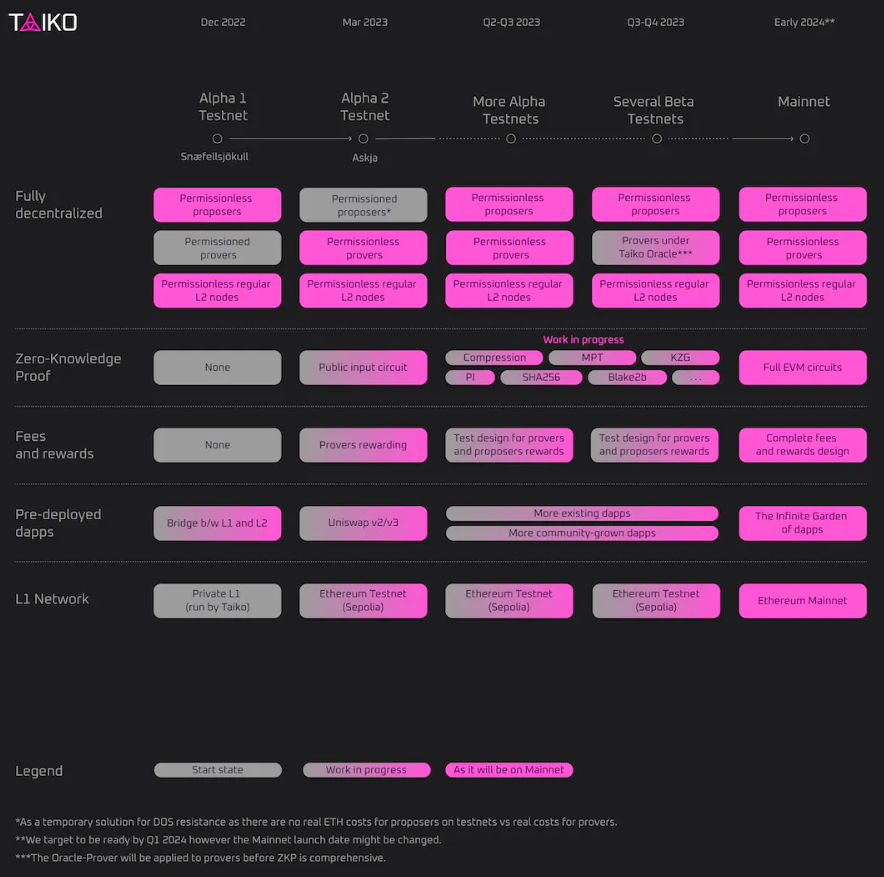
Beta testnet is expected to launch in Q3–Q4, with mainnet launch anticipated in early 2024.
Summary
In the traditional Ethereum trilemma, only two of decentralization, security, and scalability could be achieved simultaneously. The emergence of Ethereum-equivalent ZK-Rollups offers a solution to this dilemma. Building a zkEVM is a long and challenging process, but it is worthwhile—requiring patience and long-term vision. While the long-term success of Type 1 zkEVM remains uncertain, Vitalik appears to suggest that Type 1 zkEVM is the right path forward.
As an Ethereum-equivalent zkEVM, Taiko enhances the Ethereum ecosystem by maintaining decentralization, censorship resistance, and security, while also reducing proof times through protocol design and placing greater emphasis on community and user experience regarding Ethereum compatibility. If Taiko continues progressing steadily, it may become the first fully decentralized Type 1 zkEVM to go live on the Ethereum mainnet.
Join TechFlow official community to stay tuned
Telegram:https://t.me/TechFlowDaily
X (Twitter):https://x.com/TechFlowPost
X (Twitter) EN:https://x.com/BlockFlow_News
 Web3CN






