








Praised by Vitalik's New Article: Exploring Taiko's Technological Innovation and Ecosystem Development in Ethereum L2
TechFlow Selected TechFlow Selected
Praised by Vitalik's New Article: Exploring Taiko's Technological Innovation and Ecosystem Development in Ethereum L2
Ecosystem expansion continues to gain momentum, with the token TGE approaching.
 Navigating Web3 tides with focused insights
Author: TechFlow
With the return of the bull market and the approval of Ethereum ETFs, excitement around the Ethereum ecosystem has surged. Among the projects drawing significant attention recently is Taiko, an L2 initiative that has sparked widespread discussion. Following Vitalik’s earlier move of bundling Taiko’s genesis block with a message praising its technical direction, he further highlighted Taiko in his latest article titled “Layer 2s as cultural extensions of Ethereum,” stating:
Each Ethereum L2 has its unique "soul." Taiko emphasizes "seamless user experience," "community-driven development," "security first," and being "Based (multi-dimensional 'on' Ethereum)."
In numerous major events prior to this, Vitalik had repeatedly shared his views on the evolution of Ethereum L2s—such as asserting that ZK technology represents Ethereum's future and advocating for Multi-proofs as essential for long-term scalability. Taiko, frequently praised by Vitalik, stands out as one of the first projects actively implementing these visions:
As a Type-1 zkVM, Taiko is not only the first team in the industry currently developing Based Rollup architecture but also the pioneer in implementing the concept of Multi-proofs. It aims to enhance system security and robustness while supporting efficient, low-cost processing of complex computations and large-scale transactions.
These outstanding technical capabilities and innovations have positioned Taiko as a leading innovator in the Ethereum L2 space, fueling high community anticipation for its mainnet launch and token airdrop. On May 27, 2024, Taiko officially launched its mainnet. At this pivotal milestone, Vitalik once again showed his support by bundling block height "1," whose metadata includes the names of every core contributor to Taiko, expressing his hopes for the mainnet launch and thanking the team for their critical contributions toward achieving decentralized, community-led network activation.
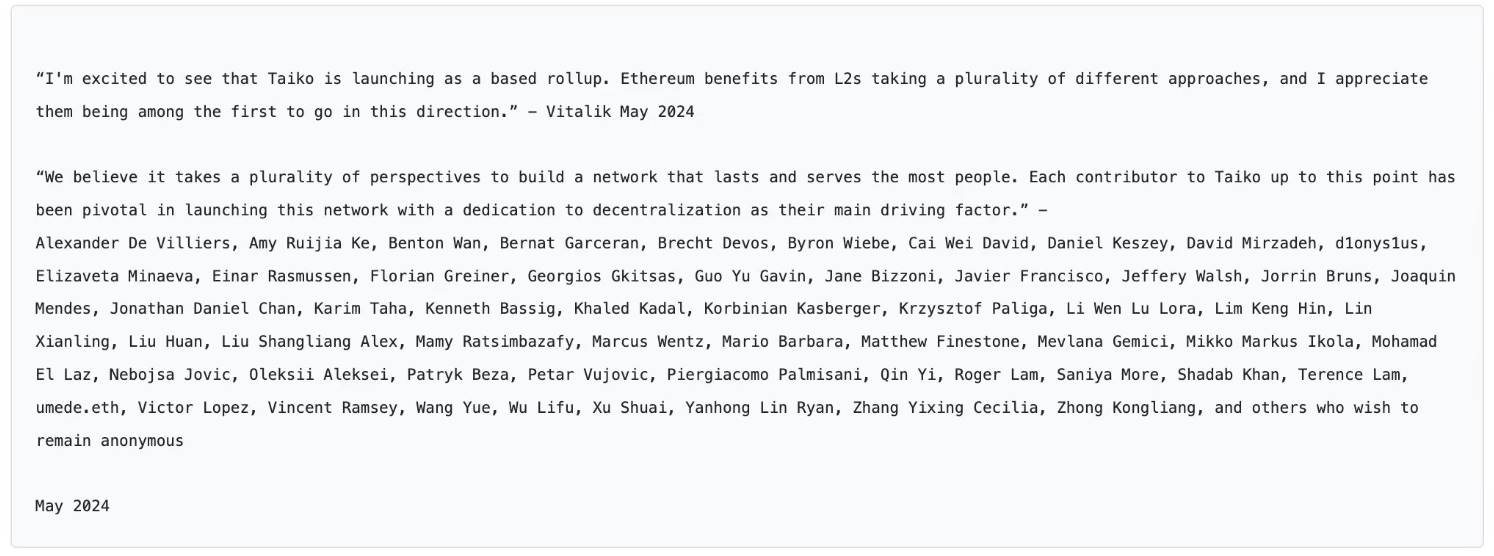
With the mainnet live, another key milestone—the TGE (Token Generation Event) of Taiko—is now entering its final countdown.
This article dives into Taiko, exploring its core technical advantages and ecosystem-building strategies, and unpacking its vision of constructing a truly decentralized, permissionless, fully secure, highly efficient, and accessible L2 architecture that inherits all of Ethereum’s security properties.
Frequent Praise from Vitalik: Taiko’s Technical Innovations Enable True Decentralization
Amid fierce competition in the crowded L2 landscape, Taiko has carved out a distinctive position—not just due to its star-studded founding team, but more importantly because of its exceptional technological innovation.
It's widely known that Taiko’s core team consists largely of the original members behind Loopring, the first ZK-Rollup deployed on Ethereum. In 2020, Loopring became the first Chinese project to be listed on Coinbase. Daniel Wang, co-founder and CEO of Taiko, was previously the founder of Loopring and brings extensive Web2 experience, having served as a tech lead at JD.com and a senior software engineer and tech lead at Google. With such a rare combination of Web2 and Web3 expertise, Taiko attracted immediate attention upon inception, backed by solid technical foundations in both product design and implementation.
Technically, Taiko is composed of three primary modules:
-
Multi-Prover: Leverages multiple zkVMs and SGX-integrated proof systems to directly compile and run the Rust-based Ethereum Virtual Machine, generating zero-knowledge or TEE proofs to verify the correctness and integrity of Ethereum block execution. Through Multi-Prover, Taiko can scale Ethereum without modifying existing smart contracts or dApps, while inheriting Ethereum’s security, decentralization, and compatibility.
-
Layer 2 Rollup Node: Manages and executes transactions on Layer 2 while interacting with Ethereum Layer 1 (L1). Using rollup technology, Taiko increases Ethereum’s transaction throughput, reduces costs, and maintains decentralization and security.
-
Taiko Protocol: Defines and enforces the rules of the Layer 2 rollup, ensuring transaction correctness and network security. Through smart contracts and decentralized validation, the Taiko protocol enables efficient Ethereum scaling while preserving its decentralized and secure nature.
Taiko aims to become a Type-1 zkVM: As a general-purpose computing platform based on ZKP, zkVM verifies computation correctness without revealing execution details. It allows computationally intensive tasks to be processed off-chain, with only verification results submitted to the blockchain—greatly enhancing scalability. Compared to other solutions, Type-1 zkVM is fully Ethereum-equivalent, meaning it runs the EVM natively on Ethereum. However, due to high technical barriers, few projects pursue this path. Taiko is among the pioneers. With Taiko, developers and users can securely experience Ethereum with lower fees, without any modifications to Ethereum itself.
The BCR architecture, built on Multi-proofs (interactive multi-prover proofs), further amplifies Taiko’s advantages in cost, efficiency, and security.
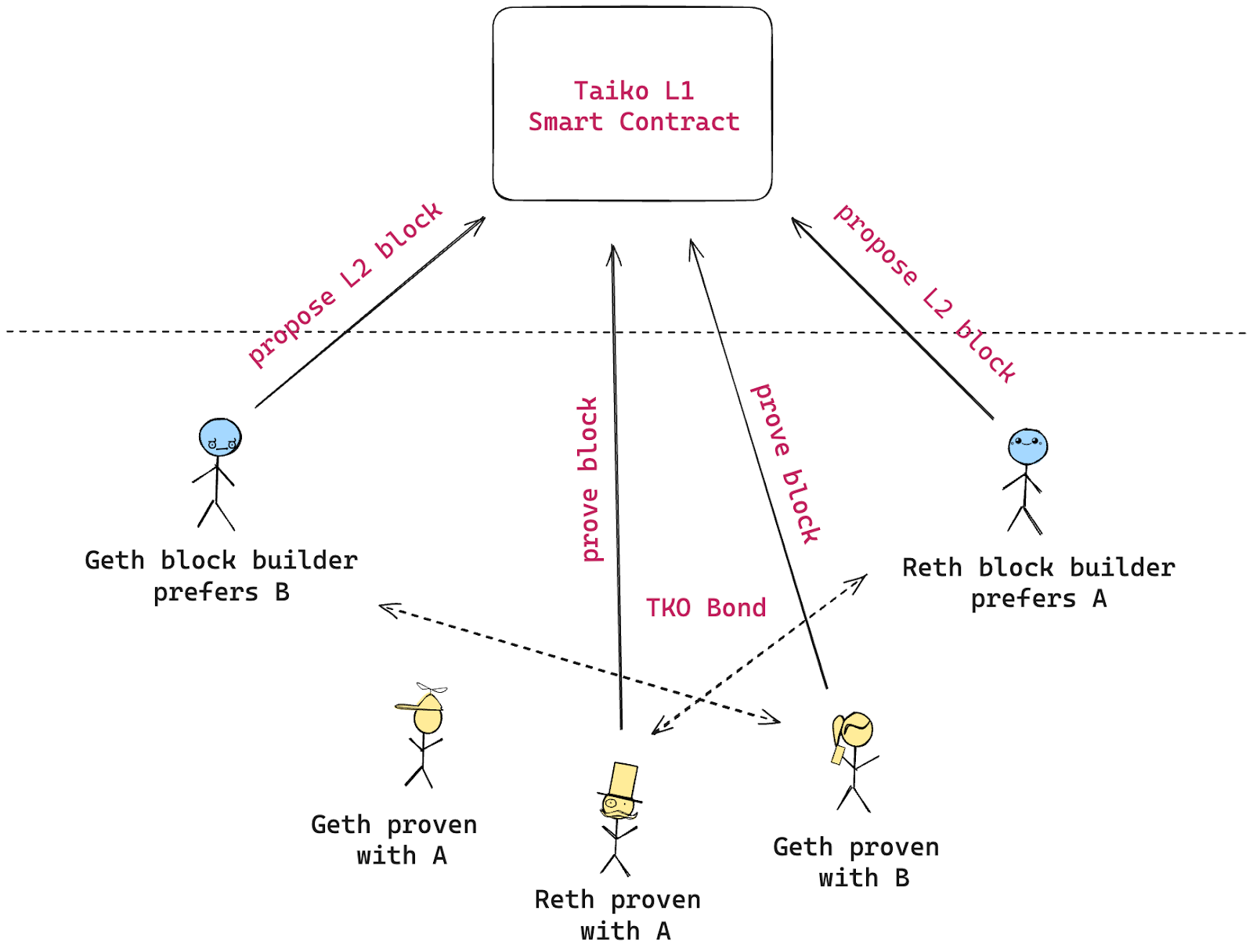
A key innovation in the Taiko protocol, the BCR framework (Based Contestable Rollup) centers on "contestability": anyone can act as a proposer submitting block proposals, and any validator disputing the state transition result can submit a challenge proof to alter the L2 block state, choosing between correct and incorrect forks. Proposers must bundle user transactions and generate zero-knowledge proofs, with multiple proposers competing to submit blocks. Validators verify the proposed blocks and proofs, also competing in the process. This ensures decentralization in block creation and submission, while significantly enhancing network security.
Multi-proofs are the foundational concept behind BCR, originally proposed by Vitalik as a crucial direction for Ethereum’s future upgrades. He argues that single-proof schemes cannot adequately handle bugs hidden within complex zkEVM code, whereas Multi-proofs generate multiple types of proofs for a single block—ensuring system continuity even if one proof type fails, and enabling timely detection of erroneous state transitions.
As the first project to implement Multi-proofs, Taiko interprets ZK multi-proofs as multi-SNARKs + multi-client—using various ZK-SNARKs to prove different Ethereum node implementations. This approach lays the groundwork for future diversity in SNARKed nodes at Ethereum L1. Additionally, Taiko employs the Halo2-KZG proof system, maintaining efficiency and low cost when handling complex computations and large-scale transactions. Currently, Taiko has launched Raiko, a multi-prover environment enabling construction, execution, and benchmarking of ZK-VM targets, supporting SP1, Risc0, and SGX, with ongoing integration efforts for Jolt and Powdr.
Furthermore, during the "Multi-proofs for rollups" Twitter Space event held on December 13, 2023, Vitalik deeply discussed another core innovation of Taiko—BBR (Based Booster Rollup)—and expressed strong admiration.
Before understanding BBR, let’s briefly explore Based Rollup: Also known as L1-sequenced Rollup, this concept was first introduced in March 2023 by Justin Drake, a researcher at the Ethereum Foundation. It refers to a rollup whose sequencing is entirely driven by the base L1. This design outsources sequencing responsibility to L1 validators, making consensus, data availability, and settlement layers all reside on Ethereum, with only the execution layer built atop the rollup network. This eliminates the need for additional security mechanisms or consensus algorithms to ensure transaction validity and order—reducing technical complexity, latency, and operational costs—while allowing Taiko to fully inherit Ethereum’s security and decentralization, making it a more attractive L2 option.
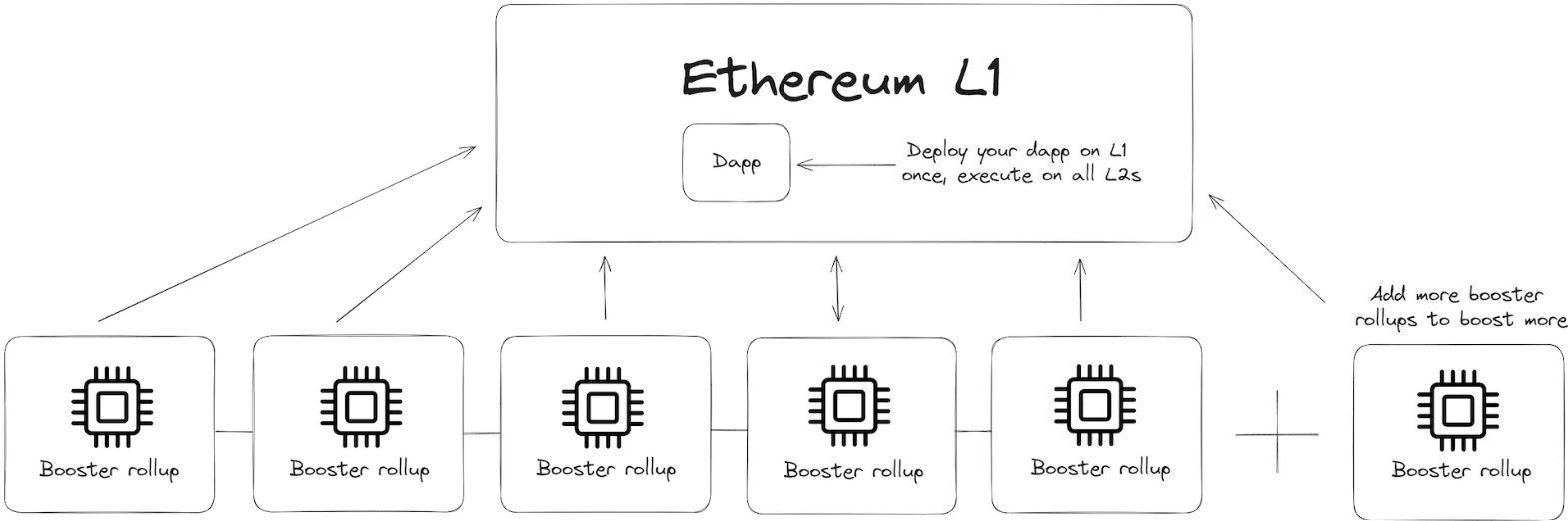
The idea of BBR emerged from Taiko’s deeper exploration of Based Rollup: adding plug-and-play native Ethereum L1 DApp expansion capabilities to further amplify its strengths. BBR not only integrates seamlessly with L1 but is also fully compatible with Ethereum’s existing architecture, capable of enhancing any rollup type. Its two-layer structure separates transaction execution from storage, balancing efficiency with decentralization. This solution closely resembles native Ethereum extension, improving efficiency in execution and storage. DApps need deployment only once and automatically extend across all L2s; additional block space can be added via extra "booster rollups" without requiring further setup.
Compared to other OP or ZK-type L2 projects, Taiko’s suite of technical innovations delivers a uniquely superior experience for ecosystem participants.
Permissionlessness is a defining feature of Taiko: Anyone can propose or prove blocks. Everyone has the opportunity to participate in network building.
By outsourcing sequencing to L1 validators through Based Rollup, Taiko becomes a true embodiment of Ethereum’s decentralized ethos at Layer 2. The open proposer model encourages broad participation, further enhancing decentralization and promoting healthier network operation.
For developers, Taiko extends Ethereum using Ethereum’s own execution model—making it more secure and efficient. A single deployment enables infinite scalability, saving time and labor costs while reducing transaction fees and boosting extensibility.
Since its inception, Taiko has never ceased rethinking L2 design and pushing the boundaries of innovation—from Multi-proofs and Based Rollup to BBR and Type-1 zkVM. Across multiple dimensions, Taiko has been a pioneering explorer in the L2 space, earning investments from top-tier industry institutions:
In March 2024, Taiko announced a $15 million Series A round. Combined with $22 million raised in two previous rounds, Taiko has secured a total of $37 million in funding. Investors include Sequoia China, Generative Ventures, Lightspeed Faction, Hashed, Token Bay Capital, and the Ethereum Foundation.
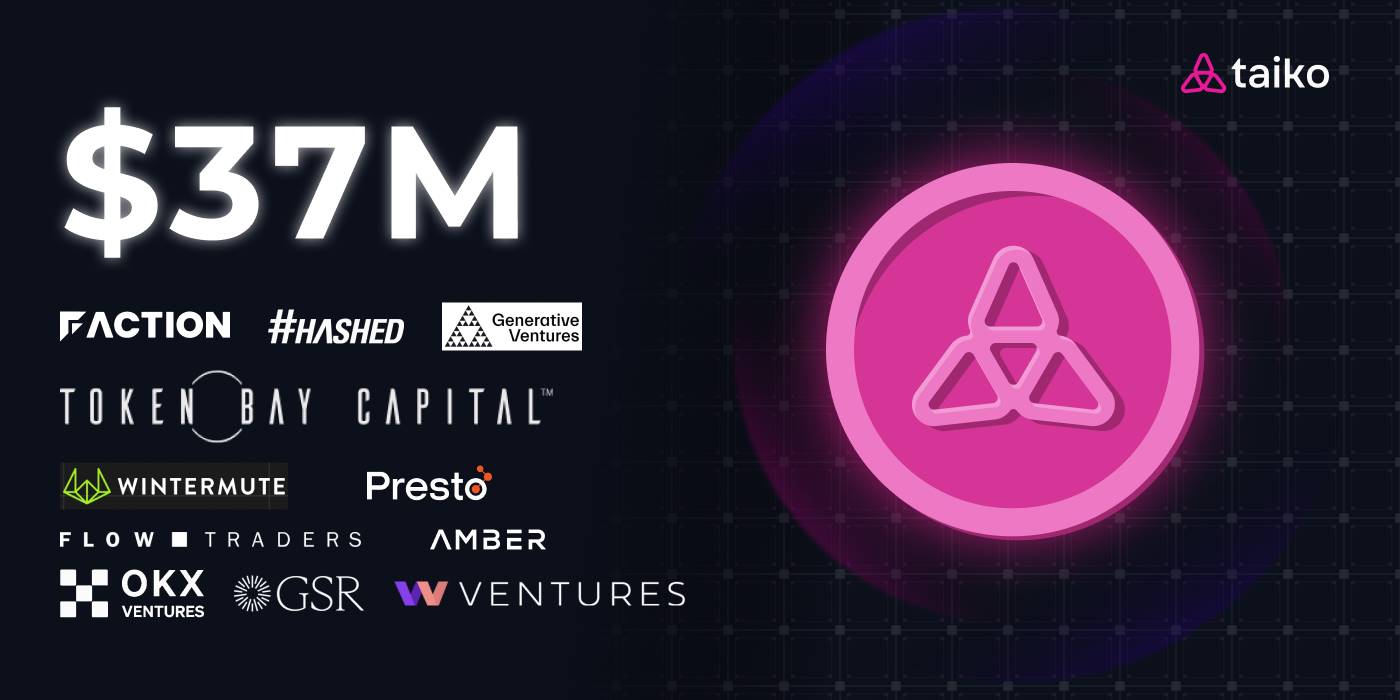
Taiko has consistently focused on deep thinking and continuous innovation in Layer 2 networks. With mainnet launch and accelerated ecosystem growth, Taiko is actively pursuing collaborations with leading industry projects while emphasizing community engagement and cohesion to enrich ecosystem diversity and vitality.
Accelerating Ecosystem Expansion, TGE Approaching
May 2024 has firmly placed Taiko in the spotlight of the crypto community.
First, the mainnet launch drew widespread attention. Since beginning development in 2022, Taiko has operated testnets and accumulated over 1.1 million unique wallets, more than 30,000 decentralized proposers, and over 14,000 decentralized validators during testing phases. After seven testnet iterations over two years, Taiko finally launched its mainnet on May 27.
Additionally, shortly after mainnet launch, Taiko’s token is expected to debut within weeks. Compared to other leading L2s in terms of TVL and market cap, Taiko—with its multiple technical innovations, backing from renowned investors, and high praise from Vitalik—is seen by many as a highly promising contender in the Ethereum L2 race.
On May 23, just before mainnet launch, Taiko’s Genesis Airdrop sparked broad community discussion.
According to Taiko’s published tokenomics, the TAIKO token has a total supply of 1 billion, with 5% allocated to the Genesis Airdrop. Recipients include block proposers, block provers, testnet interactors, Galxe campaign participants, and GitHub contributors to eligible repositories. Notably, airdrop claims will occur on the Taiko L2 mainnet, with no vesting or lock-up periods for the distributed tokens.
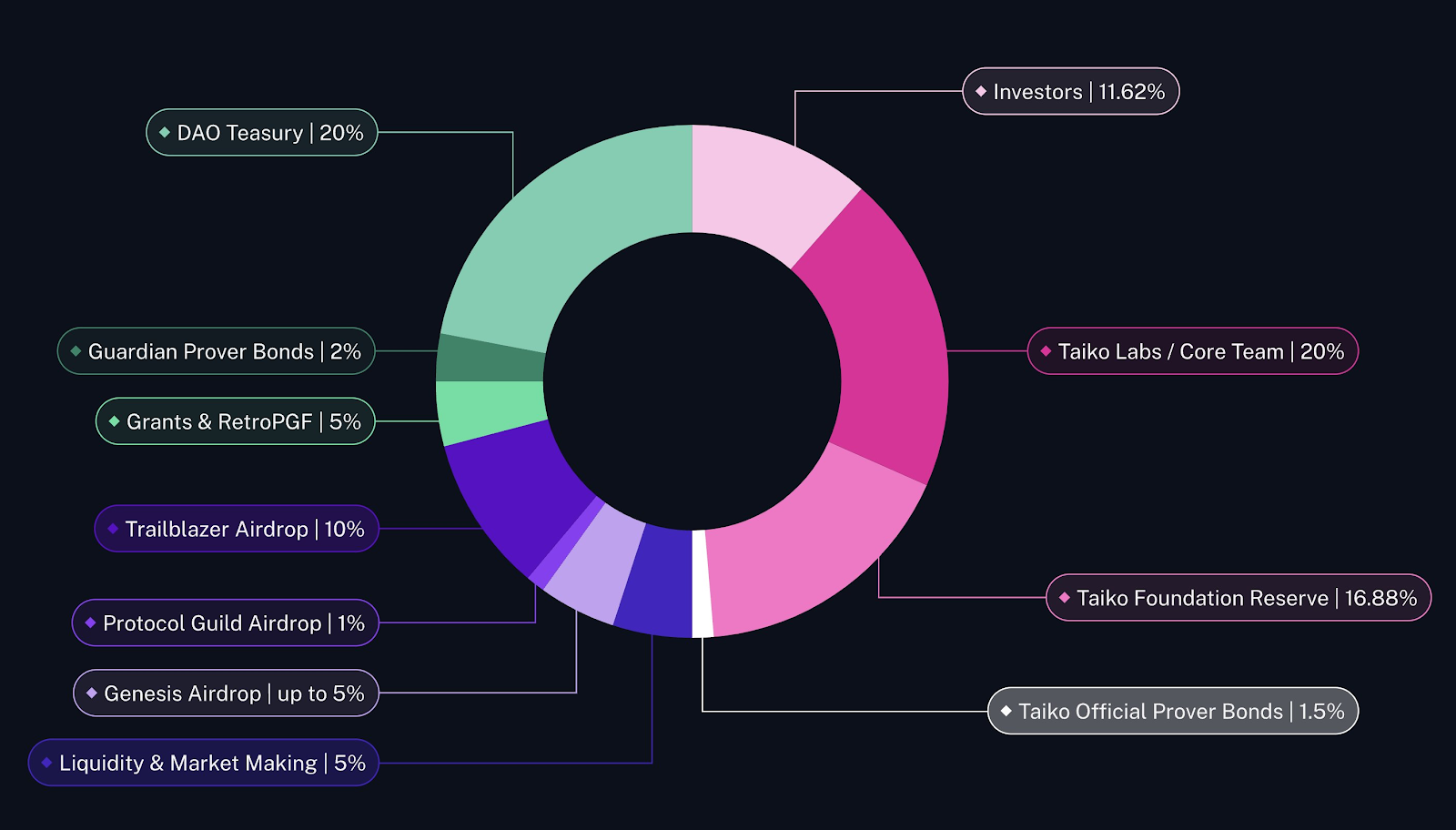
Shortly afterward, Taiko launched its airdrop lookup page, and social media quickly filled with users sharing their claim amounts. According to off-exchange information from AEVO Premarket, TAIKO is currently trading around $5.
However, large airdrops rarely satisfy everyone, and Taiko’s Genesis Airdrop was no exception—eliciting mixed reactions, with some users publicly expressing dissatisfaction.
In response to community sentiment, the Taiko team updated its official FAQ, revealing that over 300,000 addresses claimed more than 50 million airdropped tokens. Subsequently, Loopring—one of the recipients—announced it would redistribute its 2.5 million TAIKO tokens to its own community.
Moreover, this Genesis Airdrop marks only Phase One, representing 5% of total supply, with another 10% reserved for future airdrops. For example, the Trailblazers program offers enhanced Pioneer Points—participants who engage in Trailblazer activities and mint faction badges on mainnet day will receive exclusive rewards.
On the ecosystem front, Taiko had already built a substantial foundation prior to mainnet launch.
According to Taiko’s official website, over 100 projects have joined its ecosystem, spanning wallets, NFT marketplaces, oracles, DeFi, and AI applications.
With the mainnet now live and ecosystem momentum accelerating, Taiko is set to welcome more high-quality partnerships and announcements, including Pyth, Etherscan, PancakeSwap, and LayerZero.
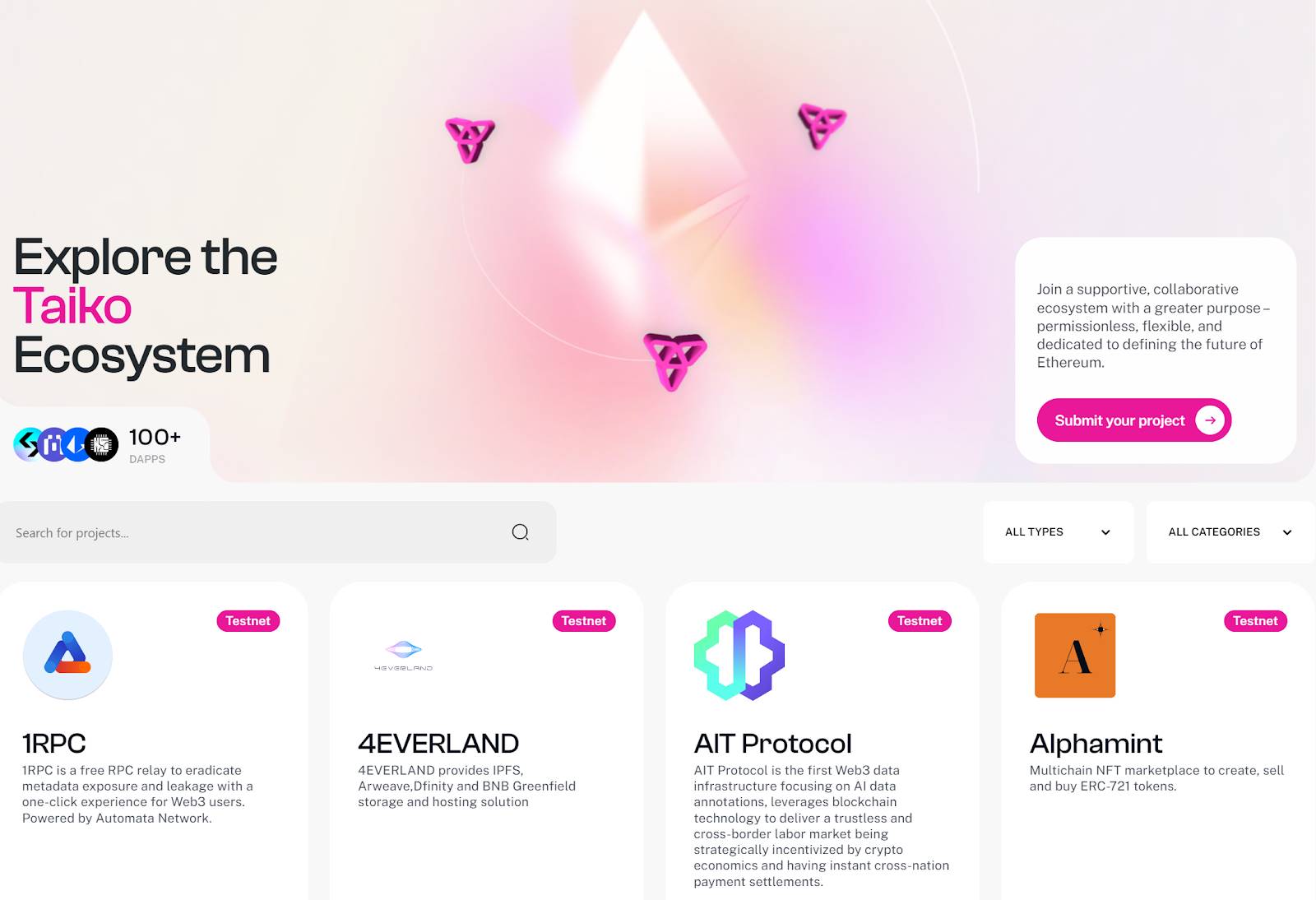
This rich ecosystem stems partly from Taiko’s low development barrier enabled by its technical advantages: as a Type-1 zkVM L2 solution, Ethereum dApps can seamlessly migrate to Taiko, often requiring no deployment adjustments or code changes from developers.
Equally important, Taiko places strong emphasis on ecosystem development and offers comprehensive support programs: developers can access regularly updated documentation, practical tools, and tutorials. Additionally, Taiko has launched an ecosystem grant program aimed at unlocking innovative potential, providing funding, operational, and technical support to developers building on Taiko—further driving ecosystem growth.
Overall, while the mainnet launch marks just the beginning of Taiko’s new chapter—and its post-launch performance across various metrics remains to be seen—its multiple technical breakthroughs, impressive fundraising, and stellar team background provide strong momentum for future growth. These combined strengths are precisely why so many in the community continue to watch Taiko closely.
For crypto projects, technical innovation is fundamental to survival, while ecosystem development is crucial for long-term success. Therefore, listening to the community, implementing effective incentives, and delivering transparent, diverse, and engaging participation experiences remain central throughout a project’s lifecycle. With mainnet launch and key milestones achieved, we look forward to innovators like Taiko continuing to drive the evolution and advancement of Ethereum’s L2 landscape.
Join TechFlow official community to stay tuned
Telegram:https://t.me/TechFlowDaily
X (Twitter):https://x.com/TechFlowPost
X (Twitter) EN:https://x.com/BlockFlow_News
 深潮TechFlow






