Exclusive Interview with VeChain Founder Sunny: From Louis Vuitton to the Crypto World, Web3 Is the Perfect Answer to Sustainability
TechFlow Selected TechFlow Selected
Exclusive Interview with VeChain Founder Sunny: From Louis Vuitton to the Crypto World, Web3 Is the Perfect Answer to Sustainability
Bridging blockchain technology to the real world and steadfastly executing it—Vechain.
 Navigating Web3 tides with focused insights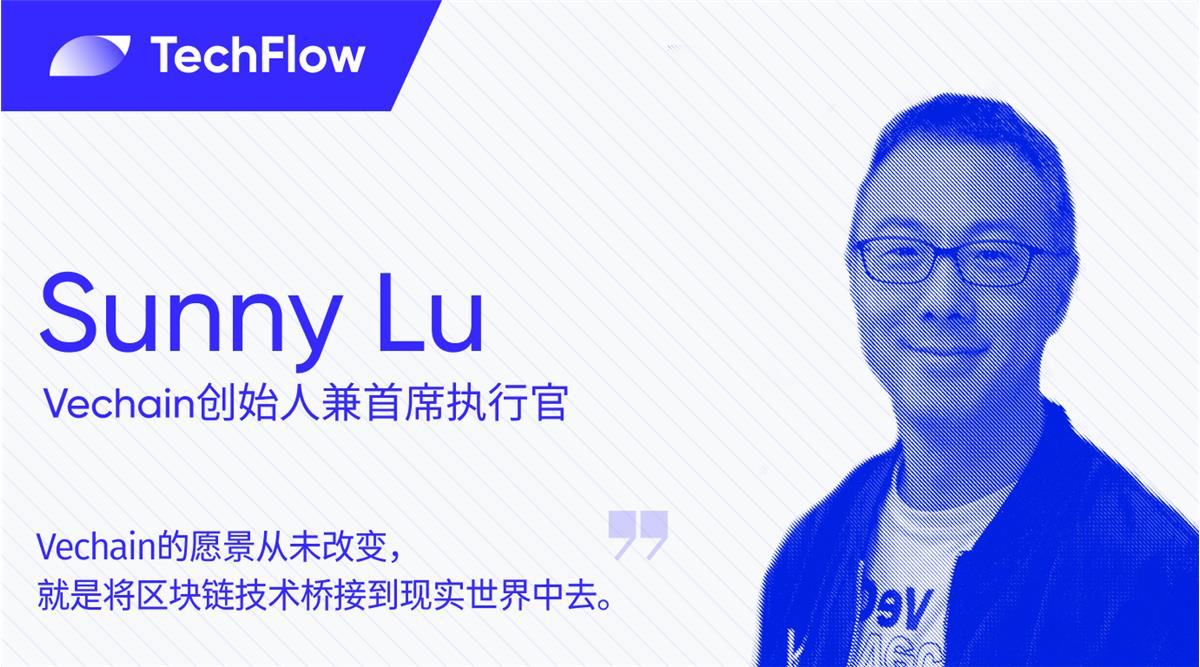
"From the beginning until today, Vechain's vision has never changed: to bridge blockchain technology into the real world." ——Sunny Lu
One common criticism of Web3, blockchain, and crypto is that they seem confined to the virtual world—a purely financial game driven by price charts, creating stories of sudden wealth or total loss. The narrative shifts with trends, but what lasting impact does it leave on our imperfect reality? What exactly has it changed?
Perhaps there’s an exception—an early blockchain project that has stayed true to its mission since 2016: Vechain, committed to bridging blockchain technology with the real world, and executing that vision relentlessly.
Vechain has been active in the blockchain space since 2016. Its Proof-of-Authority (PoA) consensus mechanism makes the VechainThor public blockchain particularly suitable for enterprise use. Unlike Web3 projects focused on virtual worlds, Vechain has consistently concentrated on applying blockchain commercially in real-life scenarios. To date, Vechain has been implemented across various industries—including luxury fashion retail, textiles, food and beverage, energy, automotive, and professional services—and has partnered with organizations such as Givenchy, Walmart, BYD, and the government of San Marino.
In early 2023, Vechain collaborated with Boston Consulting Group (BCG) to release its third whitepaper, "Web3 for Good," detailing four key strategies for leveraging blockchain in sustainability.
With curiosity and questions in mind, TechFlow reporter Sunny interviewed Sunny Lu, founder and CEO of Vechain (VeChain), in Austin, Texas.
Sunny humorously shared his journey—from leaving his role as CIO at Louis Vuitton in 2014 to founding Vechain, his conversation with Vitalik Buterin in 2015, and his pivotal Paris trip in 2016 that led to Vechain’s first partnership with Givenchy.
TechFlow: Welcome, Sunny. Could you introduce yourself and share how you decided to create VeChain after leaving Louis Vuitton (LV)?
Sunny: Actually, I started getting involved in the cryptocurrency and blockchain space back in 2013, so this year marks my 10th anniversary.
At the time, there weren’t many blockchains—just Bitcoin, Litecoin, Dogecoin, and a few others. Most returns came from Bitcoin investments, whether through mining or trading, and the returns were quite substantial.
I also began studying the technology itself. The more I learned, the more convinced I became—it was cutting-edge and represented the future.
By then, I had already worked in information engineering for about 20 years, and I kept asking myself: How can we use blockchain technology to solve real-world problems?
But even now, 90% of blockchain applications are financial in nature, which personally doesn't interest me much.
I’ve always wanted to explore how this technology could address real-world challenges. We experimented with different approaches. But Bitcoin’s design was very simple and minimal—only a few hundred lines of code—which imposed certain limitations.
Back in 2013 and 2014, we actually tried different technologies like colored coins—you might not have heard of them:
The idea was to assign different “colors” to specific bitcoins based on their intended purpose.
Additionally, you could write scripts—similar to smart contracts, but offline ones—to automate Bitcoin transactions, enabling more complex applications than simple ledger entries or single transactions.
Then in 2015, I had a fascinating trip with Fengbo Shen and Vitalik, spending several days in Shanghai and Chengdu.
During that trip, we had many discussions. At the time, Vitalik shared the Ethereum whitepaper and the concept of smart contracts. Although the idea of smart contracts existed before, he was the one who made it practical and implementable.
That really opened my mind. A smart contract platform was clearly the perfect solution for tackling complex problems or building more sophisticated logic on the blockchain. Suddenly, we could do so much more!
Simply put, if Bitcoin is like Excel, then smart contracts are like equations on the blockchain. So I started thinking: If Bitcoin can make data tamper-proof, can smart contracts make actions tamper-proof?
This was truly the technological direction that would allow me to realize all the ideas I’d been pondering and solve real-world problems!
Actually, Vitalik was one of the three founding partners of Fenbushi Capital and also Vechain’s first angel investor.
Building upon the EVM smart contract framework, we made significant improvements—making it faster, more scalable, while maintaining the same level of security.
I can say Vechain is better suited for enterprise adoption because we’ve stuck to our original vision from day one—bridging technology with the real world—and that hasn’t changed.
Even years later in 2018, when we launched the Vechain blockchain, we paid tribute to Ethereum by coding Ethereum references into Vechain’s genesis block.
Another factor was my prior experience and network before launching Vechain.
I previously worked at Louis Vuitton and other multinational companies. In 2012, at LV, I participated in a global project called “Track and Trace,” building a system to trace each product from raw materials to manufacturer, warehouse, store, and finally to the customer.
It’s easy to build a centralized system for this, but later we turned to blockchain. I realized traceability was a perfect use case—because while LVMH is unique and powerful enough to build its own centralized system, it still relies on external suppliers and partners. Most other luxury brands use third-party manufacturers and supply chain providers. This was the perfect example of how we could bring multiple stakeholders onto a blockchain. That’s how we got started.
TechFlow: What are VeChain’s current main goals and achievements?
Sunny: To fully harness the power of blockchain technology and bring it to the real world, supporting large-scale, real business applications. That’s our vision—even though we’ve slightly upgraded it recently: advancing sustainability. But fundamentally, it’s the same.
I remember it was really interesting. Back in 2015 and 2016, even before we launched our public blockchain, we built a blockchain solution for Givenchy—that was our first user. I don’t like calling them clients; I prefer users, because they used the system, innovated their processes, and co-built blockchain applications with us.
Starting in 2016, I began traveling to Paris to meet my former LV colleagues. I was lucky—Givenchy’s global CEO was both my mentor and my boss in Asia. I arranged a meeting, trying to explain blockchain, how revolutionary it was, and where the future was headed.
About 20 minutes in...
He interrupted me and said: “Sunny, I don’t understand anything you’re saying. Just tell me what to do.” Fortunately, he trusted me. We agreed: “Let me run a pilot. If it works, we’ll scale it up.”
I still remember the product name was Infinity—I believe that was a good omen. It was a great name.
I also recall the SKU number was 150090. From product development to launch took only three to four months.
During that time, I lived with some of my engineers in a basement Airbnb in Paris, working closely together. We went from headquarters to manufacturers to warehouses every day, observing firsthand how Givenchy’s supply chain operated. I already knew the process from my time at LV, but I wanted to deeply understand the existing workflow, how blockchain could improve it, and what changes were needed.
Four months later, we launched Vechain’s first supply chain management solution for Givenchy, and they were extremely satisfied. Today, 100% of Givenchy’s leather goods globally are covered by this system.
TechFlow: How did you assemble your first engineering team?
Sunny: Well, it’s all about how people connect. In the early days of learning about Bitcoin and blockchain, I leveraged my opportunities at LV to travel the world.
Every business trip—whether domestic or international—was an opportunity. As head of IT systems and digital solutions, I attended store openings in cities like Chengdu, Xiamen, Beijing, and Shanghai.
On these trips, I started seeking out Bitcoin and blockchain meetups and attending them. There weren’t many attendees back then. We always joked: It’s the same group of people moving from one event to another.
I spent a lot of time on the Bitcoin Talk forum—the only blockchain forum I knew at the time—exchanging ideas and learning from others.
Back then, talking about commercial blockchain applications seemed odd. Enterprise adoption wasn’t real yet, so my ideas attracted attention.
My initial engineering team included members from Morocco, Colombia, and Shanghai. We started remotely, then flew to Paris to work together. Even though they’ve long moved on, those were wonderful days!
It was a fascinating experience—different time zones, languages. At LV, I managed a team in Singapore while leading a global project from Paris, so this wasn’t new to me. But this was a different style—more geeky, more technical. Very fun.
TechFlow: Can you explain VeChain’s shift from a consortium chain to a public chain in 2017?
Sunny: When we launched our first product on a consortium chain for our first enterprise client, we began realizing that consortium chains aren’t truly blockchain.
The level of trust isn’t comparable to that of a public blockchain.
Several business conversations with clients sparked this realization—we had considered it for a while, but one particular discussion stood out.
We were working with Renault, a French automaker, developing apps with partners in Paris. Later, other car companies approached me wanting to do the same—only better.
But since it was a consortium chain, previous users saw them as competitors!
I said no—that goes against the spirit of decentralization, innovation, and unlimited collaboration. I even tried convincing them: We should collaborate instead.
These conversations led us to consider using a public blockchain. On a public blockchain, you don’t need anyone’s permission to build any kind of application. It should be open-source, free, and permissionless.
So in early 2017, we decided to transition to a public blockchain.
TechFlow: Since becoming a public chain in 2017, VeChain has undergone major strategic shifts and progress, including partnerships with Givenchy, Walmart, BYD, and the government of San Marino. Through blockchain upgrades in 2018 and 2021, VeChain has established itself in the sustainability space. After building relationships with major institutional partners, how has VeChain leveraged blockchain to enter the sustainability field?
Sunny: Coming from the luxury industry, I worked on a track-and-trace project.
So I believed supply chains were a solid starting point. I had convenient resources, connections, and personal relationships that helped move things forward.
We explored every possible approach. For us, this wasn’t contradictory—it was the same methodology: digitizing business problems so they could be implemented on blockchain.
Then we looked at the benefits and value of blockchain and tried to make them visible and accessible to users.
We collaborated with various commercial partners. Our extensive work with PwC and DNV, who are also digital certification partners and investors, was crucial.
We provided a digital passport for San Marino and partnered with H&M, The Ocean Cleanup, BYD, and others on sustainability initiatives—with BYD providing behind-the-scenes carbon emission calculation formulas.
Phase One (2017–2021):
We explored various possibilities for blockchain applications.
These four years were our “from zero to one” phase:
We launched the VechainThor blockchain,
Developed blockchain applications with commercial partners, and achieved results.
Some of those results still benefit us today. We also tested how VechainThor could integrate with different enterprises and adoption models.
Phase Two (starting 2022):
We entered the next stage. We realized that mass adoption among billions of users is extremely difficult—but it’s not the only challenge.
We also need to engage individual users. That’s the beauty of blockchain.
That’s also the beauty of Web3.
When we talk about business partnerships, we usually discuss business models: What’s the ROI? You sign a contract, and cooperation begins...
The beauty of blockchain is: Every individual can be treated equally as a business entity.
You can’t sign millions of contracts with individuals—you don’t even know where they are, they’re highly dispersed. So like Web3 or blockchain, we need gamification to acquire and retain users.
We believe the future of Web3 should be an equal blend of enterprise models and gamified individual engagement.
Everyone creates value, contributing to collective ecosystem value. That’s our understanding of Web3.
Starting in 2018, we began brainstorming: What’s next? We needed to look 10 to 20 years ahead.
Two conversations were particularly impactful.
The first was during Vechain’s rebranding in 2018.
Over breakfast with a partner from DNV, we had an unusual discussion: If money, assets, and time weren’t concerns, what would you truly want to do?
We both arrived at the same answer: For future generations, for our children. For us, that meant sustainability.
If we want a world that’s more sustainable for the next generation, our children should live more comfortably here.
At the time, it was a grand vision. We didn’t know how to achieve it. But from that breakfast onward, we held onto the idea and kept refining it.
In 2018, we began prioritizing partnerships with sustainability-focused businesses. We piloted BYD’s carbon emission calculations and EV battery management, tested H&M’s recycled fabric clothing, and joined The Ocean Cleanup project.
By 2021, we concluded it was the right moment to announce a new strategy.
But we spent nearly two years publishing a new whitepaper to refine and systematize our thinking. Web3 and blockchain technology are the perfect answers for sustainability.
We traveled a long road on this idea, and this year we accelerated quickly. We released a new whitepaper co-authored with BCG.
We named it: “Web3 for Better”—that’s the short version of my story.
TechFlow: How do you think Web3 can motivate individual users to take environmental action and care about sustainability?
Sunny: A critical question—perhaps we can find answers in history.
Web1: 30–40 years ago, when the internet began, the focus was connectivity. Just being online was enough. Users were largely passive.
I still remember loading a webpage took two hours in university. Then you could only read the content.
No fresh updates. So Web1 was about connectivity—foundational infrastructure, step one. Users were passive. It was a read-only web.
Dominant companies then were ISPs—Orange Business Services, China Telecom, AT&T—and hardware makers like Cisco and IBM.
Web2: Focused on mobility.
After years of internet growth, needs evolved. People didn’t just want connectivity—they wanted access anytime, anywhere.
I remember 10–15 years ago, every ad emphasized “mobile-first.” Without mobility, you had no future.
Mobility made users more interactive. When you engaged with platforms, you interacted with others.
You could generate your own content (UGC). Right?
Because of user interactivity, dominant Web2 companies were giants like Apple, Amazon, Facebook, Twitter, and WeChat.
Web3: Users own their internet data.
Think about the evolution: from passive to interactive. What’s next? Ownership. I own my creations. Platforms no longer control traffic or user data.
Actually, I create the data. I should own it. I should be responsible, in control, deciding how my data is used.
Blockchain makes this possible.
Whether through smart contracts, tokens, incentives, or tokenomics, Web3 centers on users. Whether big corporations, enterprises, or individuals—Web3 must be user-first.
Users aren’t just interactive—they’re creative. Because I’m the owner, I’m incentivized by my creations. So users evolve from passive to indirect to creative.
Yes, that’s Web3—and blockchain fits perfectly here.
From an enterprise perspective: This is my business, so I go to blockchain.
From an individual perspective: Whatever I do, I put my data on blockchain—and figure out how to make it valuable.
The biggest challenge: How to verify everyone’s contributions and derive value from them.
How do individuals connect upward? Ideologically, the key to user engagement lies within users themselves.
So whatever we do, we must prioritize users. We must consider how to motivate users to contribute effort and participate.
If you believe in the same thing, that becomes the core of our entire sustainability strategy. That’s what sustainability requires. We see different challenges:
There are many terms in sustainability—sustainability, ESG, impact, carbon emissions, footprint—each with different standards and protocols.
Sustainability is typically driven by large corporations, governments, or big nonprofits.
How do we motivate individuals? That’s where Web3 comes in.
The real goal of sustainability is to get everyone to contribute, to live more sustainably. Ultimately, the entire environment—natural, social, economic—becomes more sustainable and enduring.
Sustainability shouldn’t just be a corporate initiative. It should be the baseline of how you and I live. That’s where Web3, combining smart contracts with other technologies like IoT, provides the answer.
TechFlow: For people to participate in Vechain’s sustainability initiatives, do you have concrete plans and execution methods?
Sunny: We’ve identified several pillars for our sustainability strategy:
Whitepapers:
Vechain is one of the few projects in crypto to publish three whitepapers.
The first was in 2017, the second in 2019—delayed slightly due to COVID-19.
Now, we’ve released the third edition.
The whitepaper includes a brief journey from 2017 to 2023—our roadmap, different steps, and layers of thinking.
Essentially, from the first two whitepapers, we delivered on promises and ideas. Now, we’re offering a broader framework to fulfill those commitments and partial goals.
It covers both strategy and execution.
Diverse Communication:
We’re calling builders to join us.
We need diverse content—formats, designs, videos, online/offline workshops—to continuously communicate. That’s why I travel so much. My team and I seize every opportunity to visit different regions and spread the word—not just me, but the whole team.
Even before the whitepaper launch last November, we started organizing business workshops with various participants—individual developers, operations, media. They help build and convey content, spreading awareness of our vision, mission, and inspiration, motivating more people to join us.
This can’t be solved by one entity alone. It’s my job—and everyone’s job.
Tools:
Ultimately, we need to enable applications. So we call on builders—they need tools, right? Builders come with different skills and resources, but how can they easily adopt accessible Web3 tech? We need more tools. That’s why we’ll launch a new mobile wallet extension this summer. VORJ, a recent aggregator launch, allowed me to create a token in five minutes without coding—named “Free Coffee with Sunny.”
When I ran developer workshops, we used this tool. It’s fantastic—no coding needed, anyone can create their own smart contract now.
In VORJ, we offer not just smart contract creation, but also an API hub and various tools to make builder onboarding faster and easier, accelerating ecosystem growth.
TechFlow: In the fast-changing crypto world, where does the motivation to stay focused on one direction come from? How do you think through directional choices?
Sunny:
My motivation comes from multiple sources. When making decisions, I always consider long-term value. Continuously expand my strengths, learn, and evolve. Balance collaboration with competitiveness. Completing unknown pieces of the puzzle during the journey toward our vision is deeply fulfilling.
TechFlow: Why did VeChain decide to establish an engineering team in Dublin?
Sunny:
The more research you do, the more you see patterns in regional expertise and talent distribution. Europe is more advanced in sustainability concepts and holds greater potential for future applications.
We remain globally operational. This decision aligns closely with where top talent resides. Dublin is a tech hub—not just for crypto, but for Web2 too. Our office is literally across from Amazon’s Dublin building. Our CTO is based there.
Our largest community is in the U.S., followed by Europe, then Southeast Asia.
For team structure: HQ in San Marino, tech center in Singapore (our origin point), business hub in Milan.
It’s a highly decentralized setup. Operations aren’t just about location—they’re about how you grow after delivery.
Join TechFlow official community to stay tuned
Telegram:https://t.me/TechFlowDaily
X (Twitter):https://x.com/TechFlowPost
X (Twitter) EN:https://x.com/BlockFlow_News
 深潮TechFlow