Deep Dive into BRC20: From Inception to Future Trajectory, Exploring Its Impact on the Bitcoin Ecosystem
TechFlow Selected TechFlow Selected
Deep Dive into BRC20: From Inception to Future Trajectory, Exploring Its Impact on the Bitcoin Ecosystem
The narrative of the BTC ecosystem requires time and cycles; BRC-20 can only be considered a spark.
 Navigating Web3 tides with focused insights
Author: zf857.eth, R3PO
Has the era of pricing in satoshis arrived, or is this just self-entertainment during a bear market? R3PO remains cautious about this trend but urges everyone to closely monitor this space. Is this boom a genuine wealth opportunity, or will it further exacerbate the overall market weakness? It all began with an experiment—just like every other transformative technology: Bitcoin, Ethereum, NFTs… the list goes on.
1. The Birth of BRC-20
At the end of December 2022, Casey Rodarmor introduced the concepts of Bitcoin Ordinals and Inscriptions to the public.
First, a brief introduction to related concepts. A Bitcoin block is like a page in a shared ledger that records all BTC transactions. In 2021, the size limit for Bitcoin blocks was set at 1 megabyte, a restriction designed to prevent spam attacks on the network. Two Bitcoin upgrades—SegWit in 2017 and Taproot in 2021—increased the block size to 4 megabytes.
Suppose you want to create your own cryptocurrency on Bitcoin—you would need two things: satoshis and labels. Satoshis are the smallest units of Bitcoin, similar to how cents are the smallest unit of the US dollar. Labels are additional data that can be attached to satoshis. Ordinals allow data to be inscribed into individual satoshis on the Bitcoin blockchain. Using a logical ordering system called Ordinal Theory, each individual satoshi is assigned a unique number. Arbitrary data can then be inscribed into each individual satoshi. This data can include images, videos, audio, text, or even entire applications.
Ordinals enable the creation of NFTs that are fully native to Bitcoin, requiring no second-layer solutions, no changes to the Bitcoin protocol, and maintaining backward compatibility with the network.
On March 9, 2023, an anonymous developer named domo launched the $ordi token and the experimental BRC-20 protocol standard. BRC stands for "Bitcoin Request for Comment," analogous to Ethereum's ERC standards. Notably, the BRC-20 standard does not use smart contracts like popular token standards on EVM blockchains. Instead, BRC-20 tokens embed JSON data within ordinal inscriptions, enabling users to deploy, mint, and transfer tokens.
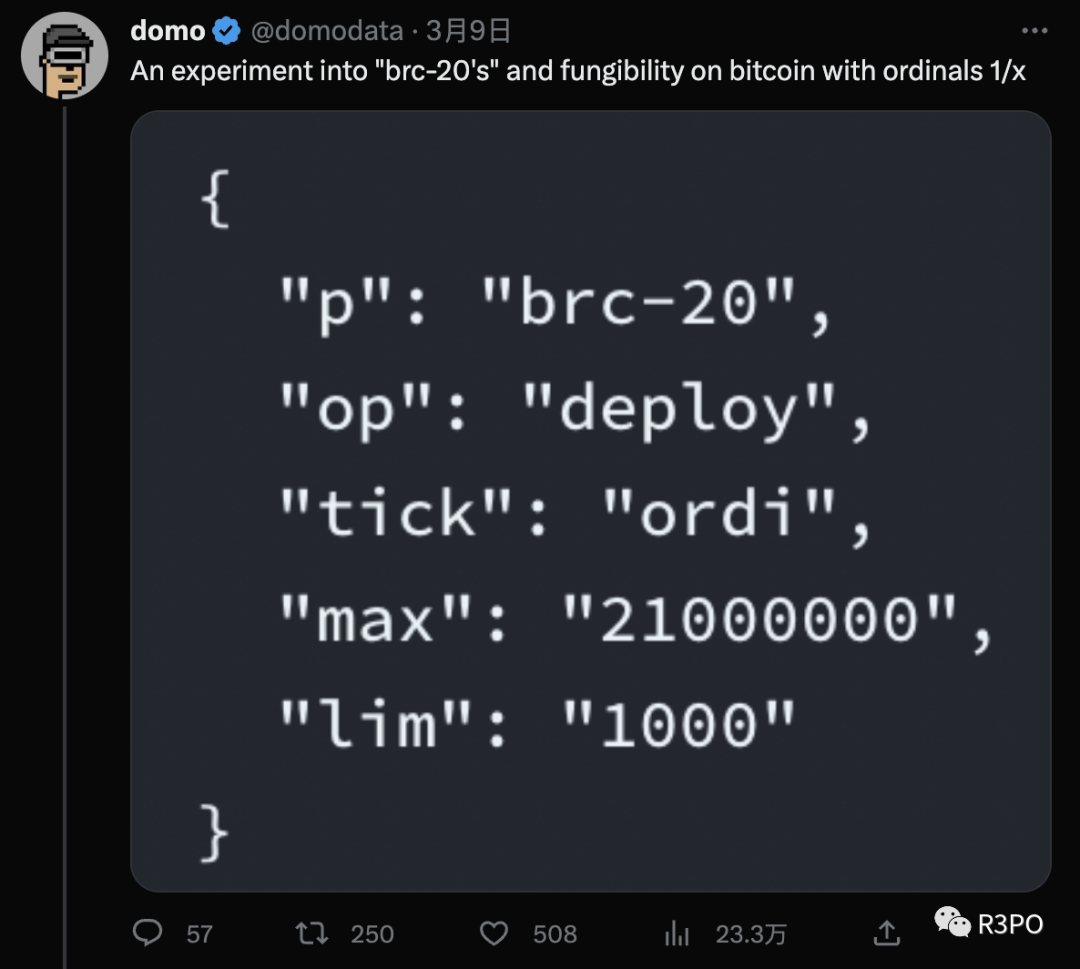
The first BRC-20 token, $ordi, contained the following JSON data, defining the token name, limiting each mint to 1,000 tokens, and capping the total supply at 21 million tokens:
For most people, Bitcoin has long been viewed solely as digital gold. But should Bitcoin also support more complex functionalities? The introduction of ordinals and inscription-based NFTs has sparked renewed interest in Bitcoin, with the community beginning to explore Bitcoin’s potential as a way to store immutable data.
2. How the BRC-20 Boom Has Impacted the Bitcoin Ecosystem
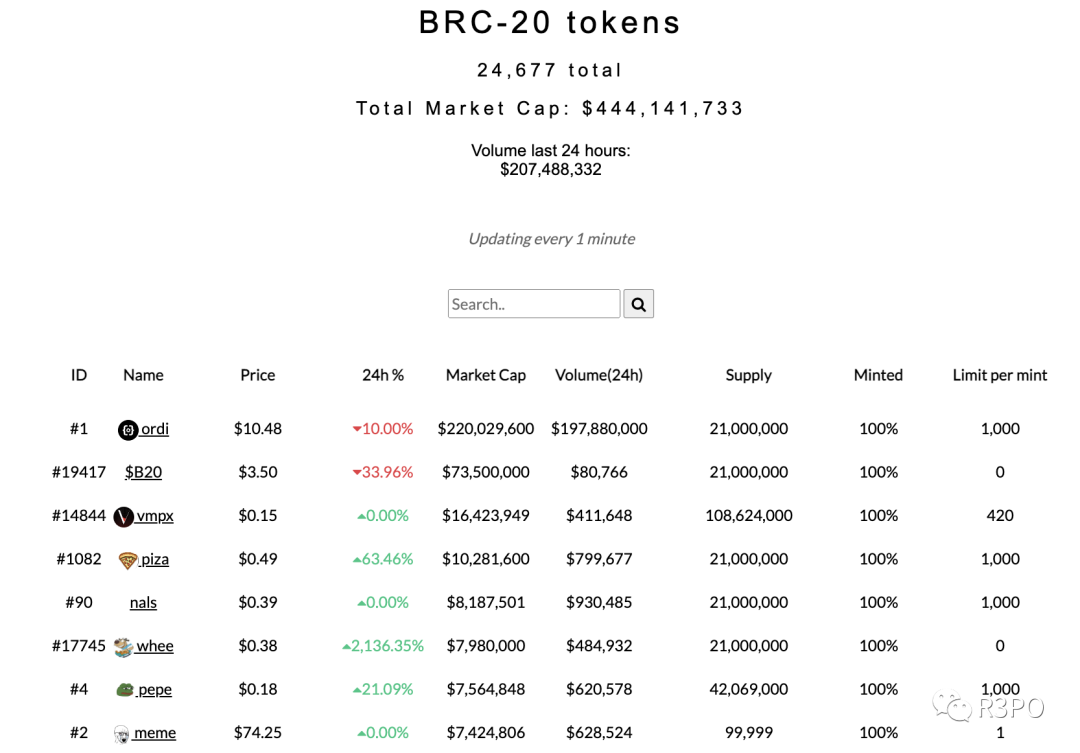
According to brc-20.io, as of May 22, 2023, over 24,000 BRC-20 tokens have been deployed, with a total market cap of $400 million. $ordi leads the pack with a market cap of $200 million, accounting for half of the total. As Bitcoin’s first native token, $ordi has symbolic significance—akin to CryptoPunks in the NFT world—with a total supply of 21 million. Creator domo has stated that $ordi is purely experimental and lacks practical utility, but this hasn’t stopped speculation and FOMO from driving its popularity.
1. BRC-20 Brings More Revenue to Bitcoin Miners
Bitcoin incentivizes miners to secure the network through two mechanisms: block rewards and transaction fees. Block rewards halve approximately every four years and will eventually approach zero in the long term. Therefore, transaction fees will ultimately become the sole source of miner revenue—a topic of ongoing concern within the Bitcoin community, as fees have historically made up only a small portion of miner income. Now, however, transaction fees account for a near-historic percentage of miner revenue. According to Dune Analytics, as of May 22, fees generated by the BRC-20 protocol have reached 1,201 BTC, with 87.6% coming from BRC-20 activity.

2. BRC-20 Causes Severe Congestion on the Bitcoin Network
Over the past month, the wealth effect driven by the $ordi token has attracted a large influx of users to trade BRC-20 tokens on the Bitcoin network, resulting in severe congestion and skyrocketing gas fees. On May 7, Binance suspended Bitcoin withdrawals twice in one day due to massive withdrawal volumes and surging fees. On May 8, the Bitcoin network halted block production for one hour due to congestion, with transaction fees peaking at $30 per transaction—the highest since May 2021.
The growing interest in Ordinals and BRC-20 has led to high transaction fees and sluggish performance on the Bitcoin network. Think of the Bitcoin network as a two-lane highway, where each vehicle represents a transaction from point A to point B. Miners act as tollbooth operators, verifying transactions and allowing them to pass through. Transaction fees are akin to the price drivers pay at toll booths. Ordinals NFTs and BRC-20 tokens are like trucks carrying digital goods—they occupy more space on the highway and at toll plazas. A surge in these “trucks” (NFTs and tokens) causes congestion and saturation on the Bitcoin network, leading to longer transaction processing times. Some users pay higher fees for priority processing, which drives up transaction costs for everyone.
The creation and exchange of NFTs and BRC-20 tokens increase demand for Bitcoin’s transaction processing capacity, directly impacting fees. The deployment of Ordinals has not only significantly increased activity on the Bitcoin blockchain but has also caused a sharp rise in activity on networks like Litecoin.
3. The Narrative Around Bitcoin Layer 2 Returns to the Spotlight
BRC-20 has indeed contributed to expanding Bitcoin’s ecosystem, and many in the crypto world are refocusing attention on Bitcoin itself. However, from a practical standpoint, BRC-20 currently holds no intrinsic value—it’s like writing a number on a piece of paper and declaring it a check. Without smart contracts, BRC-20 relies on inscriptions as a ledger, but an immutable ledger struggles to support an efficient and stable system. Moreover, it consumes valuable Bitcoin network resources, including paying miner fees in satoshis and enduring long confirmation times. Due to its instability, issues frequently arise during transactions. Shortly after UniSat launched a BRC-20 trading market, it had to suspend operations due to attacks. The frenzy around BRC-20 and Ordinals NFTs has severely congested the Bitcoin network, making “how to resolve on-chain congestion and reduce gas fees” an urgent issue for Bitcoin’s ecosystem development.
Thus, the narrative around Bitcoin Layer 2 solutions has returned to the forefront:
1. Lightning Network: One of Bitcoin’s earliest Layer 2 solutions
Primarily used in Bitcoin payment scenarios, the Lightning Network helps users save costs and improve efficiency. Its core idea is to move transactions off-chain, with only final settlement occurring on the Bitcoin mainnet. This increases transaction throughput, enabling faster and cheaper payments.
2. RGB Protocol: Infrastructure enabling smart contract functionality on Bitcoin
The RGB protocol is a colored coin protocol based on Bitcoin, allowing users to create and exchange various types of digital assets by extending the Bitcoin protocol without affecting mainchain transactions. It functions as a scalable, privacy-preserving smart contract system developed by the LNP/BP Standards Association, primarily supporting smart contract deployment on Bitcoin and the Lightning Network. Developers can use RGB to deploy tokens, NFT issuance contracts, DeFi applications (DEXs, lending), DAOs, and more. The protocol promises to support complex smart contracts compatible with both Bitcoin and the Lightning Network.
3. Layer 2 Sidechain Solutions
Sidechain solutions involve building a separate blockchain with customizable features such as ledger design, consensus mechanisms, transaction types, scripts, and smart contract support. These sidechains are connected to the Bitcoin mainnet via specific cross-chain technologies. Stacks, Rootstock, and OmniLayer are examples of Bitcoin sidechains that use bridges to transfer BTC between the sidechain and mainnet. These chains support smart contracts and enable the development of DeFi and other dApps, offering strong scalability and relatively low implementation difficulty. Their ledgers remain relatively secure. However, sidechains do not allow everyone to run nodes, rely on centralized entities for consensus, suffer from low decentralization, and face unresolved risks related to cross-chain bridges—key reasons why many promising sidechain scaling solutions have yet to achieve widespread adoption.
3. When the Tide Recedes, Where Will BRC-20 Go?
In the current market environment, the Ethereum NFT story seems stale, while BTC-native NFTs appear to have injected new excitement—analogous to gold rush prospectors greedily exploiting the vast untapped potential of the BTC ecosystem. It’s undeniable that many ETH holders and NFT enthusiasts are rapidly shifting their attention to BRC-20. However, an overlooked fact is that this BRC-driven boom is primarily fueled by existing players from the NFT space. These “gamblers” once bet over $500,000 on a picture of a monkey during the last bull market. Wherever this group goes, we see liquidity and wealth effects emerge in that ecosystem. For a few, it may feel like a life-changing opportunity; for most, it resembles a classic Ponzi scheme—a game of musical chairs. Ordinary investors must be especially cautious of the risks embedded in this BRC-20 hype.
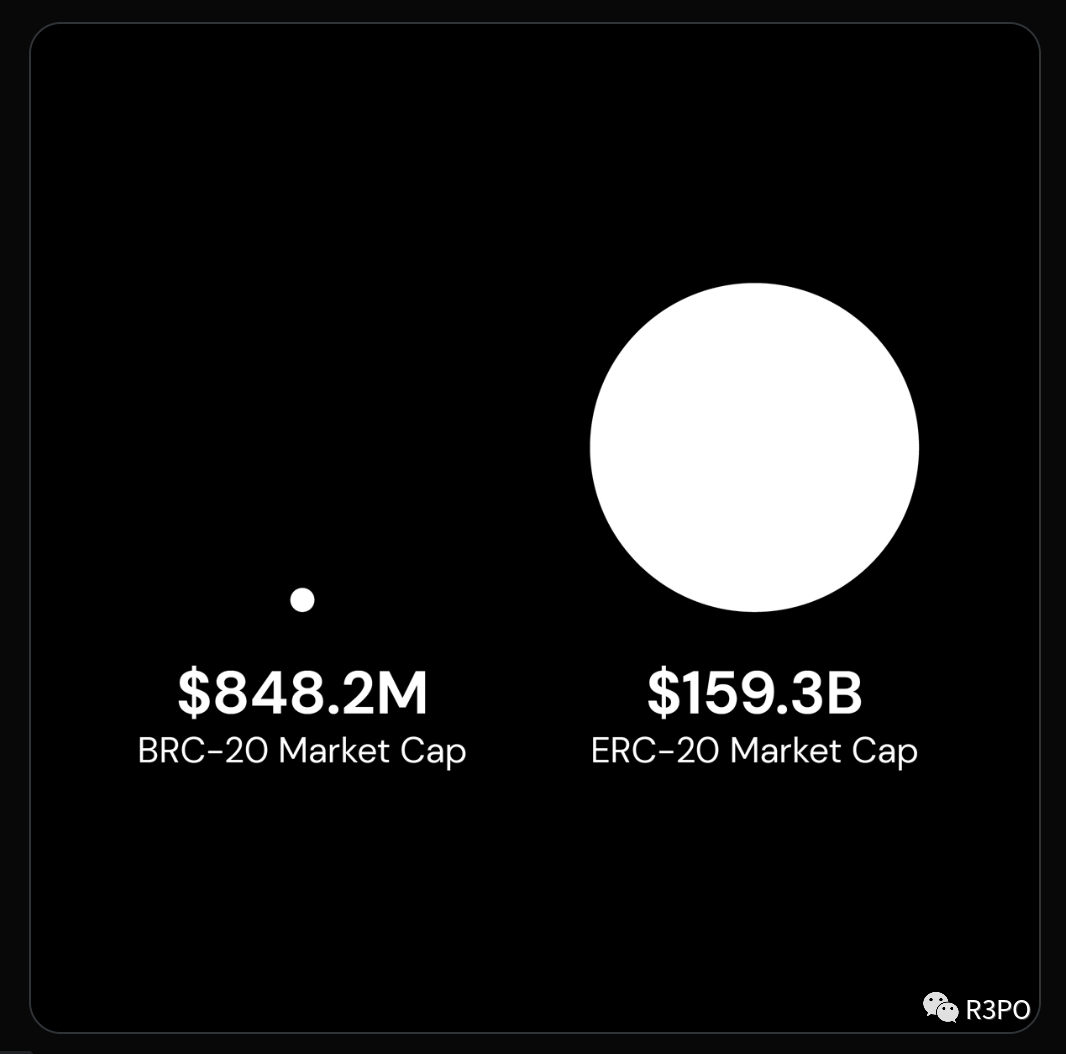
Yet, as shown in this chart, even accounting for hype and FOMO, we’re still far from realizing the true potential of this new economy. Compared to the scale of the ERC-20 market on Ethereum, BRC-20 is still in its infancy. While BRC-20 may currently face numerous issues and lack real utility, if more builders begin focusing on this space, I believe it could soon be used for many other purposes—such as serving as tokens for dApps built on BTC.
While we don’t endorse FOMO-driven speculation on valueless assets, it’s clear that the ecosystem has evolved from early OTC order-book trading to include NFT wallets, secondary markets, and NFT minting tools. Though much of the infrastructure remains immature, the positive outlook for the BTC ecosystem across the broader crypto market is evident.
The narrative around the BTC ecosystem requires time and cycles to unfold. BRC-20 is merely a spark—whether it ignites a wildfire depends on the next moves of projects like the Lightning Network and Layer 2 sidechains. Ordinals, Inscriptions, and BRC-20 tokens have already demonstrated that demand for Bitcoin block space extends beyond peer-to-peer transactions. Users now want to do on Bitcoin what they’ve done on Ethereum and BNB Chain. While Casey Rodarmor and domo sparked this ecosystem with their innovations, it’s now up to the community and developers to take it to the next level.
Join TechFlow official community to stay tuned
Telegram:https://t.me/TechFlowDaily
X (Twitter):https://x.com/TechFlowPost
X (Twitter) EN:https://x.com/BlockFlow_News
 R3PO
R3PO