Decoding Bitcoin NFTs: BRC20 vs SRC20, Who Takes the Lead?
TechFlow Selected TechFlow Selected
Decoding Bitcoin NFTs: BRC20 vs SRC20, Who Takes the Lead?
Although both protocols have contributed to the blockchain narrative, user-friendly platforms will be key to their widespread adoption due to their technical complexity.
 Navigating Web3 tides with focused insights
Author: MathBusiness
Translation: TechFlow
In the current surge of Bitcoin NFTs, two innovative protocols have emerged—Ordinals/BRC20 and Stamps/SRC20.
This article explores the key differences between them.
Technical Foundation
-
Ordinals/BRC20: Ordinals use the BRC20 protocol to embed data into individual Satoshis (the smallest unit of bitcoin). This enables unique tokens with attached digital content, creating non-fungible digital collectibles on the Bitcoin blockchain.
-
Stamps/SRC20: Stamps utilize the SRC20 protocol to directly embed data into UTXOs. This ensures persistence within the blockchain and introduces semi-fungibility, allowing users to issue various types of digital assets.
Security
-
Ordinals face potential data pruning, affecting long-term security. The BRC20 protocol’s reliance on nodes raises concerns about data loss and modification, as decentralized networks may delete old witness data.
-
Stamps provide enhanced security and immutability by embedding data directly into the UTXO set. This method ensures that once data is on the blockchain, it remains permanently preserved, immune to pruning or manual alterations.
Use Cases
-
Ordinals are suitable for applications where data persistence is not critical. The risk of data pruning may limit their use in scenarios requiring persistent data integrity.
-
Stamps excel in applications demanding persistent data integrity. Legal documents, certificates, and historical records benefit from the immutability of Stamps, ensuring long-term reliability.
Regulatory Compliance
-
The possibility of data loss and modification in Ordinals may raise regulatory compliance concerns, especially in industries requiring tamper-proof records.
-
Stamps, with their permanence, offer a robust solution for compliance. Their tamper-proof nature aligns with legal standards, making them a reliable choice for industries where data integrity is crucial.
Scalability
-
The BRC20 protocol relies on nodes to store witness data, potentially leading to blockchain bloat and scalability issues as adoption grows.
-
Stamps are designed to occupy minimal space in the UTXO set, contributing to efficient scalability. This minimizes impact on the overall efficiency of the Bitcoin network, addressing concerns related to blockchain bloat.
Innovation Potential
-
The Ordinals/BRC20 protocol offers an innovative way to inscribe and track individual Satoshis, providing granular data embedding. However, the risk of data pruning presents trade-offs in terms of persistence.
-
Stamps introduce the innovation of semi-fungibility, enabling users to issue various types of digital assets. Direct embedding into the UTXO set ensures secure and permanent ownership records, fostering new possibilities.
Market Adoption
-
Ordinals: Market interest in Ordinals has been significant due to the uniqueness of assigning numbering schemes to Satoshis, especially in the early stages. However, concerns over data pruning may affect long-term adoption.
-
Demand for Stamps is steadily increasing, with over 10,000 NFTs issued in the first month alone, indicating strong market adoption. The advantages of immutability and semi-fungibility make Stamps a preferred option.
The Future of Bitcoin Data Embedding
-
Ordinals contribute to the richness of the Bitcoin ecosystem, but concerns about data persistence and scalability may influence their future role. Innovations like Stamps offer alternatives with enhanced capabilities.
-
Stamps, with their immutability and unique features, will play a significant role in the future of data embedding on the Bitcoin blockchain.
Evolution of Bitcoin NFTs
-
The historical significance of Ordinals lies in their early exploration of Bitcoin NFT possibilities.
-
Stamps, with growing demand and distinct advantages, represent a paradigm shift. They mark a revolutionary step forward in securely embedding immutable data on Bitcoin.
User-Friendly Platforms
While both protocols contribute to the blockchain narrative, user-friendly platforms will be key to widespread adoption due to their technical complexity. Accessibility is essential for driving integration of innovative protocols.
Market Cap Comparison
-
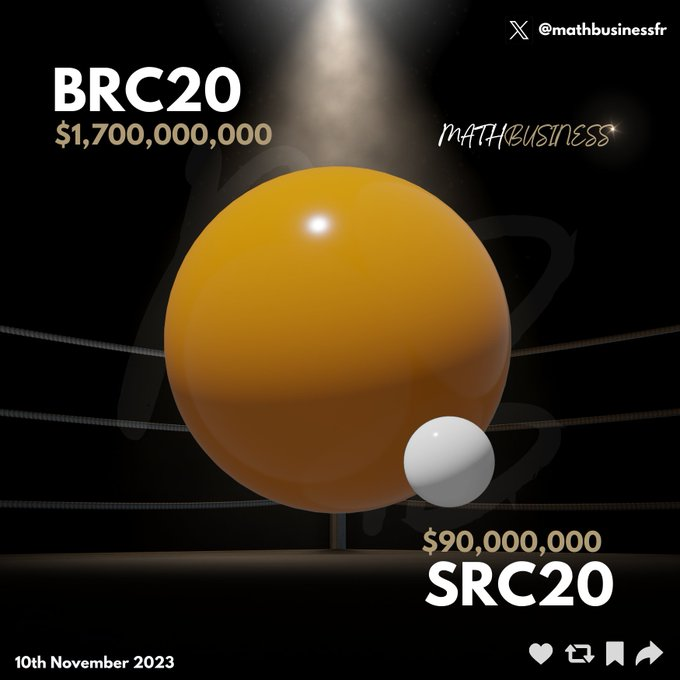
BRC20: $1,700,000,000
-
SRC20: $90,000,000
-
The BRC20 market cap is currently 19 times that of SRC20.
BRC20 and SRC20 Tokens
Representative BRC20 Tokens
-
$ORDI - Market cap $110M (first BRC20 token and highest market cap)
-
$SATS - Market cap $468M (most holders)
-
$XING - Market cap $1.2M (rare sats)
Representative NFTs on BRC20
-
Bitcoin Punks (first issued NFT)
-
BitcoinFrogs (highest market cap)
-
BitcoinApes_ (most collected)
BRC20 resource management website: https://www.ord.io/
Representative SRC20 Tokens
-
$KEVIN - Market cap $11M (first issued SRC20 token)
-
$STAMP - Market cap $50M (highest market cap SRC20 token)
Representative NFTs on SRC20
-
Flocks (first issued NFT)
-
$STAMP, market cap $50M (highest market cap)
SRC20 resource management website: https://stampchain.io/
Perspectives on Bitcoin NFTs
In the realm of Bitcoin NFTs, the choice between Ordinals/BRC20 and Stamps/SRC20 comes down to priorities. Ordinals offer granularity, while Stamps deliver enhanced security, immutability, and scalability. Innovation continues to drive the NFT space forward, and the future holds exciting possibilities.
Join TechFlow official community to stay tuned
Telegram:https://t.me/TechFlowDaily
X (Twitter):https://x.com/TechFlowPost
X (Twitter) EN:https://x.com/BlockFlow_News
 @mathbusinessfr