BRC20 Ecosystem Warming Up? A New Chapter or an Illusion
TechFlow Selected TechFlow Selected
BRC20 Ecosystem Warming Up? A New Chapter or an Illusion
Will the pursuit of absolute fairness undermine stability?
 Navigating Web3 tides with focused insights
Author: ChandlerZ, Foresight News
On February 24, Bitcoin's on-chain gas fees saw a significant increase after prolonged low levels, rising from an average of 1-2 satoshis per byte to over 12 satoshis per byte for high-priority transactions. Just weeks ago, the Bitcoin mempool was fully cleared for the first time in nearly two years, but the number of unconfirmed transactions has now climbed back above 100,000.
According to Geniidata monitoring, within the past 24 hours, on-chain minting activity has shown a highly concentrated pattern, primarily focused on the MASK project.
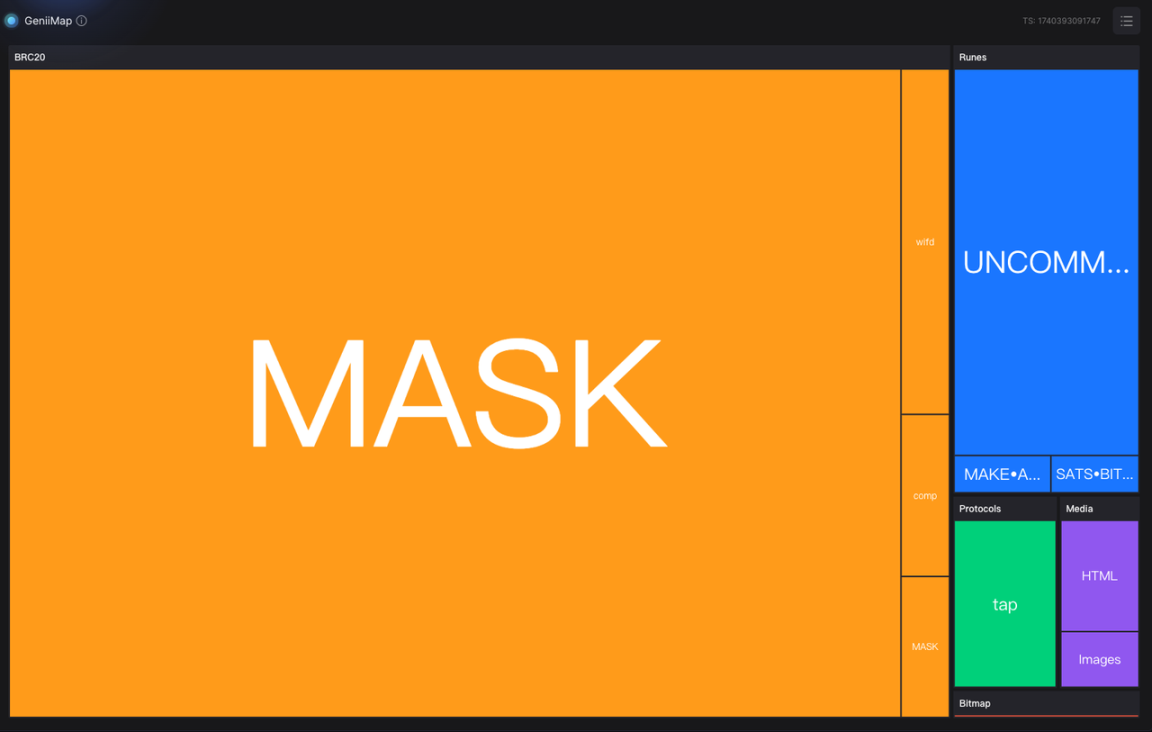
The total supply of MASK is 2.1 million cards, each containing 10 tokens. The current market price remains around $0.18, with a total market cap of approximately $3.06 million. As of the latest data, the project’s minting progress has reached 82.69%, and this surge in activity has sparked widespread discussion about a potential new recovery phase for the BRC-20 ecosystem.
From a deeper market logic perspective, the current crypto market is at a unique inflection point. Amid growing skepticism toward so-called "cartel theories" in ecosystems like Solana and BSC, BRC20—which symbolizes a certain level of "fairness"—appears to be regaining attention. However, market memory hasn't faded; the previous volatility in the Bitcoin ecosystem continues to cast a shadow.
First you see it rise, then you see it fall
Data from The Block shows that starting April 20, 2023, driven by the BRC-20 ecosystem, transaction volume on the BTC network began to surge sharply, nearly doubling in less than a month. Transaction fees rose even more steeply, increasing nearly tenfold in under half a month. At its peak, over 70% of Bitcoin's on-chain transactions were related to BRC-20 projects.
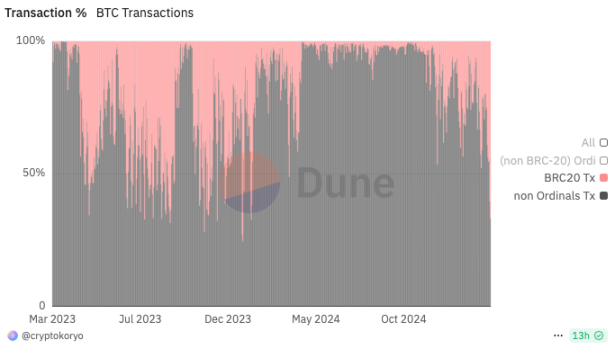
Behind this apparent prosperity, however, lay a fragile ecological foundation. After entering 2024, the Bitcoin ecosystem gradually fell into a downturn—a shift reflecting the market’s deeper struggles with Bitcoin’s application layer. Although there had been high hopes that innovations based on inscription protocols could inject new vitality into the Bitcoin network, the actual development trajectory has significantly deviated from expectations.
Looking back at the evolution of the BRC20 ecosystem, we must confront a harsh reality: most early popular projects have experienced dramatic price corrections. ORDI dropped from a high of $87 to $11, Sats fell from 0.00000086 to 0.00000012, and many other projects—and even Bitcoin-based NFTs—have seen declines of up to 90%, effectively "zeroed out," leaving only heavily grassroots-promoted projects like 𝛑.
This phenomenon is no accident, but rather an external manifestation of deep structural market issues. From its inception, the BRC20 protocol adopted "true fairness" as a core principle, eliminating pre-mints and scientist allocations through fully transparent on-chain mechanisms, aiming to provide all participants with genuinely equal opportunities. While this design theoretically achieves maximum decentralization, it has revealed clear limitations in practice.
The Paradox of Fairness and Market Control
From a market structure standpoint, mechanisms such as team allocations and initial token distributions in traditional crypto projects are essentially market stabilization tools. Though often criticized as centralized, they play an indispensable role in maintaining market stability. These mechanisms allow project teams to manage market fluctuations to some extent and provide necessary price support for long-term development.
In contrast, the BRC20 ecosystem’s fully open minting model, while maximizing participation fairness, leads to extremely dispersed token holdings. Without effective price support mechanisms, market volatility tends to be far more severe. In such conditions, shifts in market sentiment can easily trigger chain reactions, resulting in rapid price declines.
A deeper issue lies in the incentives for large capital players. In traditional crypto projects, big money can influence market movements in various ways to generate profits. Under the BRC20 inscription model, however, such maneuverability is greatly reduced. When so-called "whales" or "institutions" realize that establishing effective control over supply is difficult, they naturally shift their focus to markets where capital management is easier. This creates a paradox: the pursuit of absolute fairness may lead to market instability, ultimately harming all participants. A balance must therefore be struck between complete fairness and necessary market stability.
The renewed popularity of the MASK project indicates that the market's desire for fair mechanisms has not entirely vanished—regardless of whether this project will again prove to be a "shooting star." But how to establish effective market stabilization mechanisms while preserving basic fairness remains a core challenge for the entire crypto ecosystem. This requires innovation at the protocol design level, possibly introducing new mechanisms to reconcile the seemingly contradictory goals of decentralization and market stability.
Join TechFlow official community to stay tuned
Telegram:https://t.me/TechFlowDaily
X (Twitter):https://x.com/TechFlowPost
X (Twitter) EN:https://x.com/BlockFlow_News
 Foresight News