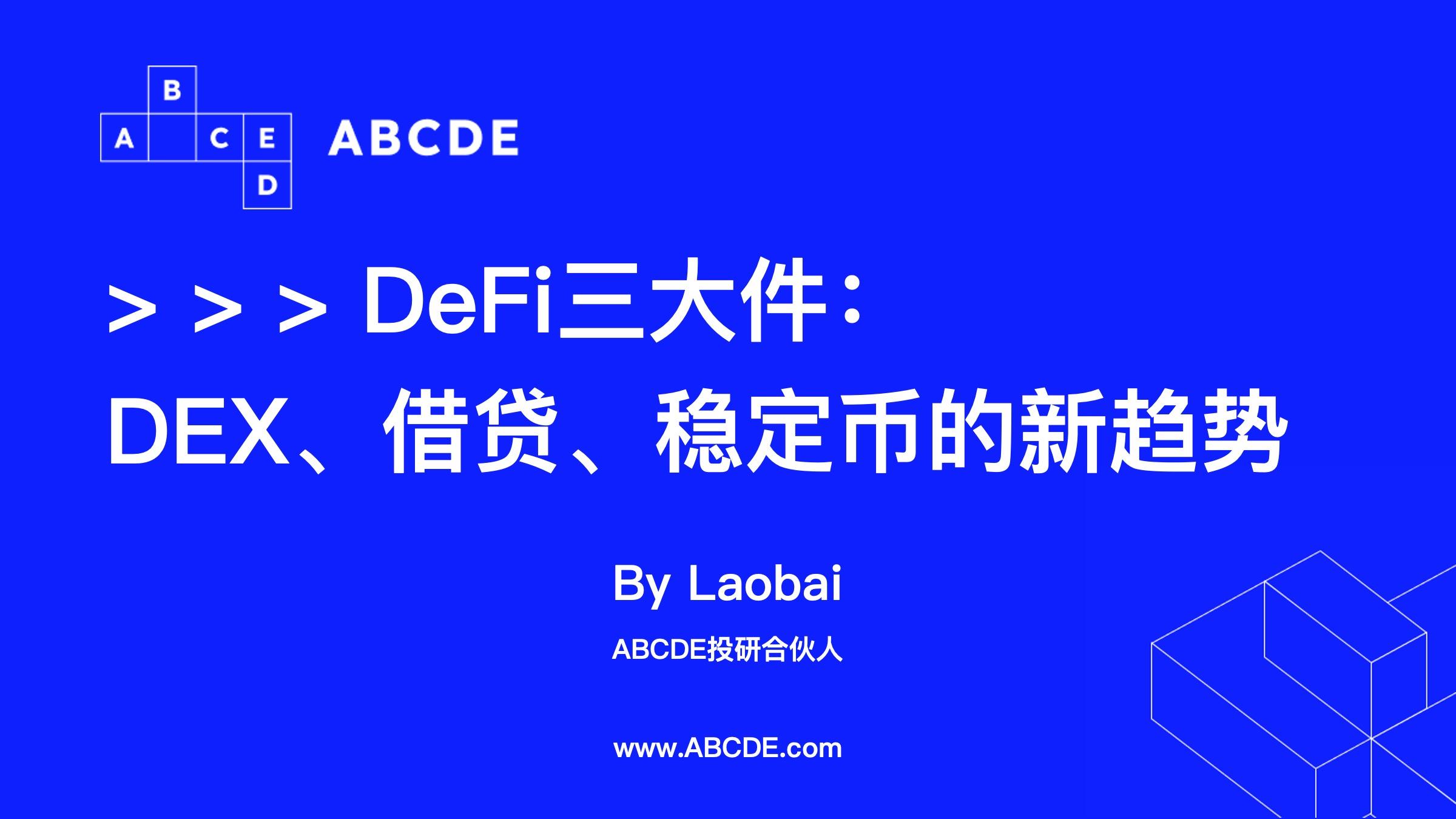
DeFi's Three Core Components: New Trends in DEXs, Lending, and Stablecoins
TechFlow Selected TechFlow Selected
DeFi's Three Core Components: New Trends in DEXs, Lending, and Stablecoins
What are the current DeFi trends worth watching?
 Navigating Web3 tides with focused insights
By: Lao Bai
In recent years, there hasn't been much innovation in the Dex market. Aside from the Curve War, a duopoly has essentially solidified. However, four trends are currently worth watching: the "Frankenstein" model Ve(3,3), Hybrid DEXs, UniV3-Fi, and Curve's next-generation Tricrypto upgrade. In the lending space, cross-chain (omnichain) lending, isolated pools, and oracle-free, no-liquidation lending are the main trends. Regarding stablecoins, beyond pure algorithmic models, RWA-backed stablecoins and those built on LSDFI developments are also worth attention.
Since Uniswap V3 launched, there have been few major innovations in DEXs—except for the Curve War. The DEX sector has now officially entered a two-player dominant phase. Those earlier DEXs that tried to improve slippage or reduce impermanent loss have mostly disappeared.
Four Current Trends in DEXs
1. The Frankenstein Model: Ve(3,3)
This is happening right now. AC initially launched Solidly on Fantom, attempting to merge Uniswap, Curve, and OHM, giving birth to the Ve(3,3) concept. However, it didn’t gain much traction. Even its Ethereum version failed to catch fire. Ironically, Velodrome—a fork on Optimism—became wildly popular.
I think this is partly due to the decline of alternative Layer 1 chains and the rise of Layer 2s, and partly thanks to OP’s generous incentive programs.
Now, Ve(3,3) is spreading across various chains. Chronos recently launched on Arbitrum, Thena on BSC, and there’s one on Polygon whose name I can’t even recall…
Overall, each project makes minor tweaks to Solidly, similar to how Sushi modified Uniswap. Interestingly, Uniswap itself didn’t catch on, but the fork Velodrome exploded in popularity—outright dominating Uniswap on Optimism.
Personally, I’m not a big fan of this model. First, it feels overly stitched-together; second, it’s too complex for average users, lacking the simplicity and clarity of Uniswap.
The Curve War is also complex, but it’s designed for projects and whales—the target audience is different.
Lastly, Velodrome’s success is inseparable from OP rewards. Major vote-buyers like SNX use their airdropped OP tokens for vote-locking. Whether this flywheel can keep spinning once incentives end remains to be seen.
2. Hybrid DEXs
Another form of stitching, but more focused on user experience integration.
-
After FTX collapsed, distrust toward CEXs increased, yet users still crave their smooth trading experience. This led to the emergence of CEX-like UX combined with DEX self-custody. Frontends resemble DYDX or Blur: connect your wallet, deposit funds (off-chain), trade off-chain, then settle withdrawals back on-chain.
-
Second is the AMM + Order Book hybrid, combining market makers’ order books with traditional LP-based AMMs. Trades automatically execute at the best available price between the two systems. For long-tail assets (where order books may lack depth or market makers), AMM acts as a fallback mechanism.
I’ve discussed multiple such projects. The most representative is probably Vertex, which recently launched on Arbitrum and combines both approaches above. It supports not only spot trading but also derivatives, and has a credible team.
However, we didn’t invest because we believe the DEX space is already too crowded.
Of course, this is normal for ABCDE—we talk to 40–50 projects per month, but only invest 1–2 times. Our goal is a "One Shot, One Kill" strategy.
3. UniV3-Fi
A few key points: First, the V3 license protection period recently expired, effectively open-sourcing it. We’ll likely see more V3 forks across chains. Second, various financial applications built on top of V3 are emerging—Paraspace (which was recently controversial) offers lending using V3 NFTs; Panoptic builds options on V3; Gammaswap hedges impermanent loss based on V3. More innovations leveraging V3’s infrastructure are expected.
4. Curve’s Next-Gen Tricrypto Upgrade — Curve previously dipped a toe into mainstream coins, but retail adoption remained low due to significantly higher gas fees than Uniswap. This upgrade brings gas costs down to V3 levels, opening up broader usage among retail users and aggregators. Combined with SNX V3’s Atomic Swap improvements, the competition between Curve and Uniswap in the mainstream spot market will be a key battleground going forward.
Three Trends in Lending
1. Omnichain Lending
Trends from Compound V3 and Aave V3 designs, along with RDNT’s popularity, clearly show omnichain lending is the direction. But according to Teacher Mindao, current implementations are still in a “pseudo-omnichain” phase—more accurately described as “cross-chain lending.” True omnichain lending should allow deposits, withdrawals, borrowing, and repayments on any chain, share liquidity across chains, and maintain a unified interest rate curve. No platform has achieved this yet.
2. Isolated Pools
The idea of isolating collateral assets started with Euler and has since become standard—even adopted by large platforms like Aave and newer ones. The goal is to prevent scenarios like XVS or Mango, where oracle manipulation on a single asset collapses an entire protocol. While less flexible, it ensures one bad apple doesn’t spoil the whole barrel.
3. Oracle-Free, No-Liquidation Lending
This model is especially suitable for long-tail asset lending. Mainstream assets already have mature depth and liquidation mechanisms, but many platforms hesitate to list long-tail assets—even with isolated pools—due to high risks of oracle manipulation and inefficient liquidations. Eliminating these two components could unlock further capital efficiency for long-tail assets. Currently, three distinct approaches exist:
One is Timeswap, which uses an extremely complex three-variable XYZ=K AMM. The design is clever, but I doubt many users truly understand it. Another is InfinityPools, which leverages V3 LP positions—effectively enabling automatic liquidation via V3. Lastly, Blur’s Blend protocol—originally a peer-to-peer NFT lending system—has a smart design that could potentially be adapted for long-tail ERC20 lending with slight modifications. Not sure if anyone will pursue that path.
Key Trends in Stablecoins
Not much new to say about stablecoins. Last year’s Luna collapse basically declared “algorithmic stables dead,” and Frax’s move to 100% collateralization recently cemented that view.
While new overcollateralized stablecoins continue to emerge—using various technical safeguards against depegging—market concerns aren’t really about depegging anymore (even semi-algorithmic Frax rarely depegs). Instead, real-world utility is what matters most.
MakerDAO’s Endgame Plan, Aave’s GHO, Curve’s crvUSD, SNX’s V3 sUSD, and Arthur’s proposed BTC-backed NUSD—all were detailed in a thread I posted two months ago, so I won’t repeat them here (link).
2. RWA-Backed Stablecoins
Ondo is currently working on this with their OMMF stablecoin, backed by MMF (money market funds) and U.S. Treasuries—something operating on the fringes of the crypto ecosystem.
3. Stablecoins Built on LSDFI
LSDs boomed before and after the Shanghai upgrade. I suspect someone will eventually build a stablecoin on LSDFI—perhaps forking Liquity, replacing collateral with stETH or a basket of LSD-denominated ETH, and adding some yield mechanics…
Not sure if any project has done this yet, but if not, I expect it will happen eventually.
Join TechFlow official community to stay tuned
Telegram:https://t.me/TechFlowDaily
X (Twitter):https://x.com/TechFlowPost
X (Twitter) EN:https://x.com/BlockFlow_News
 Lao Bai