The End of DeFi Legos: Vaults Left with Nothing but Deposits
TechFlow Selected TechFlow Selected
The End of DeFi Legos: Vaults Left with Nothing but Deposits
Products should serve the network, not roles.
 Navigating Web3 tides with focused insights
By: Zuo Ye
Binance has partnered with USD1. Exchanges no longer assess token listings solely by “trading volume.” Instead, Binance monetizes its largest real-world user base and sells access to project teams. WLFI aims to drive direct adoption of USD1—enabling users to use USD1 just as they do USDT: for earning interest, pricing, and payments.
This is not an isolated case. OKX subsidizes USDG; Sun Yuchen’s HTX subsidizes U. Major exchanges are all forging their own paths.
On-chain, however, the landscape differs. Yield distribution standards have been homogenized around USDT and USDC. Collaboration among Vaults is dwindling and increasingly opaque—even less robust than partnerships with mainstream consumer products.
Recall that Bitwise is building Vault-based asset management, upgrading the non-custodial wallet concept into a non-custodial treasury; and Kraken, leveraging Euler/Morpho/Aave, has launched a product offering 8% APY.
Do DeFi Lego components retain only theoretical value? And how can pure conduit value withstand exchange-driven disruption?
DeFi Horror Story: Scaling Up, Earning Down
“Network effects stem from human connections; tokens are merely units of measurement.
In the years ahead, tokens will no longer signify the crypto industry; history will more likely anchor itself in the AI industry.
When USDe and Binance jointly offered 12% APY, many believed USDe would migrate from on-chain environments into mainstream exchanges—and eventually into true off-chain payment networks.
After October 11, Binance effectively abandoned Ethena as a partner and pivoted to support U and WLFI’s USD1. Ethena, in turn, shifted toward the Hyperliquid ecosystem and survives primarily as a white-label platform.
The real revelation is this: if even on-chain stablecoins cannot penetrate mainstream industries, then more complex DeFi products must reach users through intermediary industries.
This explains why Vaults & Yield products are surging in popularity—yet end-users no longer opt to hold UNI or Aave tokens. Their understanding of DeFi has collapsed into a single activity: depositing funds.
- Ideal user flow during DeFi Summer: participate in BTC/ETH network nodes to earn tokens → engage with DeFi protocols → compose DeFi Lego modules
- Actual user flow in 2026: convert USDC via CEX or bank card → locate a Vault offering higher APY → spend using a Neobank’s U Card
Yes—users interact directly with Vaults, often indifferent to whether the underlying infrastructure is Morpho or Euler. They may not even care which specific Vault they use; what matters most is Kraken’s or Coinbase’s co-marketing efforts.
Among 522 protocols, 709 assets, and 3,489 active Pools, inter-protocol, inter-asset, and inter-Pool nesting relationships have ceased to matter—the era of DeFi Lego has ended.
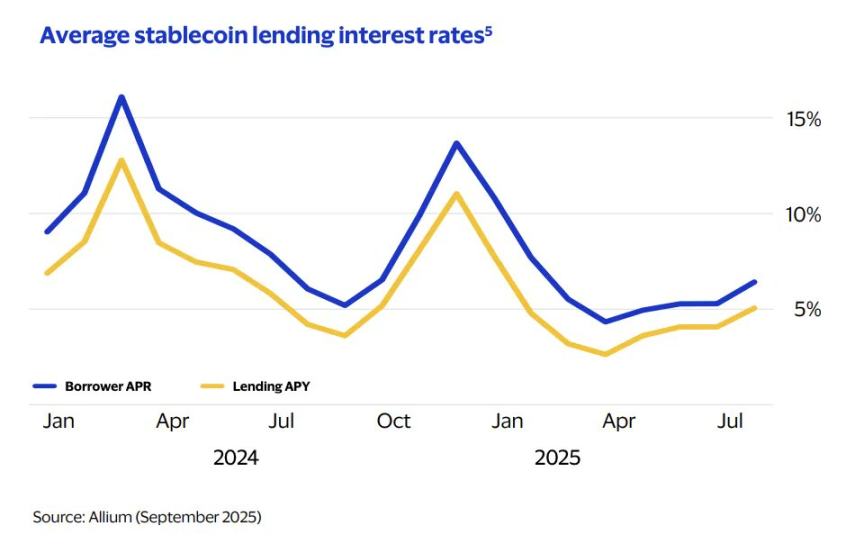
Caption: Average borrowing rate
Source: @visa
The most visible sign of this ending is that stablecoin borrow APRs have fallen as low as 6.4%. With cumulative lending volumes having grown to $670 billion over the past five years, large scale coupled with stable rates is now the norm.
The demise of DeFi Lego has stripped governance tokens of intrinsic value. Governance tokens no longer derive worth from voting rights but rather from long-term, committed holding: one person creates BNB, 100 people hold BNB, 1,000 trade BNB, and only 10,000 truly believe BNB holds value.
Treasury valuation metrics are no longer defined by blockchain energy consumption or native protocol governance standards—but by universally recognized fiat units: the U.S. dollar. In this sense, USDC/USDT have effectively replaced cross-chain bridges.
If USDT/USDC themselves become conduits, then Pools and Vaults need not emphasize integration with specific cross-chain bridges or assets—supporting stablecoins alone suffices for most users’ needs.
Human-to-human value has been excluded from DeFi’s operational framework. Human consumption value stands as the sole economic driver—and stablecoins have ultimately become the sole requirement for Vaults.
Even Vaults generating yield on stablecoin assets still require users’ USDT/USDC—but these stablecoins won’t be deployed into other DeFi protocols, nor reinvested into Treasury securities. Instead, they sit idle in limited steps, awaiting exit.
Referencing select rural commercial banks in China, where large-deposit product rates have dipped below 1%, we may soon witness the bizarre spectacle of stablecoin projects charging users negative fees (i.e., paying users to transact) in 2026.
Ultimately, all DeFi protocols converge into homogeneous deposit products—whether traditional spot DEXs, lending protocols, or perpetual DEXs. Cap has even launched Stabledrop, converting more airdrop value into stablecoin assets rather than native tokens.
A careful mapping of today’s DeFi landscape reveals an unfinished “large-head, large-tail, hollow-middle” structure: countless DeFi Vaults compete fiercely for user deposits, yet no longer interconnect to amplify leverage. Instead, they guard against each other to prevent deposit outflows—and all rely on U.S. Treasuries as underlying assets, funneling capital toward numerous Neobanks.
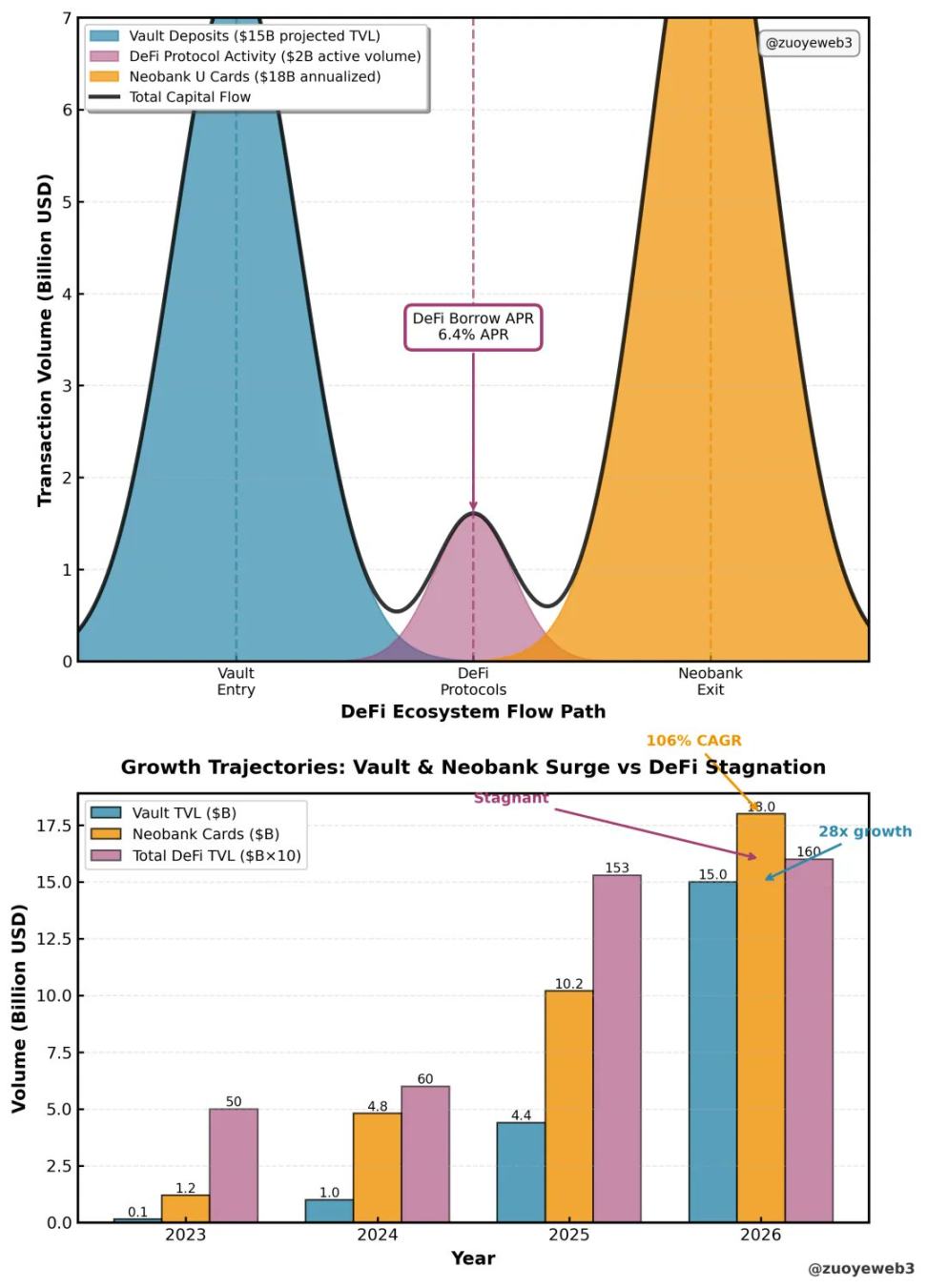
Caption: DeFi circulation landscape
Source: @visa @artemis @DefiLlama
Neobanks’ collective rush toward U Cards has driven their monthly transaction volume from $100 million in 2023 to $1.5 billion today. Though Neobank users remain predominantly on-chain, their strong spending power is evident—yet DeFi’s downturn remains a major reason for fund withdrawals.
This results in unidirectional interaction between users and protocols. Meanwhile, Vaults have become entirely flattened: any coordination occurs privately, and users only perceive disputes—or feel unease—after the fact, much like the xUSD incident.
Tracing the evolution of DeFi and stablecoins, real-world use cases boil down to just three domains: trading, yield generation, and consumption. Trading is split among CEXs, spot DEXs, and perpetual DEXs; DeFi has fully pivoted to yield-centric Vault models; and consumption is divided between Tron-powered USDT and emerging Neobanks.
Objectively speaking, when retail deposits flow into Vaults, tokenized equities, perpetuals, prediction markets, and meme coins, the disappearance of “altcoin season” is inevitable. Retail investors find nothing left to buy—or sell—leaving only a world of deposits, devoid of DeFi’s promised prosperity.
TradFi Lessons: Satisfy People, Don’t Just Persuade Them
Learn AI, then learn banking—and earn money effortlessly.
It’s unequivocal: current stablecoin yields represent individual protocol features—not an independent sector!
A true sector requires competing protocols to collectively elevate the entire industry—like perpetual DEXs or AI competitions. But today’s DeFi Vaults operate solely as entry points, lacking coordinated processes or exits. Each treats others as rivals—with zero cooperation.
Consider Alibaba’s Double Eleven shopping festival: details grow ever more convoluted—even Qwen may struggle to compute optimal strategies.
Vaults follow suit: Curators design increasingly intricate strategies, leaving users helpless beyond initial deposits. When Vaults inevitably fail, users face only professional litigators from law firms.
From DeFi’s developmental standpoint, once ordinary users become passive consumers unable to engage with production layers, institutionalization follows—and retail investors gravitate toward alternative, freer financial markets.
- Retail investors storm GME to battle Wall Street
- Retail investors flock to memes, rejecting altcoins
A clear trend emerges: while DeFi leans into institutionalization, traditional banking proactively innovates to meet evolving market demands—the clearest example being Revolut’s $75 billion valuation.
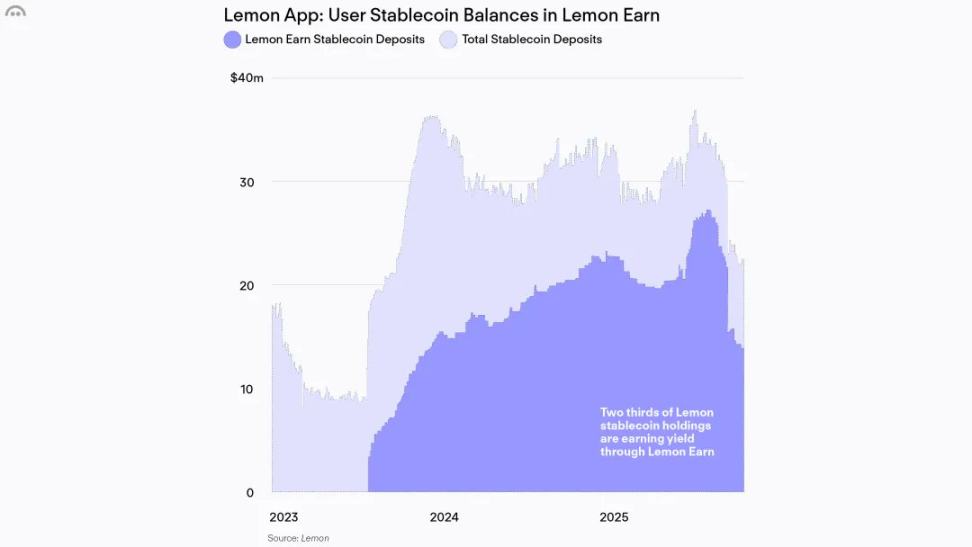
Caption: Off-chain users aren’t valuable
Source: @lemonapp_ar
In contrast, Aave—the largest DeFi bank—has a token market cap of just $2.5 billion. Its deposits even rival those of America’s top 20 banks—a pattern echoed across most DeFi Vault products, which hold little intrinsic value.
Consider Aave’s Latin American strategy: embedding itself within younger, underserved demographics. For instance, Argentina’s Lemon financial product brought Aave 130,000 wealth-management users—but only $40 million in deposited funds.
Compare that to Aave’s on-chain addresses: just 170,000 addresses support its $32 billion TVL—demonstrating that retail network effects massively inflate project valuations. Pursuing only capital scale guarantees no future for DeFi tokens.
Moreover, as Vaults gain influence within lending protocols, traditional protocol brand value erodes. Morpho introduced Sky Treasury Curators to “balance” Stakehouse’s dominance; Aave V4 is fundamentally modular. Ultimately, all of DeFi becomes backend infrastructure.
Aave’s launch of a mobile app signals anxiety—not further ease.
In this context, DeFi learning from banking isn’t embarrassing. Per McKinsey, global banks earned $1.2 trillion in profit in 2024 alone.
Yet crisis looms: in 2018, 25% of users opened bank accounts directly during purchases; by 2025, that figure dropped to just 4%. Honestly ask yourself: which Vault commands 25% user loyalty?
Frenzied APY competition reflects malignant Vault rivalry. Traditionally, big banks serve large clients; small banks serve smaller ones—especially young users who must gradually build credit scores before qualifying for premium banking services.
Now is the moment for DeFi Vaults to rebuild retail trust. Partnerships with CEXs mark a promising start: Vaults aggressively vie for CEX entry points, turning CEXs into upstream channels.
Though Vaults must share revenue with CEXs, they thereby gain access to tens of millions of real users. Users, meanwhile, aren’t wholly passive—they’ll seek higher, safer yields post-CEX, catalyzing new interactive dynamics.
Conclusion
Products must serve networks—not roles.
When retail users stop participating in protocol governance (voting, holding, trading), awareness of the protocol fades—and on-chain human presence vanishes.
Today, Vaults & Yield have become the dominant on-chain paradigm. To rediscover human value amid network effects absent native tokens, DeFi must humble itself—and learn from TradFi, which has operated quietly and effectively all along.
Join TechFlow official community to stay tuned
Telegram:https://t.me/TechFlowDaily
X (Twitter):https://x.com/TechFlowPost
X (Twitter) EN:https://x.com/BlockFlow_News
 @zuoyeweb3