Interview with Ethereum EIP Editor Victor: A Silicon Valley Engineer's Crypto Multiverse
TechFlow Selected TechFlow Selected
Interview with Ethereum EIP Editor Victor: A Silicon Valley Engineer's Crypto Multiverse
Victor Zhou, both an EIP Author and an EIP Editor.
 Navigating Web3 tides with focused insights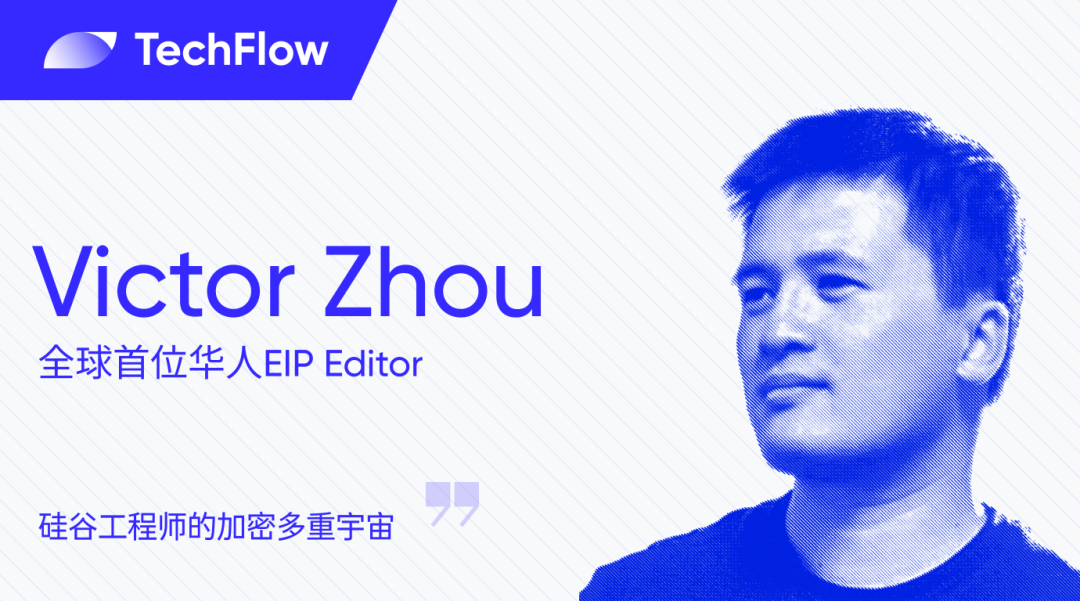
Interviewer: Sunny
Editor: Min
Sunny weather in Silicon Valley’s South Bay.
You may not be familiar with the name Zhou Zainan (Victor Zhou), but protocols such as ERC1202 and ERC5750 might ring a bell. Victor Zhou is an author of Ethereum Improvement Proposals (EIPs) and the first Chinese EIP editor globally. He carries a diverse set of identities spanning Web2 and Web3.
He is a seasoned Silicon Valley engineer who joined Google in 2012 and worked there for ten years. He is also the founder of "Zai Ge Zai Gu," a prominent high-tech Chinese community in Silicon Valley, whose annual overseas Spring Festival Gala is known as “the New Year's Eve dinner for Bay Area Chinese.”
He is a builder within the Ethereum community, having developed EIP protocols such as ERC1202 and ERC5750, and became the first Chinese EIP editor, promoting application-layer standardization on Ethereum for over five years.
He is also an investor who launched the cryptocurrency investment fund AlephCrypto.
Now, he has taken on a new identity—entrepreneur. In 2023, after leaving Google, Victor Zhou embarked on his own Web3 startup journey.
With many curiosities and questions in mind, TechFlow reporter Sunny met Victor Zhou at a café in Silicon Valley for an in-person interview to discuss his multifaceted perspectives on the Ethereum community, crypto investing, and entrepreneurship. Throughout the conversation, Victor often used engineering language and logic to explain his understanding of the crypto industry. While initially abstract and technical, these analogies ultimately offered profound and objective insights into the essence of things.
About Himself and the Ethereum Community
TechFlow: Could you briefly introduce yourself? How did you jump into the crypto rabbit hole while working at a major Web2 tech company, and how did you get involved in building Ethereum?
Victor Zhou: During my ten years at Google, I worked across various teams including Ads, Search, YouTube, and the Blockchain division. Outside regular work hours—from nine to five—I have always been actively involved in open-source contribution communities such as Wikipedia and the Ethereum community. I began actively participating in Ethereum protocol design around 2017. I’ve always had a deep passion for open-source development, which I believe eventually led me into the crypto space.
TechFlow: As the first Chinese EIP editor in the Ethereum community and author of protocols like ERC1202 and ERC5750, you are responsible for reviewing all EIP submissions to the ETH community. What kind of Ethereum Improvement Proposal (EIP) is more likely to be accepted as a standard? What are your key review criteria?
Victor Zhou: Ethereum, as a decentralized community, governs itself very differently from traditional companies, relying instead on a series of governance mechanisms.
EIP stands for Ethereum Improvement Proposal. It is a core component of Ethereum governance, where many critical community decisions originate. For example, every hard fork requires an EIP. Notable execution-layer EIPs include EIP-1559 for fee reforms; well-known application-layer EIPs include ERC20 and ERC721. The EIP Editor is responsible for reviewing and approving EIPs—acting as a “gatekeeper” and playing a crucial role in Ethereum governance. Many people mistakenly believe that founders like Vitalik can issue directives or make unilateral decisions for the Ethereum community and developers. This reflects a centralized corporate mindset rather than how Ethereum actually works. On Ethereum, progress happens through proposing ideas, gaining community support, and achieving implementation.
I hold two roles: EIP Author and one of the seven global EIP Editors. While being an EIP Editor is highly influential, there are only seven editors worldwide compared to dozens of active authors. Personally, I identify first as an “author” (EIP Author), and secondarily as an “editor” (EIP Editor).
An author is the proposer and “driver” of a proposal. Their role is to draft new protocol standards, refine them based on public feedback—especially from developers—and guide the proposal toward finalization.
The editor ensures that each EIP complies with formatting rules, clarity, readability, technical feasibility (not necessarily optimality), and facilitates peer technical reviews before final approval.
At its core, Ethereum governance relies on this collaborative process between authors, editors, and broad developer/user participation through “voting with their feet.”
TechFlow: During the last bull market cycle, new blockchains surged forward rapidly, and Ethereum was criticized for inefficiency. Yet after going through the cycle, it remains the king of smart contract platforms. Based on your experience, what do you think gives Ethereum its competitive edge? What has it done right?
Victor Zhou: First, I don’t comment on prices or markets—that’s not my expertise. Technically and application-wise, however, Ethereum (and its compatible chains) demonstrates superior technological maturity compared to other blockchain types. The EVM has achieved significant network effects. A vast number of DeFi and other dApps are built using ERC standards. For instance, ERC20 tokens like USDT and USDC amount to over $110 billion. Nearly $50 billion worth of various ERC20 tokens are locked in DeFi. Additionally, the NFT market size is around $10 billion.
In summary, Ethereum’s core competitiveness stems from three main aspects:
1. Vibrant Ecosystem and Technological Leadership
Ethereum’s rapid and leading technological evolution comes from a thriving ecosystem of talented builders and projects pushing innovation. One example is client diversity—a foundational principle in Ethereum’s development. Unlike most blockchains that rely on a single node implementation, Ethereum’s foundation early on supported independent node implementations in Python, Go, and C++. This ensured the protocol remained “protocol-based,” not “implementation-based,” preventing any single team from monopolizing protocol interpretation. Later versions emerged in JavaScript and Rust. This technical diversity strengthened Ethereum’s security, enriched its ecosystem, and broadened its developer talent pool.
Similarly, multiple wallet implementations were encouraged early on—such as MyEtherWallet (MEW) and Mist—allowing third-party wallets to join seamlessly. This approach resembles Tencent’s “horse race” model. Ethereum deliberately avoids appearing “official.” The Foundation stays small and supports the ecosystem mainly through grants, maintaining a humble, neutral, and decentralized posture. This mode of interaction fosters organic outcomes, setting it apart from many chain projects run like centralized corporations.
2. Standardization and Interoperability
Ethereum has established numerous strong open standards across execution and smart contract layers, enabling widespread interoperability among dApps. For example, a project can launch an ERC20 token, and another project like Uniswap can instantly integrate all ERC20-compliant tokens. A third party building a UI can interact with Uniswap and immediately interoperate not only with Uniswap but also its forks and even versions deployed on other chains. This composability creates powerful network effects.
3. Network Effects Forming a Moat
Since its inception, Ethereum has accumulated extensive applications and network effects amplified by open standards and interoperability. We can estimate Web3’s potential network effects by comparing them to Web2.
Web2 network effect:
Benefit = N(user) × N(merchant) (approximately N²)
In traditional internet models, merchants operate as isolated islands. Each user interacts with one merchant at a time, generating linear value.
Web3 network effect:
Benefit = N(user) × N(merchant) × N(merchant1) × N(user1) × … × N(merchantn) × N(usern) (can scale to N⁴, N⁵, …, Nⁿ)
In Web3, merchants are connected via blockchain—not isolated, but forming an interdependent archipelago. Users can interact with multiple merchants simultaneously. This isn’t just a change in subject—it’s a dimensional upgrade in network effects, adding depth to the internet. Ethereum’s standardized protocols and interoperability further amplify this dimensionality, effectively increasing the base of tetra by 10⁶. Such network effects are truly transformative and beyond imagination.
About Investing
TechFlow: Besides being an engineer, we know you've worked at investment firms and later founded your own crypto fund, AlephCrypto. As an investor in the crypto space, what is your investment philosophy?
Victor Zhou: I am a builder and protocol developer. We back builders because we believe blockchain today is akin to the early days of the internet—an era of intense technological innovation. We favor founding teams with strong technical backgrounds or deep understanding of blockchain products. We believe we’re entering a next-generation industrial revolution no less significant than Information Technology (IT): Trust Technology (TT).
Blockchain will fundamentally transform human life by digitizing trust, assets, and rights. Just as computer networks made digital information surpass printed knowledge, we believe non-digital contracts will soon be replaced by machine-enforceable “digital contracts.”
About Entrepreneurship and Silicon Valley
TechFlow: According to your LinkedIn profile, you left Google in April 2023 and started your own company (in stealth mode). What motivated you to start a venture at this particular moment?
Victor Zhou: I’m happy to share my recent career decision. Many friends may wonder why I would voluntarily leave a stable job at Google during a period of global economic downturn. This choice may seem risky, but I believe it’s precisely during such times that truly groundbreaking innovations emerge.
Historically, many great companies were born in economic winters. Airbnb was founded in 2008. Uber, Slack, Square, and Pinterest emerged in 2009. Google rose during the 2001 dot-com bubble. Armies often launch offensives in winter—because every day afterward gets warmer.
One of the biggest challenges today is securing funding. I’m fortunate to have already secured investor trust and backing before leaving Google. Meanwhile, the current talent market is oversupplied, with many skilled professionals seeking new opportunities—giving us a unique chance to recruit top-tier talent. For technology-deep startups, the winter reduces external noise and hype, making it easier to attract long-term, technically literate investors and team members.
I’ve chosen to focus on Smart Contract-as-a-Service. I believe the infrastructure for this field is nearing maturity and holds immense potential to reshape our lives. I look forward to making meaningful contributions in this domain.
TechFlow: Can you tell us anything about your startup project? Why this direction?
Victor Zhou: “The ‘Trust Technology Revolution’ brought by blockchain is the most significant technological shift since the Information Age. Its revolutionary power lies in dramatically improving the efficiency of creating, transferring, and storing trust in human collaboration. Smart contracts are the primary vehicle for trust creation, transfer, and storage—the next generation of software. Guided by this vision, I founded D3Serve, derived from ‘Decentralized Serve’ and aligned with Web3 principles. We aim to lead in the Smart Contract-as-a-Service space, building foundational infrastructure for next-gen trust technologies by offering reliable, highly scalable smart contract services that greatly enhance trust efficiency in business and personal collaborations.
As a co-founder, I am an expert in smart contract standardization with deep industry knowledge and extensive experience. I’ve actively contributed to smart contract standard development and achieved notable success in this field. With this expertise, I am confident our team can deliver innovative products that meet real user needs.
Currently, our company is developing its first product in stealth mode, focusing on domains and account abstraction (Account Abstraction). While I can’t disclose specific details yet, I’m highly confident in this direction and look forward to unveiling our early product soon.
We firmly believe our smart contract services will enable businesses and individuals to establish trust relationships, formalize agreements, and collaborate more efficiently and securely. We are committed to providing advanced technical infrastructure and a simple, reliable environment for smart contract development and deployment. We will continuously innovate and improve to meet evolving market demands.
Finally, I am passionate about smart contract standardization and adoption. Through D3Serve, I hope to drive broader use of smart contracts across industries and contribute meaningfully to the advancement of the trust technology revolution.
TechFlow: Whether in China or the U.S., many big tech employees are transitioning to Web3 startups. From business models to thinking and user experience, what do you see as the biggest differences between Web2 and Web3 entrepreneurship?
Victor Zhou: This is a broad question touching multiple dimensions. If given the chance, I could write a full article on it. Briefly, the biggest differences between Web2 and Web3 entrepreneurship can be seen in three areas:
-
First, accounts and payments are natively built into Web3. This means that unlike Web2, which often relies on freemium models, Web3 users are more naturally inclined to pay.
-
Second, the boundary between creators and fans is clearer in Web2, whereas in Web3, audiences and creators often blur—passionate fans become co-creators, and creators follow each other like fans.
-
Third, community boundaries differ significantly. Web3 sees the rise of decentralized autonomous organizations (DAOs) and other novel organizational forms that transcend individual platforms.
Currently, Web3 still faces UX challenges—high fees, long delays, low throughput—similar to the early internet. However, we remain confident that with technological advances and community effort, these issues will gradually be resolved. Web3 promises a more open, inclusive internet experience that fuels innovation, collaboration, and societal progress.
TechFlow: Recently, the SEC’s regulatory moves toward crypto have been unfavorable. Coinbase CEO Brian Armstrong even said that if regulation remains unclear, Coinbase might leave the U.S. Do you think Silicon Valley—or the U.S. overall—will remain a hotspot for Web3 startups? Would you consider relocating to Singapore or Hong Kong to build your company?
Victor Zhou: For entrepreneurs, a clear and legally sound regulatory environment is undoubtedly essential. A stable, transparent, and fair framework supports both entrepreneurs and industry growth. Recently, blockchain industry leaders like Coinbase have strongly criticized the SEC’s regulatory stance, even suggesting they may move operations out of the U.S. Notably, this view has gained support from many U.S. lawmakers.
The trust technology industry, being highly impactful and innovative, presents new challenges for regulators worldwide. At the same time, it offers opportunities for regions aiming to surpass the U.S. in global competition. Jurisdictions in Europe, Asia, and Latin America are viewing this space as a strategic opportunity and actively crafting supportive policies, resulting in a diverse and vibrant global landscape.
For example, the UK Law Commission invited me and other open-source community members to advise on DAO governance regulations to better understand crypto developments. We welcome regulatory innovation across jurisdictions and are optimistic about the future.
Whether Silicon Valley or the U.S. will remain a Web3 startup hub has no definitive answer. The current situation may pose challenges for the U.S., but it also creates opportunities elsewhere. Regions worldwide are striving to create innovation-friendly environments to attract entrepreneurs and investors. As for relocating to Singapore or Hong Kong, that depends on specific business needs and strategy. We will closely monitor global regulatory shifts to ensure we operate in the most conducive environment for our mission.
Join TechFlow official community to stay tuned
Telegram:https://t.me/TechFlowDaily
X (Twitter):https://x.com/TechFlowPost
X (Twitter) EN:https://x.com/BlockFlow_News
 深潮TechFlow