








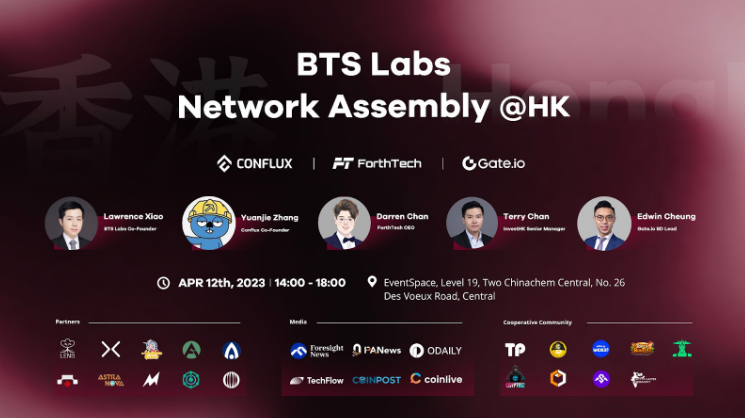
The BTS Labs Network Assembly @HK, hosted by BTS Labs, was successfully held in Hong Kong on April 12.
TechFlow Selected TechFlow Selected
The BTS Labs Network Assembly @HK, hosted by BTS Labs, was successfully held in Hong Kong on April 12.
The BTS Labs Network Assembly @HK, hosted by BTS Labs and co-organized by Conflux, ForthTech, and Gate.io, was successfully held in Central Hong Kong.
 Navigating Web3 tides with focused insights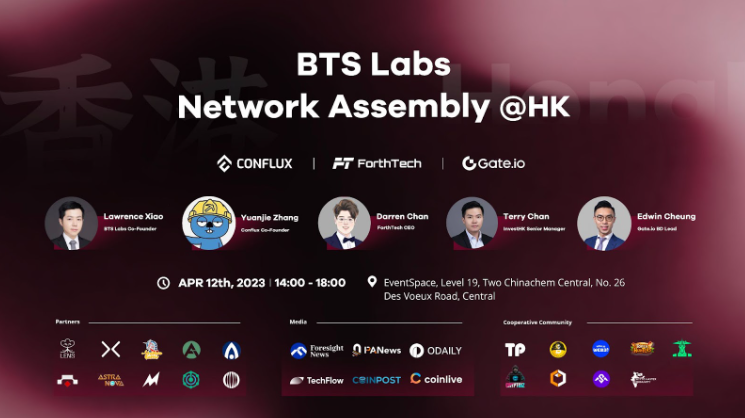
On April 14, 2023, the BTS Labs Network Assembly @HK, hosted by BTS Labs and co-organized by Conflux, ForthTech, and Gate.io, was successfully held in Central, Hong Kong. We extend our sincere gratitude to the supporting organizations: Lens Protocol, Cyberconnect, StableBattle, OMEE, Ariva Digital, EMG, Astra Nova, TALAXEUM; media partners: Foresight News, PANews, TechFlow, Odaily, Coinpost, Coinlive; and community partners: TokenPocket, Buidler DAO, Token Hunters, Cryptoiz Research, Coinmuhendisi, Satoshi Club, Hello Web3, Metaverse Space for their strong support!
BTS Labs Network Assembly @HK —— BTS Labs joined hands with Conflux, ForthTech, and Gate.io to host a project-sharing event in Hong Kong. Attendees included Eric Lee, Founder of BTS Labs; Lawrence Xiao, Co-Founder of BTS Labs; Yuanjie Zhang, Co-Founder of Conflux; Darren Chan, CEO of ForthTech; Terry Chan, Senior Manager of Financial Technology at InvestHK; and Edwin Cheung, BD Lead at Gate.io. Guests discussed the latest trends, technologies, and applications within the rapidly evolving Web3 ecosystem.
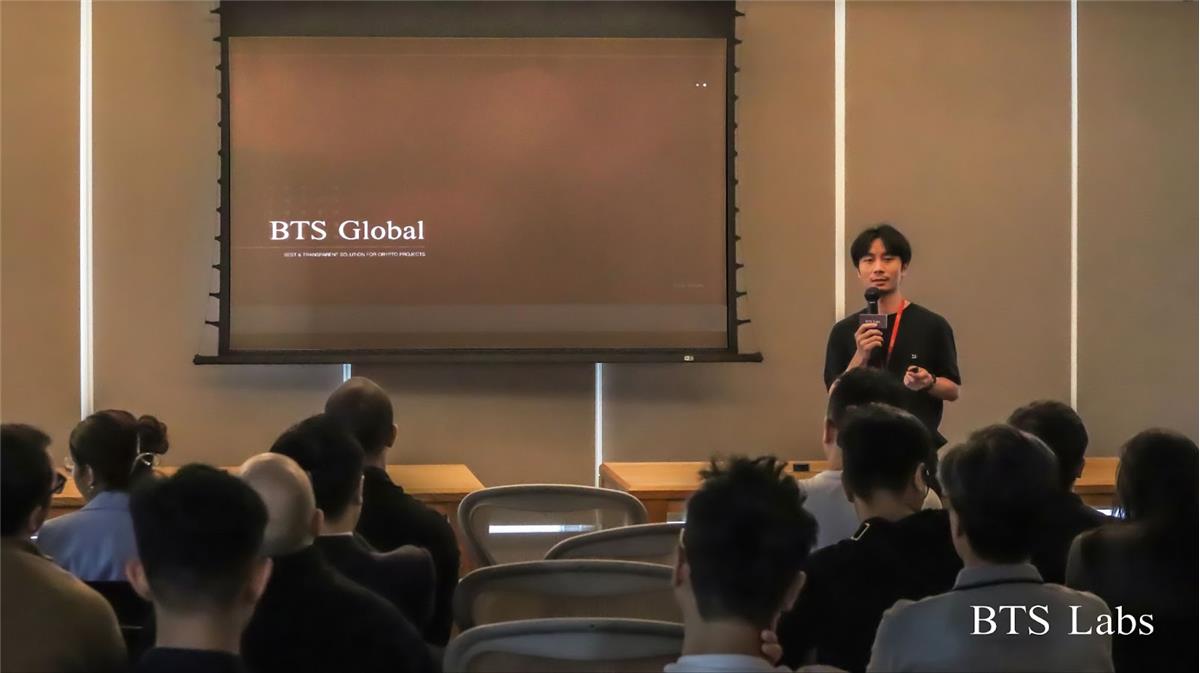
The event kicked off with Eric Lee, Founder of BTS Labs, who provided an in-depth introduction to BTS Global (comprising BTS Labs, BTS Ventures, and BTS Trading), which focuses on delivering advisory services across investment and financing, market making, branding, and marketing. Among the many projects they have supported, AAVE, Sushi, Flow, Polkadot, YGG, Dfinity, Chiliz, Galxe, Alpaca, Crypto Blades, Polygon, and CyberConnect are widely recognized in the industry. When discussing future market characteristics, Eric shared three key insights:
1) Liquidity: With the release of new policies and regulations in Hong Kong, we are witnessing a return of seasoned players as well as increasing participation from newcomers in the Web3 space, particularly evident in regions such as Southeast Asia, Africa, and South America.
2) Regulations: Recently, U.S. regulators like the SEC have intensified scrutiny over exchanges and projects or firms registered in the United States. Many U.S.-registered entities have been forced to withdraw operations or exit the U.S. market entirely. This is only the beginning. In the coming years, not just the U.S., but also Europe and various Asian countries will introduce more regulatory frameworks. As a result, corporate management and operational costs will rise significantly. The CeDeFi concept will likely become one of the defining features of the next bull market.
3) Corporate Competition: We observe that in both Western and APAC markets, many new entrants take on multiple roles simultaneously, often starting in community operations or marketing before transitioning into other positions or sectors within Web3. Future demands on professionals and companies alike will grow increasingly stringent—not only in terms of expertise and reputation, but also brand equity, decision-making ability, and risk management. These factors will be even more critical in Web3 compared to traditional Web2 industries.
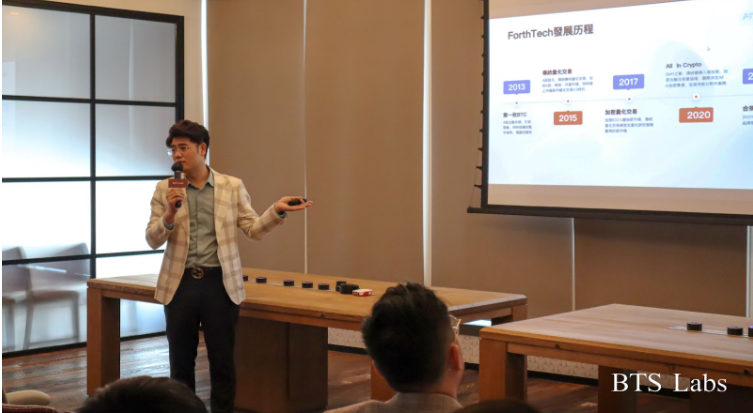
Next, Darren Chan, CEO of ForthTech, introduced how his team entered the crypto trading market in 2017 as pioneers in professional crypto quantitative trading. They possess extensive experience in strategy development, database processing, server infrastructure and maintenance, IT implementation, and security risk control. After navigating two full market cycles (bull and bear), they formally established their company in 2021, primarily offering quantitative trading, market-making, and liquidity provision services. Leveraging AI algorithms, they help clients securely and steadily preserve and grow their digital assets. As a professional digital asset technology service provider, ForthTech actively embraces change and leads industry transformation.
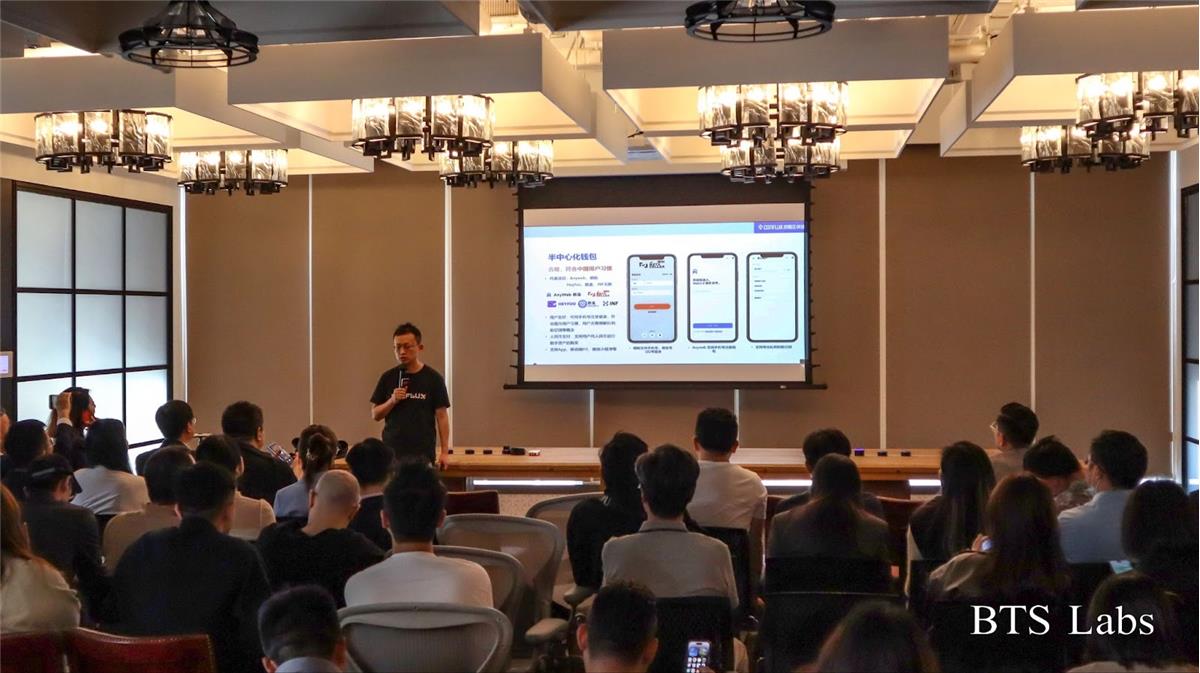
Following that, Yuanjie Zhang, Co-Founder of Conflux, delivered a presentation titled “Exploring China’s Web3.0: Starting from Wallets.” He introduced Conflux's semi-centralized wallet application designed to enable users unfamiliar with Web3 to join the ecosystem more easily and manage their digital assets conveniently. Within communities and project ecosystems, users can participate using their own usernames.
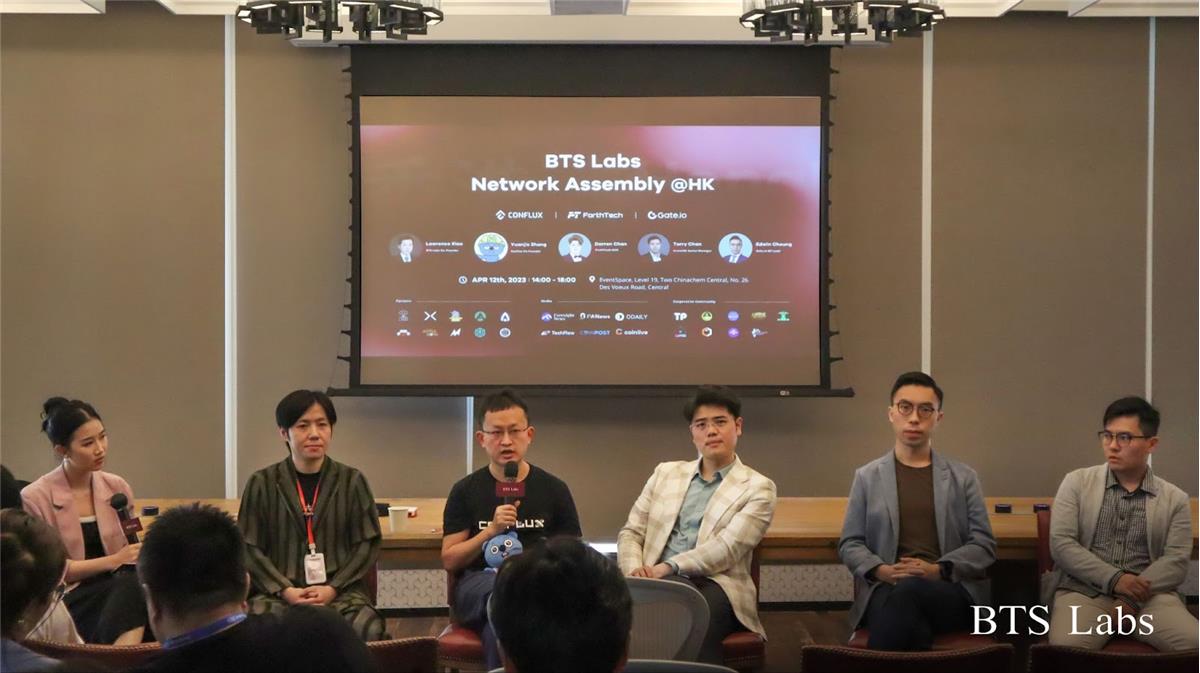
After the guest presentations, a panel discussion commenced, covering topics including the challenges Hong Kong faces in becoming a mainstream virtual asset trading hub, similarities and differences between the upcoming post-Bitcoin-halving bull market and the previous one, and the convergence of artificial intelligence and blockchain. Other discussions included potential measures the Federal Reserve might take in the cryptocurrency market and which sectors the panelists were bullish on.
Lawrence Xiao, Co-Founder of BTS Labs, mentioned that blockchain and AI offer numerous integration opportunities. For instance, popular AI applications today like ChatGPT and MidJourney are actually centralized—developed, fine-tuned, and released by single teams or companies for use by the general public or professionals. End users have limited control and permissions—for example, being restricted to 50 queries per day on ChatGPT or accessing databases updated only up to 2021. Drawing parallels with the popular X-to-Earn model from the last bull cycle, we could adopt a "Train-to-Earn" approach to train AI models. Everyone participating in training would receive corresponding rewards, thereby addressing issues of data timeliness and subjective bias in AI outputs.
Yuanjie Zhang, Co-Founder of Conflux, shared insights on how Hong Kong's licensing initiatives for exchanges, stablecoins, and digital wallets could bring tremendous growth opportunities to the industry. Notably, the stablecoin license will apply to all freely circulating currencies in international foreign exchange markets, especially CNH and HKD, presenting significant industrial potential. Currently, China ranks first globally in total trade volume, with imports and exports reaching RMB 42.07 trillion. The demand for offshore RMB as a transaction medium continues to grow. Even a 1% increase in adoption of blockchain and stablecoin technologies in trade and payment scenarios could generate tens of billions of CNH-denominated stablecoins. This would greatly boost liquidity in the broader crypto industry and drive demand for on-chain and off-chain financial services. If the last cycle was driven by long-term bullish momentum from Western financial institutions, this cycle will be fueled by financial spillover effects from the rise of a major Eastern power!
Darren Chan, CEO of ForthTech, noted that the primary challenge lies in reshaping business models under new regulations. In the current crypto ecosystem, most stablecoins are pegged to the U.S. dollar. With recent risks emerging in the U.S. banking sector, these dollar-backed stablecoins are inevitably vulnerable to shocks. Therefore, as a region committed to advancing the digital asset industry, Hong Kong may need to implement further measures to foster safer and more robust development of the crypto sector. It will also be essential to clearly define the obligations and responsibilities of different participants in trading activities through independent oversight bodies—an approach differing from the current state of exchanges and trading institutions, posing certain difficulties. Regarding the fast-evolving new ecosystem, Hong Kong must accelerate legal and regulatory framework development. Despite these challenges, we believe Hong Kong’s digital asset sector still holds vast development potential.
Terry Chan, Senior Manager of Financial Technology at InvestHK, expressed that Hong Kong is continuously improving its regulatory environment and infrastructure, aspiring to become a global Web3 hub.
Edwin Cheung, BD Lead at Gate.io, explained that Web3 and decentralized finance represent a new network paradigm built on blockchain technology. They break away from traditional centralized models, enabling greater transparency, security, and efficiency. These systems empower users with enhanced ownership and control over their data, promote the circulation, innovation, and value creation of digital assets, open broader market opportunities, unlock developmental potential, and carry profound social and cultural significance. At the same time, they address pressing issues in today’s internet landscape—such as data ownership, data security, privacy breaches, and monopolization by tech giants—providing more reliable safeguards for digital assets.
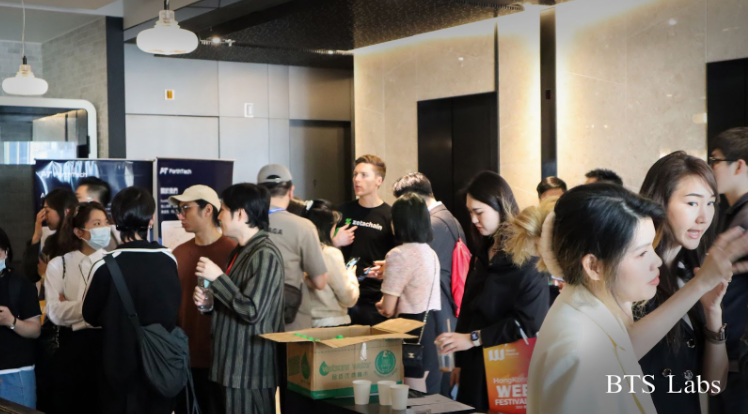
The event concluded successfully with vibrant networking among attendees. The successful gathering not only injected fresh momentum into the advancement of Web3 technology but also created new development opportunities for various projects and institutions based in Hong Kong.
Join TechFlow official community to stay tuned
Telegram:https://t.me/TechFlowDaily
X (Twitter):https://x.com/TechFlowPost
X (Twitter) EN:https://x.com/BlockFlow_News
 @btslabs_global






