








Order Book + AMM? Kuru Labs Raises $11.5M to Power EVM Chain Monad
TechFlow Selected TechFlow Selected
Order Book + AMM? Kuru Labs Raises $11.5M to Power EVM Chain Monad
The project aims to build a hybrid DEX combining a fully on-chain order book and automated market making on Monad, a high-performance EVM public chain.
 Navigating Web3 tides with focused insights
Author: ChandlerZ, Foresight News
Structural bottlenecks in on-chain trading experiences are becoming increasingly apparent. While the AMM model propelled the early development of decentralized exchanges (DEXs), its limitations in liquidity efficiency, price discovery mechanisms, and support for limit orders have consistently left a gap between on-chain and centralized exchanges. On the other hand, although the CLOB model offers greater flexibility and precision, it has long been constrained by public chain performance and high on-chain execution costs, making practical deployment difficult.
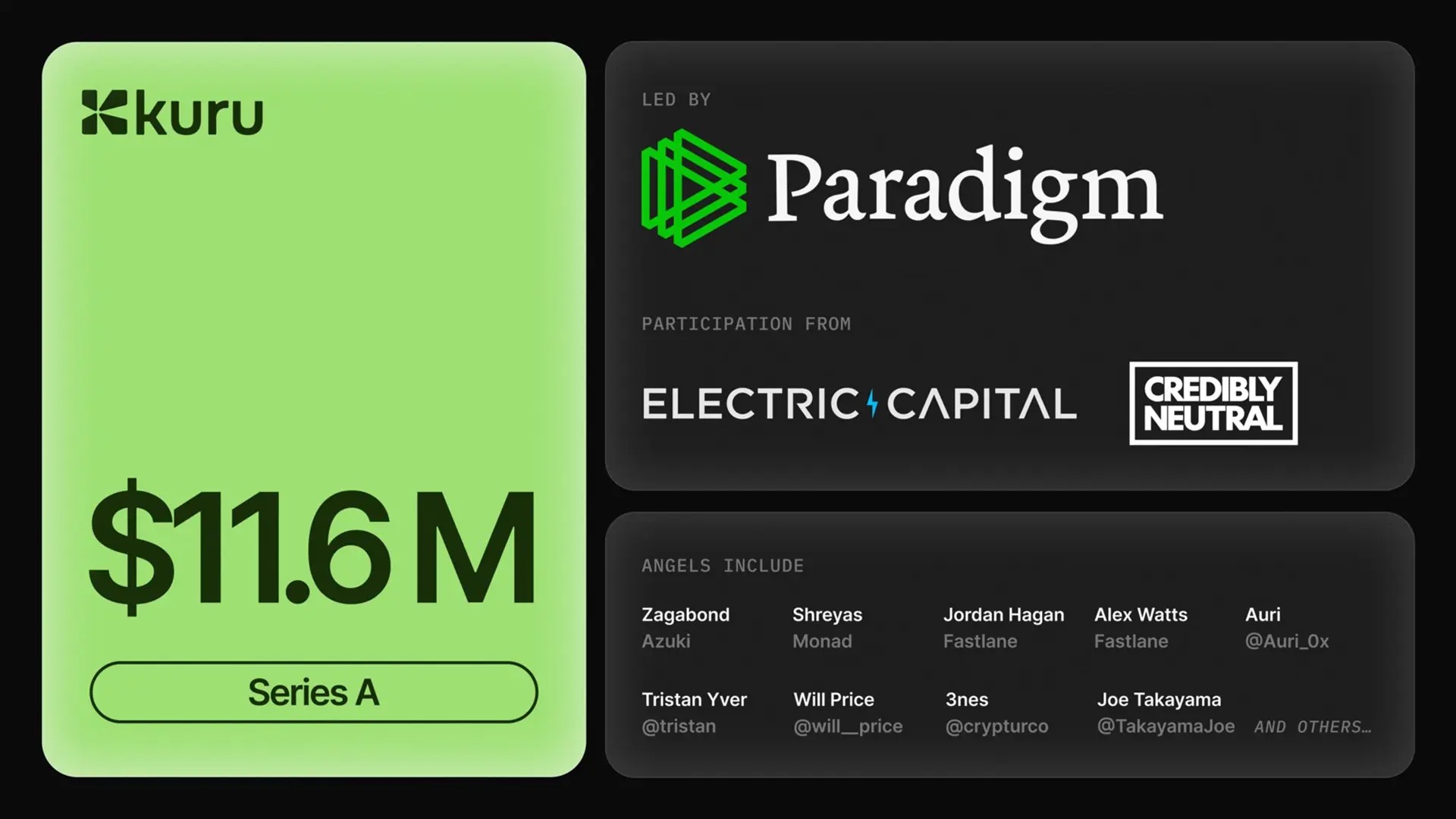
On July 7, Kuru Labs, a decentralized exchange built on the high-performance Layer 1 blockchain Monad, announced the completion of an $11.5 million Series A funding round led by Paradigm, with participation from angel investors including 0xDesigner, Viktor Bunin, Zagabond, Tristan Yver, Kevin Pang, Will Price, Alex Watts, Jordan Hagan, 3nes, Shreyas Hariharan, Auri, and Joe Takayama.
Kuru Labs is dedicated to building a fully on-chain trading platform on Monad that integrates order book architecture with automated market-making logic. By re-architecting the underlying infrastructure, the project aims to deliver a more balanced product experience for both professional traders and everyday users.
Project Background
Kuru Labs is a startup focused on building on-chain order book-based trading platforms, founded in 2024 by a team with expertise in high-frequency trading, DeFi protocol development, and on-chain system optimization. The project’s goal is to create a fully blockchain-native decentralized trading platform that combines both order book and automated market-making functionalities. Rather than relying on existing architectures, Kuru seeks to build from the ground up—merging the strengths of the two dominant models to recreate a spot trading system on-chain that closely mirrors the experience of centralized exchanges.
In terms of funding, Kuru completed a seed round in mid-2024, raising $2 million led by Electric Capital, with participation from Brevan Howard Digital, CMS Holdings, Pivot Global, Breed, and Velocity Capital, as well as angel investors Keone Hon, Jarry Xiao, and Eugene Chen. That round was primarily used to establish the technical team, develop a minimum viable product (MVP), and prepare for testing phases.
This latest announcement marks the close of Kuru’s Series A round, totaling $11.5 million, led by Paradigm. According to Vaibhav Prakash, co-founder of Kuru, Paradigm has played an active role in shaping the microstructure of on-chain markets. The team plans to use the Series A funds to expand its team and realize its vision of a fully on-chain order book on the Monad mainnet.
Technical Architecture and Product Design
Rather than adopting the AMM model commonly used by mainstream DEXs today, Kuru is attempting to build a hybrid system that combines order book mechanics with automated market-making functionality. Its core idea is to introduce a default automated market-making algorithm into each trading pair's order book on-chain, ensuring that even in the absence of active liquidity providers, users can still receive baseline pricing support. Unlike traditional order books that rely on centralized market makers for liquidity or AMMs that impose uniform constraints via pricing curves, this design enables flexible switching between the two models.
In terms of operation, Kuru has designed an order management mechanism tailored for on-chain environments. Submitting and canceling limit orders incur low and predictable gas costs, enabling market makers or algorithmic traders to operate frequently without being hindered by high transaction fees. The team is also developing a passive liquidity mechanism that allows ordinary users to contribute assets to liquidity provision through strategy contracts without needing to actively manage their orders. This approach aims to lower entry barriers while increasing capital coverage across the on-chain order book.
Technically, Kuru has chosen the Monad blockchain as its deployment platform. Monad is an Ethereum EVM-compatible Layer 1 blockchain currently in testing phase. The second stage of its testnet launched in June, with 161 validator nodes now running across 64 cities in 33 countries.
Monad Labs was co-founded by several former developers from Jump Trading. In April 2024, the company raised $225 million in a funding round also led by Paradigm, with participation from Electric Capital, Coinbase Ventures, Castle Island Ventures, GSR Ventures, and Greenoaks. Prior to this, Monad Labs secured $9 million in pre-seed funding in May 2022, followed by $10 million in seed funding in December 2022, and later raised $19 million in another round led by Dragonfly Capital.
Unlike existing EVM chains, Monad does not simply replicate Ethereum’s codebase. Instead, it rebuilds the execution engine from the ground up, employing a parallelized architecture and pipelined scheduling mechanisms to enhance throughput and reduce block latency. Internal test results indicate that Monad can achieve up to 10,000 TPS in controlled environments while maintaining one-second block times. Leveraging this foundational performance, Kuru is building a fully on-chain, scalable matching system. Since Monad supports EVM bytecode, Kuru can maintain compatibility with Ethereum’s developer tools and user-facing applications, minimizing migration costs.
Despite its technically advanced architecture, Kuru faces real-world constraints. The Monad mainnet has not yet launched, meaning its chain-level performance and network stability remain unproven in live environments. Kuru’s product design heavily depends on the real-time responsiveness and predictability of on-chain transactions; any delays in Monad’s delivery would directly impact the platform’s launch timeline and the viability of its core features.
Ecosystem Outlook and Uncertainties
Kuru’s hybrid order book model is still in the early stages of market validation. This approach aims to offer a new on-chain alternative between traditional AMMs and centralized order books—making market-making behavior more aligned with conventional trading systems while preserving the openness and composability of decentralized protocols. In ideal conditions, such an architecture could not only support major trading pairs but also serve long-tail assets, providing a unified trading infrastructure for diverse asset types.
The team remains relatively optimistic about market opportunities. First, the order book trading logic better aligns with the strategic habits of professional market makers and institutional investors. Second, with support from high-performance infrastructure like Monad, execution efficiency could improve significantly, potentially enabling models previously limited to centralized exchanges to run on-chain for the first time. Additionally, due to Monad’s compatibility with the Ethereum developer ecosystem, Kuru stands to attract existing developers and protocols looking to integrate its trading components, leaving ample room for product expansion.
However, several uncertainties remain at this stage. The first is technological execution risk. While Monad’s design goals are compelling, there is still a significant gap between whitepaper promises and real-world performance. Factors such as on-chain throughput, transaction confirmation speed, and node synchronization could all become limiting factors. The second challenge lies in actual user adoption incentives. Most on-chain traders today are already accustomed to using AMM platforms, and convincing them to switch to an order book model will not be easy. Although Kuru’s mechanisms aim to simplify liquidity participation, their real-world effectiveness remains to be seen over time.
Join TechFlow official community to stay tuned
Telegram:https://t.me/TechFlowDaily
X (Twitter):https://x.com/TechFlowPost
X (Twitter) EN:https://x.com/BlockFlow_News
 Foresight News






