








Bitget AMA Recap: Ethereum Shanghai Upgrade Countdown – The Ecosystem and Opportunities in the LSD Sector
TechFlow Selected TechFlow Selected
Bitget AMA Recap: Ethereum Shanghai Upgrade Countdown – The Ecosystem and Opportunities in the LSD Sector
This AMA focused on the Ethereum upgrade, analyzing dimensions such as LSD and the Ethereum ecosystem.
 Navigating Web3 tides with focused insights
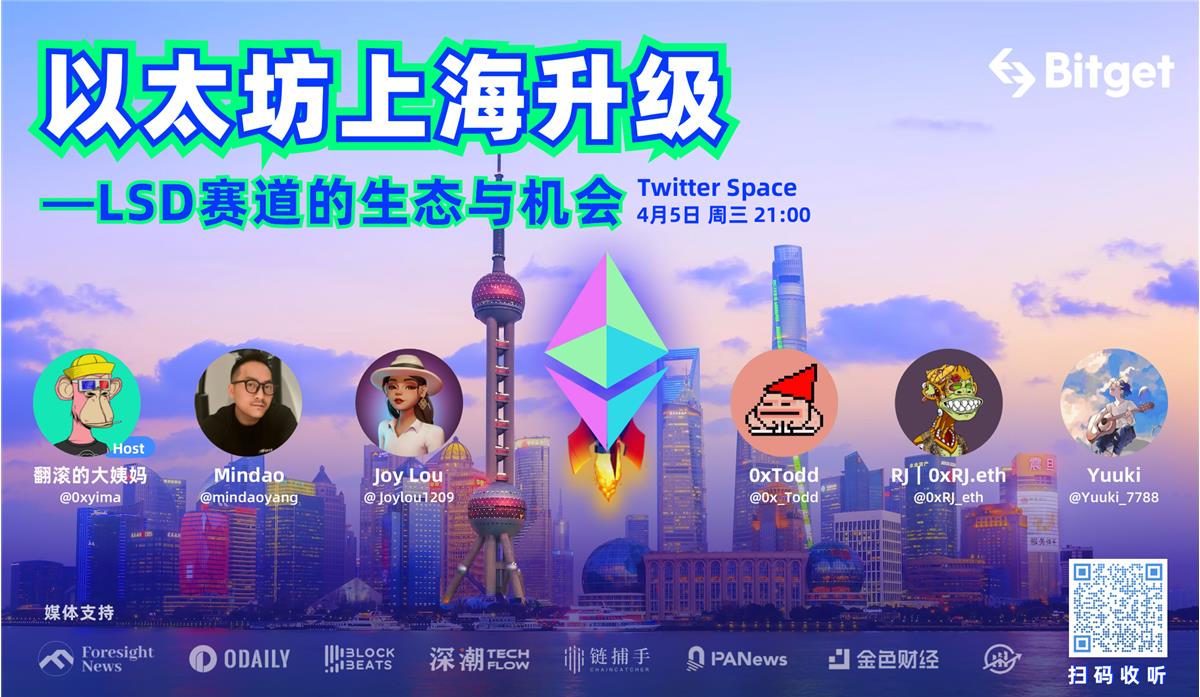
Last week, Bitget hosted an online Twitter Space discussion themed "Ethereum Shanghai Upgrade – The Ecosystem and Opportunities in the LSD Sector." The session was moderated by Big Aunt on a Roll, and荣幸ly featured five industry experts as guests: Mindao, Joy Lou, 0xTodd, 0xRJ.eth, and Yuuki.
This Space focused on analyzing the Ethereum upgrade from multiple dimensions including LSD and the broader Ethereum ecosystem. Guests shared their personal insights from various angles regarding the pre- and post-Shanghai-upgrade cycles, resulting in dynamic exchanges and differing viewpoints.
Q1: Since its launch in 2015, the Ethereum blockchain has undergone several major upgrades. What makes this upgrade uniquely different compared to previous ones? And how will the upgraded components directly benefit the current LSD sector?
0xTodd: Every Ethereum upgrade is unique. Last year’s merge transitioned Ethereum from Proof-of-Work to Proof-of-Stake (PoS), completing the consensus switch. However, one final piece of PoS remains incomplete—withdrawals from staking. Only when users can withdraw their staked ETH will PoS be fully realized. The most critical aspect of the Shanghai upgrade is enabling withdrawals for Ethereum's PoS mechanism. At its core, this upgrade completes PoS once and for all, laying solid groundwork for future Ethereum scalability efforts.
Yuuki: The biggest immediate benefit of this upgrade is the ability to withdraw ETH. Additionally, four protocol improvements focus on three key areas. First, reducing Ethereum gas fees—such as through EIP-3860 and EIP-3855. Second, speeding up transaction processing. Currently, much attention centers around ETH withdrawal capabilities. Further developments like Layer2 enhancements are expected in subsequent upgrades.
Mindao: Without a withdrawal function, PoS is fundamentally incomplete—similar to a national policy that allows only rate hikes but no cuts, or tax increases without reductions; it cannot form a closed loop. A major issue with ETH has been its low staking rate—only about 15%. This staking rate directly reflects network security, so a low rate inherently weakens overall network safety.
The primary reason behind Ethereum’s low staking rate has been the inability to withdraw funds. As a result, LSD products have been excessively amplified by market demand. Therefore, this upgrade marks a milestone event for the completeness of Ethereum’s economic security model. In significance, the Shanghai upgrade ranks second only to the original shift to PoS.
Q2: With ETH withdrawals now enabled, what impact might selling pressure have on secondary market prices? How will current staking prices change—will they rise or fall?
RJ: Many believe there could be significant short-term selling pressure. But looking at the longer term, actual selling pressure may not be substantial. If the Shanghai upgrade succeeds, it brings clear benefits to the entire Ethereum ecosystem—enhancing liquidity and boosting market confidence.
Reasons why near-term selling pressure may remain limited: Among Ethereum’s four current staking methods, real selling risk mainly exists among solo stakers—individual node operators. These users are typically early adopters who took on high risks by operating standalone nodes under long lock-up conditions, which suggests strong long-term belief in Ethereum—essentially, they are “true believers.” Given this mindset, successful upgrades would further strengthen their confidence. Early technical contributors and investors alike tend to agree: even if they withdraw funds, they’re likely to immediately re-stake them—or reinvest via other means—to capture higher returns.
Joylou: Regarding post-withdrawal selling pressure, I think some selling pressure will exist and could significantly affect secondary market prices.
Yuuki: Qualitatively speaking, my view aligns with general market sentiment. If we assess the Shanghai upgrade qualitatively, it’s undoubtedly positive for Ethereum both mid- and long-term. Confidence in increased ETH staking ratios post-upgrade implies less circulating supply, supporting ETH price growth—a medium-to-long-term outlook. For trading purposes, however, we must also consider short-term price volatility, requiring more quantitative analysis. A crucial moment occurs four to five days before the upgrade, when we can begin estimating potential secondary market selling pressure. Post-upgrade daily outflows are expected to be small—likely just tens of thousands of ETH per day. Ultimately, the combined effect of principal and profit withdrawals after the upgrade may significantly influence markets and token prices.
Mindao: From validators’ and ETH-denominated holders’ perspectives, assumptions that these users will convert ETH into fiat upon withdrawal are questionable. Those holding ETH as a base currency usually don’t intend to exchange profits for fiat. In the month following the upgrade, many may choose to withdraw—not due to selling pressure—but because the new format offers greater convenience, such as migrating to new address formats or switching staking providers.
0xTodd: To evaluate whether people will sell, we should first examine their approximate cost basis. On-chain data is fully transparent. From 2020 to today, despite poor liquidity, the ultimate floor price isn't determined by average costs, but rather by the lowest psychological threshold among participants. Second, exchange-based holders—constrained by lower liquidity and retail investor behavior—are potential candidates for withdrawal and selling. Third, Ethereum’s core philosophy isn’t simply "the more you hold, the better." Its interest accrual mechanism automatically sends accrued rewards to your designated withdrawal address—like an automated salary system, regularly transferring excess yield to your account. Finally, regarding cashing out: converting ETH into stablecoins represents direct liquidation. There’s also indirect liquidation—for example, purchasing LSD tokens. While not an immediate sale, value realization happens later down the line. Overall, after the Shanghai upgrade concludes, Ethereum’s market may undergo a period of notable downward pressure.
Q3: Could our expert guests share insights on specific projects within this sector—what advantages or opportunities they offer, or perhaps highlight any high-market-cap projects showing technological advancements?
Yuuki: Provided additional technical-level analysis on topics such as defining and calculating selling pressure, ETH yield returns, and staking rates. On the topic of emerging opportunities in the LSD sector, he noted that LSD products have complex structures—and thus correspondingly complex risk profiles. Without innovation, the LSD ecosystem may struggle to grow significantly. He detailed characteristics of the three dominant operational models currently prevalent in the LSD space. Lido and Rocket Pool stand out as leaders in innovation and progress, while Frax has demonstrated rapid growth. It remains to be seen whether these projects will achieve even greater success post-Shanghai upgrade.
RJ: When the total staking pool expands, where new capital flows becomes a key question. Beyond direct LSD-related projects, distributed validator technology (DVT) represents a foundational direction for future Ethereum-layer staking infrastructure. DVT addresses challenges like fragmentation mitigation, maintaining block production stability, and enhancing network decentralization—all aspects I personally find highly promising.
Yuuki: Added context on SSV: approximately 67% of ETH participating in network operations must use DVT solutions. This figure helps gauge the intrinsic value of protocols like SSV.
Q4: This year is shaping up to be a breakout year for Layer2. After the Shanghai upgrade, how will interactions between Ethereum mainnet and Layer2 evolve? What developments can we expect?
Mindao: Layer2 plays a vital role in extending and capturing Ethereum’s overall value, significantly strengthening the ecosystem. LSD assets themselves represent another form of expansion beyond Ethereum. Post-upgrade, two major shifts are expected in the LSD sector: First, backend node validation across all LSDs will gradually simplify. Second, ETH transitions from an equity-like asset to a debt-like asset.
After the upgrade, every node—regardless of size—can essentially gain liquidity through zero-coupon bond-style trading in the market. This is precisely why I’m not particularly bullish on a few top-tier projects—they lack significant liquidity advantages. Instead, I see stronger potential in large-scale applications built atop Ethereum Layer2. The true strength of Ethereum as a leading public chain lies in its ability to attract major decentralized applications.
RJ: Reduced gas fees represent the most direct benefit for Layer2 post-upgrade. The MEV (Maximal Extractable Value) sector also deserves attention, as it captures significant profits during periods of high price volatility. Lido’s staking yields doubling positions it strongly as the leading LSD project, giving it a distinct edge in MEV capture. Additionally, DeFi innovations within the LSD space—such as decentralized exchanges and new lending protocols—are worth watching.
Joy Lou: The most noteworthy LSD project remains Lido. Frax’s business growth rate is very high, making it essential for long-term portfolio allocation. DVT and FYI business models haven't yet formed complete value loops, but once closed-loop functionality is achieved, yield-aggregating LSD protocols like USH and LSDX could see rising demand.
Three additional promising directions: first, yield aggregation; second, lending plus stablecoins; third, multi-chain integration with innovative new models. Based on current market trends, we do believe both the LSD sector and ETH itself have room for correction.
Q5: What ETH/BTC exchange rate do you anticipate in the next bull market? Where could ETH price go in the future?
0xTodd: My overall outlook is somewhat bearish. April may see partial pullbacks, though ETH trended healthily prior to the Shanghai upgrade. Current market indicators resemble those seen between April and May 2019.
RJ, Mindao, Joy Lou: Hold relatively optimistic views and express confidence in Ethereum’s future trajectory.
Founded in 2018, Bitget is a leading global cryptocurrency exchange serving over 8 million users across 100+ countries and regions. Bitget partners with globally recognized organizations, including legendary Argentine footballer Lionel Messi, Italian football club Juventus, and premier esports organizer PGL.
Note: Markets carry risks; invest cautiously. This article does not constitute investment advice—it serves solely to present and exchange guest perspectives.
Join TechFlow official community to stay tuned
Telegram:https://t.me/TechFlowDaily
X (Twitter):https://x.com/TechFlowPost
X (Twitter) EN:https://x.com/BlockFlow_News






