Decoding Etherscan: A Business Model Behind the Blockchain Browser That Earns Tens of Millions Annually
TechFlow Selected TechFlow Selected
Decoding Etherscan: A Business Model Behind the Blockchain Browser That Earns Tens of Millions Annually
For a long time, Etherscan has been one of the most popular and widely used tools in the cryptocurrency field.
 Navigating Web3 tides with focused insights
Author: Launchy
Translated by: TechFlow
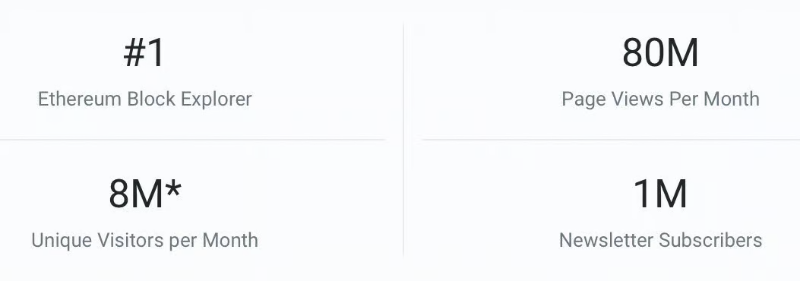
Etherscan is a tool that helps users browse the Ethereum blockchain, commonly known as a blockchain explorer, with 80 million visits per month. For years, Etherscan has been one of the most popular and widely used tools in the cryptocurrency space.
With Etherscan, users can easily analyze blocks and transactions on the Ethereum blockchain. Through this platform, everyone can experience one of the core principles of blockchain technology: transparency. From detectives investigating suspicious "rug pull" activities on-chain to traders monitoring large-scale capital flows, Etherscan provides us with essential tools to better understand what’s happening behind the blocks.
Etherscan does not have a token. While it operates at the heart of the crypto Web3.0 ecosystem, Etherscan is considered more like a “traditional SaaS business” rather than a fully native blockchain application. It simply offers users tools to better understand blockchain transactions.
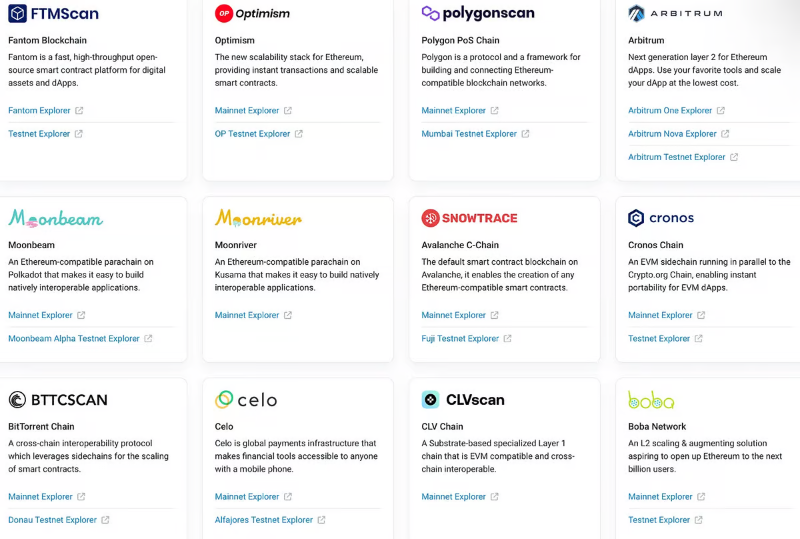
Since its founding in 2015, Etherscan has become the go-to blockchain explorer. By 2023, Etherscan had expanded to support over 18 blockchains.
How Does Etherscan Make Money?
Like many other software companies, Etherscan generates revenue by providing services. Although Etherscan also offers some B2B products, it primarily operates as a B2C business. However, advertising has become a significant source of income for Etherscan.
At a high level, Etherscan generates revenue from the following sources:
SaaS: Etherscan offers SaaS services mainly targeted at businesses, such as building blockchain explorers-as-a-service (which they call EaaS).
API Plans: Etherscan offers API plans for accessing its data, priced from free to $399 per month, with unpublished enterprise pricing available.
Advertising: Etherscan features five types of ads. Details are provided below.
On-chain Services: We found that one of Etherscan's products, BSCscan, offers delegation services, and Etherscan is developing additional on-chain tools, including wallet-to-wallet messaging, token approval revocation tools, and more.
Donations: This is straightforward. The platform allows users to donate to support its development and maintenance.
Let’s make some revenue estimates.
Newsletter: $120K–$300K Annually
If Etherscan has 1 million subscribers, depending on CPM rates, each newsletter could charge between $20,000 and $50,000. Since the newsletter isn't a "core" product and open rates aren’t discussed here, we assume a 50% discount on pricing.
Etherscan could charge $10,000 to $25,000 per newsletter issue (with monthly publication). Overall, they could generate $10,000 to $25,000 in monthly revenue from newsletters.
Website Advertising: $3.2M–$8.64M Annually
Website advertising is divided into four types: homepage banner ads, standard banner ads, header text ads, and button ads.
Frankly, this revenue heavily depends on how Etherscan chooses to monetize. As shown in the examples below, it varies based on industry verticals, monetization methods, and market conditions.
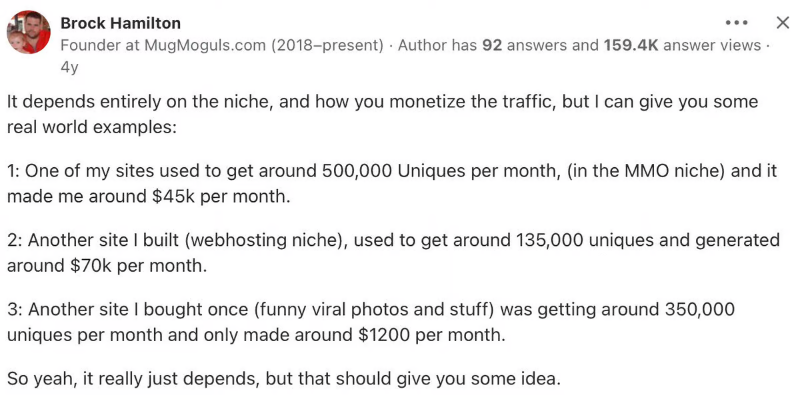
Estimating ad revenue based on website traffic is tricky because it varies significantly across industries, domains, and geographies. For context, every 1,000 pageviews can earn anywhere from $0.10 to $50.
A very generic formula is: monthly traffic / 1,000 * RPM.
RPM ranges from around $15 per 1,000 impressions to as high as $100 in specific niches like real estate insurance. Let’s assume the crypto sector’s RPM falls between $30 and $50.
Using extremely rough estimates, I project that Etherscan’s monetization potential—with four distinct ad placements and higher crypto-sector RPM—could yield:
80 million monthly pageviews. According to Playwire, 10 million pageviews should net at least $25,000 per month. At this rate, Etherscan should net $200,000 monthly.
8 million monthly unique visitors. Based on the Quora source mentioned above, 500,000 unique visits in the gaming sector can net $45,000 monthly. At this rate, Etherscan should net $720,000 monthly (assuming crypto RPM is comparable to gaming).
API plans, on-chain services, and SaaS: $2.91M–$12.55M annually.
Assuming Etherscan converts the following percentage of unique visitors (8 million) into paying customers at the lowest price point ($199/month):
0.1% → 8,000 customers paying $199/month → $1.91M annually.
0.5% → 40,000 customers paying $199/month → $9.55M annually.
As for Etherscan’s Explorer-as-a-Service (EaaS), these are more like one-time deals (perhaps with some recurring maintenance fees). Most of the on-chain services listed on the site—token approvals, block scanner chat—remain in testing phases.
Therefore, we estimate annual revenue from these services falls within the low seven-figure range ($1M–$3M).
Team Size and Expenses
According to LinkedIn, Etherscan has 29 employees. LinkedIn categorizes the top five “departments” as follows:
Engineering – 12 people
Business Development – 8 people
Operations – 4 people
Community and Social Services – 3 people
Information Technology – 2 people
Let’s create a scenario to estimate how much Etherscan spends annually across these five departments:
Engineering: Within a salary range of $100K–$200K, Etherscan would spend $1.2M–$2.4M annually.
Business Development: Within a range of $80K–$120K, Etherscan would spend $640K–$960K annually.
Operations: Within a range of $70K–$100K, Etherscan would spend $280K–$400K annually.
Community and Social Services: Within a range of $60K–$90K, Etherscan would spend $180K–$270K annually.
Information Technology: Within a range of $100K–$150K, Etherscan would spend $200K–$300K annually.
Overall, for the above five departments, Etherscan would spend $2.5M–$4.33M annually.
However, an important point is that Etherscan is based in Malaysia—this significantly reduces salary expenses. A more realistic assumption would be to halve the annual headcount cost, resulting in $1.25M–$2.15M annually.
As always, this figure represents only headcount costs. It does not include other operating expenses such as third-party vendors, office space, etc.
Profits
Our estimates result in the following:
Etherscan’s revenue: $6.23M–$21.49M annually.
Newsletter → $120K–$300K annually;
Website advertising → $3.2M–$8.64M annually;
API plans, on-chain services, and B2B SaaS → $2.91M–$12.55M annually;
Etherscan’s expenses: $1.25M–$4.33M annually.
Our rough calculation yields:
Minimum gross profit of $1.9M ($6.23M – $4.33M);
Maximum gross profit of $20.24M ($21.49M – $1.25M).
What’s Next?
For Etherscan, moving into business intelligence is a logical next step.
They already possess all the blockchain data and could launch dashboard products similar to Dune or wallet labeling features like Nansen. This appears to be a relatively easy way for Etherscan to expand vertically without requiring substantial additional resources.
In fact, Etherscan’s lack of movement in this direction suggests they are already highly profitable in their established domains—raw blockchain data—and their brand (website traffic/ad revenue).
Etherscan is in a strong position. They are not based in the U.S. and have not launched any token. As the blockchain ecosystem matures, let’s watch how this undisputed king of blockchain explorers navigates the market.
Join TechFlow official community to stay tuned
Telegram:https://t.me/TechFlowDaily
X (Twitter):https://x.com/TechFlowPost
X (Twitter) EN:https://x.com/BlockFlow_News
 beehiiv