








Nexus Labs: How to Scale Blockchain Through Verifiable Cloud Computing?
TechFlow Selected TechFlow Selected
Nexus Labs: How to Scale Blockchain Through Verifiable Cloud Computing?
This article will introduce the features and architecture of Nexus and Nexus Zero, and explore how they advance the development of blockchain technology.
 Navigating Web3 tides with focused insights
Author: Stanford Blockchain Review
Translated by: TechFlow
This article is from the Stanford Blockchain Review. TechFlow is an official partner of the Stanford Blockchain Review and has been exclusively authorized to translate and republish this content.
As blockchain technology continues to evolve, more and more application scenarios are emerging. However, challenges remain when it comes to large-scale adoption—one of which is blockchain scalability.
To address this issue, Nexus Labs has proposed a new solution—a general-purpose verifiable cloud computing network built on blockchains that provides computational power and scalable access for blockchains, rollups, and smart contracts. This article will introduce the features and architecture of Nexus and Nexus Zero, and explore how they can advance blockchain technology.
Introduction
Verifiable cloud computing makes it possible to outsource computation of traditional programs (e.g., written in Rust or C++) to remote servers like AWS or Google Cloud, while receiving both program outputs and cryptographic proofs verifying the correctness of the computation. This allows users to outsource computations to untrusted servers while retaining the ability to verify results.
The potential impact of verifiable cloud computing on the blockchain space is profound. By enabling smart contracts to mathematically verify outsourced computation, storage, and interactions with external systems, this technology could dramatically enhance the computational capabilities of smart contract platforms.
Nexus is an attempt to realize general-purpose verifiable cloud computing, particularly aimed at scaling Ethereum applications. In this article, we provide a brief overview of the key innovations our team is developing to achieve this future.
Verifiable Computation
Verifiability can be defined and implemented in various ways. Common approaches include:
-
Validity Proofs: Using zero-knowledge proofs / zk-SNARKs, verifiers can mathematically confirm whether a given program was computed correctly.
-
Fraud Proofs: Provide proofs of invalidity. This approach is often called optimistic computation and requires at least one honest party to detect and prove fraudulent behavior.
-
Consensus Proofs: Do not require mathematical correctness; instead, assume that a threshold (t-of-N) of participants are honest or economically rational. This is the method adopted by blockchains and sidechains.
Each method involves significant trade-offs between usability and security. Generally, zero-knowledge proofs offer the strongest security guarantees, while consensus/state-machine replication provides the most practical and robust foundational algorithms today.
Security and Liveness
Verifiability alone is insufficient. Building truly decentralized applications requires two security guarantees:
-
Security: Equivalent to verifiability/correctness properties.
-
Liveness: Ensures that applications eventually execute—i.e., they are censorship-resistant.
Systems such as Optimistic and ZK Rollups can provide security (via fraud proofs/ZKPs), but fail to guarantee liveness (e.g., if they rely on a centralized sequencer). A system that provides both security and liveness is considered fully correct.
Nexus: Achieving Fully Correct General-Purpose Verifiable Cloud Computing
Nexus is a decentralized marketplace for verifiable cloud computing.
It enables developers to host serverless cloud applications written in traditional languages (e.g., Rust, C++, Go)—similar to AWS Lambda—while benefiting from security and liveness guarantees.
There are two distinct versions of Nexus: Nexus and Nexus Zero.
Nexus Zero: A Zero-Knowledge Cloud Computing Network
Nexus Zero is a decentralized off-chain network of zero-knowledge provers that allows Ethereum smart contracts to outsource general computation.
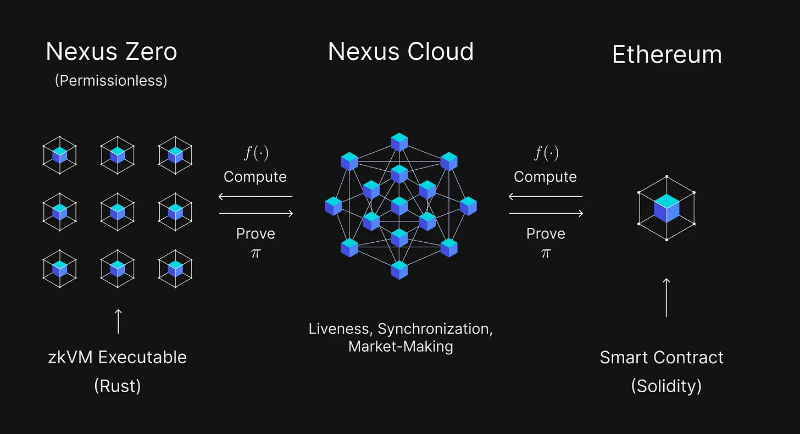
It consists of three components:
-
A general-purpose zero-knowledge virtual machine (zkVM).
-
A permissionless prover network.
-
A decentralized market maker network.
Applications on Nexus Zero are stateless "zk-Functions," directly invoked by smart contracts. This means Nexus Zero uses a single universal circuit to prove any computation (within runtime limits), rather than compiling each program into separate circuit representations.
Nexus: A Decentralized Cloud Computing Network
Nexus is a decentralized cloud computing network—in other words, a network composed of independent, externally perceivable "serverless blockchains."
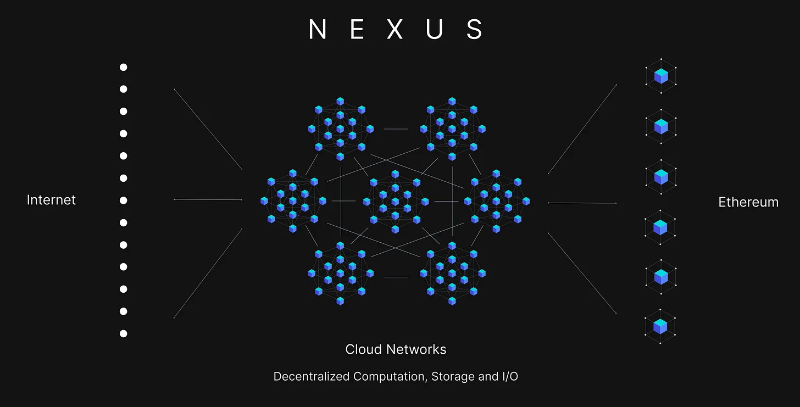
Applications on Nexus are stateful "Nexus Functions," directly callable by smart contracts. The Nexus network can be used to outsource computation, storage, and I/O capabilities from smart contract systems. It can also replicate any proof system (e.g., ZK or optimistic), effectively performing the same functions as AWS/Google Cloud—but with full correctness guarantees.
The Nexus network reaches internal consensus and communicates with external systems through special multi-party computation techniques (such as threshold signature schemes). Node incentives are based on traditional Proof-of-Stake (PoS).
Thus, developers can use Nexus to instantly launch a "serverless blockchain" connected to Ethereum. These networks can serve as sidechains, oracle networks, storage/data availability layers, guardian networks, decentralized sequencer networks, or dedicated blockchains.
Nexus: Simplicity
Beyond achieving general-purpose verifiable cloud computing, one of Nexus Labs’ central goals is to deliver an extremely simple and enjoyable developer experience.
That’s why both Nexus and Nexus Zero are designed to feel just like traditional cloud computing. Developers can write programs in familiar languages and import their preferred libraries.
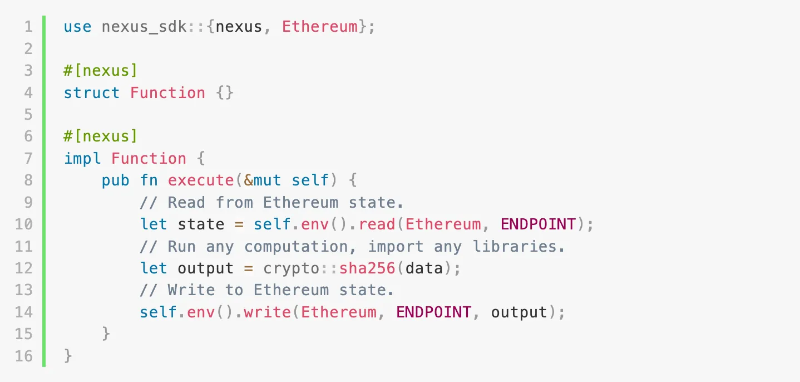
The above shows an example of a stateless "Lambda function" on Nexus connected to Ethereum, triggered on every new block. Functions also have access to persistent storage and a local POSIX-like file system.
Moreover, unlike regular smart contracts, Nexus Functions can maintain state across invocations and run long-running tasks—such as rollup sequencers or any zero-knowledge proof generation—as long as two conditions are met: 1) the task is deterministic, and 2) it compiles to WASM.
Conclusion
General-purpose verifiable cloud computing opens up entirely new frontiers in blockchain scalability, promising to greatly enhance the computational capacity of blockchains, rollups, and smart contracts.
Join TechFlow official community to stay tuned
Telegram:https://t.me/TechFlowDaily
X (Twitter):https://x.com/TechFlowPost
X (Twitter) EN:https://x.com/BlockFlow_News
 Stanford Blockchain Club






