Exclusive Interview with Nexus Founder Daniel: How to Rebuild Trust Mechanisms in the AI Era?
TechFlow Selected TechFlow Selected
Exclusive Interview with Nexus Founder Daniel: How to Rebuild Trust Mechanisms in the AI Era?
A deep dive into Nexus's founding vision, the future trajectory of verifiable computing, and the tight integration among zkVM, distributed computing, and AI trusted execution.
 Navigating Web3 tides with focused insights
Interviewee: Daniel Marin, Founder and CEO of Nexus
Interview and article by: Alex, OpenBuild Content Team
As AI computing power expands rapidly and Web3 infrastructure evolves at pace, verifying the authenticity of large-scale computation has become a core challenge for global digital systems. Nexus is advancing a frontier exploration—building a globally collaborative, publicly accessible verifiable computing network that integrates zero-knowledge virtual machines (zkVM) with a distributed prover network, forming an "infinite world supercomputer."
In this exclusive interview, OpenBuild speaks with Daniel Marin, founder of Nexus, to explore the origins of Nexus, the future trajectory of verifiable computing, and the deep integration between zkVMs, distributed computing, and trusted AI execution. He also shares how Nexus achieves high-performance scaling for general-purpose computing through dual drivers of technology and ecosystem—all without compromising privacy.
Guest Profile
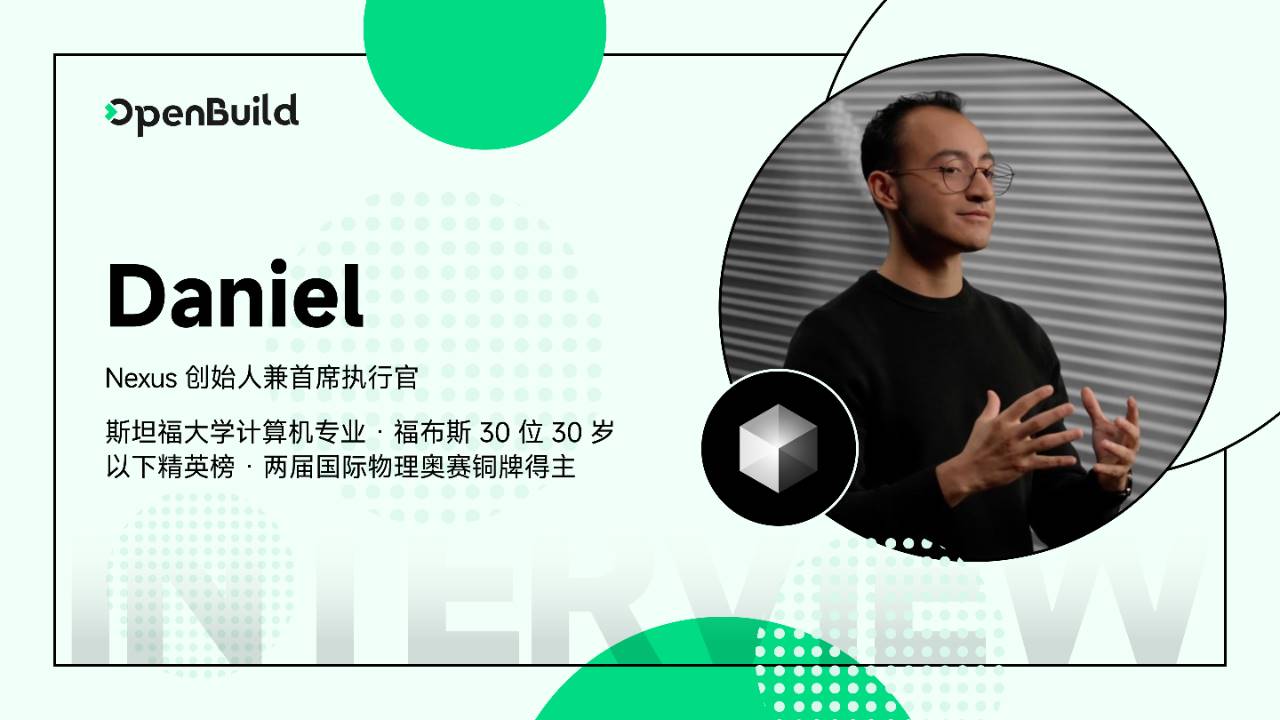
Daniel Marin, Founder and CEO of Nexus, graduated from Stanford University with a degree in Computer Science. He founded Nexus in 2022 with a mission to build a digital world where "every action is verifiable, every model auditable, and every interaction provable." He won bronze medals at the International Physics Olympiad in 2018 and 2019, and was named to Forbes' "30 Under 30" list in 2025. Nexus has raised $25 million in funding from leading investors including Pantera Capital, Lightspeed, and Dragonfly Capital.
Founding Vision: A Verifiable Computing Platform for Everyone
OpenBuild: What inspired you to found Nexus? What problem were you originally trying to solve?
Daniel Marin: At the time, I was involved in a research project at Stanford's Cryptography Lab, where I witnessed the rapid evolution of zero-knowledge proofs—particularly inspired by Microsoft Research’s Nova paper[1]. It made me realize we could efficiently combine multiple zk proofs to create a new paradigm of "general-purpose verifiable computing"[2].
On the other hand, I observed three major bottlenecks in today’s blockchain ecosystems:
1. Users cannot easily contribute computing power
2. Developers require specialized expertise to participate
3. The chain itself faces severe limitations in scalability and performance
I began asking: Could anyone, using any device—even an old smartphone—join the network, contribute compute resources, run AI-level tasks, and still prove the authenticity of those computations?
This became the starting point for Nexus—a chain that gets faster as more nodes join. Unlike traditional blockchains, the more people participate in Nexus, the faster and stronger the network becomes. Each new device isn’t a burden—it’s an accelerator. My original motivation for founding Nexus was simple: to make the internet safer and more trustworthy.
For years, I've been thinking about whether we can build a "universal verifiable computer"—an infrastructure where anyone can verify computational results. With breakthroughs in zero-knowledge proof technology, this goal finally became feasible. My experience at the Stanford Cryptography Lab, especially being inspired by Microsoft Research’s Nova paper[3], solidified this vision. I realized we could efficiently compose multiple zk proofs into a new paradigm of "general-purpose verifiable computing."
Beyond that, I saw multiple constraints in current blockchain systems:
• Ordinary users cannot contribute resources;
• Development门槛 are high, requiring complex tools;
• Scalability is severely limited.
So I had an idea: Let everyone connect to the network using their own devices—even just a phone—contribute computing power, and collectively build a trusted supercomputer capable of large-scale computation.
That’s the origin of Nexus. Unlike traditional blockchains where "more nodes mean slower performance," Nexus operates on the principle that more nodes equal greater strength.
The Future of zkVM and Verifiable Computing
OpenBuild: What was your initial vision for "verifiable computing," and how do you see its future now?
Daniel Marin: We’re at a turning point in computing paradigms. I believe verifiable computing will reshape our understanding of scalability, performance, and even application design.
Scalability[4] here unfolds across two dimensions:
• Vertical: Accelerating zkVM speed via hardware like GPUs;
• Horizontal: Connecting more devices to form a global compute network, creating exponential compounding effects.
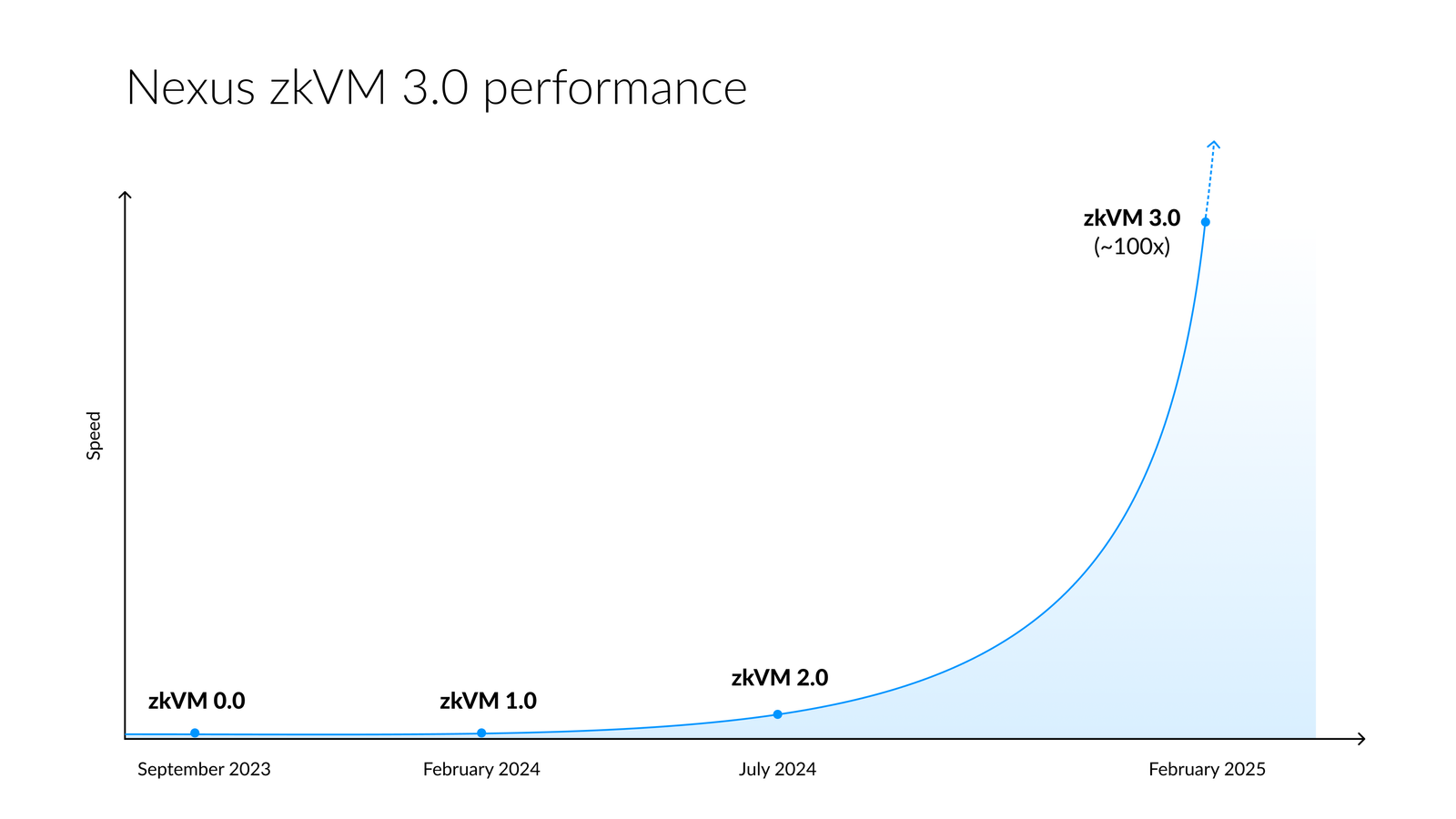
This isn’t theoretical. We expect zkVM speeds to reach 1GHz on an M2 MacBook Pro within the next year—meaning a single laptop could verify one block per second. It’s like witnessing Moore’s Law unfold in the zk space.
On the application side, we’re particularly excited about AI verification needs—such as auditability of model behavior and traceability of AI-generated content. This is exactly why we established the Nexus Verifiable AI Lab[5].
Fundamental Differences from Traditional Blockchains
OpenBuild: What fundamentally sets Nexus apart from other chains? How does it address the challenges of AI infrastructure?
Daniel Marin: Everyone talks about scalability, but they overlook the most critical issue: insufficient underlying compute power.
As AI applications grow broader and models become more complex, required compute grows exponentially, along with extremely high-frequency transaction demands. So the real question is: How can we access enough compute to support tens of billions of transactions per second—and ensure users still trust them?
This is precisely the problem Nexus aims to solve:
• It’s a world supercomputer;
• Every connected laptop or phone increases network performance;
• Any user can easily contribute idle compute—no technical background needed.
We’ve built a zkVM-powered Layer 1 blockchain that verifies not just transactions, but arbitrary computations. It aggregates global idle compute, enabling any user to join with one click.
In essence, Nexus is not a traditional "chain"—it’s an infrastructure network optimized for universal verifiable computing.
The Vision of a "Verifiable Internet"
OpenBuild: You’ve mentioned that Nexus is building a “verifiable internet.” What does that mean, and how is it different from today’s internet?
Daniel Marin: Our envisioned "verifiable internet" represents a new paradigm:
• Every action can be proven;
• Every model can be audited;
• Every piece of data can be verified.
From AI to healthcare, identity systems to on-chain finance, every component of the future digital world will be built upon verifiability.
This is not just an upgrade in trust mechanisms—it will drive a transformation in business models. In this internet, trust doesn’t require "belief," only "verification." Powered by verifiable computing, the digital society will become more transparent, efficient, and secure.
Roadmap and Product Plans
OpenBuild: Looking ahead 6–12 months, what are Nexus’ key priorities from both technological and ecosystem perspectives?
Daniel Marin: We’ve just launched our global Testnet III[6], which will run until mainnet launch in Q3 this year. 👉 Feel free to visit: app.nexus.xyz to participate in testing and earn rewards.
At the same time, we’re focusing on:
• Developing the next version of zkVM;
• Building out the Nexus Verifiable AI Lab;
• Expanding our ecosystem with over 50 partner projects.
Going forward, we’ll continue iterating to make "verifiable computing" a core pillar of both AI and Web3.
Conclusion: Building a Trusted Digital Civilization
From Daniel’s insights, it’s clear that Nexus isn’t merely trying to "improve blockchain," but rather uses verifiable computing as a starting point to redefine the logic of trust in the future digital society.
In this era of generative everything and data explosion, "verifiability" is becoming a more critical foundational layer than "consensus" for the next generation of infrastructure.
Join TechFlow official community to stay tuned
Telegram:https://t.me/TechFlowDaily
X (Twitter):https://x.com/TechFlowPost
X (Twitter) EN:https://x.com/BlockFlow_News