A Guide to the Top Five Upcoming ZK Projects: Scroll, Starknet, Zksync, Taiko, and Polygon
TechFlow Selected TechFlow Selected
A Guide to the Top Five Upcoming ZK Projects: Scroll, Starknet, Zksync, Taiko, and Polygon
Last week, discussions surrounding the ZK narrative reached unprecedented heights.
 Navigating Web3 tides with focused insights
Written by: Salazar Slytherin
Compiled by: TechFlow
Last week, discussions around the ZK narrative reached unprecedented heights. CoinGecko, a popular cryptocurrency data aggregator, introduced a new category specifically for ZK tokens.
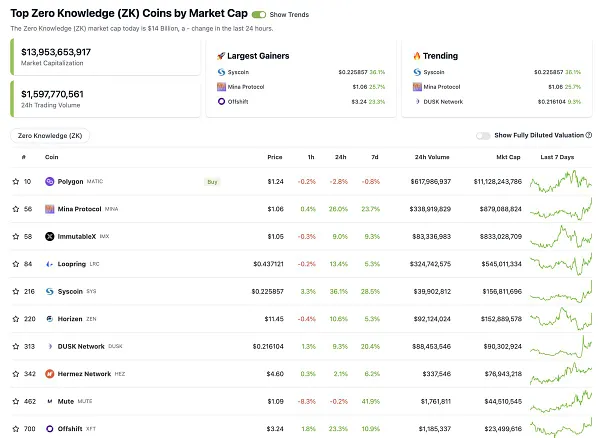
Some of these tokens, such as $LRC, $DUSK, $MUTE, and $MINA, have experienced significant growth. However, these are not necessarily the best projects or true innovators in the ZK space. Before identifying which projects are truly at the forefront of this new technological era, it’s important to consider all factors and developments within the ZK ecosystem.
"Builders are building"—many of them haven’t launched yet. Most are still on testnet and do not have tokens. We’ll explore them in this brief article.
1. Scroll
Type 2 zkEVM aims to be an EVM-equivalent rollup, making it easy for developers to port their code from L1 to its zkRollup.

2. Polygon zkEVM
Polygon has invested heavily in teams like Hermez and Zero to develop a Type 2 zk-EVM that is EVM-equivalent. The goal is to allow developers to build on Polygon zkEVM as easily as they do on Ethereum L1.
3. Starknet
It is not compatible with the Ethereum Virtual Machine (EVM), freeing it from the constraints of EVM functionality. Instead, it builds and uses its own technology, Cairo. It also features its own zk-SNARK-based zero-knowledge (ZK) algorithm—zk-STARK. This offers advantages such as trustless setup and superior ZK performance.
4. Taiko
Taiko is a Type 1 zkEVM, making it fully equivalent to Ethereum. It prioritizes EVM compatibility and zkR decentralization over proof generation, and it is also part of Loopring.

5. Zksync
Type 4 zkEVM. Developers write code in Solidity, which is then translated into Yul (converting high-level language code into low-level code). Then, LLVM (Low-Level Virtual Machine) compiles Yul into ZK bytecode, which is executed via zkVM.

Summary
A technology once considered challenging and thought to take years to realize is now almost within reach, giving us even more reason to be excited and eagerly anticipate its various technical implementations. ZK-Rollups (zkRs) have the potential to scale Ethereum (ETH) in ways previously unimaginable.
Join TechFlow official community to stay tuned
Telegram:https://t.me/TechFlowDaily
X (Twitter):https://x.com/TechFlowPost
X (Twitter) EN:https://x.com/BlockFlow_News
 Salazar.eth