Movement Co-Founder Clashes with Former Scroll Member, Sparked by Dispute over Defining Authority of Public Blockchains
TechFlow Selected TechFlow Selected
Movement Co-Founder Clashes with Former Scroll Member, Sparked by Dispute over Defining Authority of Public Blockchains
This骂战 triggered by technical discussions has also drawn community attention to the two ecosystems.
 Navigating Web3 tides with focused insights
By Pzai, Foresight News
In the blockchain space, friction between different projects frequently arises due to technological and community-related factors.
On November 27, Rushi Manche, co-founder of Movement, lashed out at former Scroll employee Toghrul Maharramov on X. Toghrul had previously referred to users directly as "e-beggars" in some posts—so much so that it became a meme within the Scroll community. Rushi stated bluntly, "Almost no one would recognize you as an EVM L2 based on the work you've done." This technical debate quickly escalated into a public feud, drawing significant community attention to both ecosystems. This article outlines the full timeline of events to help readers understand what transpired.
The Battle for Technical Definition
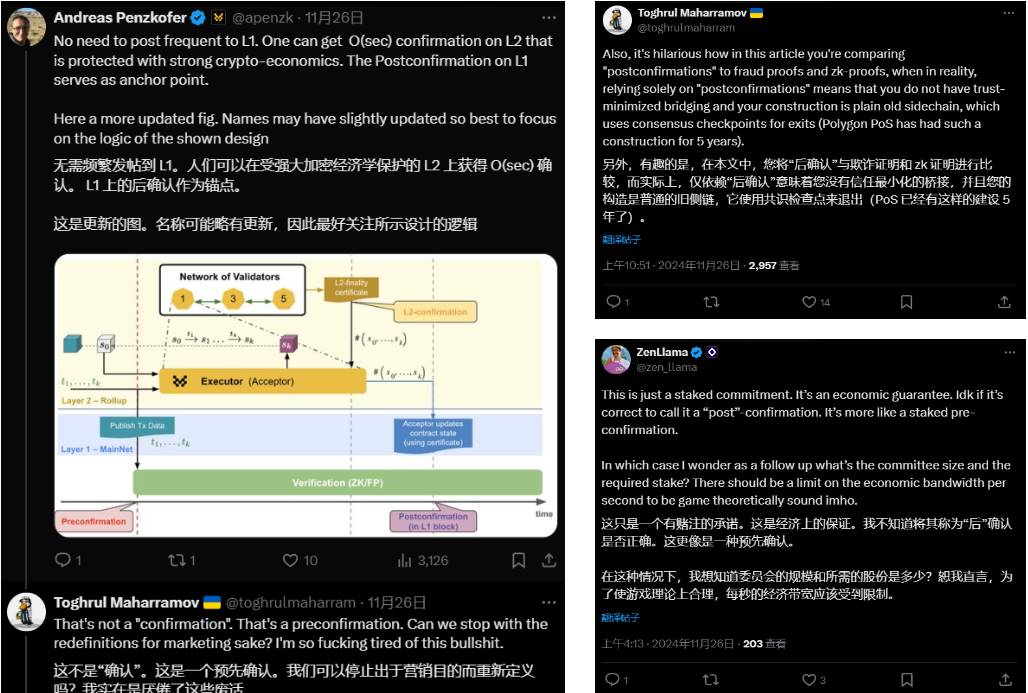
The conflict originated on November 26 during a discussion about "post-confirmation." In blockchain networks, post-confirmation refers to validators rapidly verifying the correctness of a newly created block after its proposal. This process occurs during the confirmation phase and aims to accelerate transaction finality while offering a degree of security. As a modular Move framework, Movement’s approach to post-confirmation involves economic guarantees through L2 MOVE token staking to achieve instant L2 finality, followed by state updates on L1 once proofs are submitted. The validator network verifies new blocks, submits signed attestations, and confirms or rejects new blocks within the L1 staking contract.
Toghrul expressed skepticism about Movement's concept of "post-confirmation," engaging in discussions with Movement researchers Andreas and Franck. The core disagreement centered on whether "post-confirmation" was simply another form of pre-confirmation. Toghrul insisted that this mechanism represented only part of the overall confirmation process and argued that "post-confirmation" did not minimize trust in bridging—claiming it was effectively equivalent to Polygon sidechains and therefore shouldn't qualify as a Layer 2. Monad’s DevRel ZenLlama also leaned toward the pre-confirmation perspective. Up to this point, the exchanges remained focused on technical definitions.
The Fire Ignites
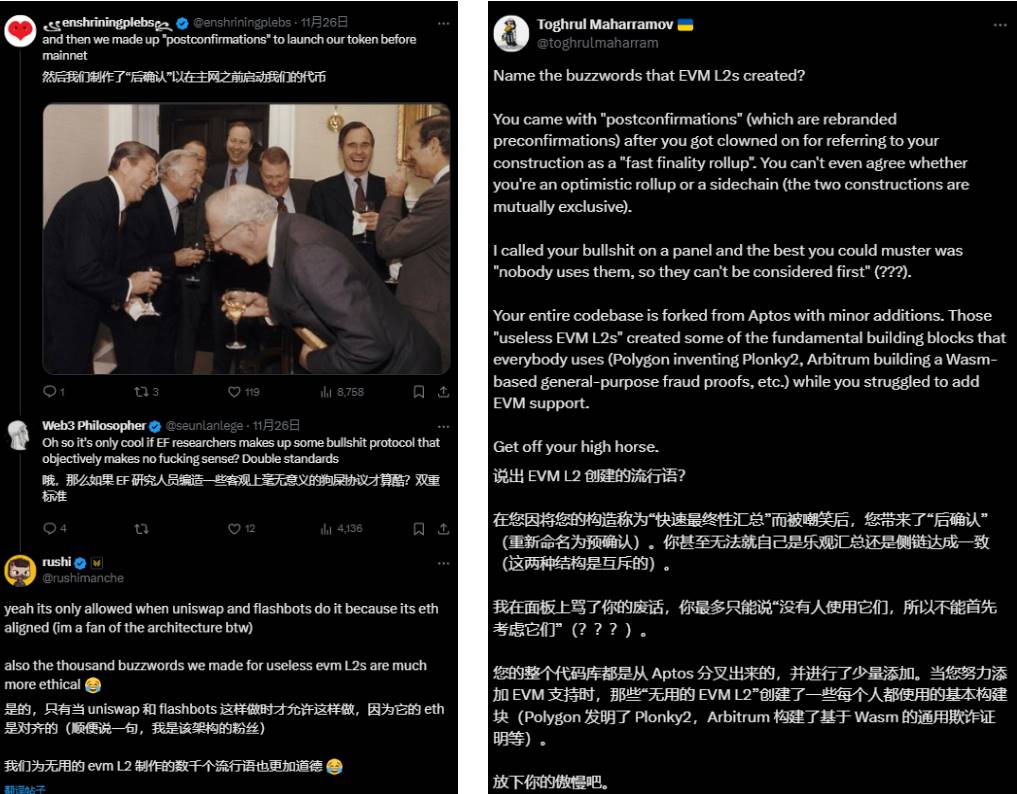
In another post, Rushi criticized the fact that “only protocols aligned with Ethereum—like those proposed by Uniswap or Flashbots—get attention today,” adding that thousands of terms have been coined for what he considers “useless” Ethereum L2s. Since Toghrul had just finished debating with Movement’s researchers, he promptly fired back, accusing Movement of being a direct fork of Aptos and leveraging infrastructure from what he called “useless L2s,” concluding with: “Please drop your arrogance.”
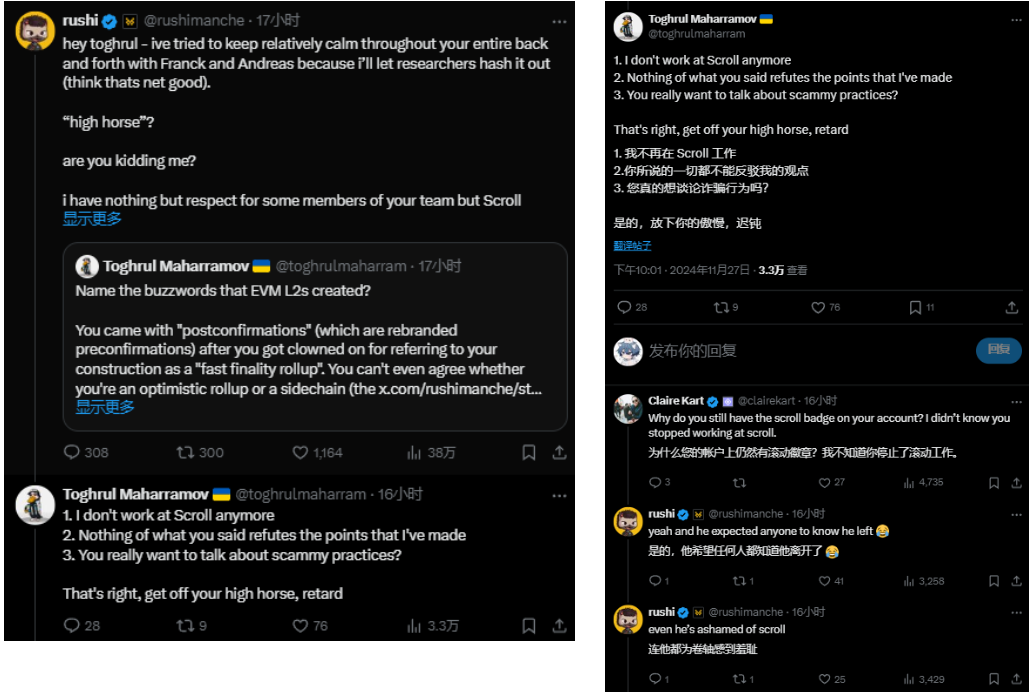
That final remark appears to have provoked Rushi, who responded with a lengthy thread stating: “I have respect for some members of your team, but Scroll and you might be among the worst projects in this space—so bad that at least six of your colleagues (half of whom are no longer on the team) have come to me apologizing for your behavior.” He launched a scathing critique of his former employer Scroll, alleging predatory airdrop distribution, team dumping (via secondary market sales and high-valued insider takeovers), and airdrop front-running. He concluded: “Technical debate is one thing—I’m sure we can improve. If you want to jump ship with Franck, come join us. Otherwise, fix your damn chain so it’s not an outright scam.”
At the moment when Movement opened registration for its MoveDrop airdrop on November 27, criticism of Scroll gained further traction among community members, turning what began as a technical debate into part of a broader project marketing narrative.
Interestingly, Rushi claimed that a quarter of Scroll’s team had applied for positions at Movement over the past two months. Toghrul quickly responded, confirming he had left Scroll—but at the time of replying, he still hadn’t removed the Scroll badge from his X profile. Rushi remarked: “Even he is ashamed of Scroll.”
Community Reaction
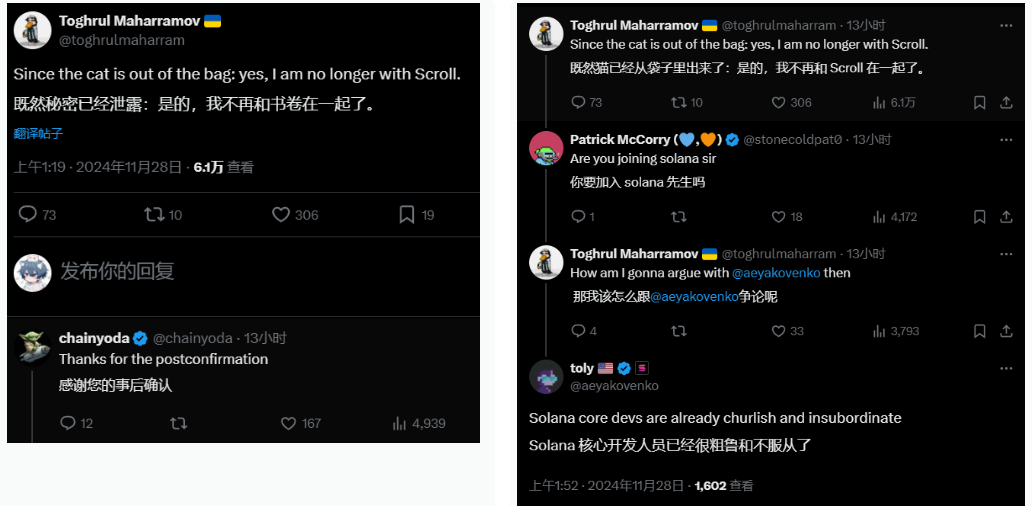
After Rushi’s attack, Toghrul officially confirmed his departure from Scroll. Some users joked, “Thanks for the post-confirmation,” while others asked if Toghrul would join Solana. Solana co-founder Toly humorously replied: “We’re already reckless enough.”
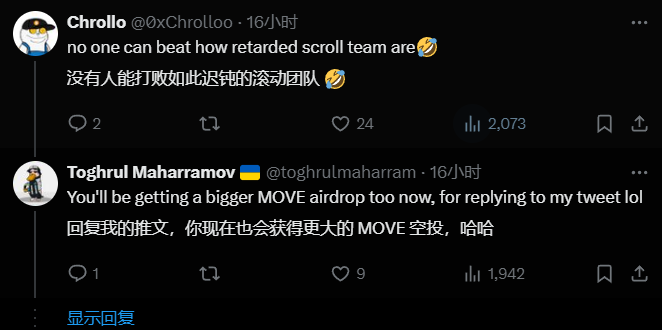
Following the incident, many community members condemned Toghrul and the Scroll team. In response, Toghrul shot back at critics: “Replying to my posts will definitely get you a bigger MOVE airdrop, right?”
What started as a technical debate revealed deeper tensions between emerging public chains built on new architectures like Move and the established EVM L2 ecosystem.
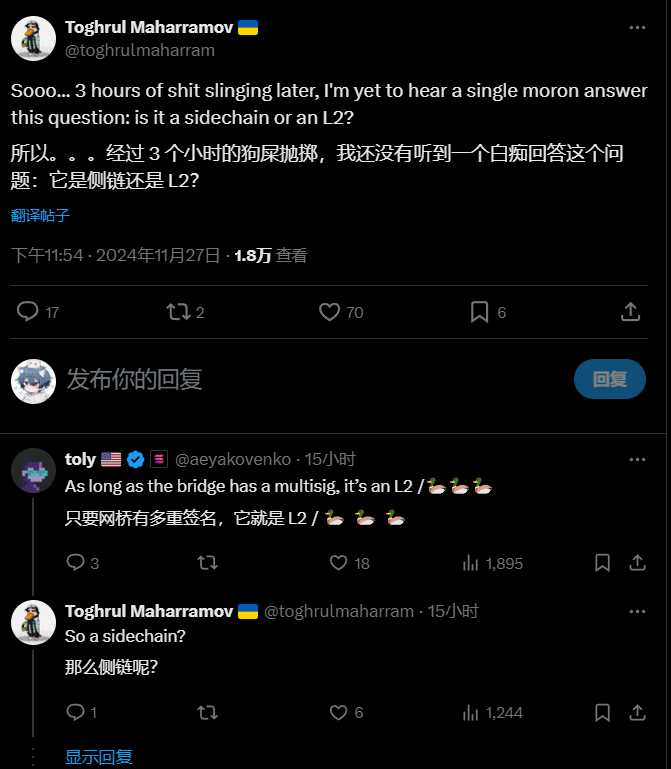
For Movement, Rushi received widespread community support. Meanwhile, Scroll has long positioned itself around ZK technology. Toghrul later posted: “Still haven’t heard the final answer—Is Movement a sidechain or an L2?” To which Toly commented: “As long as the cross-chain bridge uses multi-sig, it can be called an L2.”
Join TechFlow official community to stay tuned
Telegram:https://t.me/TechFlowDaily
X (Twitter):https://x.com/TechFlowPost
X (Twitter) EN:https://x.com/BlockFlow_News
 Foresight News