Exclusive Interview with Move Industries CEO Torab Torabi: After the Market Maker Scandal, How is Movement Rebuilding Trust?
TechFlow Selected TechFlow Selected
Exclusive Interview with Move Industries CEO Torab Torabi: After the Market Maker Scandal, How is Movement Rebuilding Trust?
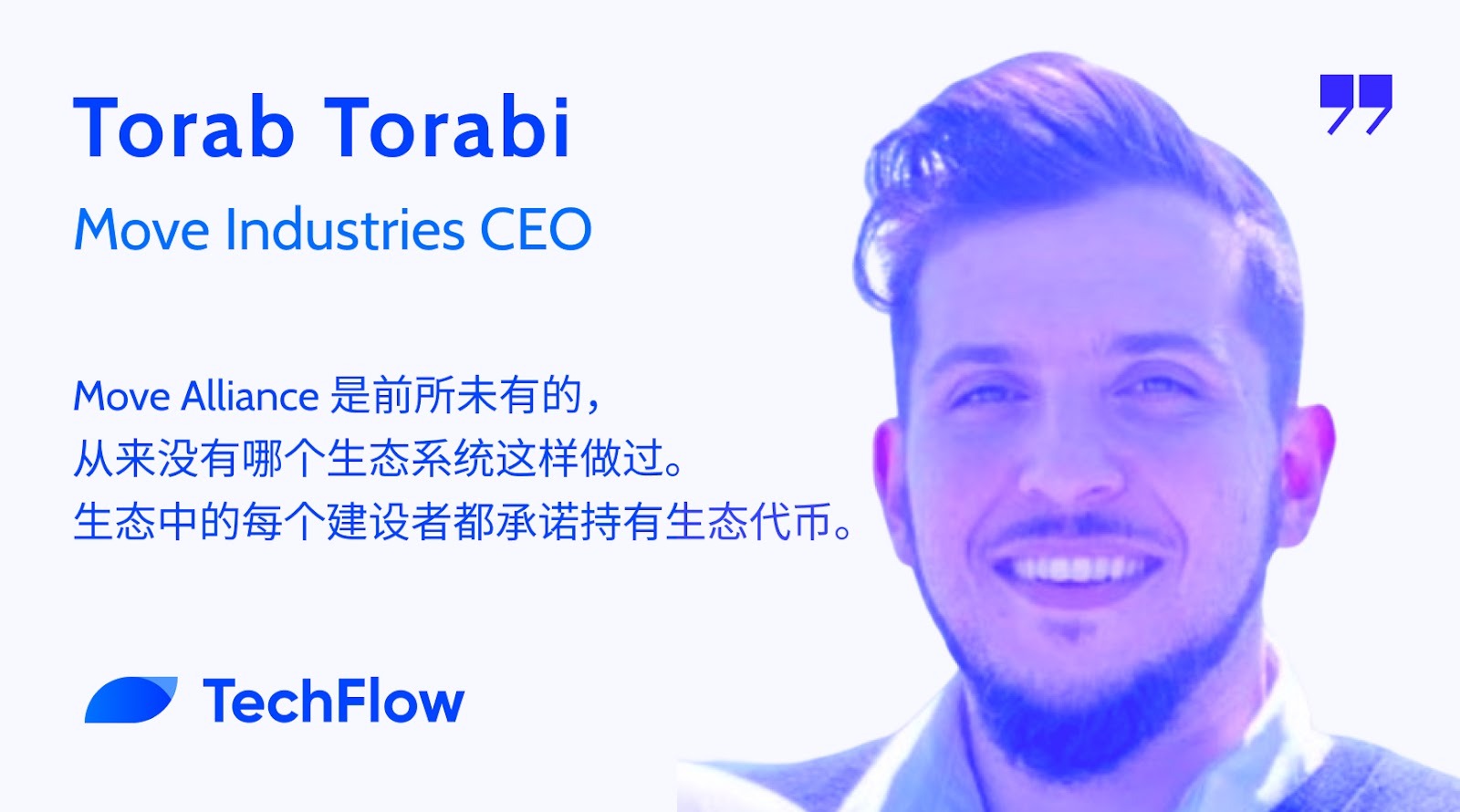
Move Alliance is unprecedented; no ecosystem has ever done this before.
 Navigating Web3 tides with focused insights
Written by: TechFlow
Introduction
In December 2024, on the first day of its token launch, Movement (MOVE) faced a massive sell-off by market maker Web3Port, dumping 66 million tokens and creating approximately $38 million in selling pressure. The token's market cap plummeted from $3 billion to under $500 million.
Subsequent investigations revealed a market-making agreement described by internal legal counsel as "the worst contract I've ever seen"—a company named Rentech, with almost no public information, appeared on both ends of the contract simultaneously as a subsidiary of Web3Port and an agent for the Movement Foundation.
In May 2025, after internal issues at Movement Labs led to the dismissal of Rushi Manche, a new independent company, Move Industries, was established. It acquired part of the Labs team through arm’s-length transactions and appointed Torab Torabi as its CEO.
What did this crisis mean for Movement? How does the new leadership plan to clean up the mess? How will the value of the MOVE token be realized? With these questions in mind, TechFlow sat down with Torab Torabi, current CEO of Move Industries.
Part 1: A New Chapter for Movement—Brand, Role, and Strategy
TechFlow: Thank you for joining us. Could you first introduce yourself to our readers?
Torab: My name is Torab. I’m one of the founding members of Movement and recently became CEO of Move Industries. Before this, I worked in Silicon Valley, focusing on mobile data analytics and sales growth at Salesforce and Sensor Tower.
About five years ago, I went full-time into crypto. I joined Marinade, the largest DeFi protocol on Solana at the time, where I truly learned the ins and outs of crypto and blockchain, especially DeFi.
Later, I worked on a stablecoin project that didn’t succeed—looking back, it was simply too early. I joined the Movement team about two and a half years ago as a founding member. It’s been around nine months since I took on this new role, and the experience has been great.
TechFlow: You’ve recently become CEO of Move Industries. What’s the biggest change in your daily work? How has your leadership style evolved from being BD/growth lead to CEO?
Torab: It’s been a big shift from the start. Previously, my focus was external. As CEO, I now manage both internal and external stakeholders. Investor relations is also new to me—I never touched that before. These have all been valuable learning experiences.
I quickly realized that my previous role came with significant responsibility but without real decision-making power. I often compare it to being a step-parent—you carry all the responsibilities of a parent but lack the authority. Jokingly, you don’t even have the right to yell at the kids.
Now, as CEO, I have the ability to lead the team and make final decisions. The biggest difference is going from being a passenger to being the driver. But what I’m most proud of is that we’ve retained the vast majority of our team members, developers, and investors.
TechFlow: Shortly after Rushi Manche left due to controversy over preferential treatment of the market maker, you founded Move Industries. What were the core considerations behind this decision? Why choose the name “Move Industries”—is there a deeper meaning?
Torab: After the incident, the first thing was acknowledging the problem, understanding how we got here, and building mechanisms to prevent recurrence. Our first action was removing that market maker. Now we only work with top-tier, professionally recognized, and exchange-trusted market makers.
Many people wonder how Movement initially gained momentum. The answer has always been—and will always be—the community. Through close collaboration with community members worldwide.
We launched the “Global Hubs” program and will continue focusing on this during trust rebuilding. Trust is hard to build, but even harder to rebuild. We once had that trust; it collapsed, and now we’re working to restore it. This has been our priority over the past few months.
As for the name Move Industries—it reflects our effort to build an entire industry around the Move language: infrastructure, applications, developer tools, and a thriving ecosystem. “Industries” signifies scale, maturity, and long-term commitment. It signals that this isn’t about one company or one person, but a movement of developers, builders, and users united around exceptional technology.
TechFlow: As CEO, what kind of leadership do you believe Movement needs at this stage? And regarding the community, what key actions do you plan to take to rebuild and strengthen trust?
Torab: First, it’s not about doing something entirely new. I’m continuing the principles I believed in when I joined Movement. I entered the crypto space because I saw a financial system open only to a few.
My biggest “aha moment” was when I could use my Solana holdings as collateral to borrow USDC or USDT. I thought: “This is incredible—I can buy a car without selling my assets.” Then I started researching and realized this is exactly how the wealthy operate. Look at Elon Musk or Jeff Bezos—they rarely sell shares; they just borrow against them. I thought: “Why don’t ordinary people have this ability?”
Crypto is enabling people worldwide—even those without bank accounts—to access million-dollar financial services (assuming sufficient collateral). To me, the question is: How do we bring this to everyone else? That’s why I joined Movement. That’s what I want to build.
We recently announced Move Alliance, allowing builders to grow alongside Movement.
One major issue in most ecosystems is that builders want the chain to succeed so they can succeed too, yet they aren’t economically aligned with it. Move Alliance is unprecedented—no other ecosystem has ever required every builder to commit to holding the ecosystem token.
When the MOVE token reaches its rightful value, all ecosystem builders will benefit alongside us, rather than competing over users or fees as before. At the incentive level, they are now truly aligned with us.
Part 2: Recent Progress and Core Competitiveness
TechFlow: Move Industries launched with the principle of leading through technology and community building. Since then, what specific initiatives have been implemented in these two areas? Any key milestones or achievements to share?
Torab: First, blockchain is technology. The first thing I focused on after taking over was improving chain performance. We brought in Dr. Young Yang Liauw as our Chief Technology Officer. He previously led the Move platform at Aptos and was at Facebook during the development of the Move programming language, leading teams that built many of its core tools. He is also one of the maintainers of the Libra open-source software.
Under Young’s leadership, we launched the Monza upgrade—a transformative improvement. We reduced latency from 12 seconds to 1 second. The results were immediate: TVL grew by 61%, daily DEX trading volume increased tenfold, and stablecoin TVL rose sevenfold. We expanded from a single public node before Monza to over 70 nodes afterward, giving developers real freedom to build.
We achieved zero network downtime, processing over 35,000 swaps daily, with more than 11,000 smart contracts deployed across the ecosystem. The chain has become genuinely usable and competitive with top-tier blockchains.
We recently announced our transition from L2 to L1 and cleaned up our tech stack. No longer a patchwork of components, we now own the entire stack as a sovereign chain. This gives us control over every technical aspect, enabling decentralization and network governance. More importantly, L1 provides a foundation for developers and builders to fully leverage the potential of the Move programming language.
In today’s market, you must have a clear thesis because general-purpose L1s are essentially dead.
TechFlow: The launch of Move Alliance is a recent milestone. How does Alliance operate in practice? How is its buyback mechanism designed to ensure on-chain transparency and verifiability? What role do you expect it to play in driving ecosystem growth? Which projects have joined so far?
Torab: Virtually every team actively building in our ecosystem has chosen to join the Move Alliance program. I think part of the reason is that the standard model—where each chain has its own token and every team launches their own—is simply unsustainable.
Why do teams launch tokens? They want to create an economic event for themselves and their users. But what if we wait for the optimal moment—or skip it altogether?
After talking to builders and understanding their needs, we proposed: “What if you used your revenue to buy back MOVE tokens? If you hold them in your treasury, we can offer you annual yields similar to staking rewards.”
Each team in the Alliance has KPI-driven metrics to ensure financial alignment as part of the Alliance.
How does it work exactly? Each team agrees to use 50% to 100% of their generated revenue to buy back MOVE tokens.
In Q1, each team will have a dashboard tracking all these activities—we’ll monitor revenue and daily purchases. Teams are expected to use their income to buy back and hold MOVE tokens in their treasuries within a certain timeframe.
All of this will be publicly visible because it’s all on-chain. We’ll set up dashboards so anyone can monitor and verify these activities.
TechFlow: Speaking of buybacks, can you share more details about the current MOVE buyback framework and progress made so far?
Torab: When the market maker news broke, Binance refunded us $38 million to be used for buybacks—this is well-documented in public records. We executed those buybacks, reclaiming nearly 2% of the token supply.
Currently, we have two MOVE reserves—one on Ethereum (ERC-20 MOVE) and one on the Movement chain. Together, they amount to roughly 2% of total supply. We’ve barely touched them, but we plan to deploy them soon.
There are different buyback models. Hyperliquid uses a mechanical approach—buying back a fixed percentage daily. Others build cash reserves and deploy them strategically when appropriate. Both models have merits.
However, I see buybacks as a short-term solution. The core question teams must answer is: What is the token’s value? How do we make it central to the ecosystem?
One of the biggest mistakes I see teams make is launching multiple tokens on one chain. I always joke: marrying a second or third wife won’t make you a better husband to the first. That’s what these foundations are doing.
To me, it makes no sense. You’re diluting attention and value. From my perspective, any value created by the team should flow back into a single token.
At Movement, I pledge we will never issue more than one token from our team. Any value we create—whether through products we launch or not—will return to the MOVE token. To me, this is a fundamental ethical principle—not creating more tokens.
TechFlow: In September this year, Movement announced its upgrade from an Ethereum L2 to an independent L1. What were the core strategic reasons behind this move? Do you believe L1s have a better chance than L2s to differentiate themselves in today’s competitive landscape? What specific changes has this upgrade brought to projects from technical and ecosystem perspectives?
Torab: First, performance. Users care about speed, cost, and usability. While decentralization is important to us, it’s a gradual process.
We start more centralized. Every launched chain follows this trajectory—starting with a small group of validators and gradually increasing.
But performance comes first.
Our top priority was making Movement a highly usable network capable of competing with top blockchains. We’ve achieved that—that’s reason one.
Second is the economic model. As an L1, we can now enable staking, meaning MOVE holders can stake and earn rewards.
A beneficial side effect: because we have Global Hubs (groups of builders and advocates promoting the Move language and Movement ecosystem worldwide), we can fund their activities—such as user acquisition and education—using staking rewards. Everything operates as a self-sustaining model. Global Hubs can stake their MOVE tokens to stay economically aligned with Movement and receive staking rewards. They can then use those rewards to fund local events like developer workshops, marketing campaigns, and other initiatives.
TechFlow: Movement positions itself as the “Serving the People’s Chain.” Around this identity, which verticals or ecosystem segments is Movement currently prioritizing? What upcoming developments should the community look forward to most?
Torab: As I mentioned, the Move language was built for money. Ironically, that’s why it was shut down—Facebook wanted to create its own stablecoin, and the U.S. government feared it would replace the dollar.
This is the core value proposition of Move, which is why we recently announced our partnership with KAST. We believe they have the potential to become the de facto new bank in crypto. We want to be the foundation they build on. As part of this, we’re hosting hackathons and inviting builders to construct around it.
Think of it like a shopping mall—you need restaurants, stores, parking, etc. We aim to build a complete ecosystem.
But I don’t like telling builders what to build. Instead, I want us to become more consumer-facing and mobile-first. That’s why we partnered with Replit to launch the Move Builder Kit.
Replit is one of the leading cloud development platforms, focused on front-end and real-time coding applications, especially mobile apps. One reason for this strategic partnership is to empower our builders with these tools. We want to push everyone toward being more consumer-focused and mobile-centric.
60% of web traffic comes from mobile devices. Billions of people have phones but no laptops. Without a comprehensive mobile strategy, you exclude a huge portion of the global population from becoming users.
TechFlow: Within the broader Move-language-driven ecosystem, where do you see Movement’s current position? Sui and Aptos are already relatively mature. What do you see as Movement’s core competitive advantages? Looking ahead, where do you ultimately want Movement to stand in this landscape?
Torab: There’s a question of whether people actually perceive differences between SVM, Move, or EVM. Personally, I believe the differences are real and significant.
Looking at the origins of Sui and Aptos, most team members and founders come from Facebook’s original Diem (formerly Libra) project. While impressive due to their Facebook ties, even inspiring reverence, my view differs.
The entire spirit of crypto is the opposite—it’s about “building something for the people, by the people.” Our team is more crypto-native. My career has been built in crypto. Though I have some Web2 background, from the beginning, my entire crypto journey has been in the trenches of DeFi.
I believe this is our advantage at Movement. Builders say we’re more grounded. When they come to Movement, they feel we truly understand them. That’s point one.
Point two: We will never launch another token. All value created in our ecosystem will flow back to the MOVE token. This is a fundamentally different strategy from other ecosystems.
Point three: We will never compete with our builders. When building a product, you must ask: Who does this prevent from building the same thing? For example, Deepbook on Sui or Decibel on Aptos—they’re essentially competing with their own builders. We will never do that. We support our builders, but we’ll never build a competing project. It’s part of our philosophy.
Part 3: Industry Perspectives and Market Outlook
TechFlow: Recently, news that Rushi Manche, former co-founder of Movement Labs, launched Nyx Group sparked discussions in the community. Opinions are divided, though skepticism seems dominant. Are you concerned that Rushi’s renewed activity might bring past controversies around Movement back into the public eye? What’s your personal take on the launch of Nyx Group? As someone who once worked closely with him, do you think Rushi Manche is using Nyx Group to prepare for a comeback into the spotlight?
Torab: Honestly, we’ve been heads-down building, and I only found out when an investor asked me about it. I had no idea.
People love drama, so anything controversial gets attention. It’s a bit sad because we’ve made so many incredible strides, yet some still ask about this. But it has no real impact on us.
People will always associate him with the project to some extent, but I believe our team is focused on execution. I always joke: our car has no rearview mirror—we only look forward. I’m not worried about the issue you raised.
Drama is drama, but we’ve moved beyond it.
Over this past year, we’ve focused on where Movement is headed, not where it’s been.
That said, what excites me is our recent listing of the MOVE token on Aerodrome, the largest DEX on Base. This means the MOVE token should soon be accessible to all Coinbase users globally (except in New York). You’ll see it very soon.
TechFlow: Final question: As 2025 draws to a close, what key predictions or expectations do you have for the 2026 crypto market?
Torab: My wife always asks me: “Should I buy some Bitcoin?” I say: “I think so. Generally, Bitcoin goes up.” She replies: “What kind of answer is that? You work in crypto—don’t you know if Bitcoin will go up?” I say: “If I knew that, I’d be a trader, not a builder.”
I can’t give price predictions. But I can say we’ll see greater adoption of stablecoins. Different chains like Tempo and Plasma are launching, positioning themselves around the payments track.
I believe there will be significant international legislation targeting U.S. stablecoins. The USDC-USDT duopoly isn’t healthy for other countries—because if everyone adopts this “network dollar,” they’re effectively shorting their own currencies.
We’re already seeing this in the UK—holding above a certain amount of stablecoins requires declaration. I believe such regulations will push people toward privacy.
We’ve already seen growth in privacy coins like Zcash and Monero. I believe that as more stablecoin regulations emerge, people will shift toward privacy and security.
I believe we’ll return to the cypherpunk spirit that launched Bitcoin.
Join TechFlow official community to stay tuned
Telegram:https://t.me/TechFlowDaily
X (Twitter):https://x.com/TechFlowPost
X (Twitter) EN:https://x.com/BlockFlow_News
 深潮TechFlow