AMA Recap | One Token, Three Chains: Understanding Decentralized Storage BNB Greenfield
TechFlow Selected TechFlow Selected
AMA Recap | One Token, Three Chains: Understanding Decentralized Storage BNB Greenfield
One token, multiple public chains, diverse applications.
 Navigating Web3 tides with focused insights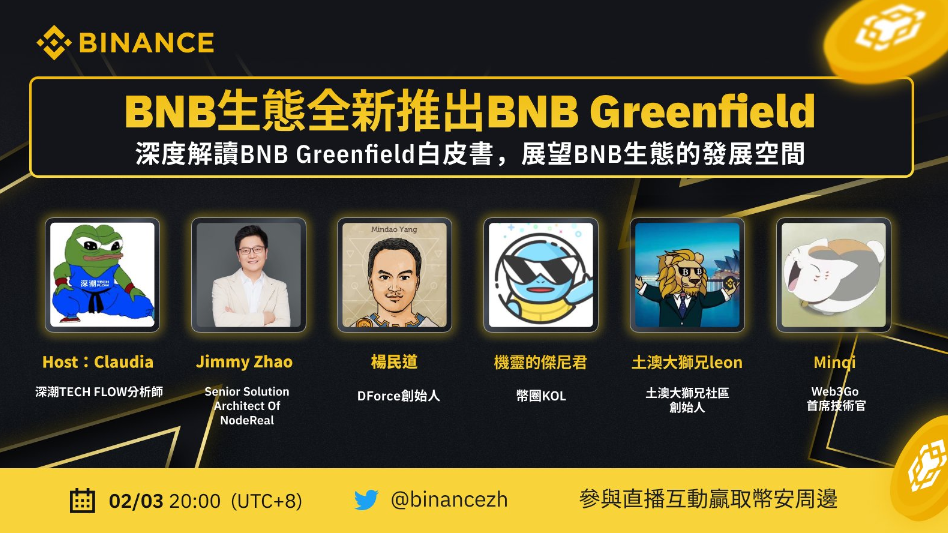
Compiled by: Claudia, TechFlow
On February 1st, BNB Chain underwent a significant ecosystem upgrade with the release of the BNB Greenfield whitepaper—marking BNB’s entry into the “one token, three chains” era.This will be the third blockchain to use BNB as its native token, following the BNB Beacon Chain and BNB Smart Chain. In short: one token, multiple public chains, diverse applications.
Once successfully launched, BNB Greenfield will become a public chain that integrates smart contracts with decentralized storage—a new milestone for the BNB Chain ecosystem.On BNB Greenfield, users won’t just own and store data—they’ll also be able to financialize and trade it.
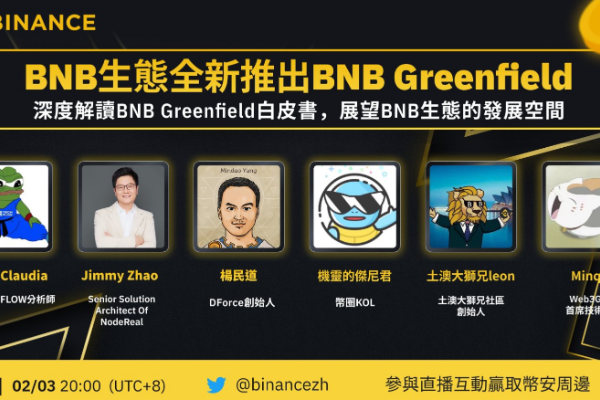
Guests:
Host: Claudia, TechFlow
Jimmy Zhao, Senior Solutions Architect at NodeReal
Jiuni the Clever, Crypto KOL
Minqi, CTO of Web3Go
BroLeon, Founder of Tu'ao Dashixiong Community
Mindao, Founder of DForce
TechFlow:BNB Chain has launched BNB Greenfield—“one token, three chains.” Looking back, both BNB Chain and BNB Smart Chain have led innovation. From your perspectives, what strategic vision does BNB Greenfield reflect from Binance? What are your thoughts on BNB Greenfield?
Jimmy Zhao
I'm Jimmy Zhao from NodeReal. Our entire team has been deeply involved in the development of Greenfield. We participated because if we want widespread Web3 adoption, storage is a core problem that must be solved. Relying on centralized cloud storage or traditional data centers creates an obvious flaw in the overall Web3 tech stack—even if such storage works well, it becomes the weak link in the chain. That's why we wanted to join this project and bring strong technical talent into this innovative effort.
Jiuni the Clever
When Binance released BNB Greenfield recently, I skimmed through the whitepaper and shared some thoughts on Twitter. Based on the introduction here, it may apply to personal data storage, which overlaps significantly with Filecoin, as mentioned earlier.
Secondly, hosting and deploying websites—this is impressive. You can deploy a website within minutes, which is very convenient for beginners and Web3 practitioners.
Thirdly, new social media models. Recently, the decentralized social app Damus has gained attention—I tried it myself, but it was quite laggy. Last year during the Web3 boom, another decentralized social project started but eventually died halfway. If Binance can truly deliver a new social media model enabling vibrant participation among Web3 builders, that would be great. It could also store BNB Smart Chain and transaction data. If BNB Greenfield succeeds in this area, it would represent a major technological leap for Binance.
Minqi
Let me first provide some background for non-technical audiences. When BNB Chain talks about "one token, three chains," they refer to: BNB Smart Chain (where BNB is used for smart contract deployment and gas fees, like PancakeSwap), the Beacon Chain (mainly for staking and selecting block producers—related to mining), and now BNB Greenfield—the third chain, whose primary purpose in the whitepaper is data storage.
Scaling solutions like Rollups involve a Layer 2 chain or service aggregating changes from Layer 2 and submitting them to the main Layer 1 chain while maintaining cryptographic self-proving capabilities. In contrast, early Sidechains lacked this self-proving ability. The practical difference is that if a Rollup-based chain goes down, users can still clearly prove their account state cryptographically—even if the chain stops operating. But with a Sidechain, once it fails, all data is lost because every node is gone—you might only see deposit/withdrawal records on the main chain. There are hybrid approaches like Validiums and Volitions, but I won't go into those now. Regardless of the scaling method, Layer 2 data is inherently stored off the Layer 1 chain—it's a technical necessity.
BNB Chain updates blocks every 3 seconds compared to Ethereum’s 12 seconds. On average, BNB Chain processes 150–200 transactions per block, versus ~100 on Ethereum—not peak capacity, just current usage. I just checked Etherscan; you can verify this.
BNB Chain stores several times more data than Ethereum, so archive nodes are naturally larger. Companies like NodeReal and ourselves run full and archive nodes for BNB Chain, providing data indexing services. Raw data volume is already in the terabytes. BNB Chain internally recognizes this issue—data volume is huge, causing syncing difficulties and client-side pressure. Back in May last year, the official team introduced something called BS (Binance Sidechain), specifically designed to address this. It’s essentially a ready-to-use code framework—deploy your service and your chain runs independently. Cross-chain functionality and BNB Chain contract interfaces are pre-integrated. Some projects have already adopted it.
For example, Anchor, NodeReal, and Meta X were jointly developed by Web3Go—we provided data analytics. The core idea is having this BS system to support high-frequency projects and exchanges. This gives project teams more freedom while reducing load on the main chain.
Technically speaking, Sidechains seem fragile—if they fail, they’re gone. Self-proving capability in Rollups is essential. However, the unified module approach of Sidechains reduces development overhead. Now, what if we add unified storage via Greenfield? Even if a Sidechain collapses, storage remains unified under Greenfield. This reduces dependency on Rollup-specific features. Even though Rollup storage is off-chain, an additional layer of unified protection never hurts.
In my view, Greenfield—though positioned as a dedicated storage chain—is more akin to a cloud storage provider for Rollups and Layer 2 projects. Of course, it can do more than that, but it certainly serves this role. Based on Web3Go’s experience, Greenfield appears to be a pragmatic move addressing real problems using existing frameworks. Our assessment: it's a solid, valuable solution.
BroLeon, Tu’ao Dashixiong
The benefit of today’s discussion lies in viewing this from multiple angles. At first glance, Greenfield seemed confusing—different from Binance’s earlier BS proposal, which we initially expected to launch first. After reading the whitepaper carefully, however, I sensed Binance is aiming big. While many projects focus narrowly on breakthroughs, Binance demonstrates ambition across the entire crypto industry.
First, this benefits the entire industry by resolving a long-standing pain point—the Achilles’ heel of Web3. Many apps claim to be Web3-native, yet remain vulnerable under traditional pressures. For instance, when Uniswap’s frontend got blocked, users couldn’t access it. People always believed Web3 should enable true decentralization, but key bottlenecks persist. By building infrastructure at the foundational level, Binance isn’t just helping itself or its ecosystem—it’s offering a base-layer solution with broad implications, pushing the field forward.
Second, it’s a bright spot for the BSC ecosystem. My community and I benefited greatly from BSC’s rise, so we’re excited about new opportunities here. Though the economic model hasn’t been revealed, Greenfield will undoubtedly create new BNB utility scenarios. Unlike AR and Filecoin, which required starting from scratch and incentivizing user growth, Greenfield uses BNB natively. Users can directly use their BSC addresses—no need to rebuild user bases or design complex incentive schemes. This gives it a faster start.
Additionally, its support for smart contracts enables direct integration between stored data and DeFi—potentially sparking new innovations. Currently, some use AR or Filecoin, but there’s still a learning curve. Most users don’t know where their data is stored—NFTs, metadata, etc.—they just see it through portals. These data points aren’t widely utilized yet.
If Greenfield can refine the concepts in its whitepaper and push them forward, there may be new opportunities—similar to the BSC wave—that could generate profits.
Another exciting aspect is decentralized social media, a space I closely follow. Whenever something new emerges, I try it. Right now, Lens is doing well, unfortunately it hasn’t deployed on BNB Chain yet. In my opinion, given BSC’s existing user base, launching a decentralized social platform here could be easier. Adding integrated storage could further simplify onboarding. Using smart contracts and token economics for fan management and subscriptions could make this smoother. I’m particularly interested in this direction.
Mindao
In the storage sector, I began exploring decentralized storage back in 2014—around the same time as Ethereum’s ICO. Later, I invested in Filecoin in 2017 and have since been involved in mining. My main focus shifted to DeFi during the DeFi summer, starting with Binance’s BSC smart contract chain.
I’m impressed by Binance’s timing, especially launching Greenfield now. As previous experts noted, crypto fundamentally rests on three pillars: consensus, execution, and storage layers. Applications like DeFi, NFTs, and GameFi sit atop these. Binance has captured a significant share—perhaps 30–40%—of the DeFi summer boom, second only to Ethereum.
A clear trend this cycle is blockchain modularity—separating data validity into dedicated chains. Interestingly, BSC and the new storage chain resemble a reversed Filecoin. Filecoin started with storage and is now adding smart contracts, which are about to launch. So Binance’s timing is fascinating—just as Filecoin integrates smart contracts.
I believe Greenfield’s strongest potential lies in meeting Layer 2 Rollup demand for Data Availability (DA). That’s why I don’t think it will directly compete with Filecoin on general-purpose storage. All scalability ultimately depends on DA to achieve data expansion. Given this, and considering Binance doesn’t need massive upfront investment to bootstrap hardware like Filecoin (which spent billions), Binance already has advantages. With BSC’s smart contracts generating vast frontend data, and potential future needs for BSC Rollups or even data services for Arbitrum and Optimism, Greenfield could serve as an excellent DA layer. This represents a massive opportunity—not just another DeFi, NFT, or SocialFi play, but a foundational, chain-level opportunity.
TechFlow:BNB Chain has extremely high daily active users and many star projects. Compared to other public chains, what advantages and shortcomings does it have?
BroLeon
As Mindao mentioned, after the DeFi summer, BNB Chain captured a large portion of TVL. BSC’s current status stems from unique strengths: backing by Binance, a highly creative ecosystem, and a user base primarily composed of risk-willing retail investors—all positives. Horizontally, a current issue is the lack of standout new projects post-DeFi summer. Check DeFi Llama—top TVL projects remain those that rose during the initial DeFi wave.
This is common across chains. What we now need is a “killer app”—not necessarily DeFi-based—but something with innovative tokenomics that attracts sustained capital and user interest, showcasing distinctiveness. We haven’t seen that yet.
On the upside, BNB Chain has inherent advantages. First, Binance automatically converts USDC deposits into BUSD—an aggressive move that boosts BUSD adoption. With many users holding BUSD, participating in yield farming or projects via Binance becomes seamless. Second, Binance operates what I consider the most secure and efficient cross-chain bridge. Third, Binance dominates over 70% of centralized exchange market share—providing a massive user base. When promising projects emerge, people can easily participate with readily available funds. These are natural advantages. But I don’t think this trend will last forever. With Greenfield advancing, more dev teams will build on it—possibly triggering an explosion. That’s my personal outlook.
Jimmy Zhao
As previously mentioned, this is an exciting new chain solving critical data access issues. Since NodeReal has been deeply involved since inception, let me share technical insights. Greenfield currently offers programmability—unlike AR or Filecoin, which aren’t developer-friendly enough. Greenfield provides full compatibility with BSC’s smart contract integration. Developers already familiar with BSC face minimal learning curves. Requiring developers to learn new languages, paradigms, and patterns on unfamiliar chains incurs high costs. Greenfield clearly considers developer experience—encouraging wider participation and growing the ecosystem, benefiting Web3 and decentralization overall.
Regarding data access, I reviewed the whitepaper: unlike IPFS, Greenfield uses object IDs—offering a more familiar access model. For developers experienced in Web2 or cloud storage, this eliminates learning costs—making it extremely developer-friendly.
Many Layer 1 consensus designs (e.g., Filecoin, AR) require heavy computation and high hardware demands. Greenfield addressed this by adopting a mechanism similar to BSC: penalizing bad actors based on incentives to ensure chain security. They call this “profile challenge,” proactively avoiding intensive computation needs. This design lays a better foundation for scalability, performance, and future growth.
Other guests mentioned wallet compatibility. Being EVM-compatible, users can seamlessly transfer BNB from BSC to Greenfield, open new accounts, and pay fees directly. This respects user habits and delivers excellent UX—adding significant value.
Minqi
From my perspective, it’s practical. Technical sophistication isn’t BNB Chain’s highlight—you can’t force comparisons with other chains. From day one, it leveraged Binance Exchange to drive growth. Its current strengths lie in accessibility and resources. Innovation isn’t its selling point. Yet, considering its resource integration and ecosystem-building capabilities—including this formal Greenfield rollout and past integrations across various frameworks—it demonstrates competence beyond pure technology. That’s my take.
Mindao
Speaking of BSC, our project was among the earliest to deploy there—truly pioneers. Throughout the journey, BSC succeeded by extending exchange functions—DeFi lending, DEX services—essentially expanding Binance’s business. Thus, BSC users highly overlap with Binance users. Compared to Polygon or other Layer 2 users, profiles differ significantly. Binance excelled at mobilizing retail users with high engagement—very successful in BSC’s early days.
But there are issues—we’ve watched BSC evolve and hope Greenfield corrects past strategies. As BroLeon noted, why haven’t more innovative projects emerged on BSC? Several reasons: early excessive support for top-tier projects.
If dominant players monopolize trading, mid-tier projects struggle. Consider Polygon vs. Optimism—both competing with BSC. Optimism launched before Arbitrum, yet we chose Arbitrum. Why? Optimism required special configurations and favored partnerships with giants like Uniswap.
Projects seeking fair competition flocked to Arbitrum. That’s why GMX emerged there, not on OP—it was a fairer environment without biased mining incentives. A variety of ideas collided, producing meaningful innovation. For a Layer 2 chain, it’s best not to overly favor specific projects—letting the ecosystem grow organically is ideal.
You can offer general policy support, but avoid singling out leaders. Over-support creates perceptions of unfairness—blue-chip projects may hesitate due to reputation concerns. That’s the biggest issue. For Greenfield, as someone building data-layer apps, I hope Binance learns from BSC—let everyone compete openly.
Though Binance likely wants rapid ecosystem growth, from a builder’s perspective—having deployed across chains—I’ve seen some thrive while others fail. Native applications flourish where fairness prevails. I hope Greenfield fosters openness, avoids favoritism, and lets competition drive innovation—potentially surpassing slow-starting storage projects like Filecoin/AR.
Another crucial point: BSC should separate asset ownership from the exchange. After FTX collapsed, Binance faced FUD. Many didn’t notice, but BSC’s TVL dropped sharply—especially application-related funds. I discussed this with users: why withdraw to other chains? Their concern: assets are exchange-mapped tokens—if the exchange fails, the chain might too. For BSC to become a truly independent public chain, isolating assets is essential. Avoid relying solely on exchange bridges—use more third-party bridging methods. These are BSC’s two biggest challenges. Solving them could redefine its public chain trajectory.
Jiuni the Clever
Over the past year or two, when major exchanges launched EVM-compatible chains, I explored each. Clearly, BSC hosts more projects and applications. Trading on BSC is faster and cheaper than ERC networks. Thus, BSC suits high-frequency trading. For small retail users, ERC gas fees might consume 10% or more of principal per round-trip—making it unfriendly. Hence, BSC holds advantages in speed and low cost.
Moreover, BSC boasts numerous projects—lending, DEXs, GameFi. Binance often provides funding, boosting leading apps that attract attention and users. Compared to other exchange chains, BSC leads in user count and TVL. Currently ranked second in total TVL across all chains, BSC clearly holds strong advantages.
Security-wise, BSC uses advanced blockchain tech, experiencing fewer attacks. For severe incidents, backed by Binance, proactive compensation or defense measures are likely. So using BSC feels relatively safe.
TechFlow:Does the launch of BNB Greenfield signal an upcoming explosion in the Web3 domain combining smart contracts, integration, and distributed storage? How do you view this赛道’s prospects and significance?
Jimmy Zhao
Predictions are notoriously difficult—and often hated. They require deep industry understanding and luck. Let me share my view on the value Greenfield brings.
Distributed storage chains like this can revolutionize our choices. Beyond developers, individual users can store vital, irreplaceable data—extremely important.
Storing on personal computers or centralized services carries high risk. Permanent, distributed storage helps preserve critical information. This applies not only to consumers (toC) but also enterprises (toB).
Also noteworthy is Layer 2 data access. Integrating this with Layer 2 and Sidechain data strengthens Web3’s foundational architecture—highly promising.
Another key advantage Greenfield offers is ownership. On IPFS, uploaded data is fully public—no ownership concept exists. Greenfield prioritizes data ownership, access control, and exchange mechanisms. Economic models built on data ownership can unlock novel use cases—benefiting both Web3 and society at large.
Minqi
First, what kind of explosion? If comparing to ChatGPT’s AI explosion, Greenfield alone may not trigger that—no recent breakthroughs in distributed data tech. Still, Binance partnering with Amazon—two industry leaders—is surprising and encouraging. The distributed storage sector is sound—its technical use cases exist. Binance’s ecosystem might explode, but it takes time. Personally, Greenfield feels like a genuine response to identified problems—using existing strengths to solve real issues. Not hype-driven, not chasing trends—this is a legitimate solution already in motion. That’s my overall view.
Jiuni the Clever
From a personal view, if BNB Greenfield launches alongside Binance’s倾斜 toward related investments and funds, short-term bursts are likely—possibly a surge in on-chain projects.
As for the赛道’s future: smart contracts aren’t an issue. Distributed storage, however, appeals more to real-world applications than speculative “play-to-earn” models popular among traders. It may not explode like GameFi or DeFi did. Likely, we’ll see gradual application rollouts with many projects joining—but perhaps limited explosive user adoption.
BroLeon, Tu’ao Dashixiong
To me, this news clearly supports BNB’s price short-term—it’s bullish, and just the beginning, since only the whitepaper has been released. Further catalysts—economic model details, application rollouts—will gradually expand market imagination. This alone supports BNB, especially given its recent strength. Previously, expectations rose ahead of IEOs—prices surged when CZ hinted at rallies. To me, BNB lacked a compelling narrative—until now. Greenfield provides a substantial story framework. Tonight, so many guests discuss it, so many listeners tune in—why? Because it’s new, full of unknowns and imaginative possibilities. This fuels upward expectations—people buy into narratives. So yes, short-term BNB price support is evident.
Long-term, from an ecosystem perspective, forget grand visions—earlier speakers noted CZ is playing a big game, with Binance expanding into every infra corner—we’re positive. From users’ view, the key question is: can they feel it? When BSC launched, few initially noticed or understood its purpose. Early DeFi mining confused many. So now, the focus is on launching applications that materialize this story—with tangible value.
During DeFi’s rise, I recall a mining project yielding 100x overnight—powerfully educating newcomers. Combined with BSC’s far lower transaction costs than Ethereum, masses poured in, creating glory. When Greenfield rolls out, I wonder if Binance will offer initial support for a strong start—making developers and users see profit potential or “gold mines.” If Binance commits existing resources, a spectacular launch is possible.
Today, Binance sent a small amount from its $1 billion recovery fund to one address—sparking excitement. Many now watch that address, eager to identify the recipient project. Once known, expect a sharp rally. Currently, Binance heavily influences market sentiment and capital flows—a competitive edge unmatched by other BNB-linked chains.
Mindao
I see this less as a technical explosion and more a narrative explosion. Greenfield is a landmark event within the broader modular blockchain trend. What’s this big narrative? Modular blockchains—separating consensus, execution, and storage. Whether new chains or Ethereum’s evolution, this direction is clear. From 2014–2018, Ethereum pioneered monolithic chains—consensus, execution, storage all together. Layer 2 separated computation. But Layer 2 scalability hit limits—chiefly data constraints. Hence, the rise of dedicated Data Availability (DA) layers—moving data off the main chain. Essentially, functional separation.
We’re seeing real applications emerge in storage. As a Filecoin storage provider myself, I observed last year’s network saw dozens-fold growth in useful data—versus previously filling with junk. Storage now has concrete use cases. In 2023, expect more DeFi frontends and NFT projects relying on decentralized storage. Even hot projects like Damus—decentralized social—must solve relay and data storage.
This year, demand for data storage—whether general-purpose or DA layers for modular chains—will surge. But this doesn’t guarantee immediate application-layer prosperity. Still, it’s coming fast. Filecoin is about to integrate its FVM smart contract platform—enabling rich applications. Binance’s whitepaper mentions Ethereum compatibility—meaning BSC’s smart contracts can directly access Greenfield data. This architecture closely resembles Filecoin+FVM interacting with its data layer. Smart contracts owning data—where data itself becomes an asset—could spawn entirely new asset classes beyond DeFi. Such applications may emerge this year or next. Will they match DeFi summer’s frenzy? I’m cautious—progress may be gradual.
Another explosion? Vertical integration across chains. Not just exchanges—public chains themselves are consolidating. Ethereum, dominant in settlement and consensus, now expands into Layer 2. Binance mirrors this—from Cosmos-based consensus to BSC’s DeFi to now data layer. Whether centralized players or “pure” public chains, all are pursuing vertical integration—bundling all infra into single chains. This trend is unmistakable this cycle—shared by Ethereum, Solana, and BNB Chain alike.
Join TechFlow official community to stay tuned
Telegram:https://t.me/TechFlowDaily
X (Twitter):https://x.com/TechFlowPost
X (Twitter) EN:https://x.com/BlockFlow_News