








Proof of Merkle Tree Reserves should become the standard for crypto exchanges
TechFlow Selected TechFlow Selected
Proof of Merkle Tree Reserves should become the standard for crypto exchanges
Following FTX's collapse in the crypto world, in the days after the November 9 FTX incident, major centralized exchanges (CEX) have publicly announced or directly disclosed their Merkle tree proof-of-reserves.
 Navigating Web3 tides with focused insights
Following FTX's collapse in the crypto world, in the days after the November 9 incident, major centralized exchanges (CEXs) have publicly announced or directly disclosed their Merkle-tree proof-of-reserves, hoping to use Merkle proofs to make previously opaque CEX asset reserves transparent, thereby demonstrating their own exchange's reserve status and proving that funds have not been misappropriated or moved.
Undoubtedly, FTX’s downfall has cast a shadow—or even an indelible stain—over the opaque operating mechanisms of the entire CEX industry. In this context, Merkle-tree proof-of-reserves appears to bring a glimmer of hope to the sector. As a technical solution, it was proposed and applied years ago. But what exactly is a "Merkle proof," how does it prove that user assets within an exchange haven't been misused, and can it truly demonstrate that these assets are being securely held?
A Merkle tree is a data structure used in cryptocurrencies such as Bitcoin and Ethereum—it is a cryptographic technique capable of compressing data. By using Merkle trees, multiple pieces of data can be combined into one, allowing large-scale datasets to be summarized and stored efficiently, while also enabling cryptographic verification that specific data items are included within the summary. Moreover, by verifying the integrity of the Merkle root, the integrity of all underlying data in the tree can be proven.
The leaves of a Merkle tree consist of the hash values of individual data entries from a dataset. Specifically, adjacent hash values are paired, concatenated, and hashed again to produce parent hash values. This process continues upward until the topmost hash value—the Merkle root (or root hash)—is generated. The Merkle root contains the cryptographic fingerprint of all data in the tree, meaning any alteration at any node will result in a completely different root value, making tampering with recorded hashes impossible.
Suppose our account and balance information, labeled as data A, is recorded within the Merkle root. We can verify whether data A is indeed included in the Merkle tree using the following elements:
- Data A (account and balance information)
- Hash of B
- Hash of CD
- Root hash
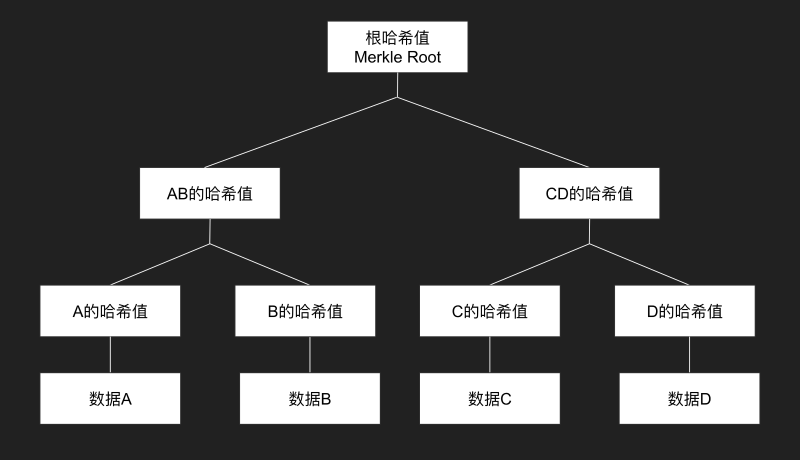
Figure 1: Illustration of Data Storage in a Merkle Tree
Next, we compute the hash of data A, combine it with the hash of B to calculate the hash of AB, then use the hash of AB together with the hash of CD to compute the root hash. By comparing our computed root hash with the provided one, we can verify that data A is indeed recorded in the Merkle tree.
If all users' assets on a centralized exchange are recorded in a Merkle tree and the proof is valid, the exchange can prove to each user—without revealing other users’ information—that “their data has been recorded in the Merkle tree” and that their assets truly exist.
How is this proof system actually implemented in practice? Trust in this system relies on both the Merkle tree (dynamic deterrence) and audits (third-party professional oversight). Dynamic deterrence means that any user can act as a verification node and expose the exchange by proving they are not included in the Merkle tree, thus revealing a fake root hash. However, this mechanism serves no other purpose—for instance, the root hash does not inherently represent the sum of all user balances. Both components are essential; relying solely on cryptographic proofs cannot solve all issues, as real-world implementation is far more complex than theory, with many exploitable points.
Nevertheless, compared to previous CEX models that relied only on audits, introducing Merkle trees effectively grants users whistleblower rights, enabling a degree of decentralized monitoring over CEX reserves—an important advancement and a positive development for a market currently suffering from severe confidence issues.
Yet, can adopting Merkle-tree proof-of-reserves fully guarantee user asset safety? While Merkle proofs allow us to verify that our assets are recorded in an immutable hash, does this completely ensure that funds haven’t been misappropriated or moved?
Centralized exchanges handle massive volumes of transactions per second, making it impractical to update the root hash every second. Therefore, the root hash we see is likely not the most current. On the other hand, Merkle tree computation primarily involves a series of fast hash function operations, so in principle, updates could occur relatively frequently.
Beyond the issue of update frequency, Merkle-tree proof-of-reserves faces several critical challenges:
-
Frontend fraud: The Merkle tree data resides on the exchange’s own servers, and the frontend interface through which users interact is controlled by the exchange. The exchange could potentially return falsified pages to deceive users, creating risks of frontend fraud. This issue requires mitigation via third-party software verification.
-
Credibility of third-party audits: Just as in traditional finance, where audit errors or even illegal behavior sometimes occur, similar risks exist in the crypto space—even though audits are not yet widely adopted here. Audits do not guarantee perpetual objectivity or fairness.
-
Interconnected transactions, liabilities, margin trading, and similar activities cannot be reflected solely through reserve data.
The cryptocurrency market demands greater transparency. Making Merkle-tree proof-of-reserves standard across crypto exchanges would help establish industry norms and rebuild user trust.
For investors and users alike, ensuring fund security remains a sword of Damocles hanging over every industry participant. Throughout this bear market—no matter who falls or survives—the wheels of Web3 will not stop turning forward.
Join TechFlow official community to stay tuned
Telegram:https://t.me/TechFlowDaily
X (Twitter):https://x.com/TechFlowPost
X (Twitter) EN:https://x.com/BlockFlow_News






