








Interview with AAVE Executives: Protocol Ambitions, Expansion on StarkNet, and the Future of DeFi
TechFlow Selected TechFlow Selected
Interview with AAVE Executives: Protocol Ambitions, Expansion on StarkNet, and the Future of DeFi
This article features an interview with Marc Zeller from Aave's Strategy Department, whose insights offer everyday readers a broader perspective on the development direction of cryptocurrency.
 Navigating Web3 tides with focused insights
Written by: Aylo
Translated by: TechFlow
One way to stay confident during a bear market is to talk with successful people in the field.
This article features an interview with Marc Zeller from Aave’s strategy team. His insights allow ordinary people like us to understand the direction of crypto development from a broader perspective.
What is your origin story with cryptocurrency?
I first learned about Bitcoin through drugs and the dark web — something quite common among crypto OGs. My initial reaction was that it was economically impossible — you can't create money without inflation.
I lived through the 2014 altcoin era. Then, in 2015, a close friend introduced me to Ethereum. When he told me about Ethereum, my first thought was: “Another altcoin” — there was a new Bitcoin every week, most of which were worthless.
But he said, wait — Ethereum has something different: smart contracts, the world computer, etc. I started thinking this “altcoin” might actually be doing something real. That curiosity changed my life in many ways.
In 2015, I co-founded Ethereum France with several tech-savvy friends. The Ethereum Foundation reached out and asked us to organize a community event in Europe, which began in 2016 and has been held annually ever since.
Beyond that, in 2016 I joined the ecosystem full-time working at ConsenSys on stablecoin research.
In 2019, I joined ETHLend as they transitioned into what we now know as Aave. I helped support Aave’s creation and have been here ever since.
What did we learn from the last industry cycle?
We learned a lot, yet also learned nothing — this cycle is much better than the previous one. During the 2017–2018 ICO boom, people were mostly selling PDFs, whitepapers, and dreams — that was essentially it.
This cycle, we’ve seen many narratives — most of them nonsense. But all of these are actual applications running on blockchains. In this cycle, blockchain network usage has increased by several orders of magnitude. We now have live code, applications, DAOs, and a real ecosystem. We have full DeFi, NFTs, and many other industry layers.
I think this is the first cycle where, even if prices fall, no one says crypto is dead.
I believe the ecosystem has finally found enough product-market fit to sustain itself for years. That’s why this cycle feels so different. I hope we learn and grow wiser — but we shouldn’t develop hero worship in crypto, especially in DeFi. We attract massive capital and attention, but DeFi and crypto are decentralized — no single entity should dominate.
So my hope for the next cycle is: fewer superstars, more builders and protocols speaking for themselves.
Why did so many DeFi platforms fail while Aave survived?
Being the last one standing carries a terrible responsibility. We are essentially the only major DeFi protocol never exploited, hacked, or mentioned on rekt.news.
From 2020 to 2022, we spent $1.6 million auditing Aave V3 — I believe this is the largest audit expenditure for any single application.
We’ve done everything humanly possible to secure our users.
So far, it’s paid off — but zero risk is impossible.
How would you describe Aave today?
Aave’s vision is complex and will take years to mature — but we’re moving forward step by step.
V1 introduced flash loans, stable rates, and aTokens — things that didn’t exist in DeFi at the time.
Then came V2, which brought order-of-magnitude improvements in gas costs, new features, and functionality.
Now with V3, we’re actively preparing for a stablecoin (GHO), content creator protocols, monetization protocols — such as Lens or social media.
All of this forms part of a roadmap. We still have much to do — as I said earlier, Aave has delivered only 5% of its plans.
What about the remaining 95%?
Over a year ago, we tweeted about debit cards — but due to low engagement in the DeFi and crypto Twitter sphere, people forgot. Since then, we’ve obtained an e-money institution license and built a dedicated team to handle it.
We’ve announced we’ll launch an Aave app and wallet — a one-stop shop combining social media and DeFi services on top of financial technology.
We’ll use the stablecoin (GHO) as the primary currency.
Many things are already public. We’re not working in the dark — we’re just releasing things step by step. Clearly, we’re focusing more on near-term deliverables — for example, V3 on mainnet and GHO will likely go live in the coming weeks.

The only thing we at Aave Company do is technical work.
We need to ensure it's mature, secure, and audited — then we submit it to the DAO. We've been working on the GHO stablecoin for a year.
And the vote happens directly on the governance contract — implementation is carried out by the governance contract itself.
So it's a completely new way of working.
This has never existed in any prior industry: you organize a team to contribute to a protocol, then the token-holder community governs whether things happen or get rejected.
Why do we need GHO, and why is it important?
There are two answers. Within Aave, when you operate the largest liquidity protocol, launching a decentralized stablecoin is a natural evolution. Economically, borrowing USDC using ETH is almost identical to minting GHO using ETH — it's essentially the same market. Aave’s stablecoin isn’t entering uncharted territory; it’s simply extending what we’ve known and done over the past year. And because the protocol already has critical mass in liquidity, enabling such services makes sense — we already have the liquidity, participants, brand, and infrastructure. All that remains is making GHO succeed.
Second, for Aave, the stablecoin will become the hub where all these services synergize. For efficiency, making the stablecoin the primary currency — or at least one of the currencies on Lens — allows Aave to provide liquidity for fintech services and then convert into fiat.
In a broader context, I believe the entire ecosystem is overly dependent on centralized stablecoins or fiat. And I think the only solution is reducing the dominance of assets like USDC — not that they’re bad, but they’re too centralized for crypto.
USDC may currently back 80–85% of DAI, and GHO might initially follow a similar path.
But I hope in the future, DAI could consist of 50% USDC, 20% GHO, 20% Curve stablecoins, and 10% others. As we build more strong, decentralized stablecoins, we can gradually reduce USDC’s importance in the ecosystem.
I welcome GHO, DAI, CRV, FRAX, or any decentralized stablecoin — because I believe strong diversity will make stablecoin collateral more diversified, making the ecosystem more resilient and censorship-resistant.
When can we expect Portals? What about CCIP?
On the roadmap, Portals have been delayed a bit. To launch Portals, we need V3 first. V3 was supposed to launch earlier on Ethereum, but it’s now pushed to the coming weeks — delaying Portals accordingly.
Current plan: launch V3 on Ethereum mainnet first, then roll out GHO, then activate Portals.
For Portals’ infrastructure, the current roadmap includes V0 and V1. V0 uses trust-based credit lines. We whitelist entities like cross-chain bridges and market makers — they can mint A-tokens out of thin air within their credit limits, and they’re incentivized to replenish those limits. This creates portable, “just-in-time” cross-chain liquidity across any market where Aave pays interest to the protocol.
We’re starting with V0 because we don’t yet have access to true cross-chain interoperability protocols — that’s what CCIP means.

Currently, the two most mature players in the space are Chainlink with CCIP, and Layer Zero — we’ve partnered with both from day one.
Honestly, neither is mature enough to meet our high standards for decentralization, security, and safety.
For example, Layer Zero in its current form is heavily centralized, and CCIP isn’t usable yet. That’s why we’re sticking with V0 for now.
Once we have a robust cross-chain messaging solution, we’ll launch V1. V1 will introduce dynamic credit lines — like cross-chain collateralized credit — enabling use cases beyond simple bridge transfers. With cross-chain messaging infrastructure, you’ll be able to have cross-chain debt positions. For instance, if you hold LINK on Ethereum and want instant access to USDC on Polygon, you’d activate a Portal via a third-party dApp — your debt would be on Polygon, while your collateral stays on Ethereum. That’s the long-term vision for Portals.
Do you regularly receive updates from Chainlink about CCIP?
We speak with Chainlink weekly about CCIP and other synergies — our relationship is excellent. They share our high security standards.
They won’t release anything until they’re 100% sure it’s safe for public use.
That’s why you don’t see Chainlink or Aave on rekt.news.
Will Aave deploy on non-EVM chains?
The answer is yes. And we’ve already voted on it — specifically for StarkNet and Cairo. These chains have been budgeted, received funding from the DAO, and a deployment team (BGD Labs) has been organized. We expect this to happen when StarkNet launches in 2023.
Aave is absolutely not an EVM maximalist. But some analysis is needed. Non-EVM means all your Solidity expertise becomes instantly obsolete because the codebase is entirely different.
So if you're a world-class Solidity developer, you might be terrible in Rust. That’s reality — skills don’t magically transfer when you switch languages. You must either find or retrain talent to adapt to the new environment. Acquiring new talent requires three main currencies: time, attention, and money.
When rewriting your entire codebase in a new language, your usual audit partners become useless — the world’s best Solidity auditors lack experience in Rust or other smart contract languages. So you need to find new auditors — even if none have prior experience.
You must also consider whether deploying on a new chain is worth the cost. If you spend 6–9 months and $1 million entering Solana but fail, you’ve wasted the DAO’s funds.
Why choose StarkNet?
What drives us toward StarkNet is that it’s a game-changer. It’s a real L2, compatible with Ethereum, and ultimately anchored to Ethereum. But being non-EVM, it differs significantly — especially in computation.
Everything you do technically on a blockchain costs money. Storing data costs money. Changing a variable costs money.
On Ethereum, performing mathematical operations at the smart contract level is extremely expensive. On StarkNet, it’s nearly free. Right now, DeFi is simple and dumb — not because we can’t do math, but because complex math is too costly. Risk parameters, interest rate curves...
What excites us about StarkNet is the possibility to build Aave V4 on it — not fully defined yet, but featuring more math, optimization, and efficiency. That’s why it’s so interesting for experimentation.
Where does Lens fit into Aave’s overall vision?
It’s a new way to monetize content. If you’re a content creator earning income from your creations, you know how bad Web2’s content economy is. Lens empowers creators and increases their earnings. I believe this clearly aligns with what we’re doing at Aave — there are many parallels between liquidity protocols and content creation.
For most users, the only visible link between Aave and Lens will be GHO. Most may not even know DeFi, but they’ll use GHO. For example, they might use their credit card to buy GHO and support their favorite creators. But for creators, Lens will be a game-changer. Much of the value provided by their community (not all) will go directly to them. They’ll be able to do cool things with their audience that are nearly impossible in Web2.
I run a YouTube channel with a large audience — YouTube takes 60% of all ad revenue, maybe more. Same with Twitch. When someone subscribes to my Twitch channel for ~4 euros, I earn less than 1 euro — the rest goes to Amazon.
Compared to Twitter, I have only a small community on Lens — yet I’ve already earned $350. That’s significant. In a month where I posted AI-generated art, I earned zero from Twitter (with 70k followers). So I’m very excited to see where this goes.
What are you bullish on in the coming years?
I believe the next big narrative in DeFi will be LSD — liquid staking derivatives. LSD is the best form of collateral.
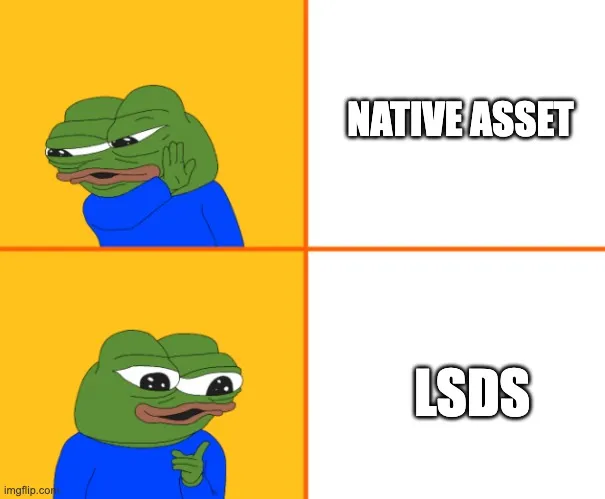
When you hold stETH, you earn ~5% ETH yield. You can borrow DAI against it and spend it, or borrow more ETH to stake and compound into more stETH. Depending on your leverage and collateral, you can boost your yield and gain leveraged exposure to ETH. It’s up to you. I see this as excellent collateral — if ETH holds steady, your collateral grows 5% annually, and so on.
This experiment began with stETH on Aave — a huge success. Afterward, stETH generated $3 billion in deposits and ~$1 billion in borrows on Aave. I believe we can extend this to Polygon via stMatic and MATIC X. Borrowing MATIC is more efficient. Once governance approves, Aave will launch an Instadapp feature allowing similar leverage on Matic.
I believe greater LSD diversity benefits Ethereum. Currently, Lido controls 30% of all ETH staking. If alternatives like Rocket Pool and StakeWise grow, we’ll achieve a more decentralized ecosystem. A good way to drive this is by integrating more LSDs into DeFi.
If I hold 1 ETH, I’d stake all of it except what’s needed for gas. Holding excess ETH serves no purpose. If you own ETH, stake it — or use staked ETH as collateral.
The second thing to promote in DeFi is using LP tokens as collateral — something Aave pioneered in 2022. The market wasn’t mature then, so it didn’t take off. But now, I believe the market is ready. For example, using Curve LP tokens or 3CRV as collateral to borrow other stablecoins and lever up makes sense.
For instance, providing liquidity on Convex, or even Curve stETH — since the underlying asset is ETH, this could be excellent collateral, especially with added incentives.
I think it’s time to boost DeFi efficiency. Most core projects have now found product-market fit — it’s time to enhance their profitability and efficiency.
DeFi L2s are also interesting. For example, Aave has Morpho — a second layer. Morpho enables a P2P layer atop Aave. If you deposit stablecoins into Morpho, you earn either Aave’s yield or a better P2P-matched rate from borrowers on the Morpho layer. As a liquidity provider, you always earn at least Aave’s rate — often more. As a borrower, you get lower rates than on Aave.
I believe we’ll see more yield derivatives emerge. The first that comes to mind is 88MPH, which lets users access their yield early — you lock up collateral deposited in Aave and get immediate liquidity for your future yield. There are many such protocols — Element Finance, AP Wine, etc. They haven’t gained traction yet, but I believe they’ll become future leaders if they improve efficiency.
Clearly, cross-chain positions will be powerful in the future — we still have much to build.
Finally, any life principles for crypto investors right now?
Dollar-cost averaging.
Join TechFlow official community to stay tuned
Telegram:https://t.me/TechFlowDaily
X (Twitter):https://x.com/TechFlowPost
X (Twitter) EN:https://x.com/BlockFlow_News
 alpha please


