








Are tokens a necessity for DeFi protocols?
TechFlow Selected TechFlow Selected
Are tokens a necessity for DeFi protocols?
Most projects launch tokens out of funding needs, and token sales are the preferred and simplest way to raise capital.
 Navigating Web3 tides with focused insights
Author: Ignas
Translation: TechFlow
Yesterday, I asked on Twitter whether DeFi protocols can function without tokens. The responses were eye-opening. Some said protocols cannot operate without tokens, while others disagreed. So today, let's discuss what I believe the answer is.
In my view, most projects launch tokens out of financial necessity—token sales are the preferred and easiest way to raise funds. Without funding, there wouldn't be so many projects.
Secondly, tokens play a key role in bootstrapping liquidity. Without liquidity mining, Sushiswap would not have attracted any TVL or users, as it offered no additional value compared to Uniswap V2. And I wonder—did Uniswap launch $UNI because of the threat from Sushi?
Tokens can also serve as tools for community building. However, building a community around the token rather than the protocol itself is a short-term strategy. When prices crash, your community will abandon you.
Some DeFi protocols integrate their tokens into core operations:
- $SNX, $GNS, $AMP, $RUNE facilitate the creation and transfer of liquidity.
- $USDD, $USDN, $UST, $FRAX are backed by native tokens.
- $OHM is tied directly to liquidity.
However, many protocols could technically function without tokens:
- DEXs, derivatives exchanges, DEX aggregators.
- Lending protocols.
- Yield aggregators.
- Collateralized stablecoins.
- Wallets.
Their core business models do not depend on tokens.
For these (and some other) protocols, tokens are effectively risk management tools.
$MKR serves as a backstop against insolvency: holders bear dilution risk to cover undercollateralized debt. Perpetual DEXs use tokens to build insurance funds that cover failed liquidations.
This risk management extends into protocol ownership. Would you use Aave or Compound if a single entity held all the keys to assets and protocol parameters? Protocols can use multisig to prevent this, but governance tokens extend that multisig to millions of people.
Unfortunately, not all protocols have reached this level of decentralized governance.
But decentralization is a bridge—some stand on one end, some on the other—and tokens are just one option for future empowerment. Thus, while tokens initially serve as fundraising instruments, utility can be gradually added over time.
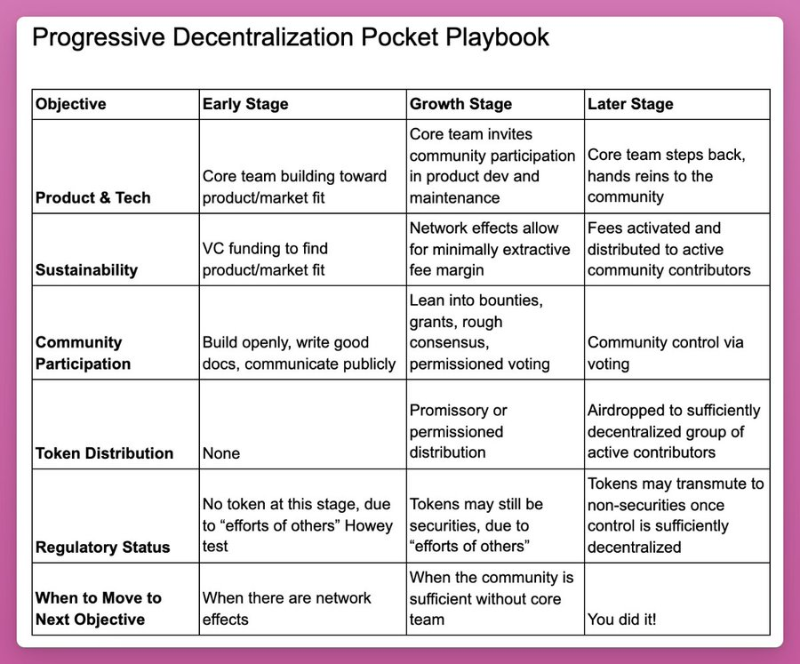
As protocols mature, they align with A16z’s vision of progressive decentralization. Once product-market fit is achieved, control and risk management are handed over to the community via tokens. Growing market cap also provides stronger protection against bad actors.
One final point: $UNI seems to be a controversial case.
-
$UNI does not manage any risk, and the contracts are immutable.
-
Revenue sharing would significantly harm LPs’ value.
Yet $UNI is the largest DeFi token by market cap.
In my view, the value of $UNI comes from:
-
Future potential utility.
-
Influence over governance of other protocols.
The Uniswap DAO voted to launch on zkSync, potentially giving zkSync a dominant edge in the zk-Rollup race. This is the power held by $UNI holders.
Overall, it is precisely the role of tokens in fundraising and attracting liquidity that enables many projects to exist. They facilitate community building and revenue redistribution, but ultimately, ensuring the security of the protocol and its governance gives tokens their final justification.
Join TechFlow official community to stay tuned
Telegram:https://t.me/TechFlowDaily
X (Twitter):https://x.com/TechFlowPost
X (Twitter) EN:https://x.com/BlockFlow_News
 Ignas | DeFi Research






