








Tokens Are Becoming a New Type of Stock
TechFlow Selected TechFlow Selected
Tokens Are Becoming a New Type of Stock
The mechanism is already mature, the railway tracks have been laid, and funding is in place.
 Navigating Web3 tides with focused insights
By Matty
Translated by Chopper, Foresight News
Last year, Apple spent $10 billion repurchasing its own shares. Share buybacks are indeed effective—they reduce circulating supply, consolidate equity ownership, and return value to long-term, loyal investors.
For over a century, dividend mechanisms have consistently driven compounding wealth growth; preferred shares have balanced interests across investor tiers; and vesting lock-up rules have prevented employees from dumping shares for quick profit. These models are well-established.
They’re not innovative—merely dull, time-tested operational mechanics of equity markets. Today, however, this classic framework is being implemented on-chain.
Buyback-and-burn, revenue-based dividends, fee-switch activation, vesting unlock schedules, and conversion of preferred shares into common shares… Web3 projects are fully replicating this financial logic—all settlements executed in real time, publicly verifiable by anyone via a block explorer. Economic models are never the core innovation; underlying infrastructure is. The logic of equity operations has been battle-tested for decades; what’s truly transformative is the channel carrying that logic—directly reshaping capital access thresholds, settlement speed, and operational transparency.
Logic Mapping
Most crypto discussions begin at the token layer and then attempt to map back to traditional finance. I believe this approach puts the cart before the horse. Starting instead from foundational equity concepts familiar to traditional investors—and then examining how tokens instantiate those concepts—makes everything instantly clear.
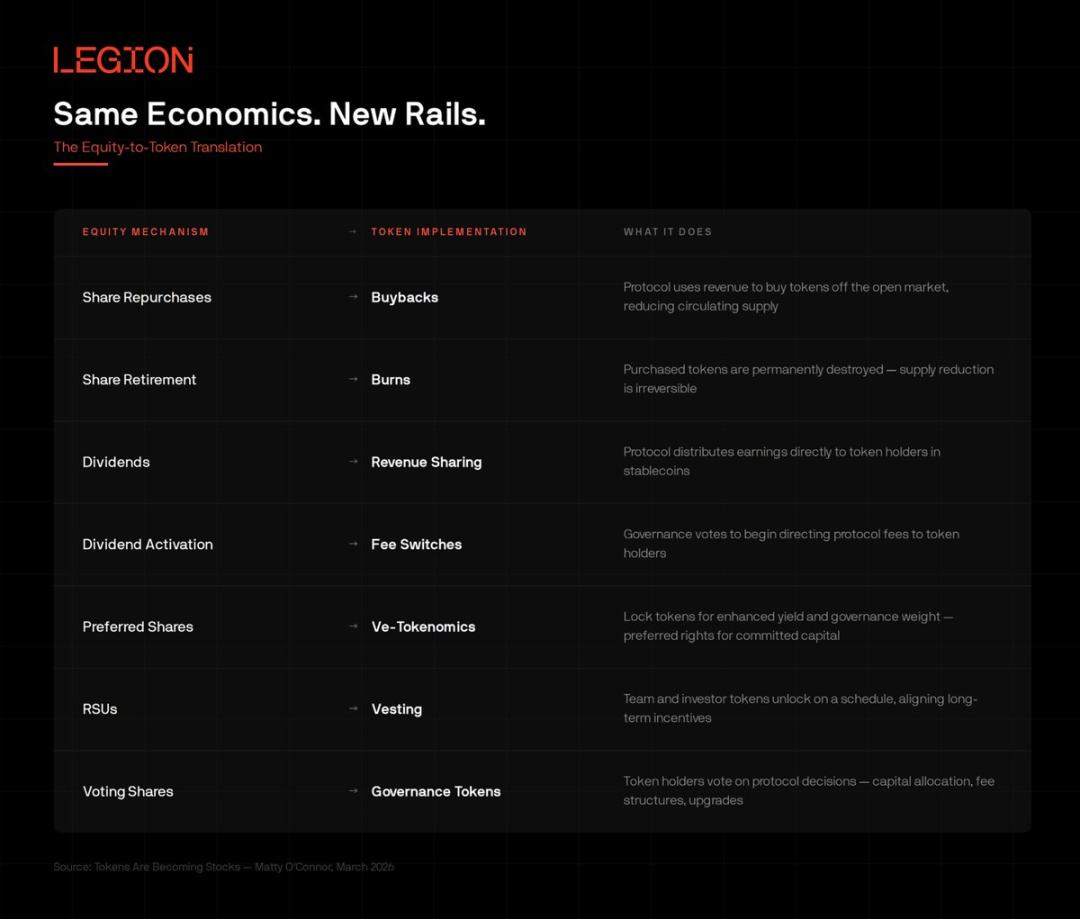
This mapping framework serves as the central benchmark for analyzing the entire sector: any token mechanism that precisely mirrors classic equity logic has a solid value foundation; conversely, infinite minting without asset backing, circular yield schemes, or point systems lacking final value are destined to fail—without exception.
A century of corporate finance history has already confirmed the core principle: only value-return mechanisms anchored to real revenue enable compounding wealth accumulation; all other schemes are, at their core, value-dilution masquerading under increasingly sophisticated packaging.
Real-World Implementation Cases
The theory is straightforward—let’s examine actual industry deployment.
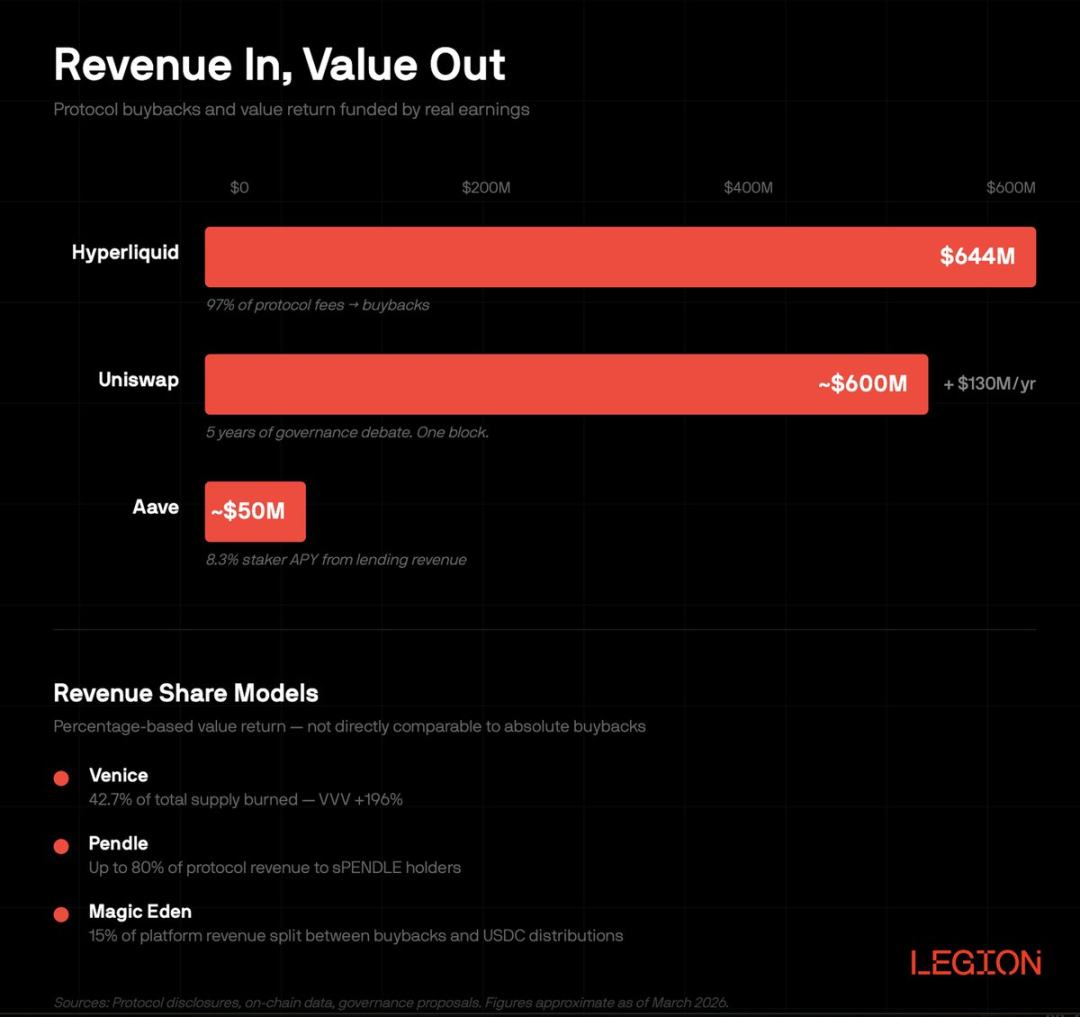
Hyperliquid allocates 97% of all protocol fees toward buying back HYPE tokens—not 10%, not a minor portion, but 97%. Its cumulative buyback amount has surpassed $644 million, accounting for 46% of the total token buyback volume across the entire crypto industry. The project’s treasury holds approximately 29.8 million HYPE tokens, valued at over $1.5 billion—funded entirely by genuine protocol revenue, not arbitrary foundation minting.
This is a direct replication of Apple’s capital-return strategy: identical underlying logic, faster settlement, and full public transparency. No need to wait for public companies to release annual 10-K filings—on-chain data updates in real time and is accessible anytime.
Uniswap, the largest decentralized exchange in crypto, delivered zero returns to token holders for five consecutive years. For five full years, UNI functioned solely as a governance token with no actual economic rights. Only in December 2025 did the fee-switch proposal pass. In the same vote, the project directly burned 100 million UNI tokens (valued at ~$600 million), with an additional ~$130 million in circulating supply to be reduced annually thereafter.
In traditional finance terms: this equates to a board vote approving a dividend program coupled with large-scale share cancellation. A decision that took five years of governance negotiation in crypto was executed on-chain in a single block.
Aave dedicates $1 million weekly from treasury surplus to token buybacks—roughly $50 million annually. Stakers earn ~8.3% annualized yield backed by real lending revenues—not inflated yields from token minting. Borrowers pay interest, generating genuine business revenue, which accumulates into distributable dividends—delivering yields even surpassing the average S&P 500 dividend yield.
All these cases share one unifying core: real revenue flows in, value flows back to holders; no equity dilution, no Ponzi-style circular economics. This capital-return logic—underpinning stock markets for decades—is now operating on blockchain infrastructure, compressing settlement time from days to seconds.
Let’s add several more noteworthy projects. Venice uses revenue to fund buybacks, having burned 42.7% of its total circulating supply while cutting token emissions by 40%; its native token VVV surged 196% in February. Supply contraction paired with earnings growth is a forceful, textbook implementation of equity market logic. Pendle abolished its two-year-old vePENDLE staking lock-up mechanism in January this year, upgrading to liquid sPENDLE—up to 80% of protocol revenue can now be distributed to stakers, with unlock periods shortened to just 14 days, eliminating the prior two-year lock-in. Over two years, Pendle’s revenue grew 60-fold, yet under the old model only 20% of users were willing to stake long-term; the upgrade from “preferred” to “common” token rights directly activated participation from the remaining 80% of the user base. Magic Eden launched a hybrid model in February:
15% of platform revenue goes toward buybacks and direct USDC distributions to stakers.
Why Did Mature Mechanisms Arrive So Late?
Given that equity-based economic models have been validated over a century, why did crypto’s first decade almost entirely ignore them?
The root cause lies in a fundamental accounting misconception that long obscured the issue for many practitioners.
Early token models effectively amounted to companies printing new shares to distribute as “dividends.” The seemingly high yields generated through token minting were never profit-sharing. Users received newly minted tokens—while their existing holdings steadily eroded in value due to inflation.
Any yield calculation based on minting reveals the truth: once token supply inflation is factored in, real yield is inevitably negative. Public companies simply cannot sustain such a model long-term—and most token projects ultimately collapse for the same reason.
Point systems and re-staking narratives are merely iterative re-packaging—new wrapping, same flaws. Points are equivalent to options on a company with zero profitability and no assets to back redemption—value approaching zero upon payout. Even in this cycle, more complex professional jargon may obscure the surface—but the underlying economic logic remains unchanged.
So-called “model innovations” simply don’t hold up. Minting tokens to pay yield is naked equity dilution—no prospectus required. It took the industry ten years to rediscover basic financial literacy already second nature to every corporate CFO—a frankly embarrassing realization.
The era of real revenue has changed the game entirely. Projects like Hyperliquid and Aave tightly bind value distribution to actual business profitability: protocol revenue accrues → token buybacks trigger; fee revenue accumulates → dividends flow to stakers.
This shift was inevitable. Once some projects demonstrated that real revenue could boost token value just as corporate earnings lift stock prices, markets stopped chasing empty narratives. Stories fade; confronting real yield is now the industry norm.
Two-Way Convergence Is Inevitable
Web3 projects adopting mature equity economics is only half the story—the other half is traditional stock markets embracing tokenized infrastructure. This latter trend is often overlooked.
T+2 settlement is already obsolete. Real-time financial settlement technology has long existed—and is now fully deployed on blockchain. When protocol data refreshes block-by-block, quarterly 10-Q reports appear outdated and inefficient. Traditional markets’ fixed trading hours (Monday–Friday, 9:30 a.m.–4:00 p.m., closed on holidays) suffer inherent limitations—whereas crypto markets operate 24/7, year-round.
These entrenched constraints in traditional finance stem solely from outdated underlying technology—now removed. What remains is institutional path dependency—not technical barriers.
Convergence has moved far beyond theory: the current on-chain tokenized stock market stands at roughly $1 billion. On March 9, 2026, Nasdaq and Kraken jointly launched an Equity Gateway, bridging compliant traditional equity markets with permissionless DeFi infrastructure. As the world’s second-largest securities exchange, Nasdaq—approved by the U.S. SEC—has begun migrating select stocks onto-chain. This is happening purely because blockchain infrastructure offers overwhelming advantages.
The most telling signal comes from BlackRock: its tokenized Treasury fund BUIDL now manages $2.9 billion in assets, distributing dividends monthly in stablecoin form, having paid over $100 million directly to investor wallets. Put plainly: BlackRock now pays investment dividends in USDC.
Convergence is inherently bidirectional: token projects build rigorous economic frameworks mirroring traditional equity; traditional markets reuse efficient, tokenized infrastructure. The endgame isn’t one replacing the other—but both asset classes sharing a unified, high-speed settlement layer.
The Natural Capital Access Divide
Today’s token market reaches only 2%–5% of the capital available to traditional equity markets—a structural hard constraint.
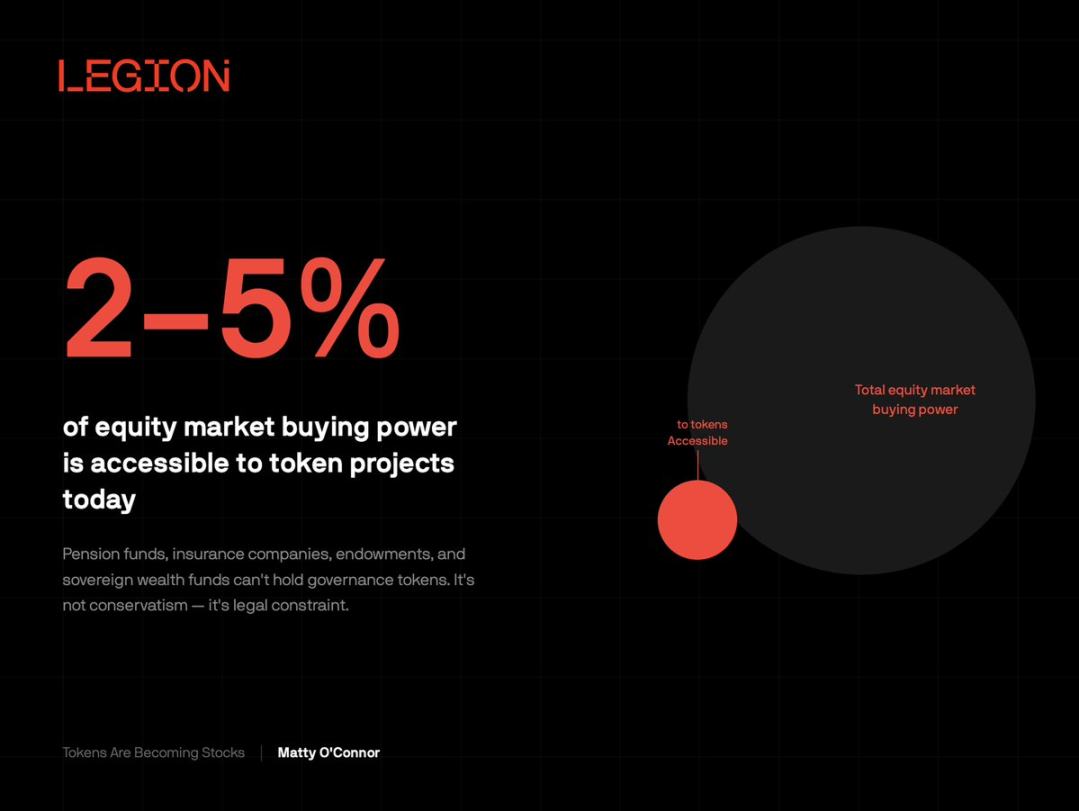
Pension funds cannot hold governance tokens; insurance firms cannot classify yield-bearing tokens as fixed-income assets; endowment fund allocation guidelines contain no dedicated category for “DeFi yield.” University endowments, sovereign wealth funds, insurance reserves—these are the world’s largest pools of long-term capital, yet they remain entirely on the sidelines. Due to fiduciary compliance requirements, even if certain token economic models are sound and robust, major institutions remain legally barred from deploying capital into most token categories.
A turning point is emerging. Assets combining native token distribution advantages with compliant equity legal protections can tap capital pools 10–100× larger than pure-token architectures. Real-revenue economic models and real-time settlement infrastructure are already mature—the sole missing piece is a regulatory framework enabling institutional capital entry.
The complementary advantages are clear. Token infrastructure delivers real-time settlement, 24/7 liquidity, global, intermediary-free access, transparent on-chain cash flows, and programmable distribution rules; traditional markets provide unambiguous legal definitions, fiduciary-compliant frameworks, institutionally mandated custody standards, and centuries of precedent safeguarding investor rights.
Neither side can build a complete, self-contained system alone—but both deeply understand their mutual value. The ultimate winner will be a new paradigm integrating both strengths.
What Lies Ahead
Yield-bearing tokens are, at heart, equity with a fully upgraded settlement experience; tokenized stocks are, at heart, digital tokens with maturing legal frameworks. These two asset classes are converging steadily—differences narrowing each quarter.
The central debate is no longer whether tokens can replicate equity logic—the answer is yes, they already do. The real question is: who will successfully bridge capital and infrastructure—and how quickly can regulation catch up to economic innovation?
The mechanisms are mature. The rails are laid. The capital is ready.
Join TechFlow official community to stay tuned
Telegram:https://t.me/TechFlowDaily
X (Twitter):https://x.com/TechFlowPost
X (Twitter) EN:https://x.com/BlockFlow_News
 @matty_


