








Who Will Lead the Next Generation of Web3 Wallets? The Past and Future of Web3 Wallets | Event Highlights
TechFlow Selected TechFlow Selected
Who Will Lead the Next Generation of Web3 Wallets? The Past and Future of Web3 Wallets | Event Highlights
TechFlow and Bitizen co-hosted an online seminar titled "Who Will Lead the Next-Generation Web3 Wallets? The Past and Future of Web3 Wallets."
 Navigating Web3 tides with focused insights
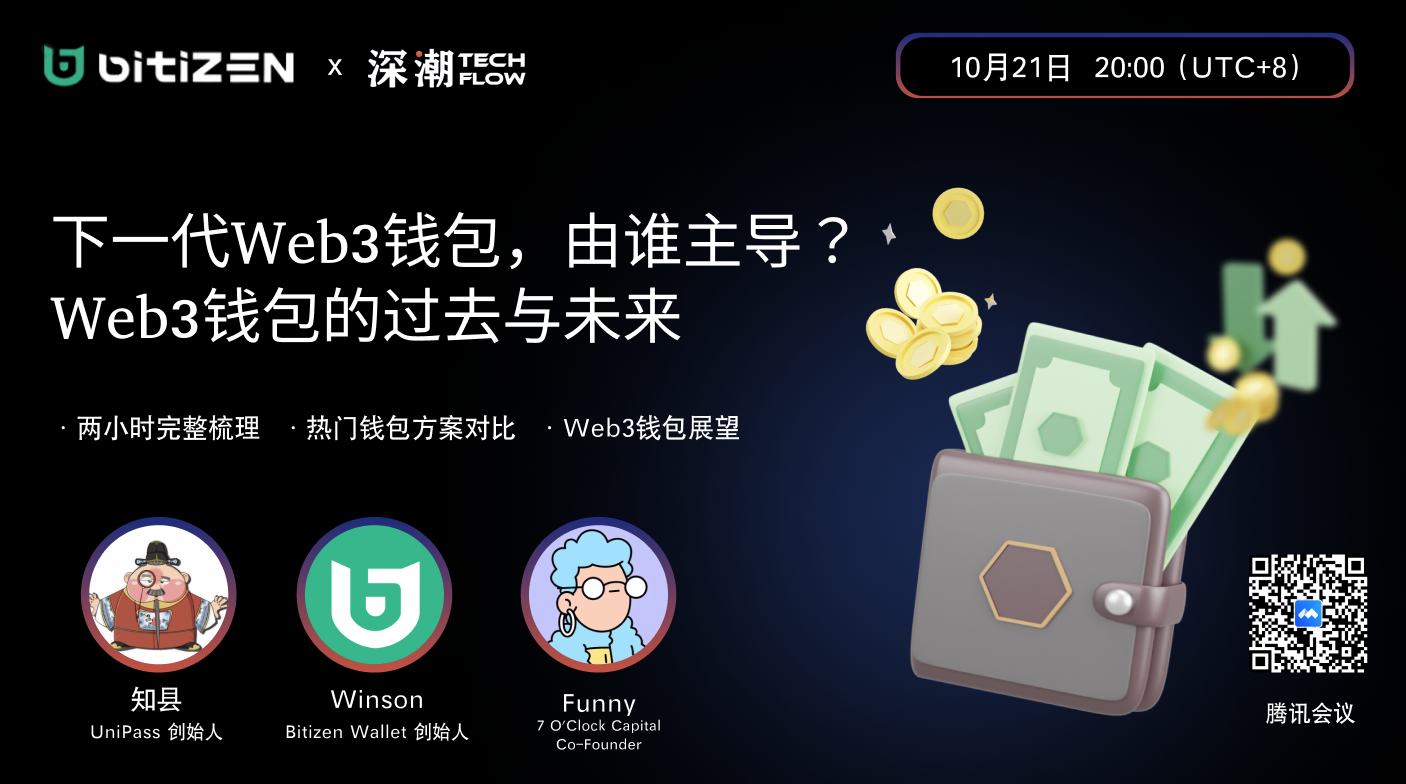
On October 21, TechFlow and Bitizen jointly hosted an online seminar themed "Who Will Lead the Next-Generation Web3 Wallets? The Past and Future of Web3 Wallets." The event invited three guests: Zhi Xian, founder of UniPass; Funny, co-founder of 7 O'Clock; and Winson, founder of Bitizen. They shared insights and engaged in discussions on popular wallet solutions, the characteristics of MPC wallets, innovation directions and development potential for wallet projects, and how innovations can become market-perceivable.
This article summarizes the highlights from the seminar.
Guests and Their Projects:
Zhi Xian: Founder of UniPass. UniPass is currently working on a smart contract wallet solution—a different track from MPC wallets—but functionally it can complement MPC wallets to deliver better user experiences. The main feature of smart contract wallets is their ability to offer enhanced functionalities such as gasless transactions, permission management, and more.
Funny: Co-founder of 7 O'Clock, a fund primarily focused on primary and secondary market investments. As investors, we take a broad view, though not necessarily deep expertise, and our perspective may differ from project teams. We previously published an article on wallets and look forward to exchanging ideas today.
Winson: Founder of Bitizen, a consumer-facing (2C) MPC wallet. We began exploring MPC wallet applications for end consumers as early as 2021. Although MPC technology has existed in the wallet space for years, it was previously concentrated in enterprise (B2B) use cases. Now, we aim to bring something new to the table.
Q1: Current wallet innovations mainly fall into two categories: functional innovation that improves user experience, and architectural innovation such as MPC wallets that innovate at the technical level. How do you view these two types of innovation? Can functional innovation be replaced by architectural innovation?
Zhi Xian: I think functionality and architecture belong to different layers.
Functional innovation is essential. Years ago, Nokia’s Symbian system had the rudiments of a smart OS, but could never support features like group video calls or TikTok-style short videos—these required foundational infrastructure upgrades such as higher bandwidth and lower costs, which brought us into the mobile internet era. Similarly in Web3, improvements at Layer 1 and Layer 2 will unlock new possibilities. In an article I wrote recently, I mentioned that smart contract wallets enable many functions impossible with EOA wallets—such as gas sponsorship, batch transactions, permission controls, offline authorization, and social recovery—enhancing both security and usability.
Current wallets are far less secure and convenient than typical mobile internet apps. If we want mass adoption of Web3, don’t we need a similar leap in infrastructure—an “iPhone moment” for Web3?
Therefore, I see these two innovation paths as complementary rather than conflicting—they can break boundaries and enable multi-functional, multi-scenario innovations.
Funny: I agree. It's like stepping forward with both feet—left and right. Ultimately, the goal is to meet user needs, which is the core metric. How to achieve that involves many considerations and depends on market choices.
The evolution of wallets is fascinating. One long-standing question is: how do wallet companies sustain themselves? Initially, wallets were seen as essential blockchain tools, but before 2017, they were mostly used by exchanges. Then hardware wallets emerged—why? Because large institutions (B2B users) with significant funds demanded high security, and wallet projects struggled to monetize, so they sold hardware devices and added asset management services.
With the rise of DeFi, cross-chain interactions created new revenue streams. Wallets evolved into platforms offering features like news feeds, cross-chain swaps, security audits, and promotional support for projects. This expansion enhances user convenience. No matter the innovation path, all developments ultimately drive the growth of the wallet market.
Q2: Why is the wallet considered such an important gateway, and what future opportunities and revenue potential exist?
Funny: All wallet investments are substantial because building wallets is technically demanding, reflecting the industry's recognition of their importance. Whether in crypto, Web3, or DeFi, individuals must have personal wallets to participate. Thus, wallets have a promising future—toward democratized finance, essentially asset management. Unless you're a laid-back company charging only fixed annual fees, asset management offers huge profit potential.
For example, many young people buy their first insurance policy not through insurers but via platforms like Alipay. Alipay resembles today’s wallet evolution—it holds funds and offers financial services. When users trust a wallet/platform, they naturally trust its recommended financial products and derivatives. Financial services will thus become a massive market.
Once you retain users, advertising becomes another revenue stream. Also consider DID (Decentralized Identifiers). Building a DID ecosystem requires extensive user tagging. Wallets are naturally positioned to link projects, rate them, and facilitate identity verification.
Wallets evolve with the industry, experiencing periodic breakthroughs. As gateways for user onboarding, wallets have vast potential across B2B and B2C markets—even if progress seems slow now.
Winson: I'm optimistic about wallet revenues—and this optimism is data-backed. The business model of 2C wallets closely mirrors Web2: expand from a user base, essentially using traffic-driven strategies.
The idea that 2C wallets can't make money ended after 2020. Last year, MetaMask generated $200 million in revenue. With the rise of DeFi, wallets have proven strong monetization capabilities.
Q3: What are your views on the pros and cons of smart contract wallets versus MPC wallets?
Zhi Xian: These aren't competing products—they can be integrated. UniPass actually uses MPC techniques to enhance user experience. For instance, when embedding SDKs, all information is exposed to third parties, so we can't grant full key permissions. That's where TSS comes in. This is a major trend—most leading wallets are adopting similar approaches. We’re currently discussing integrations with other MPC solutions.
Smart contract wallets shine in functionality and extensibility. Even in extreme cases—like private key leaks—if assets are partially stolen, you can still regain control via social recovery or other methods and reclaim your address. This matters because even after theft, non-transferable assets remain—such as SBTs or your entire on-chain activity history. It's like losing money in your WeChat wallet but recovering a decade of chat history. So, smart wallets can complement MPC in expanding functionality.
Q4: Traditional EOA wallets require signing with private keys. But how does MPC enable signing without generating a private key?
Winson: Signing is fundamentally a mathematical operation. Traditional wallets use plaintext private keys to compute signatures. MPC replaces this with encrypted multi-party computation, producing the same valid signature result—without exposing the private key. Miners only verify the signature’s validity, not whether it came from a plaintext key. By replacing traditional schemes with secure multi-party computation, we maintain compatibility while enhancing privacy and security.
We use a 2-of-3 signing scheme: three key shards, any two of which can sign. Users hold two shards, enabling full autonomy—signing, transferring, etc.—without Bitizen. Bitizen holds one shard solely to assist in signing. That single shard poses no threat to your assets. Even if we shut down, you can continue using your wallet normally.
Q5: MPC wallets use MFA (multi-factor authentication). If MFA is compromised, is the wallet still secure?
Winson: Of course, this is a highly idealized assumption, but the point of MFA is precisely that it's hard to compromise. Security is relative—not absolute. The higher the cost to attack a system, the more secure it is; the lower the cost, the less secure.
MFA increases attack costs through multiple verification layers. Suppose single-factor authentication has an attack cost of 1; moving to three factors doesn’t just triple the cost—it increases exponentially. Yes, if all three are breached, the system fails—but realistically, that’s nearly impossible.
Q6: Technical innovation doesn’t always align with market demand. Communication strategy is crucial. How do you make product innovations perceptible to users? And for a wallet like Bitizen, how do you make security tangible to users?
Zhi Xian: Ordinary users may not immediately feel technological innovation, but that doesn’t mean they won’t eventually benefit. Many technologies innovate for a period, then stabilize and find a balance between cost and market fit.
Achieving product-market fit is a major challenge for wallet teams. Historically, many products had solid positioning and user bases but were overtaken by others. How do you get noticed? There are many strategies—whether B2B or B2C. You might excel at branding, package value compellingly, or use marketing tactics that create expectations of future rewards. User exposure doesn’t equal user awareness—that’s harder, and there’s no one-size-fits-all approach due to differing resources and capabilities. This is a space for creativity—the most interesting part.
Winson: We’ve discussed this—security and the feeling of security are different. Technically, our MPC wallet is far safer than hardware wallets, yet users often *feel* hardware wallets are more secure. This reflects a psychological gap—hardware feels more self-controlled. New brands inevitably face this: if users don’t know or understand you, they won’t trust you—especially for high-trust products like wallets. Strong branding and marketing are essential.
Our wallet includes Web2-like elements—email, phone number, facial recognition, cloud storage, servers—which some label as centralized. That’s why, beyond usage safety, we emphasize two aspects: censorship resistance and privacy protection. That’s also why we open-source our code for third-party security audits. Partnering with reputable brands and major industry players also boosts user confidence in our security.
Yu Jun, a well-known Chinese product manager, proposed a classic formula: user value = new experience – old experience – switching cost. Early on, wallet supply lagged demand; the shift from B2B to B2C is only recent. I see 2019 as a key starting point—before that, users didn’t interact with smart contracts or dApps. Now, market demand drives tech progress, which in turn pushes infrastructure upgrades.
I believe new solutions can replace old ones seamlessly—or even upgrade them. When the difference between new and old experiences is large and switching costs are low, user value is maximized. With more players entering the space, the pie grows, and technology rapidly advances to a new era. Funny: As an investment firm, we meet countless projects daily. Our operational insights boil down to a few key points:
First, the most direct and essential step: third-party security audits.
Second, get endorsements—from partners, investors, or KOLs. As mentioned, security is imperceptible. When nothing goes wrong, everyone assumes you’re safe; once a breach occurs, trust evaporates instantly—this is blockchain’s harsh reality. Within the industry, seeing trusted peers use a product builds immense confidence, especially given the abundance of alternatives.
Third, wallet marketing depends on the maturity of the wallet market itself. Like Nokia, which innovated in materials (e.g., durability), but was disrupted by the iPhone, which redefined user expectations. Once a pioneering product emerges, marketing becomes effortless.
But innovation isn’t always technical. Sometimes it’s about reframing the market opportunity or addressing user pain points. Even without endorsements, user growth can surge.
Ultimately, wallets must serve users. Security is just one aspect—meeting diverse user needs is paramount. When multiple needs are satisfied, usage frequency increases. While users may install multiple wallets, they’ll habitually open the one they use most. That’s inevitable.
Q7: Some users testing Bitizen noticed backup options including cloud storage and email. Doesn’t backing up via these platforms introduce security risks?
Winson: Cloud storage and email can be hacked, but our product remains secure because backups don’t store sensitive data. Not only is hacking these platforms difficult, but even if attackers obtain the data—or we hand it over—it’s useless to them. Technically, there’s no single point of failure. High attack cost is the first layer of defense; data anonymization is the second, and more fundamental, safeguard.
Q8: Account abstraction is often discussed, with ERC-4337 being the most cited proposal. What’s its significance for the industry?
Zhi Xian: Ethereum aims to shift users from EOA wallets to smart contract wallets via account abstraction, reducing the ecosystem’s reliance on EOAs. ERC-4337 is Ethereum’s user-layer experiment toward this goal. Its benefit lies in driving ecosystem-wide compatibility with smart contract wallets.
I recently returned from Devcon, where this topic dominated discussions. Overseas, awareness has reached a normalized stage—people are debating applicable scenarios and needed infrastructure, officially entering the phase of building out the full ecosystem. We can expect diverse smart contract wallet solutions to emerge. ERC-4337 brings EVM capabilities from backend to frontend, helping developers understand its potential and shaping the future evolution of the EVM ecosystem.
Web3 needs more users. How do we attract them? Better wallets alone aren’t enough—we need more use cases. Only with sufficient flexibility and user-friendly interfaces can we support novel applications and migrate users from Web2 to Web3. Just as mobile internet succeeded PC internet, this paradigm shift requires tools like smart contract wallets.
Q9: Many B2B products are targeting “Web2.5” projects—those pursuing GameFi, NFTs, Metaverse, etc., while attracting Web2 builders. Does this make the SaaS space overcrowded? How do you position and compete?
Zhi Xian: Currently, everyone serves their own needs, depending on how you define “user.” Unlike Web2, Web3 users are highly fluid. If a wallet is the first step bringing users from Web2 into Web3, the acquisition cost is enormous—especially with seed phrase wallets, which suffer heavy user drop-off. But once users are onboarded and generate value in L3 applications, you get none of the credit. That’s unfair.
So we tell partners to explicitly mention UniPass login—it benefits them too. For apps, it acts as a liability shield. If key security fails, users and regulators know the app isn’t responsible—it should go to UniPass. This protects apps from bearing undue responsibility and spares them from having to build wallets just for social or gaming features.
On user acquisition, we adopt a commercial partnership model with early collaborators: users who sign in via UniPass are shared users, identifiable on-chain—a unique trait of smart contract wallets. We have a “co-built channel” concept: early, high-quality clients permanently use UniPass services for free—unlike typical 2B SaaS models. Even if a user later transacts with a competitor, transaction fees and gas costs still generate revenue shares for the original partner.
This is our competitive and business expansion strategy.
Q10: How do you evaluate the valuation of a wallet project?
Funny: As mentioned, wallets demand high technical expertise and cost. When evaluating wallet projects, we assess whether their solution aligns with market expectations, their technical roadmap, and implementation costs—then make a holistic judgment. A simple method is benchmarking against similar competitors’ valuations.
Additionally, we consider whether the project’s sector matches current trends or market expectations. If it fulfills a future necessity widely recognized as essential, valuations tend to be higher. For example, ZK projects command high valuations despite lacking deliverables—because the concept is strong and future prospects seem vast. Market sentiment also plays a role: in bull markets, valuations soar; in bear markets, they decline.
Valuation is multifaceted. Typically, founders propose a valuation, which investors then assess. From an investor’s standpoint, lower valuations are preferred. It’s a negotiation between differing interests—a strategic game.
Join TechFlow official community to stay tuned
Telegram:https://t.me/TechFlowDaily
X (Twitter):https://x.com/TechFlowPost
X (Twitter) EN:https://x.com/BlockFlow_News






