How will Account Abstraction EIP-4337 improve Ethereum UX?
TechFlow Selected TechFlow Selected
How will Account Abstraction EIP-4337 improve Ethereum UX?
How does EIP-4337 attempt to solve Ethereum's complex user experience using account abstraction?
 Navigating Web3 tides with focused insights
Original author: Nishil, Researcher at Biconomy
Translation: DeFi Dao
One of Ethereum's main drawbacks is its complex user experience. Let’s explore how EIP-4337, proposed by researchers from Nethermind and OpenGSN, attempts to solve this issue using account abstraction.
So let’s begin with the meaning of account abstraction (AA).
1. Definition of Account Abstraction (AA)
Account abstraction provides users with simplified account usage, reducing the need to understand underlying processes.
Just like we use a Gmail account without knowing how it works.
With account abstraction, we have the opportunity to move away from the terrifying world of seed phrases.
We can enable different signature options, gas fees can be sponsored by DApps or paid via fiat currency, and more.
Now that we know what account abstraction (AA) means, let’s learn how to bring it to Ethereum.
2. How to Implement Account Abstraction on Ethereum
Currently, there are two types of accounts on Ethereum:Externally Owned Accounts (EOAs) andSmart Contract Accounts.
-
Externally Owned Accounts (EOAs) are controlled by a user's key pair (public and private keys), which is how most users interact with Ethereum. Services like MetaMask (wallets) serve as interfaces for interacting with these accounts.
-
Smart contract accounts are not controlled by any private key but instead governed by their code. For example, all DeFi protocols are managed by smart contract accounts.
The problem with Ethereum is that externally owned accounts (EOAs) have privileges that smart contract accounts lack. The most notable example is the ability to initiate transactions. Currently, only EOAs can do this.
This is problematic because EOA functionality is hard-coded into the Ethereum protocol, leaving no room for customization.
For instance, Gmail allows you to enable 2FA on your account. Today, such customizability isn't possible on Ethereum.
EOAs on Ethereum face the following limitations:
-
Users cannot use custom signature schemes. ECDSA is the standard signature scheme used by Ethereum to generate public-private key pairs.
-
Gas fees must be paid in native cryptocurrency ($ETH).
-
Since your private key is your account, losing your key means losing your account.
All these issues can be easily solved with smart contract wallets, which allow custom logic.
However, as mentioned earlier, transactions on Ethereum can only be initiated through externally owned accounts (EOAs) secured by ECDSA—not through smart contract wallets.
Now you might ask—why don’t we just change that?
Well, EIP-2938 is one approach to solving this issue. It introduces changes to the Ethereum protocol allowing transactions to originate from smart contracts rather than EOAs.
But the problem is that it requires significant changes to the protocol.
Therefore, researchers from Nethermind and OpenGSN, with help from Vitalik Buterin, proposed EIP-4337.

This proposal presents a workaround to bring "account abstraction" to Ethereum without modifying any consensus-layer protocols.
Instead of altering the logic of the consensus layer itself, it replicates the current transaction mempool functionality at a higher level.
The process involves several moving parts, including:
-
User Operations
-
Bundlers
-
Paymasters (optional)
Next, let’s examine each of these concepts one by one.
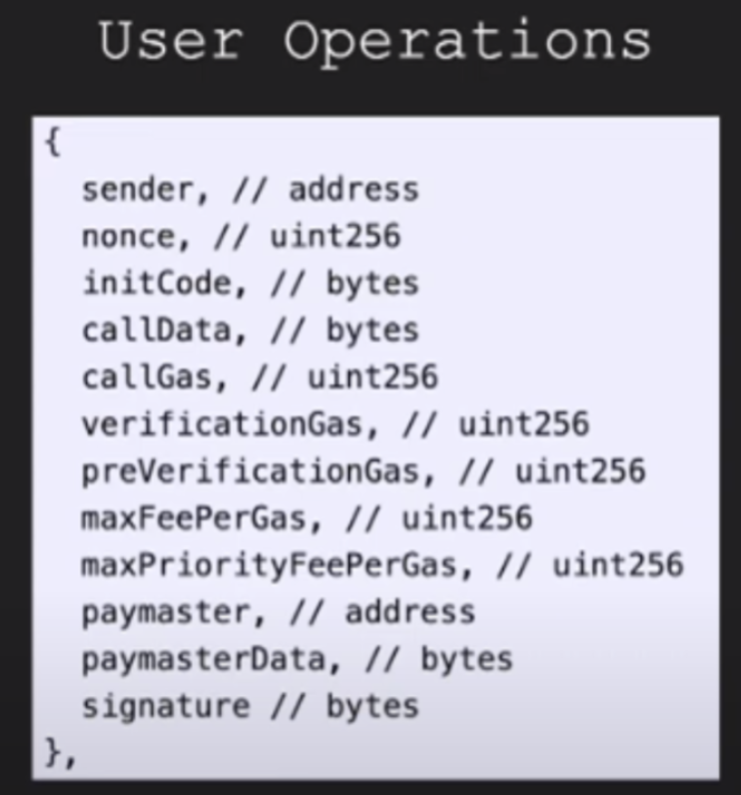
The proposal introduces the concept of "user operations," which allow us to encode custom functionality into our smart contract wallets.
User operations package a user's intent, signature, and other data for validation.
Relevant image:
Here is the general flow for initiating a transaction via a smart contract wallet:
1. Alice (the user) initiates a "user operation" containing the transaction she wants to execute;
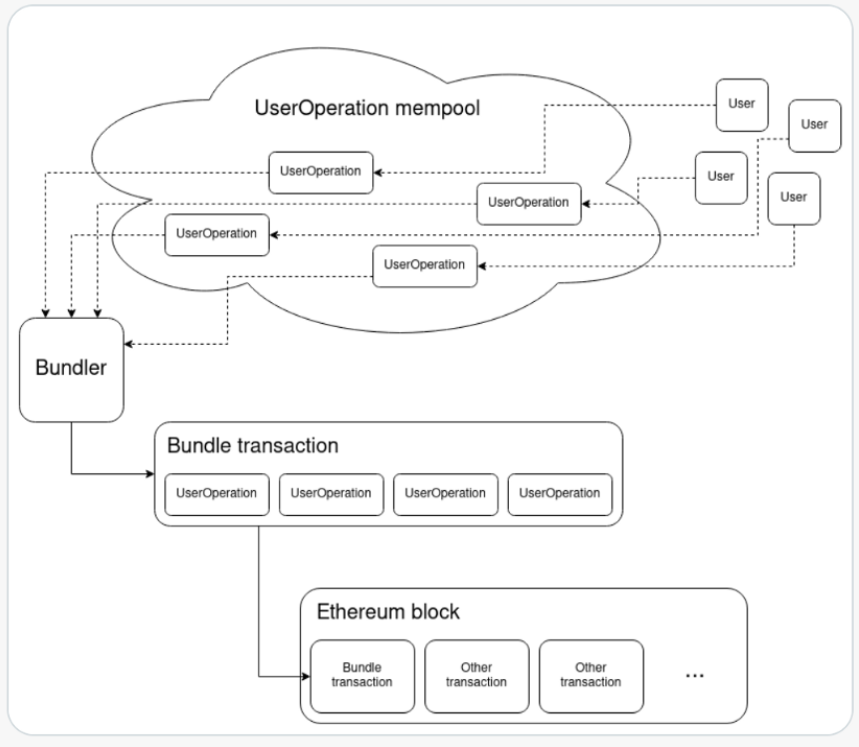
2. She sends this operation to a high-level "user operation mempool".
3. The operation is partially validated and broadcast across a P2P network of mempool nodes.
4 — The operation is selected and executed by a "Bundler"; anyone can become a Bundler—for example, MEV searchers, validators, you, or me.
5 — The Bundler bundles all operations into one large transaction.
6 — The Bundler includes the bundle along with other transactions in an Ethereum block.
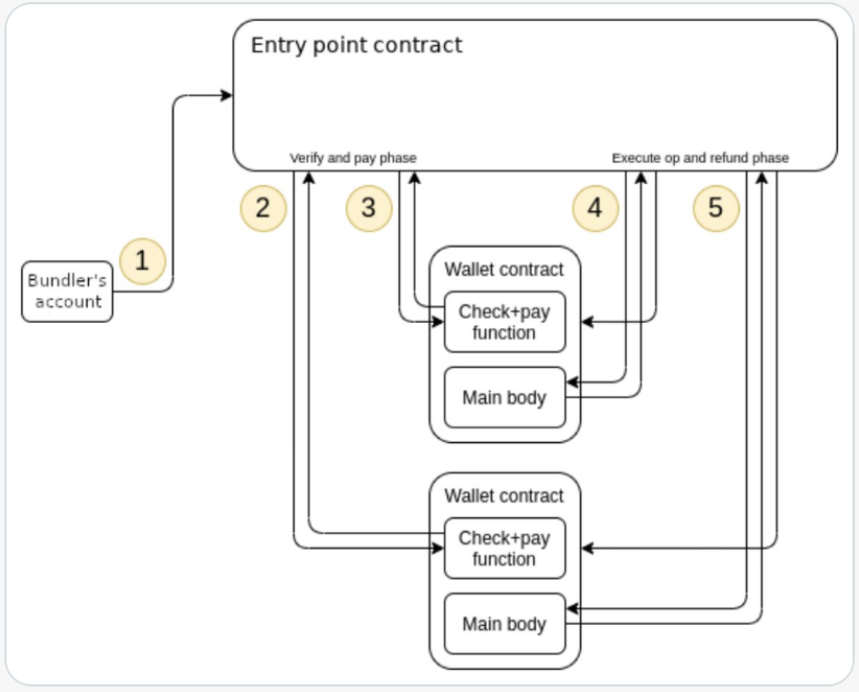
Now let’s break down the Bundler’s functions to understand how transactions are executed and verified.
1 — The Bundler routes the transaction to a global "entry point" smart contract.
2 — The global contract iterates through each user operation and calls the "validation function" within the smart contract wallet.
3 — The wallet runs this function to validate the signature of the user operation and compensate the Bundler for bundling the transactions.
4 — The wallet then runs an execution function to carry out the transaction specified in the operation.
5 — After execution, any remaining gas is refunded back to the wallet.
This EIP also introduces the concept of a "paymaster".
Users can now rely on a paymaster rather than their own wallet to sponsor their transaction fees.
Sponsored transactions open up many use cases. The most commonly cited ones include:
-
Allowing app developers to pay fees on behalf of their users;
-
Allowing users to pay fees in ERC20 tokens, with a contract acting as an intermediary to collect those ERC20s;
3. What Does Account Abstraction Mean for Us?
All of this is extremely exciting—but why should we care? Well, there are multiple reasons.
The proposal allows us to use custom signature schemes. Users can now leverage built-in schemes from iOS and Android devices, turning every phone into a hardware wallet.
It enables native support for multi-signers on Ethereum. Two or more users can now approve a single transaction, enhancing security.
Social recovery becomes possible. If a user somehow loses their key, they can simply have friends or family help recover their account.
Alright, that covers everything about this proposal.
This proposal introduces numerous innovative pathways, and I hope I’ve explained them clearly. It will be exciting to see teams build use cases that deliver better user experiences.
Join TechFlow official community to stay tuned
Telegram:https://t.me/TechFlowDaily
X (Twitter):https://x.com/TechFlowPost
X (Twitter) EN:https://x.com/BlockFlow_News
 @biconomy