Exclusive Interview with Account Labs: Committed to Account Infrastructure Development, Keystone and UniPass Announce Strategic Merger
TechFlow Selected TechFlow Selected
Exclusive Interview with Account Labs: Committed to Account Infrastructure Development, Keystone and UniPass Announce Strategic Merger
How will Account Labs respond to market competition, technological changes, and evolving user demands?
 Navigating Web3 tides with focused insights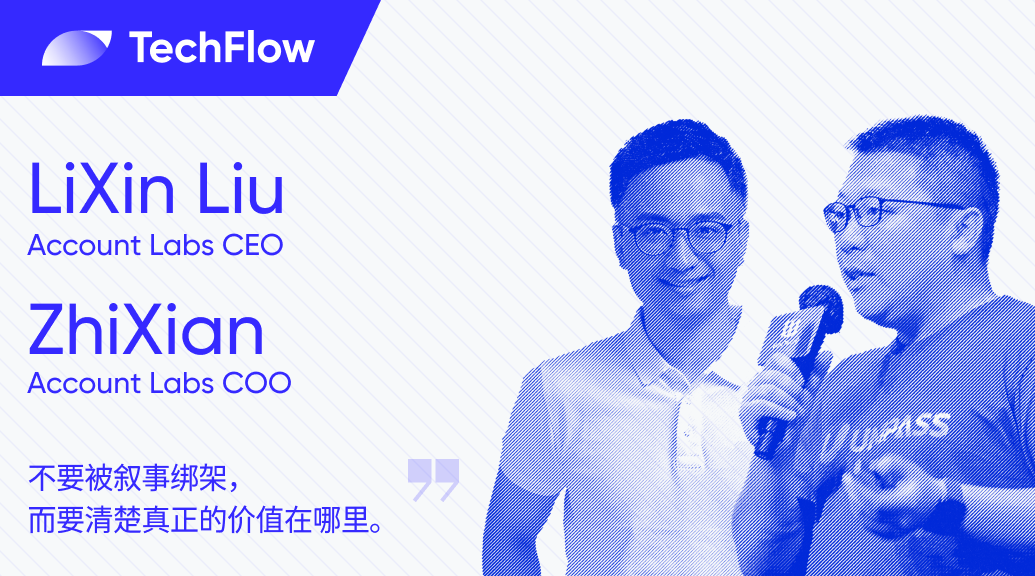
Author: David
Narratives in the blockchain industry come and go, but the topic of wallets deserves ongoing discussion.
Account abstraction (AA) and ERC-4337 are seen as key drivers of wallet innovation, potentially leading a new wave of Web3 account transformation.
However, whether new technologies can ignite widespread adoption depends on pioneers willing to blaze the trail.
On May 20, hardware wallet developer Keystone and smart contract wallet solution provider UniPass announced their merger to form Account Labs, aiming to integrate their technological strengths to deliver cutting-edge Web3 account abstraction solutions globally.
Seizing this moment, TechFlow interviewed Account Labs CEO Liu Lixin, formerly founder of Keystone, and COO Zhixian, previously founder of UniPass. In this exclusive interview, we delve into the strategic rationale behind the merger, technical integration, and their achievements across hardware wallets, smart contract wallets, and account abstraction technology.
How will the newly formed Account Labs navigate market competition, technological shifts, and evolving user demands? And how will these two industry veterans uphold long-term value amid short-term noise? This article unveils the beginning of their innovative journey.
I. Strategy and Opportunity: Firmly Committed to Building the Future of Accounts
TechFlow: Both of you are seasoned veterans in the industry. Could you share your backgrounds and your new roles at Account Labs?
Liu Lixin:
Hi everyone, I’m Liu Lixin, former CEO of Keystone and now CEO of Account Labs. In terms of responsibilities, I handle external affairs such as fundraising, go-to-market strategy, and business development, while Zhixian manages internal operations.
I first learned about Bitcoin in 2009 and entered the wallet industry around late 2017 and early 2018. Prior to that, my career began as a management trainee at Fortune 500 companies, followed by experience at two relatively successful startups, primarily in the smart hardware field—covering everything from concept prototyping and product design to supply chain and international expansion.
Zhixian:
Hello, I’m Zhixian, former CEO of UniPass and now COO of Account Labs. My main focus is on overall R&D planning and advancing internal processes for the new company.
-
I started entrepreneurship in 2012 and have worked in traditional internet sectors, mainly on traffic and gaming-related projects.
-
After entering the crypto space in 2017, I began developing the Lightning Network for micropayments.
-
In 2018, we early-adopted Ethereum’s Layer 2 solution via state channels, also focused on payments.
-
Starting in 2020, my team worked on developer tools within the Nervos ecosystem and launched several consumer-facing products.
-
About a year ago, we pivoted toward AA wallets and validated our full solution on EVM chains.
TechFlow: What was the original motivation and goal behind merging to form Account Labs? Was this a move driven by industry winter survival tactics, or a strategic decision to jointly pursue a new opportunity?
Liu Lixin:
Let me answer from the perspective of each product.
For Keystone, “huddling for warmth” has never been our primary goal. We’ve always collaborated closely with overseas communities, and our main market is international. From top software wallets like MetaMask to Cosmos-based Keplr, we’ve built strong partnerships and developed a proven strategy for community penetration. Therefore, our hardware wallet business generates solid cash flow and remains in excellent health—we don’t need to merge out of survival pressure.
In fact, after the recent Ledger incident, our daily sales surged by 20x. That event revealed just how many industry leaders and developers are actually our users—a testament to our relentless focus on product excellence and deep community engagement.
However, during our operations, we identified a significant gap: the lack of a highly adaptable hardware wallet capable of securely managing private keys while seamlessly interacting with various software wallets. This led us to closely follow programmable accounts and account abstraction. Compared to EOAs—even those using MPC—the account abstraction model offers true programmability, which unlocks immense potential.
We considered building it ourselves or partnering with external labs, but account abstraction is too vast a challenge. It’s not only part of Ethereum’s technical vision—it’s a fundamental driver for the entire EVM ecosystem. We realized going solo wouldn’t suffice; collaborating with another deeply technical team was the optimal path forward.
Moreover, account abstraction enhances hardware wallet usability through programmability. For example, it enables granular permission controls: your BAYC could be managed via hardware wallet, while other airdropped NFTs are handled directly through software wallets. This achieves a perfect balance between security and convenience.
This alignment is why merging with UniPass felt like a natural decision.
Zhixian:
Yes. For UniPass, we had just completed fundraising before the merger—our runway was still long. But I gradually realized that in the fast-evolving landscape of programmable accounts, focusing solely on product iteration without sufficient market outreach may not be sustainable long-term. So we decided we needed to lead in both product innovation and market presence.
Teaming up with Keystone accelerates our market expansion, brings faster real-world feedback, and speeds up product cycles. Our teams complement each other technically, and Li Xin and I have known each other for years—he even served as an advisor to our product earlier. Given our mutual understanding and complementary strengths, this merger was a perfect fit.
TechFlow: After the merger, how are responsibilities divided and collaboration structured across strategy, product development, and team building to achieve a synergistic effect?
Liu Lixin:
First, the evolution of AA directly shapes our strategy. Since the rise of ERC-4337 last year, we’ve seen numerous foundational opportunities worth pursuing. Strategically, we’re not just exploring theoretical possibilities of AA—we aim to actively contribute to its infrastructure.
In terms of product use cases, AA goes far beyond lowering entry barriers. It enables powerful features for advanced users—batch transactions, gas sponsorship, fine-grained permissions, and more.
Given this, the synergy between Keystone and UniPass at the product level will be strong. We believe AA-enhanced versions of both products will better serve users—not just beginners, but also experienced users seeking richer interaction experiences.
Additionally, our R&D focuses are distinct yet complementary.
Keystone excels in application layers, private key management, and secure hardware development, along with strong ties to international developer communities. UniPass brings deep expertise in foundational research—cryptography, zero-knowledge proofs, and smart contracts—with extensive hands-on experience. Thus, our technical capabilities are highly complementary.
Regarding team building, I’ve experienced rigorous management frameworks from Fortune 500 companies and spent considerable time refining the Keystone team. With this mature experience, I’m confident we can build Account Labs faster, stronger, and more sustainably.
TechFlow: How do you evaluate the timing of the merger? Is now the ideal moment to push AA into productization?
Liu Lixin:
Yes. To us, account abstraction is the final missing piece for Ethereum’s massive success—a critical enabler.
Right now, the priority is making blockchains and applications more user-friendly. Our team is exploring how AA at the account layer can solve real user pain points—like batch transfers. While the industry is still early, we believe AA will have profound, lasting impacts on Web3.
Going forward, we’ll continue investing in R&D and product iteration, and collaborate with the Ethereum Foundation and others to help establish AA standards and drive mass adoption.
So yes, now is the perfect time to plant trees. We want to participate in planting the saplings and watering them—not wait until the fruit ripens to fight over shares.
Zhixian:
I think the timing isn’t late at all—AA only entered mainstream awareness about six months ago.
Of course, "early or late" depends on your team’s perspective. If your team genuinely believes in the core value and has the resources and persistence to execute, then it’s definitely not too late. Sustained effort today builds unassailable advantages when the space heats up—just like MetaMask’s current position.
But if either capability or commitment is lacking, it might be too early. AA isn’t as hot as people assume. Rushing in blindly reveals unexpected challenges, making it hard to persevere.
TechFlow: In such a competitive landscape, how does Account Labs stand out and compete?
Liu Lixin:
I believe our edge lies in existing first-mover advantages. For example, we were among the first wallet teams to implement email-based social recovery and OpenID login. But rather than treat these as proprietary secrets or competitive weapons, we plan to actively contribute to AA governance organizations and gradually open-source our work.
That’s the beauty of Web3. Our relationship with other AA wallet teams feels more like collaboration than competition. We want to promote AA because it’s fundamentally more powerful than traditional EOA accounts (like those created by MetaMask). Within this ecosystem, we can each play to our strengths and divide responsibilities.
If there is competition, it’s about which market segment you capture. AA’s strength lies in serving diverse users—from beginners to professionals—and integrating with hardware wallets and tools like MetaMask. Early movers gain greater market share and scenario control.
Turning core features into EIPs and sharing them with the community isn’t just altruism—it establishes legitimacy and influence. In decentralized worlds, legitimacy matters immensely (though I won’t elaborate further here).
TechFlow: What is Account Labs’ biggest advantage? And what are the biggest challenges during or after the merger?
Liu Lixin:
I think our advantage stems from being “old hands” who’ve lived through full industry cycles. This deep historical context gives us better foresight and control over future directions—an essential difference between us and newer teams.
The biggest challenge comes from clients. Currently, we see two types: one group doesn’t strongly value decentralization or non-custodianship, so our AA capabilities offer little benefit; the other aligns perfectly with us—like full-chain games demanding high decentralization—but they themselves are still nascent and unproven in the market.
Given this, a major upcoming decision is whether to explore To C scenarios ourselves, similar to what LayerZero has done.
Zhixian:
I see challenges in two dimensions: business-related difficulties and team integration issues.
-
Team integration is much harder than simple cooperation—and rare in the industry. Fortunately, we already knew each other well and had successfully collaborated before, making the transition smooth.
-
On the business side, direction selection is challenging. Having been in the space long enough, we know narratives shift frequently—many rush toward trends and abandon them just as quickly. That’s why I keep reminding myself: “Don’t be held hostage by narratives.”
That’s where our “old men” advantage shows: we’re not driven by hype. We recognize narrative cores but understand where real value lies. We won’t change direction merely because of trends—we must uphold certain values. For instance, whether to meet some client demands by offering relatively centralized solutions—that’s a values question.
Therefore, I believe it’s crucial to clarify and stick to your values when facing challenges. As long as we remain steadfast, current difficulties are temporary.
At its core, the issue is that AA solutions are still new, ecosystems aren’t mature, and app compatibility lags behind. Yet, what matters most is seeing the broader trajectory of ecosystem development. Though this is a real constraint today, it doesn’t mean it won’t ease over time.
II. Business and Product: Prioritizing Needs, Knowing What to Do and Not to Do
TechFlow: Will the original products from both companies evolve into unified-branded offerings under Account Labs? What changes will existing Keystone and UniPass users experience post-merger?
Liu Lixin / Zhixian:
Great question. For now, existing users won’t notice any immediate changes—UniPass is more B2B-focused, while Keystone is purely B2C and internationally oriented. So average users currently won’t perceive much impact.
In the future, when exploring consumer-facing use cases, the two products will become deeply integrated.
TechFlow: Even if products remain independent, how will Account Labs integrate both teams’ technical strengths to provide world-leading Web3 account abstraction solutions?
Liu Lixin:
Let me clarify: there’s unlikely to be a one-size-fits-all solution for account abstraction that satisfies every function and need.
Take permission delegation as an example—it allows different private keys to manage the same account with varying rights. This applies to many scenarios: tiered asset management, multi-user accounts with differentiated access, and differing needs across B2B and B2C domains.
Think of it like a ski slope—wide and long, supporting many possibilities. For instance, combining AA, we could create a hardware wallet that doesn’t require seed phrases.
Because of this diversity, R&D lets us leverage our respective strengths across different use cases, enabling synergy between both product lines.
Zhixian:
To add, we don’t simply merge technical strengths and then seek problems to solve. The approach is reversed: first identify a market or user need, then figure out how to build better Web3 accounts to address real user demands.
With that mindset, we assess our existing technical capabilities—what can be directly applied or combined? If gaps exist, we can build new ones, confident in our enhanced cross-functional capacity.
For example, a user might hold substantial digital assets requiring hardware-level security, yet desire lightweight software wallet interactions for daily tasks—requiring permission isolation. Here, we combine UniPass’s AA framework and cryptography expertise with Keystone’s hardware capabilities.
Second, Keystone can offer hardware wallets better aligned with AA. As Li Xin mentioned, we can generate accounts with non-exportable seed phrases—eliminating the risk of seed phrase leaks at the root.
Thus, combined with AA, we ensure both security and usability, potentially delivering entirely new user experiences. This reflects our product- and market-driven integration philosophy.
TechFlow: On concrete product updates—will the third-generation Keystone hardware wallet launching in early 2024, and UniPass’s architecture upgrade within the next three months, introduce any new features?
Liu Lixin:
Keystone has always stayed close to the community, and our upcoming third-gen device is deeply community-informed.
After partnering with MetaMask, they suggested we develop a more affordable hardware wallet. Considering their millions of monthly active users’ price sensitivity, our third-gen model could drop to around $120—cheaper than Ledger Nano X, even approaching Nano S pricing.
Additionally, we’ll carry forward the popular fingerprint feature from Gen 2 and add new functions like support for importing three sets of seed phrases. Beyond QR codes, we’ll support USB and Bluetooth connectivity—highly requested features we’re implementing in this version.
Security-wise, we’re taking a big leap: instead of one secure chip, Gen 3 will use three different models working together to protect user assets—exponentially increasing hacking difficulty.
Zhixian:
UniPass recently underwent a major architectural upgrade, involving both frontend refactoring and backend contract development.
Frontend refactoring aims to make the product more adaptable to future complex demands. By optimizing architecture, we enable UniPass to flexibly respond to changing requirements and allow seamless integration with client systems. We also provide ample customization options so clients can easily embed desired elements into UniPass interfaces.
On the backend, we remain research-driven, constantly seeking better solutions. While we maintain a conservative update frequency for core contracts, we monitor trends like modular contract designs. Future iterations will incorporate more modular approaches, enhancing structural clarity, layering, and modularity—offering better flexibility for feature swaps and user freedom.
This refactoring strengthens UniPass’s foundation, making it more adaptable to diverse future scenarios.
TechFlow: Beyond product updates, will the current and future business models change? How will you sustain long-term growth and profitability?
Liu Lixin:
Zhixian and I have long shared a strong aversion to building “To VC” projects—we’re aligned on this.
For example, Keystone—if the product holds intrinsic value, there’s no need to give away free hardware and rely on software subsidies or other gimmicks to innovate on monetization. We deliberately avoid such business model experiments, forcing ourselves to deliver the best possible hardware wallet—surpassing even Ledger’s.
You might call this “clumsy,” but it’s earned us exceptional user trust and industry reputation.
Hardware wallets themselves represent a standalone business model. Even without any software integration, selling hardware alone sustains a healthy business. Future business models can be addressed later—but right now, we see AA unlocking tremendous value, not just for users but commercially as well.
I resonated deeply with Midjourney’s founder interview—he insisted from day one that Midjourney would be a paid product. That forced the team to build the best product and ensured the business model worked. I agree completely.
Zhixian:
We’re also refining UniPass’s business model—cutting unprofitable and VC-oriented paths—to achieve short-term commercial sustainability.
We won’t spend heavily incentivizing users. Instead, we prioritize user quality—real, high-potential users.
We’ll keep exploring healthy business models. Achieving positive cash flow proves our product addresses real user needs—a timeless truth in startups. Even if marketing or leverage boosts revenue temporarily, we must ensure the core business can support its scale and recover costs—without relying solely on future funding rounds. This is our promise to investors: even without next-round capital, we can grow steadily.
Product-market fit first, then scale, reduce costs, and build network effects—that’s the right path.
TechFlow: We’ve covered a lot on business. Now, for end users—simply put, who should use Account Labs’ products, in what scenarios, and what problems can your products NOT solve?
Liu Lixin:
I think the biggest issue with current hardware wallets is the “binary choice”: either use hardware for maximum security, or go “naked” with software wallets exposed to larger attack surfaces. Today’s solutions offer no flexible or customizable middle ground.
This will change dramatically. With AA’s permission controls, users can manage valuable assets via hardware wallets and lighter assets directly through software wallets. We could even combine hardware wallets with social recovery to create seedless hardware wallets.
Zhixian:
Let me add what we currently cannot solve.
One major limitation is incompatibility with non-EVM chains. Our AA wallets are built for the EVM ecosystem, meaning they only work on EVM-compatible chains. For non-EVM chains—like Bitcoin in extreme cases—we cannot offer support.
Another example is newer public chains that have some account abstraction capabilities but aren’t aligned with our “AA Wallet, ERC-4337” vision. You might view them as more powerful EOS variants or earlier flexible-account chains—they fall outside our narrative scope.
Then, I’d like to distinguish between “won’t do” and “can’t do.”
There are scenarios we choose not to pursue—not because we can’t, but because we see little value. Custodial solutions are one such case. While AA can support custodial setups, we won’t offer pure custody. We can, however, provide migratable or progressive custody—allowing users to start with low-friction custodial experiences (even imperceptibly), then later replace custodial keys with self-custody keys. This enables true onboard and offboard journeys.
So we can offer a contract framework letting you build low-barrier custodial products, while empowering users to eventually take full control. In summary, our limitations come in two forms: product constraints (e.g., non-EVM chains), and intentional directional choices (no pure custody, only custody-enabled migration paths).
III. Future and Vision: Staying True, Co-Creating a New Blue Ocean for Account Abstraction
TechFlow: What are Account Labs’ global expansion plans and regional strategies moving forward?
Liu Lixin / Zhixian:
Our global strategy includes several pillars:
-
First, leveraging Keystone’s prior success in overseas community outreach to promote account abstraction adoption—sharing knowledge with UniPass, engaging developers, and tailoring efforts based on regional user profiles, regulations, and trends;
-
Second, we call this collaborative ecosystem-building process “establishing legitimacy.” As a small startup, earning technical influence and community trust allows us to punch above our weight—unlocking partnerships with traditional Web2 brands, expanding market share, and creating ripple effects;
-
Third, narrative leadership matters. We aim to lead discourse on account abstraction—producing research reports, case studies, and beginner-friendly educational content;
-
Additionally, for the broader degen crowd, we’ll create simple, direct tools to make degenerate behaviors easier and more accessible.
For example, degens often face cumbersome cross-chain operations and lack gas fees to initiate transactions—pain points perfectly suited for programmable accounts. These can enable batch transactions, automated workflows, and more.
So establishing legitimacy doesn’t mean becoming elitist or ignoring end users.
TechFlow: That leads nicely into a related question—will future products consider user segmentation, such as institutions versus individual users?
Liu Lixin / Zhixian:
Our roadmap doesn’t rule out launching UniPass products for individual consumers, including high-net-worth individuals. However, institutional sales are more resource-intensive, so we likely won’t enter that space soon. If we do, it would probably be by providing underlying architecture to strong institutional partners, forming collaborations.
TechFlow: Regarding普及ation and education around account abstraction and more usable wallets, what initiatives does Account Labs have? How will you help more people understand and adopt these technologies?
Liu Lixin / Zhixian:
We see two main tracks for promoting technology and raising awareness.
First is technical education—explaining concepts at varying levels of depth depending on audience. Since AA and ERC-4337 are rapidly evolving, this is a long-term effort—like a large campaign fought through many small battles.
Second is case studies on mass adoption. By sharing these, we hope to guide future projects on lowering barriers and improving conversion rates—critical when traffic costs are high and efficiency is paramount. Mass adoption is vital, and we’ll build resources in this area.
Furthermore, we plan to boost awareness of decentralization and self-custody. A few years ago, this might have been tough, but now we see encouraging signs. As understanding grows, more opportunities emerge. We’ll organize events and launch collaborations to elevate awareness—part of our broader educational mission.
TechFlow: Let’s look ahead. What are your predictions for the blockchain industry over the next five years, and what role will Account Labs play?
Zhixian:
To predict the future, let’s learn from history.
Though recent market conditions feel bleak, recall 2018—right after the last bull run, heading into bear territory. Back then, Ethereum faced many challenges: immature infrastructure, sparse NFTs (only CryptoKitties stood out), and severe gas congestion. Progress seemed stalled—far less advanced than today.
Our narrative then was “return to Ethereum ruins, rebuild foundations, find growth.” Looking back now, it’s hard to imagine Ethereum evolving into what it is today. Over the years, countless “Ethereum killers” emerged, each predicted to dethrone it. Yet, after surviving repeated challenges, my outlook remains: stay committed to long-term value.
To judge the industry’s future, trust those who’ve weathered its storms—they survived for a reason. When uncertain about what to uphold, revisit history. Crypto history isn’t long. Stay grounded in core values, focus on solving essential problems—only then can the industry truly advance.
As for direction, the name “Account Labs” itself says it all (TechFlow note: referring to accounts and account-building).
Liu Lixin:
I’ve reflected on this too. Hardware wallets used to be mainly for holding coins, but now they’re becoming tools for daily interaction and managing important assets. It’s an evolution.
As long as you adhere to core Web3 principles—decentralized governance, non-custodianship—you’re on the right path. Staying on this road prevents losing faith due to external noise. Centralized systems are worsening—history proves it. Humanity needs a second option: decentralization. Once you grasp this, conviction follows.
Upholding long-term value in this industry is hard—but if you endure, the rewards compound.
Recently, a core team member asked me whether we should collaborate with emerging chains or ecosystems—for example, Argent shifting to Starnet—arguing integration friendliness and lower dev workload might bring quick user gains at low cost.
But I told him the biggest risk of such bets is that failure leaves nothing transferable to the future. So almost no one on our team gambles. Though I work in this space, I personally have little gambling mentality—I value solidity. As long as we believe in decentralization and self-custody, we’ll go all-in, pushing this mission to the extreme. We thrive where consensus is strongest, unafraid of hard work because it pays off. Sometimes, the best shortcut is no shortcut at all.
TechFlow: That’s a rare and thought-provoking answer. Have you considered spreading this ethos of pragmatism and builder mentality outward? Ultimately, what do you want Account Labs to represent in users’ minds?
Liu Lixin:
I think Account Labs may eventually encompass more than 2–3 products. We might form dedicated research teams contributing to open-source projects, or even establish an investment arm to incubate specific AA-based applications and use cases.
Ultimately, we aspire to resemble ConsenSys. Regular consumers may not know ConsenSys—they know MetaMask. Developers might know Infura. Only insiders recognize ConsenSys as the parent. But beneath the surface, ConsenSys has built foundational infrastructure. That’s exactly the role we want to play.
Zhixian:
I really love the name Account Labs—it precisely captures our core focus and the industry’s biggest challenge.
It instantly signals where our attention lies. Though we may engage in various activities, they all orbit one central theme: building better Web3 accounts. These accounts can manage assets (wallets), identities, and potentially expand to other areas like DID (decentralized identifiers)—all natural extensions.
The word “account” itself reflects a user-centric mindset. We’re partners solving user problems—not chasing distant abstractions. That’s our core value.
I believe that once entry barriers lower and device limitations lift, new capabilities will emerge, fueling explosive growth across the industry and its use cases.
An analogy: without smartphones, we couldn’t imagine today’s realities—short videos, food delivery—all impossible. Likewise, without advanced Web3 accounts, we can’t envision scenarios that might become tomorrow’s hottest domains. That’s our mission.
Our goal is to be catalysts for Web3’s breakout moments and user growth. Without progress in accounts and wallets, many visions and scenarios would remain unrealizable.
TechFlow: After navigating so much, neither of you seems to have lost your初心, continuously reinforcing your chosen path alongside industry evolution.
Overall, Account Labs’ work in Web3 carries significant importance. Focusing on user needs, solving real problems, and driving industry progress is a simple yet powerful logic—but maintaining consistency is difficult.
Account Labs is committed to building better Web3 accounts, lowering entry barriers, upholding long-term values, avoiding short-term gambling decisions, and staying true to decentralization and self-custody.
Thank you both for your time. We hope this interview inspires others steadfastly forging ahead in the ever-changing tides of the industry.
Appendix: FAQ and Primer on Account Abstraction
Due to length constraints, the two founders prepared a clear, easy-to-understand primer on account abstraction. TechFlow has compiled it below for interested readers.
https://lay2.notion.site/lay2/1eb6dadbab21474dbe74539128887924
Join TechFlow official community to stay tuned
Telegram:https://t.me/TechFlowDaily
X (Twitter):https://x.com/TechFlowPost
X (Twitter) EN:https://x.com/BlockFlow_News
 深潮TechFlow