Long Read: The Current State, Challenges, and Trends in the Development of Web3 Reputation Systems
TechFlow Selected TechFlow Selected
Long Read: The Current State, Challenges, and Trends in the Development of Web3 Reputation Systems
Reputation is one of the core components of Web3 identity. This article introduces the concept and significance of reputation systems, reviews the current development status of Web3 reputation systems, discusses existing challenges, and offers preliminary thoughts on future trends.
 Navigating Web3 tides with focused insights
In September this year, Ethereum co-founder Vitalik Buterin issued Soulbound Tokens (SBTs) to donors of his new book Proof of Stake. This marked a practical step following the May release of the paper "Decentralized Society: Finding Web3’s Soul," co-authored with fellow researchers.
The concept of SBTs, inspired by the game World of Warcraft, unlocks new use cases for tokens in Web3 and offers fresh perspectives for SocialFi. Simply put, SBTs are non-transferable tokens whose immutability allows them to serve as reliable reputation data—such as records of contributions, skills, and credentials.
Reputation is one of the core components of Web3 identity. This article introduces the concept and significance of reputation systems, reviews the current state of Web3 reputation systems, explores existing challenges, and offers preliminary thoughts on future trends. Some sections include subjective assessments or critiques of certain projects; these do not constitute investment advice, and some viewpoints may stem from insufficient research or misunderstanding. Additionally, in this article, "reputation" and "credentials" are used interchangeably, although the former is broader in scope.
What Is a Reputation System?
1. The Evolution of Reputation
The concept of reputation dates back to ancient human civilizations, where monarchies awarded medals or similar items (such as China's historical "Imperial Pardon Token") to officials and generals for their achievements.
-
In modern society, governments or international organizations grant honorific badges to individuals or groups to recognize their contributions to society, ethnicity, nation, or humanity.
-
In the workplace, companies often implement job-level or title systems to reflect an employee’s position and determine salary and benefits. Professionals also participate in training and exams organized by authoritative institutions or associations (e.g., CFA and ACCA in finance) to obtain certifications that serve as proof of capability.
-
In financial lending markets, institutions issue credit reports based on borrowers’ assets, past borrowing behavior, and transaction history. These reports serve as one form of credential for accessing loans in the credit market.

Reputation system of North Korean generals (Source: focuswashington.com)
With the advent of computers and the internet, reputation system design and applications have become increasingly diverse.
-
In online games, players accumulate points through daily logins, gameplay, and special missions. These points can be used similarly to purchased in-game currency—for example, buying characters, skins, or items.
-
In e-commerce platforms, users can upgrade their account levels via check-ins,打卡, and spending, gaining perks such as coupons, gifts, or increased credit limits for consumer loans.
-
In Web3, which emphasizes value interconnection, reputation is indispensable. Every wallet address’s on-chain activity forms a crucial part of its on-chain reputation. These activities include, but are not limited to, transfers, trades, and interactions with various DApps (liquidity provision, on-chain voting, liquidations, settlements, etc.). Addresses that perform specific on-chain actions may receive project tokens, NFT airdrops, early test access, or whitelist privileges.
In summary, the evolution of reputation can be divided into three stages:
-
Reputation 1.0: Refers to reputation in the physical world, either personal or institutional. Its influence ranges globally—from international alliances and nations down to industry groups or corporations—depending on the authority and reach of the issuing body.
-
Reputation 2.0: Refers to reputation associated with internet accounts. These systems are designed by online platforms, primarily based on user behavior within the platform and sometimes incorporating real-world identity data. Generally, each platform’s reputation system is relatively closed and non-interoperable because data sovereignty does not belong to users, who cannot “take” their data elsewhere. However, some mature social media and gaming platforms offer public data APIs, allowing third-party platforms to access partial user data with user consent.
-
Reputation 3.0: Refers to reputation tied to standalone wallet addresses or DIDs (Decentralized Identities), where a DID might bundle multiple wallets across chains and various SNS accounts. Overall, this stage is still in its infancy, actively exploring product-market fit and creating user demand. Its final form remains unknown. The only certainty is that users will own their data, and reputation credentials will enable information or value exchange across different applications on the web.
2. The Role of Reputation in Web3
As previously stated, reputation systems are essential to Web3 development and key to accelerating the Web3 flywheel effect, critical for both Web3 projects and Web3 citizens.
There are two main reasons:
-
On one hand, reputation helps projects grow their user base while enabling Web3 users to receive personalized content. Reputation systems allow new platforms to quickly identify high-fit potential users and more easily incentivize them into becoming high-quality contributors—ensuring greater participation in content creation, DeFi interactions, NFT collecting, GameFi gameplay, etc. On the other hand, as countless Web3 applications emerge, users risk being overwhelmed by information overload. However, they can leverage their historical behaviors to mint reputations or credentials reflecting their preferences, using reputation platforms and big data analytics to discover highly relevant content.
-
Conversely, reputation can match job seekers with employers. The Web3 ecosystem needs not just users, but also other value creators—developers, marketers, content creators, and governance participants. Typically, projects prefer to find “employees” with proven Web3 experience and passion, and a rich on-chain wallet history serves as strong evidence of such enthusiasm. Likewise, for Web3 job seekers, a resume built from on-chain reputations or credentials becomes a powerful, verifiable entry point. More specifically, achieving higher ranks in blockchain games increases chances of joining gaming guilds; users who actively govern a DeFi protocol are more valuable than mere token holders; users who actively promote a project on social media should have better chances of receiving token airdrops.
Reputation holds immense potential value for both project teams and users. As a16z noted in an article on reputation systems:
"Reputation tokens on digital platforms typically serve two purposes:
- Identifying and rewarding users who contribute value to the platform, serving as a signal that these users can leverage to enhance their public standing;
- Providing a form of compensation, enabling contributors to convert some of the value they create into redeemable, tradable money."
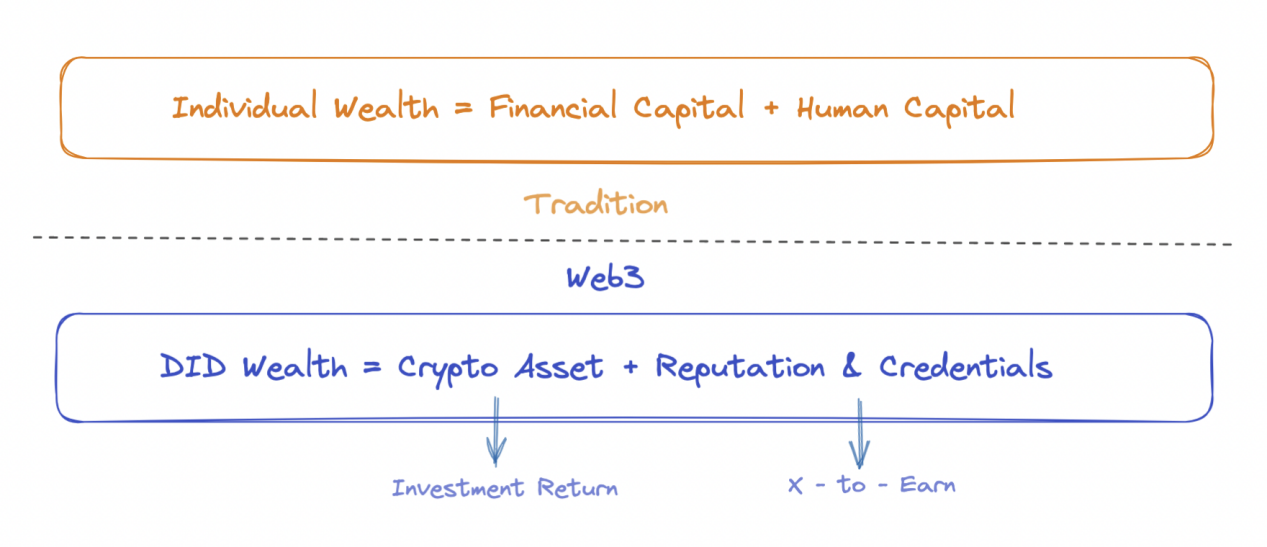
I believe that if personal wealth in financial theory equals financial capital plus human capital, then a Web3 DID’s wealth equals crypto assets plus reputation.
As Web3 applications diversify and economic models mature, earning opportunities in Web3 will extend beyond investing to various X-to-Earn models. Accumulated reputation can eventually be converted into a DID’s crypto assets—i.e., reputation monetization.
Current State of Web3 Reputation Systems
Below, we examine developments in Web3 reputation systems from three perspectives: ecosystem, economics, and technology. Overall, the field is rich in theory but still in early practice.
1. The Ecosystem of Web3 Reputation Systems
The Web3 reputation ecosystem is comprehensive, encompassing infrastructure, Web2 applications providing data sources, and Web3 applications focused on reputation systems.
1.1 Infrastructure
Infrastructure mainly includes two categories: data storage and proof-of-personhood solutions.
- Data Storage Solutions
Typically, centralized storage (like Amazon S3) or decentralized storage (like Filecoin/IPFS, Arweave) can store reputation data—whether raw or processed. However, due to characteristics like social data privacy and dynamic changes, reputation data requires a decentralized solution capable of efficiently storing dynamic data.
Ceramic is such a storage solution, already hosting numerous social projects on its network—including reputation, social graphs, and user-generated content. Ceramic emphasizes data composability, allowing users to store information streams and evolving files directly on a decentralized network via its permissionless data stream ("Stream") network.
Specifically, in Ceramic, each stored piece of information is represented as an appendable log (a computer file recording program execution), also called a Stream (similar to the open-source distributed version control system Git). Even if the stored content changes, the StreamID remains unchanged, enabling convenient version updates or rollbacks without frequently changing hash values.
Compared to IPFS, which requires manually syncing hash-logs on Git, Ceramic is far more convenient for storing dynamic data.
- Proof-of-Personhood Solutions
Since users can anonymously create multiple wallets, Sybil attacks are currently very easy in Web3 applications.For example, a user might use scripts with multiple wallets to interact with unaired projects and receive large airdrops; another user could accumulate voting power across multiple wallets to manipulate voting outcomes.
To prevent Sybil attacks, some Web3 DApps are enhancing security by implementing proof-of-humanity or proof-of-personhood systems, requiring users to prove they are real humans rather than bots.
Gitcoin Passport collaborates with BrightID and Proof-of-Humanity to help DApps defend against Sybil attacks during airdrops, governance, whitelists, and similar activities.
BrightID is a social identity network enabling users to prove they operate only one account. Users verify via verification parties or Bitu—the former being the basic step. Currently, BrightID hosts daily online video verification sessions in languages including Chinese, English, Spanish, Russian, and Indonesian. Users select sessions based on time and language preference. During verification, users scan a QR code using the BrightID mobile app, show their full face on camera, and undergo roll call and brief conversation with a verifier. Bitu is an advanced verification method categorizing connection familiarity into three levels: "Already Know," "First Meeting," and "Suspicious." Each time a user establishes an "Already Know" link with a friend or family member already verified by Bitu, their Bitu score increases by 1; establishing such a link with a stranger may result in punishment, deducting 5 points. DApps can set Bitu score thresholds as participation requirements.
Proof-of-Humanity builds trust via reverse Turing tests and integrates dispute resolution, aiming to create a registry of real humans.
Users need only complete two steps to prove their account is human-operated:
-
Step 1: Create a registration profile. Users provide information including wallet address (existing or newly created via Tornado.Cash as suggested), nickname and name, self-introduction, portrait photo, and a ~2-minute video. They must also pay a 0.125 ETH deposit—refundable upon successful registration, forfeited otherwise.
-
Step 2: Obtain peer verification and sponsorship. Successfully registered users can review new applicants. If deemed eligible, they can sponsor the applicant, certifying the address holder is a real human and hasn't registered under another address. If ineligible, reviewers can challenge the application, leading to dispute resolution via ERC792-compliant systems like Kleros.
1.2 Web2 Applications Providing Data Sources
Reputation data can be sourced on-chain and off-chain. For off-chain data, as mentioned, the primary sources today are Web2 applications with mature public APIs—especially social media and online gaming platforms widely used by Web3 users.
Social media platforms include Twitter, Discord, Telegram, and GitHub—common social tools among Web3 users. Once a wallet address links to a social account, it can aggregate the user’s off-chain behavioral data. Factors such as follower/following counts, mutual connections indicating social relationships, followed topics, and content types created can all inform the account’s reputation or credentials.
Games include Dota2, Minecraft, and World of Warcraft. If users authorize access to their gaming data, they can build robust gaming resumes, qualifying for game project airdrops or early access to internal testing.
1.3 Web3 Reputation System Applications
Although Web3 reputation systems are just beginning—a small branch of the Web3 world—they hold the keys to future Web3 access, making competition fierce. This is evident in intense battles over core positioning, representation formats, and criteria for evaluating reputation.
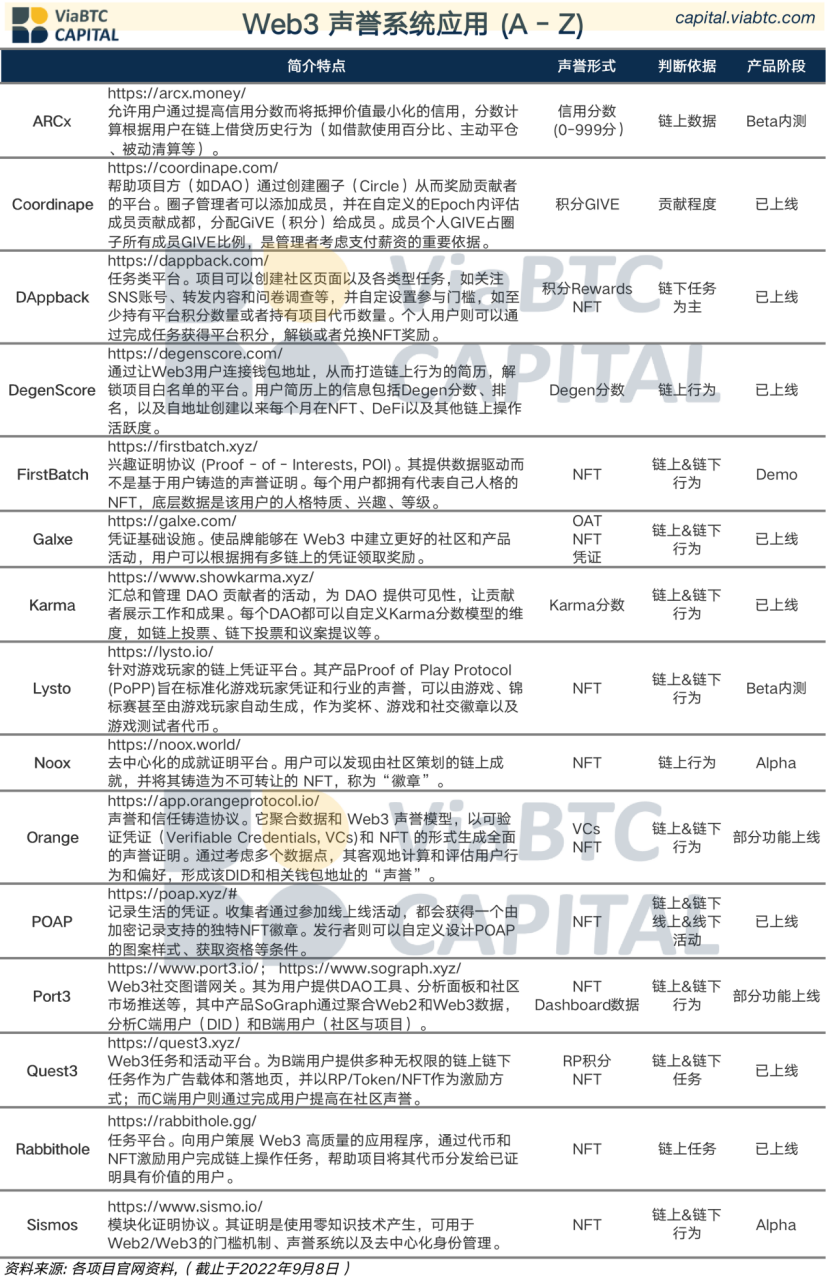
From a positioning perspective, projects emphasize different functional attributes. For instance, DappBack, Rabbithole, and Quest3 highlight task-platform features, requiring users to complete B2B project tasks within specified timelines to earn reputation credentials. Coordinape and Karma focus more on serving DAOs by assessing members’ contributions. Orange, Port3, and Glaxe (formerly ProjectGalaxy) emphasize Oracle or data infrastructure concepts, building open and collaborative reputation/credential data networks. FirstBatch and Sismos prioritize modularity, offering B2B users rich API tools for data calls. ARCx and Lysto are more specialized—one targeting credit lending, the other gaming.
Reputation representations vary widely. First, model-calculated scores: ARCx uses a 0–999 scale for credit scores; Degen calculates a Degen Score based on a wallet’s on-chain behavior across DeFi, NFTs, and other domains; Karma allows DAOs to use custom models to generate Karma Scores reflecting member contributions. Second,积分 within Web2 platforms—such as Coordinape’s GIVE points, Dappback’s Rewards points, and Quest’s RP points—used to represent revenue shares, redeem NFT rewards, or unlock privileges. Third, text-based verifiable credentials on-chain, supported by Glaxe and Orange Protocol. Lastly, many projects use NFTs, sometimes called badges or OATs (On-chain Achievement Tokens), some leveraging technical standards like ERC4973, ERC5114, or ERC721S to ensure post-minting non-transferability, non-tradability, and non-destructibility.
The richness of data sources varies. Most projects combine on-chain and off-chain data, including both online and offline sources. By incentivizing users to connect wallets and authorize SNS accounts, they enrich behavioral profiles based on historical on-chain/off-chain activities and short-term task completion.
Below is our compilation of reputation systems centered around vertical themes (excluding those embedded within individual Web3 DApps or DAOs). Overall, most projects remain in development or closed beta, launching partial features to gather massive reference data and iteratively refine product-market fit (PMF). No complete version of a Web3 reputation system exists yet on the market.
2. Economic Considerations of Reputation
Regardless of whether Reputation 1.0, 2.0, or 3.0, system design hinges on two key elements: first, identifying who deserves reputation; second, how to incentivize holders. Regarding the first point, beyond eligibility criteria, designers must consider total supply, issuance per phase, and distribution fairness. While reputation can theoretically be unlimited, scarcity enhances its value. Moreover, fair distribution increases recognition across the ecosystem. As for incentives, only by effectively granting holders prestige, material rewards, or potential benefits can sustained contribution be ensured.
From this perspective, reputation system design is deeply intertwined with economics.
In Web3, where tokens are frequently used, some industry figures advocate for a dual-token model in reputation systems:
- One serves as a signaling token, issued by the reputation provider, fungible (FT) or non-fungible (NFT), but always non-transferable;
- The other serves as an incentive token, which may be issued by the provider or a third party and can be traded and monetized.
This approach is intuitive:
- If a single reputation token were transferable or sellable, it would lose its signaling function;
- Alternatively, if the system used only a non-sellable single token, contributors would lack tangible or potential rewards.
For example, User A earns a “Senior DeFi User” reputation token for frequent trading across multiple DeFi platforms. User B, having never interacted, purchases the token from A. If a new DeFi project aims to attract active users for testing and grants whitelist access and rewards to the current token holder (User B), the outcome would clearly be ineffective.
3. Technologies Used in Web3 Reputation Systems
Most technologies used in current Web3 reputation systems are either established in the blockchain industry or mature from Web2. In general, this sector lacks clear technological innovation, focusing instead on exploring combinations and selections of existing technical standards.
3.1 Token Standards
As previously discussed, it is more reasonable for reputation tokens serving as signals to be non-transferable. Since many projects use ERC721-standard NFTs as reputation tokens, a simple way to enforce non-transferability is removing the transfer function, preventing sale, trade, or transfer after minting.
Additionally, several proposals specifically target the "non-transferable" feature:

These standard proposals primarily target non-fungible tokens—i.e., non-interchangeable tokens. However, since reputation can also take the form of points, we also need a standard similar to ERC20—but with new features like non-tradability, revocability, and the ability to validate off-chain transactions. Solv Protocol’s ERC3525 Semi-Fungible Token (SFT), submitted in December 2021, may be such a solution.
ERC3525 officially launched in early September, aiming to create a token combining ERC20’s quantitative capabilities with ERC721’s descriptive power. Specifically, it introduces a new parameter called Slot to express classification concepts, along with corresponding Slot Metadata to support business-level category logic. Slot is a struct data structure that, compared to ERC721’s simple data hashing, can record more details—such as credit tier, credit type, even credit duration—offering higher customization and broader possibilities.
At the same time, ERC3525 retains ERC721’s _tokenID while introducing ERC20’s _value for quantity. This addresses a key limitation of ERC721-based reputation tokens: immutability. In reality, user credit ratings or reputations evolve dynamically. By adjusting the _value, issuers can effectively update a user’s reputation status.
Another benefit of introducing _value & _tokenID is distinguishing membership states. For example, in a DAO reputation积分 system, ERC20 cannot differentiate between a member whose points dropped to zero and one who never earned any. With ERC3525, a token has both ownership (_tokenID) and quantity (_value). Thus, an address whose points dropped to zero still owns the token (_tokenID), just with _value = 0; an address that never earned points doesn’t even have the token (_tokenID). Therefore, ERC3525 enables smart contracts to directly read on-chain data to identify identity status.
3.2 Privacy Technologies
A robust Web3 reputation system requires not only on-chain data but also rich Web2 data and potentially linked real-world identity data. Regardless of ethics or personal preference, privacy protection is paramount. Zero-knowledge proofs—one of the most discussed privacy technologies in the industry—play a role in reputation systems, primarily for Proof of Membership. Given the complexity of ZKPs, we briefly describe their functional outcomes and processes here.
Proof of Membership allows users to prove they meet certain criteria without disclosing identity details. For instance, holders of Bored Ape NFTs, Twitter accounts with 10M+ followers, or certified accountants can verify their traits without revealing wallet addresses, Twitter handles, or certificates. Due to ZKP complexity, most projects building general or custom reputation systems opt to use existing code libraries rather than build from scratch.
Semaphore is an open-source library using zero-knowledge proofs to create identities and prove membership. Its circuits are generic circuits for proving membership. Projects can use Semaphore to create off-chain or on-chain groups, each representing a set of users with specific traits. Groups are structured as Merkle trees, with leaves being identity commitments (ID Commitments).For efficiency, projects typically store identity commitments off-chain.
Overall, the process of data storage and zero-knowledge proof proceeds as follows:
- Users create identities on the frontend and prove ownership (e.g., ECDSA signature from an Ethereum wallet or OAuth verification from a Twitter account);
- Generated identity commitments are stored off-chain;
- Users, as provers, read off-chain storage and generate witnesses using Merkle proofs and identity information to obtain commitment sets;
- Use Groth16 to generate zero-knowledge proofs from the witness.
Key Challenges Facing Web3 Reputation Systems
As previously noted, no flagship Web3 reputation system has yet emerged. The root cause lies in Web3 still being in its frontier-building phase. The overall direction of reputation systems is clear, theoretical knowledge and technology are sufficient—the industry lacks practical accumulation and product iteration. In summary, I see three major challenges: difficulty in data collection, model design, and reputation interoperability.
1. Data Collection Is Difficult
Reputation data comes from on-chain and off-chain sources. While on-chain data is public, blockchain history spans less than ten years, and public chains now contain vast amounts of historical data with increasingly rich meanings. Collecting on-chain data thus demands high costs (cloud storage, computing resources) and expertise. Moreover, current on-chain data mostly reflects financial behaviors around tokens or NFTs (trading, staking, lending), limiting the diversity of applicable reputation types.
That said, building a complete Web3 reputation system requires more off-chain data—Web2 and even real-world information. Off-chain data collection faces two barriers in Web3, which champions “user-owned data”: users themselves and centralized data-holding institutions. Only a few Web2 apps currently allow API access under user authorization—and these may revoke access at any time, especially toward Web3 projects.
Some reputation system projects plan to collect front-end data via browser extensions or frontend tools—with user permission.
However, realizing this vision requires long-term user education and habit formation:
- End users haven’t established trust in these tools and hesitate due to privacy concerns;
- End users, especially non-Web3 natives, don’t perceive clear benefits (e.g., earning tokens, receiving airdrops, getting tailored Web3 content) and lack motivation to adopt them.
Reputation systems face a classic "chicken-and-egg" problem...
2. Model Design Is Challenging
Most existing Web3 reputations or credentials carry shallow meaning—often merely proof of participation in an event: attending an AMA, trading N times on a DeFi platform, using a cross-chain bridge, following a project on Twitter or Discord. Such narrowly defined, custom reputations fail to enable deep interpretation of holder behavior, making it hard to directly identify whether a holder is a potential user, airdrop recipient, governance participant, or marketer.
Therefore, reputation system design demands finer-grained considerations—both qualitative and quantitative. For example, identifying a seasoned NFT enthusiast shouldn’t rely solely on OpenSea interaction counts, but include factors like: Do they frequently discuss NFTs on social media? Have they minted NFTs themselves? Are they early holders of multiple blue-chip NFTs? Have they engaged in NFTFi activities like fractionalization or NFT lending? Similarly, seeking a skilled DAO governor shouldn’t hinge only on token holdings, but assess proposal engagement, past proposal approval rates, community ratings, and even the impact of past proposals.
Designing sophisticated reputation systems requires domain experts and data engineers to create insightful, goal-aligned credentials. Designers must continuously run advanced computations on relevant data and regularly adjust formulas or algorithms based on performance. For the talent-constrained Web3 industry, this is a long-term challenge.
3. Reputation Interoperability Is Hard
Currently, reputation interoperability in Web3 is difficult due to two main reasons: lack of reputation consensus and lack of openness. Regarding the former, participants in the Web3 ecosystem haven’t reached consensus on various reputations or credentials. Because the industry is in early experimentation, no authoritative or reference-worthy credentials have emerged—neither across the entire industry nor within subfields. For example, in the real world, hiring financial professionals often requires holding certifications like CFA, CPA, ACCA, or FRM. In Web3, however, there’s no equivalent high-consensus DeFi reputation. Reasons include not only the shallow insights provided by current reputations but also the ambition of many projects to establish their own reputation frameworks. Even in collaborative Web3, some projects aspire to become reputation authorities—a contest whose winner remains unclear. Worse, some Web3 projects aren’t “open.” As RabbitHole’s founder once said in an interview, many communities restrict reputation usage to within their own ecosystems to retain users, sometimes not even providing members with verifiable proof of their earned credentials.
Future Trends in Web3 Reputation
Despite many challenges, the issues facing Web3 reputation systems will eventually be resolved. The "chicken-and-egg" problem will dissolve through the flywheel effect. New generations will develop interest in Web3, and closed-minded projects will either adapt or be eliminated by Web3’s dominant ethos.
Technologies like zero-knowledge proofs for privacy and machine learning for complex algorithms will see broader adoption in Web3 reputation systems. The former protects user privacy, encouraging greater willingness to share internet and even real-world data while unlocking new application scenarios. The latter enables more insightful reputation credentials, achieving precise alignment with business objectives.
Moreover, I believe that in each vertical domain, several high-consensus reputation credentials will emerge—playing roles akin to traditional professional certifications, yet achieving permissionless operation and verification without reliance on centralized authorities. These domains go beyond familiar Web3 areas like DeFi, NFTs, and gaming, possibly extending to traditional professional fields. For example, proponents in decentralized science (DeSci) are advocating blockchain-based reputation credentials to replace the h-index. They argue the h-index only measures publication count and prestigious awards, failing to fairly and comprehensively assess scientific contributions. A verifiable on-chain reputation system for scientists could take the form of one or multiple NFTs or tokenized points, evaluating a broad range of valuable activities beyond publishing and winning awards—such as peer review, teaching, and data sharing.
As on-chain reputations, credentials, or badges gain popularity, DAOs or Web3 organizations may usher in a new paradigm of human resource management. In flat organizational models, we’ve seen examples like Amoeba Management and Holacracy, both weakening traditional departmental boundaries. Holacracy completely discards departments and job titles, replacing them with circles and roles—each employee playing multiple roles across different circles. This resembles the early form of DAOs. Among Holacracy practitioners, Zappos, the U.S. retail e-commerce platform, issues different badges based on employees’ roles and skills (including outside work). These badges significantly influence salary adjustments, with employees pursuing matching badges and corresponding pay based on career interests. Yet, Zappos’ badge influence is confined internally.
For other companies, this may seem too unconventional. Governance models like Holacracy, hard to implement in the old world where job titles carry authority, might find greater opportunity in Web3. We look forward to that day…
Closing Thoughts
Reputation systems are catalysts for the Web3 flywheel effect and profoundly significant for Web3 ecosystem development. ViaBTC Capital, entering Web3 as a builder through capital services, deeply recognizes that cold starts and go-to-market strategies are challenging for projects. Accurately identifying stakeholders (users, governors, developers) at low cost remains a serious test.
References:
- https://future.com/reputation-based-systems/
- https://mirror.xyz/0x5Eba828AB4999825D8416D7EAd9563b64FD90276/jBKtY8DJv2TN6AqA6SsZrM8qJkC2ReDDJaSKPu1QLWI
- https://kermankohli.substack.com/p/web3-reputation-market-map
- https://blog.csdn.net/myan/article/details/126376974
- https://seedclub.libsyn.com/ep-8-the-rabbit-hole-that-is-nouns-dao-brian-flynn
- https://semaphore.appliedzkp.org/docs/introduction
Join TechFlow official community to stay tuned
Telegram:https://t.me/TechFlowDaily
X (Twitter):https://x.com/TechFlowPost
X (Twitter) EN:https://x.com/BlockFlow_News