The Pillars Supporting "Web3": Information, Contracts, and Identity — Centralization Remains Indispensable
TechFlow Selected TechFlow Selected
The Pillars Supporting "Web3": Information, Contracts, and Identity — Centralization Remains Indispensable
It's only a matter of time before the realization of "Web III" and DeSoc, supported by the "Internet of Agreements" and the "Internet of Identity."
 Navigating Web3 tides with focused insights
Authors: Will, Xiao Xiaopao
01 The Achilles' Heel of the Web3 World
In the movie *Infernal Affairs*, Andy Lau plays a triad mole embedded within the police force, relaying insider information to his gang. Tony Leung plays an undercover cop who infiltrates the gang. One is a corrupt mole, the other a righteous one—both have had their true identities completely erased, with no documents or records left to prove who they really are. For Tony Leung’s character, the only person in the world who can verify his original "soul" is Superintendent Wong—his direct superior.
But when Superintendent Wong plummets from the rooftop onto a car below, blood splattering everywhere, that sole “social connection” vanishes. Tony Leung’s “soul” thus evaporates into thin air, plunging him into irreversible oblivion.
Now imagine this scenario: Tony Leung enters a blockchain-based virtual world. All traces he leaves on the blockchain—digital assets, NFTs, social networks, police academy credentials—are tied to a single private key. If that one private key is lost, will Tony Leung also become a “transparent man” on the blockchain, losing his “soul”? Could he rely on “social relationships” (social recovery) within this virtual world to restore his identity?
So far, the answer is unfortunately no—Tony Leung would likely suffer the same fate as in the real world. In today’s blockchain world, the private key is everything. Without it, all you’ve created and owned on the blockchain is irretrievably lost. There's no customer service to help recover your key, and no Superintendent Wong to vouch for you.
This is the Achilles’ heel of the blockchain and Web3 world we so highly anticipate: We now have an infinitely scalable “information internet,” and blockchains capable of carrying “assets” and enabling value transfer. But what about our souls, identities, creditworthiness, and social relationships? They remain nowhere to be found.
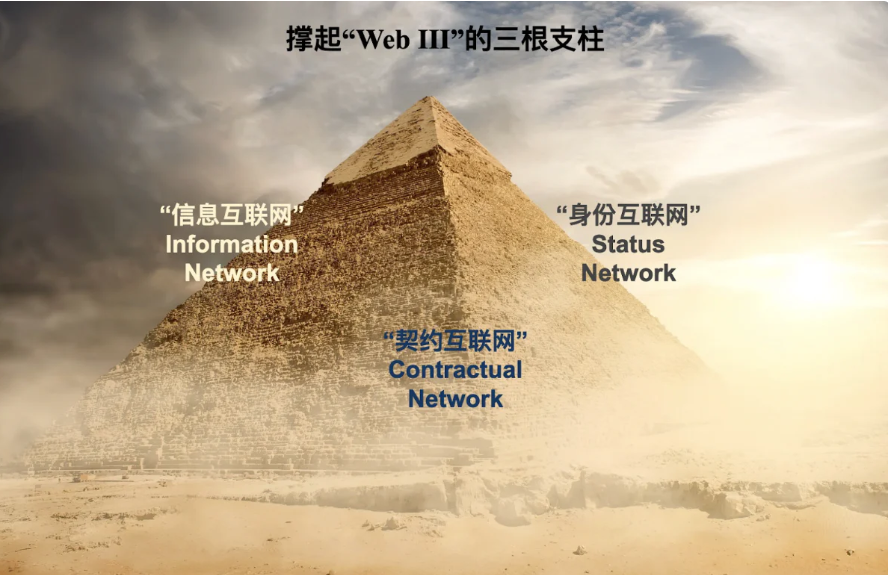
The emergence of the concept of “Soulbound Tokens” (SBTs) begins to offer an answer. A clearer vision of the Web3 landscape starts to take shape—we need three towering pillars—the “Information Network,” the “Asset Network,” and the “Status Network”—to jointly support a complete and viable “Web III.”
02 Today’s Web3: A “Contract Internet” Without “Identity”
Since its inception, Ethereum has carried the mission and aura of being a “world computer.” Yet today, Ethereum faces widespread criticism for being “overly financialized.” To date, its primary function remains financial transactions and asset trading, making its “world computer” ambition increasingly awkward: a blockchain system built solely on “addresses” without “identity,” purely contractual and smart-contract-driven, cannot sustain effective, rich, socially complex applications—this is slowly becoming consensus.
In the movie *Split*, Kevin, who has 23 distinct personalities, shifts between identities like fashion designer Barry, obsessive-compulsive Dennis, conservative religious Patricia, and mischievous juvenile—something only possible in real life through severe dissociative identity disorder. But in a virtual world with only “addresses” and no “identity,” anyone can do it effortlessly.
Take Sybil attacks, for instance—one individual can use countless “addresses” to perform the same action, thereby breaking the rules. Or consider “implicit centralization”: if one person controls vast numbers of addresses and assets, they become the de facto “center”—we bypassed an explicit central authority only to end up with invisible manipulators pulling strings behind the scenes. In a world without “identity,” “decentralization” seems like a myth.
In the real world, we live immersed in “identity,” as natural and unnoticed as air and water. But in a blockchain world devoid of identity, everything becomes simultaneously transparent and anonymous, enabling unchecked chaos and corruption. We must build a digital “identity system” to enable the digital world’s “theory of evolution”—from dog-like “passive freedom,” to ostrich-like “unrestricted freedom,” toward ant-colony-like “freedom with constraints.”
But here arises the question: In what form should “identity” appear in the blockchain world?
03 “Contractual Status” and “Relational Status” in the Blockchain World
Over 150 years ago, British legal scholar Henry Maine famously argued: “All progress in society, so far as it has been achieved, has consisted in the movement from ‘status’ to ‘contract.’” He also recognized that human “status” originates from two sources: one from “social relationships” with others, the other from “execution of contracts.” Maine advocated for “progress from status to contract” because 150 years ago, real-world societies lacked **“contractual status” (contractual status)**, hindering large-scale collaboration. But in today’s blockchain world, the missing piece is precisely **“relational status” (relational status)—the mapping of real-world social relationships onto the blockchain**—which leads to a host of new problems.
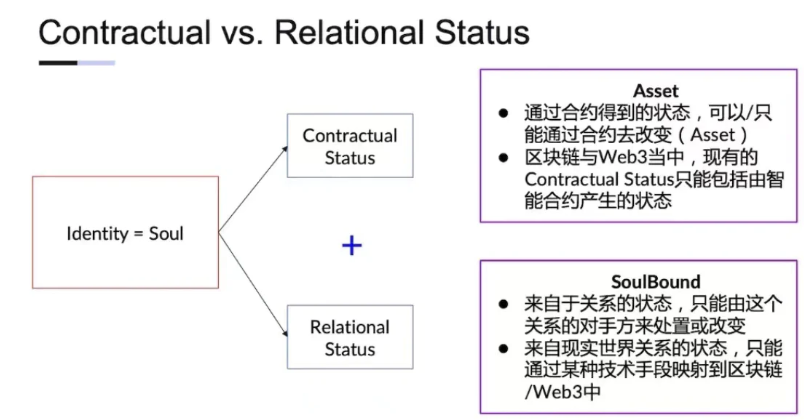
The blockchain-native **“contractual status” (contractual status)** refers to a **“status” that can only be acquired and altered through execution of smart contracts**—manifested on-chain as “assets.” While this “purely computational” system pushes “contractualization” to its extreme, achieving high efficiency, its limitations are clear due to the exclusivity of this single form of “contractual status”—resulting in narrow application scenarios and inevitable “over-financialization.”
Then, what exactly is the “relational status” (relational status)—the reflection of real-world relationships—mapped into the blockchain world?
The “Soulbound Token” (SBT), proposed by Vitalik, Glen Weyl, et al. in *Decentralized Society: Finding Web3’s Soul*, presents a plausible idea and currently the most practical solution in the Web3 space. When real-world social relationship-based “contracts”—such as work history, academic degrees—are mapped into SBTs and bound to oneself on-chain, the immense power of **“relational status” (relational status)** begins to emerge: It can be issued by others—who confirm the “relationship” by issuing an SBT to you—and can also be revoked or modified to alter your “status/identity” (status). It can even be verified through the “relationship” itself to enable recovery.
With identity grounded in social relationships, the “Achilles’ heel” of the Web3 world appears to dissolve naturally. Not only does it offer resistance against Sybil attacks (since SBT issuers are clearly visible), but it also brings a glimmer of hope to solving the long-unsolved problem of “unsecured lending on-chain.”
Therefore, our “complete state” in the digital world should encompass “information,” “assets,” and “relationships”—any absence renders it incomplete. Thus, a clear blueprint for “Web III” emerges—only by introducing “social relationships” into the Web3 world can we construct a complete decentralized society (DeSoc).
We need to build, atop the “Information Internet” and blockchain’s “Contract Internet,” another foundational layer capable of perfectly inheriting Maine’s 150-year-old concept of “social relationships”—the “Status Internet.”
04 The Coming “Web III”: “Information Internet” + “Contract Internet” + “Status Internet”
The Web3 world we envision should feature an infinitely scalable “Information Internet” (Information Network), a “Contract Internet” (Asset Network) capable of holding “assets” and enabling value transfer, and a “Status Internet” (Status Network) where our soul, identity, credibility, and social relationships can reside—resolving the fundamental questions of “Who am I?” and “What do I own?”
Only these three towering pillars together can uphold “Web III.”
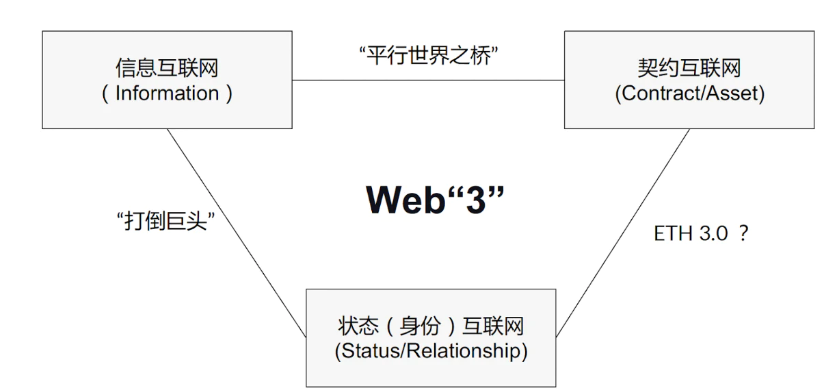
The “Information Network” built atop the internet forms the foundation of everything. Ethereum, as a powerful global state machine capable of synchronizing all smart contract executions, can fully serve as the backbone of the **“Contract Internet”**. But how can the “Status Internet” be realized? Can the internet and Ethereum accommodate modern individuals who simultaneously hold multiple “statuses” while securely and independently owning “assets”? Can blockchain infrastructure bear the weight of these three massive pillars of “Web III”?
The answer is most likely negative. Since “identity” and “contract” differ fundamentally in their underlying technical implementation logic, these differences exist not just conceptually or cognitively, but also at technical, algorithmic, and structural levels. Realizing the “Status Internet,” especially one covering all domains of social relations, would be a monumental undertaking. SBTs represent a crucial mechanism under the current framework, and the “status” they embody must originate from real-world social relationships—requiring secure, complete, privacy-preserving technological means to map them onto the blockchain, far beyond simply issuing a “token.”
Therefore, if the “Decentralized Society” (DeSoc) is to support the complex structures of real-world social relationships, data governance, privacy protection, rights distribution, etc., the “Status Internet” (relationship network) must be an independent “status network” architecture—a brand-new foundational layer.
If we dare to dream further, it might even involve forking a separate “status/status layer” (status chain) out from Ethereum’s “asset layer” (asset chain), paving the way for an “Ethereum 3.0.” This “status/status layer” could “fork” into multiple parallel universes, while the “asset layer” remains unchanged—preserving its mapping to real-world assets and allowing both parallel universes’ smart contracts to recognize those assets, achieving consistency with the real world.
05 “Web III” Is Not a Perfect World—“Centralization” Remains Indispensable
One major reason the crypto world repeatedly suffers from “over-financialization” is not only the lack of a “status/status layer,” but also the absence of a critical element—a secure, transparent, purely algorithmic “third party” that records only addresses and transaction facts without forming any “relationship” with transactors. Having such a third party that can issue and verify your “relational status” is an essential missing piece in building a Decentralized Society (DeSoc).
When such a “third-party” platform grows large enough, it won’t just play a pivotal role in establishing every reputation system and relational network within DeSoc—it will also benefit greatly from the entire ecosystem: Public “relational statuses” allow interconnected nodes across the network to serve as mutual references. The richer and more intricate these interwoven relationships become, the more society values “relationships” themselves—enabling a virtuous cycle of mutual trust. This paves the way for financial tools like credit loans, installment payments, and asset mortgages.
But doesn’t this reintroduce “centralization” into a “decentralized society”?
Even though, as the era of the “Status Internet” arrives, the concept of a “third party” may gradually resemble today’s “Web2 mega-platforms,” it will still be built upon open, computational systems—transparent, black-box-free “third parties.” Rather than choosing between the illusory utopia of Web2 giants’ “blue pills” or the extreme libertarian “red pills” of crypto-punks, we should have a “green pill”—a moderate dose.
In a “Web III” society, what we need is ant-like “freedom with constraints.”
06 Conclusion
Realizing the vision of a Decentralized Society (“DeSoc”) requires building a new infrastructural “status layer” capable of supporting the three pillars of “Web III”—the “Information Network,” the “Asset Network,” and the “Status Network.”
Yet, anyone who has attempted to implement real-world “relational mappings” on public blockchains knows how difficult it is—the ghosts of past failed ventures still float above the “digital Lethe River” at the boundary between reality and virtuality, faintly visible.
From contractual liberty, to *Radical Markets*, to SBTs and DeSoc—if the two threads binding all human activity and development—“status” and “contract”—were already conceptualized in Maine’s mind 150 years ago, we have every reason to believe: the realization of “Web III” and DeSoc, supported by the “Asset Network” and “Status Network,” is merely a matter of timing (good timing). Too early, and you become a martyr; too late, and you’ll be crushed beneath the wheels of history.
Join TechFlow official community to stay tuned
Telegram:https://t.me/TechFlowDaily
X (Twitter):https://x.com/TechFlowPost
X (Twitter) EN:https://x.com/BlockFlow_News
 Solv Protocol