What characteristics define the evolution direction of public blockchains? Five public chains poised to rise in the next bull market
TechFlow Selected TechFlow Selected
What characteristics define the evolution direction of public blockchains? Five public chains poised to rise in the next bull market
Public blockchain markets targeting private domains and specific赛道 fields, equipped with pioneering technology, remain a blue ocean.
 Navigating Web3 tides with focused insights
Author: Yilan, LD Capital
Abstract
1. As the market enthusiasm for new public blockchains rises, the concept of "niche blockchains" has emerged. What may surpass Ethereum might not be a fork of Ethereum itself, but rather more disruptive, user-friendly blockchains that can drive Web3.0 toward maturity.
2. Developing niche blockchains is an essential path for Web3.0 to shape the next-generation internet. From the perspective of meeting the scalability demands of Web3.0 applications, continuous iteration of niche blockchains holds significant importance for improving high-dimensional user experiences in the Web3.0 world.
3. The gradual completion of Ethereum's merge and layering process is unfavorable to high-performance Ethereum forks. Niche technical blockchains supported by alternative consensus mechanisms such as DAG and DiemBFT v4, along with blockchains featuring modular innovation architectures, may stand out in the next wave of blockchain development. Blockchains will gradually differentiate into those serving broad domains, private domains, and specific verticals (e.g., app-specific chains).
4. Blockchains with healthy ecosystems capable of continuously attracting native projects can survive both bull and bear markets. Blockchains currently under development carry immense untapped vitality. Blockchain development seeks balance between modular complexity and delivering simplified user experiences.
5. Blockchain solutions tailored for vertical use cases—distinctive, purpose-built, and easier to migrate to—may become the preferred choice for the next wave of crypto innovators. These choices are likely to evolve into the next generation of long-lasting blockchains following today’s general-purpose ones like Ethereum and BSC.
Introduction
Recently, Aptos secured $150 million from FTX at a $2.75 billion valuation, bringing its total funding to $350 million—an impressive achievement during a bear market. This success is partly due to its origins in Meta (formerly Facebook), where it developed viable solutions for user data management, backed by a team of top-tier scientists highly valued by investors. In contrast, Solana, which gained prominence in the last bull cycle, now has a FDV below $20 billion, while Near’s FDV stands at just $4.1 billion.
The formation of stable ecosystems on blockchains that host greater application value relies on time, user accumulation, strong technical teams, and robust communities—all working together to promote application development and real-world adoption. Building a blockchain is akin to constructing a railway: initial investment is massive, but ongoing usage fees generate sustainable revenue. The more prosperous the ecosystem, the stronger the innovation, and the higher the marginal returns—this explains why infrastructure blockchains, as core value carriers of Web3.0, command such high valuations.
The evolution of public blockchains can be broadly divided into three phases:
Phase One: 2008–2013 – After Satoshi Nakamoto published the Bitcoin whitepaper, Bitcoin gained popularity, followed by numerous "altcoins" aiming to improve upon Bitcoin, forming the first generation of public blockchains led by BTC.
Phase Two: 2014–2017 – The introduction of Turing completeness marked a turning point with Ethereum, which brought smart contracts into blockchain technology, enabling programmability and supporting decentralized applications. The emergence of apps like CryptoKitties allowed users to experience blockchain applications firsthand. Ethereum leveraged first-mover advantage to build a strong ecosystem. Blockchains from this era include ETH, NEO, QTUM, and EOS.
Phase Three: 2018–Present – Innovations in consensus mechanisms and transaction validation technologies gave rise to a batch of high-performance, low-cost blockchains such as BSC, Solana, and Avalanche.
The next phase of blockchain development, coinciding with Ethereum 2.0’s merge and sharding rollout, may follow two trends:
After sharding is complete, EVM-compatible L1s and their L2s may see users return who had previously migrated due to high gas fees, posing challenges for Ethereum forks;
Blockchains with unique technical features and innovative architectures will rise to prominence, and blockchain development will increasingly diverge into serving broad, private, or specific vertical markets (e.g., application chains).
General Classification of Blockchains and the Concept of Niche Blockchains
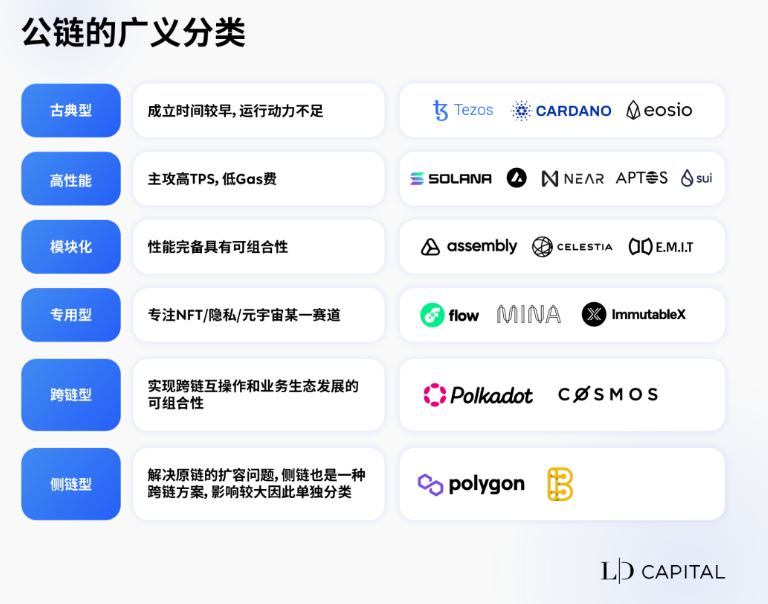
Niche blockchains are a refined subset of general public blockchains, further segmented by technical uniqueness, product-market fit, and narrative value, helping us identify evolutionary directions in blockchain development.
For example:
Defined by innovative architecture (e.g., modularity) or unique technology, represented by Aptos, Sui, IOTA2.0+Assembly, MINA (a lightweight zk-SNARK chain), and EMIT-Core;
Defined by serving specific verticals, represented by Flow, Metabit, ImmutableX, Metabit, and MINA;
Defined by value narrative, such as Celo, a green ReFi blockchain.
The market for blockchains with pioneering technologies targeting private domains and specialized verticals remains largely untapped.
Niche Blockchains
This article focuses on five projects that align with the concept of niche blockchains through innovations in architecture (e.g., modularity) and core technology.
●Aptos – A High-Performance Blockchain Born with a Silver Spoon, Using the Move Language
Aptos is a high-performance Layer 1 blockchain project initiated by former members of Meta’s stablecoin project Diem (formerly Libra). The Aptos team believes that user experience must significantly improve in security and scalability to achieve mass adoption. Among new blockchains, Aptos enjoys a strong first-mover advantage, with its public mainnet expected to launch in Q3 this year.
1.1 Overview of Aptos’ Core Technologies
Consensus Mechanism
Aptos uses an optimized BFT (Byzantine Fault Tolerance), similar to Solana’s asynchronous variant. However, unlike Solana, Aptos introduces an innovative reputation system suitable for decentralized environments. It monitors on-chain data and automatically switches leaders when validators fail to respond—without human intervention. Additionally, block submission times are drastically reduced, with average finality under one second. This asynchronous mechanism enhances network security by resisting adverse network conditions, network partitions, or DoS attacks on validators, as it imposes no synchronization assumptions.
Parallel Execution Engine for Smart Contracts in Memory
Aptos Labs developed Block-STM, a novel approach enabling flexible transaction programming with concurrent processing. STM stands for Software Transactional Memory. In experimental settings, with 32 cores processing over 10,000 accounts, Block-STM achieved up to 20x better performance than sequential execution under low contention and 9x under high contention. The theoretical peak TPS exceeds 160,000.
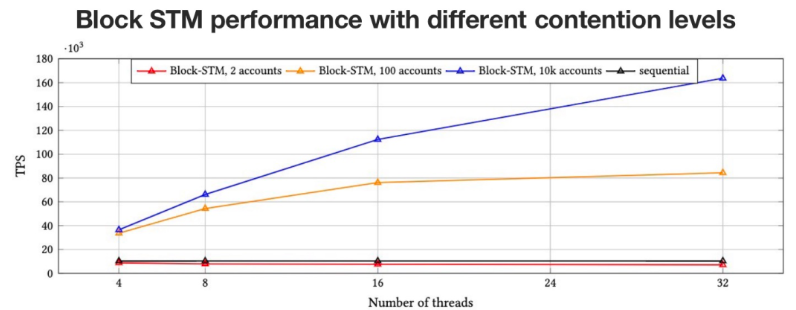
Source: Aptos Labs
Move Programming Language
The Aptos team created the Move programming language to enhance blockchain security. Move is designed not only for writing smart contracts but also allows users to manage their own accounts, modify node settings, adjust commission rates, and add new functionalities.
In summary, Aptos achieves technological innovation by parallel optimization across consensus (AptosBFT), execution (Block-STM), and environment (Move), boosting speed and reducing costs.
1.2 Aptos’ Current Ecosystem
The Aptos team is actively building its ecosystem across five sectors: stablecoins, DEXs, wallets, lending markets, and oracles. Notable projects include Thala Labs’ stablecoin, the first DEX Pontem Network, Martian wallet, liquid staking protocol Zaptos, domain service ANS, Fewcha Wallet, NFT project Aptos Toad Overload, marketplace Topaz, synthetic asset platform Clone, and block explorer Aptoscan—all showcasing high native integration. Moreover, many Solana-based projects have migrated early to Aptos, demonstrating a strong gravitational pull from the latter.
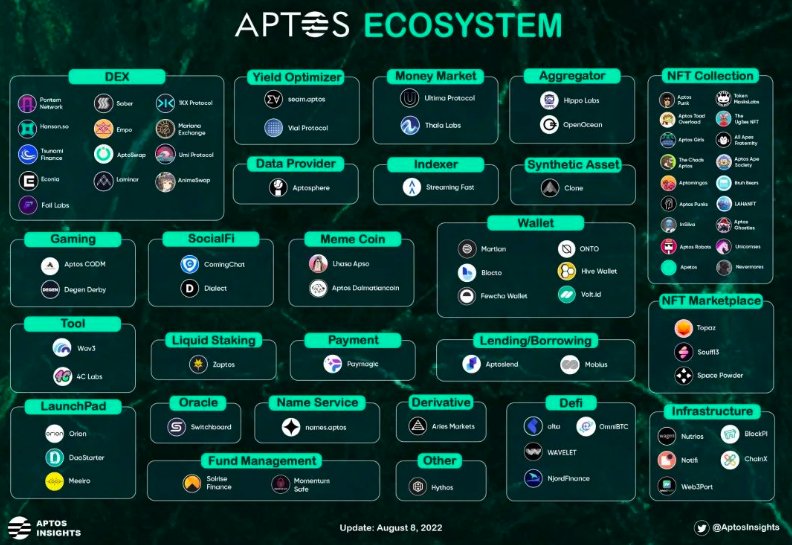
Source: @AptosInsights
●Sui – A High-Performance Blockchain Sharing Key Features with Aptos, Emerging Around the Same Time
Sui is a high-performance Layer 1 blockchain launched by Mysten Labs (founded by former members of Meta’s Diem and Novi wallet projects). Like Aptos, Sui aims to solve the blockchain trilemma, but centers on scaling composable and dynamic NFTs for broad metaverse applications including gaming, social, and commerce. Sui also raised substantial funds during the bear market (valued at $2 billion) and released its tokenomics model ahead of Aptos.
2.1 Similarities and Differences Between Sui and Aptos
From a language standpoint, Sui also uses Move as its native programming language. Although Sui’s memory data and code model differs slightly from Aptos’, Sui’s Move clearly defines when data and code are owned/shared or mutable/immutable—a feature absent in Aptos.
Regarding consensus, like Aptos, Sui’s protocol is derived from HotStuff. Both minimize inter-validator communication to reduce latency. AptosBFT is partially asynchronous. Sui separates its mempool from the consensus layer, whereas most PoS L1s operate with a single consensus protocol.
In SDK innovation, while Aptos also offers SDKs to improve DX/UX, Sui’s SDK makes interesting attempts to connect with other ecosystems and non-crypto use cases—such as providing game APIs so developers can seamlessly interact with Sui’s ecosystem (users, dApps, assets) and Move language; enabling dApp developers to port digital assets from other ecosystems to bootstrap communities; and developing frontend tools for “Handshake” to distribute, claim, or redeem Sui digital assets (e.g., payments, merchant coupons) for both crypto and non-crypto users.
2.2 Sui’s Current Ecosystem
Sui has opened registration for its incentivized testnet and launched a Chrome extension self-custody wallet called “Sui Wallet.” Its ecosystem development appears slower—aside from the wallet, only explorers, games, and social metaverse projects are currently underway. Clearly, Sui’s ecosystem positioning leans heavily toward expanding metaverse applications in gaming, social, and commerce.
●IOTA2.0+Assembly – A High-Performance Modular Blockchain Using DAG Technology
IOTA, serving as Assembly’s settlement layer, was among the first to adopt DAG (Directed Acyclic Graph) technology known as Tangle. Strictly speaking, Tangle is not blockchain technology—it is a distinctive pioneering innovation.
Together, Assembly and IOTA 2.0 offer the Web3.0 world—where large-scale UX improvements are needed—high-concurrency TPS, scalable contract chains, customizable incentives and fees per chain, shared security, and more.
3.1 Overview of Assembly’s Core Technologies
In terms of composability, Assembly functions as a 1.5-layer—a smart contract architecture layer—where individual smart contract chains built atop it serve as true Layer 2s.
Leveraging IOTA 2.0’s high-concurrency DAG structure, the IOTA2.0+Assembly combination breaks down the traditional L1+L2 model into a 2.5-layer framework, making modularity explicit. With a dedicated Assembly smart contract architecture layer, various configurations become possible—such as coupling different data availability, execution, and settlement layers.
In terms of cost, Assembly’s technical design ensures that network fees for deploying applications or interacting with the network remain among the lowest—and most stable—in the entire blockchain market.
Security-wise, Assembly uses a fraud-proof rollup model similar to Ethereum 2.0. Validators stake assets as security bonds, and any third party can submit fraud proofs if a validator updates an incorrect state, earning a reward. This ensures that as long as one honest validator exists in the committee, the chain’s state remains protected from malicious changes.
3.2 Ecosystem Development of IOTA2.0 and Assembly
Currently, 213 projects are being developed on IOTA 2.0, all of which can seamlessly migrate to the Assembly mainnet upon launch. Some projects incorporate Industry 4.0 concepts and create synergies with off-chain systems. Popular examples include IOTAlias and IOTA charging stations.
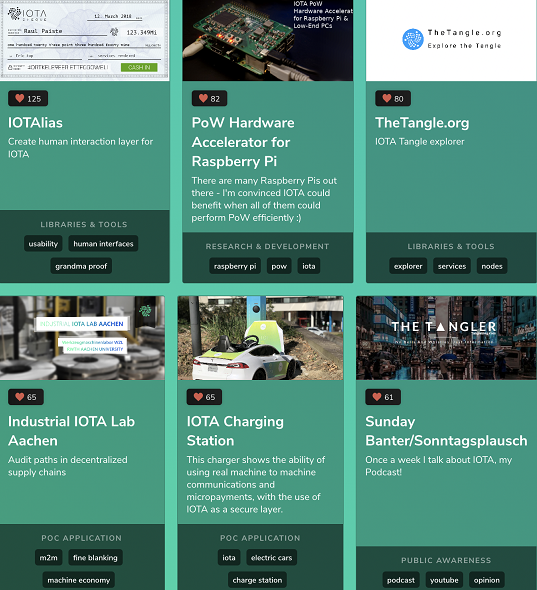
The unique Tangle model based on DAG consensus and the modular architecture of IOTA2.0+Assembly represent one of the few distinctly featured blockchains in the market, though ecosystem growth remains relatively slow.
●Mina – A Lightweight Blockchain Using Unique zk-SNARK Technology
Mina’s core philosophy is the “succinct blockchain,” where the size of all transactions processed across the entire network is capped at 22 KB per block. The latest block contains the full current state of the blockchain, allowing users to fully verify the blockchain’s state in milliseconds using a single zk-SNARK proof.
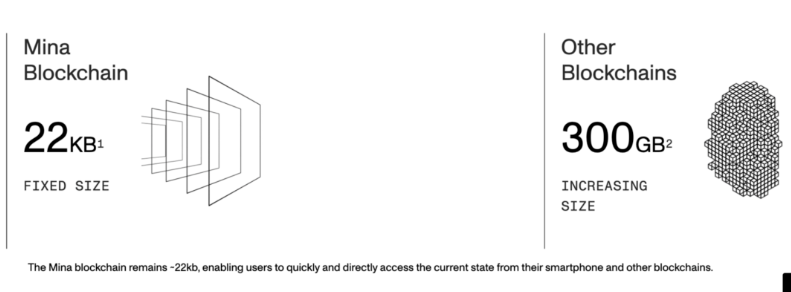
Unlike other Layer 1 blockchains that grow with each added block, Mina maintains a fixed size using recursive cryptographic proofs. Think of Mina’s recursive cryptography as taking a photo of the blockchain. Each time a new block is added, another photo is taken of the existing chain, keeping the size equivalent to one photo while preserving all information.
Mina’s use of zk-SNARKs makes it a compelling niche blockchain solution, offering distinct advantages over traditional blockchains. The zero-knowledge wave is also evolving toward modular Snark algorithms, where new cryptographic modules could yield fascinating outcomes.
4.1 Overview of Mina’s Core Technologies
Solving State Bloat
Ethereum plans to address state size issues in a future upgrade series called “The Purge.” In contrast, Mina focused from inception on curbing ever-growing data, including transactions, accounts, tokens, contracts, and other information.
Privacy Support
Zero-knowledge proofs support privacy by revealing no unnecessary information. Mina’s zk-proof verifies only state validity without exposing interacting accounts. Even Mina’s consensus nodes retain only the history of the last 290 blocks.
Decentralization Enhancement
Running a non-consensus node requires minimal disk space and computing power. While other blockchains suffer from state bloat and may require industrial-grade hardware for full nodes, Mina’s non-consensus nodes can run on smartphones or browsers. Every user can run their own node, greatly enhancing decentralization. Beyond self-regulation, the ideal of self-verification is uniquely realized by Mina.
4.2 Mina’s Current Status and Future Ecosystem Outlook
Mina Protocol currently serves as a payment chain and completed its first anniversary since mainnet launch on March 23, 2022. Smart contracts, known as zkApps, were on the Q2 2022 product roadmap. In March, Mina raised $92 million from major crypto investors including Three Arrows Capital and FTX Ventures to advance its vision of building a private and secure layer for Web3. The Mina ecosystem has cumulatively raised $140 million.
Mina currently leverages the Pickles inductive proof system to perform KYC operations without exposing user identity data, and to prove a user’s credit score meets or exceeds a threshold without revealing the actual score—enabling applications like deposit-free rentals and collateral-free loans. As the ecosystem is still nascent, zkApps leave ample room for future expansion.
Mina taps into the potential of zero-knowledge proof space without compromising decentralization, emerging as a distinctive L1 blockchain combining cutting-edge zk technology.
●EMIT-Core – A Modular, High-Performance Cross-Chain Blockchain
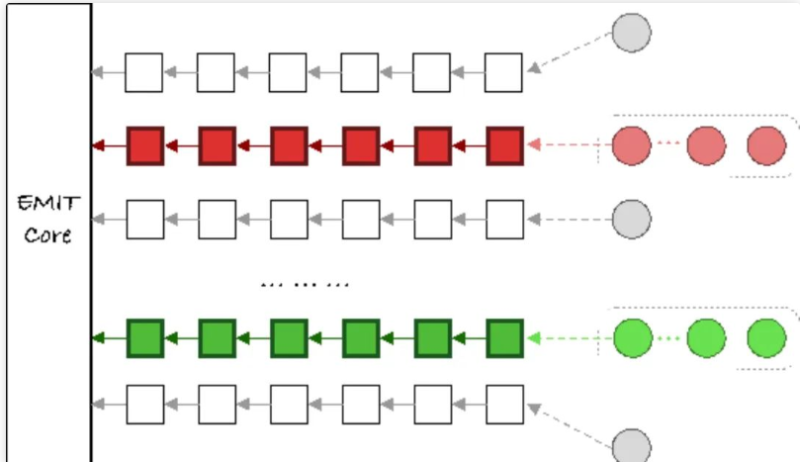
As a sub-project of EMIT, EMIT-Core’s core logic minimizes coupling between accounts via a Block-Lattice ledger structure and Random-Check consensus algorithm, thereby increasing the blockchain system’s response speed and throughput. It offers significant advantages in elastic scalability regarding computation, storage, and bandwidth. Since the system avoids complex computations, transaction fees are extremely low—even zero. This also simplifies the development of high-performance, complex decentralized applications (through open-ended extensions of EMIT-Core’s functionality).
5.1 Overview of EMIT-Core’s Core Technologies
Block-Lattice Sharded Ledger
Unlike Near’s grouped sharding, Block-Lattice represents the finest-grained sharding method—one shard per account. To achieve high throughput and low latency, the ledger decouples transactions into initiation and receipt components, created separately by different accounts. Since block creation across accounts is independent, introducing settlement states enables massive elasticity in storage and throughput. This model also generalizes cross-chain behavior. Unlike Nano’s account model, EMIT-Core uses the Random-Check algorithm to confirm blocks and supports diverse asset types.
New Scheme for Decentralized Applications
EMIT-Core views decentralized applications as a set of P2P network nodes that collectively agree on input and output sequences without needing to synchronize internal states. In extreme cases, an app may consist solely of output sequences. This flexible definition allows for highly complex application logic. Leveraging EMIT-Core’s high-throughput, low-latency architecture, decentralized apps can approach the user experience of centralized counterparts.
Random-Check Algorithm
Random-Check means a requester randomly selects some nodes from the global network and retrieves account data from them. If the states match, the state is considered valid. Security can be enhanced by increasing the number of checks or nodes per check. This algorithm guarantees EMIT-Core’s high TPS.
5.2 EMIT-Core’s Ecosystem Development
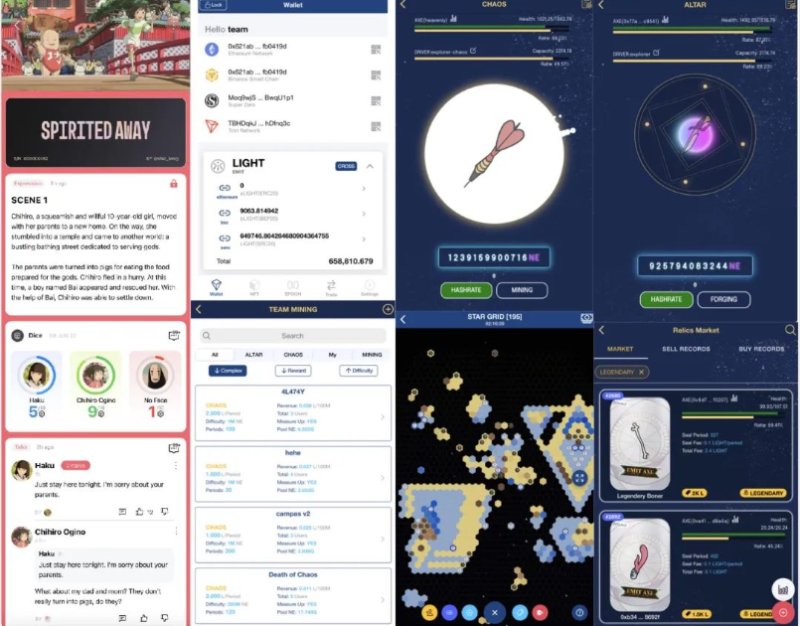
The overarching vision of the EMIT project is “integrating assets across the crypto world and creating an economically complete decentralized world.” EMIT has already built bridges connecting decentralized networks such as Ethereum, Binance Smart Chain, Tron, and Super ZERO. The EMIT-Epoch sub-project continues to absorb and expand the ecosystem—all built on EMIT-Core’s technology. To date, EMIT has developed its own cross-chain wallet and ecosystem apps including Cross, Chaos, Altar, TeamMining, StarGrid, RelicsMarket, Accounts, Assets, and Bangs—all part of the EMIT-Epoch initiative. Over time, these will grow into a fully functional decentralized economy.
Value Potential and Risks
Even with Aptos achieving a $2.75 billion valuation in a bear market, optimists believe it could grow several-fold—or even tens of times—during the next bull cycle, opening vast imaginative possibilities. Beyond comparing Aptos with leading blockchains like Ethereum, Near, and Solana, how far is such breakout infrastructure from reaching Web2.0 giants like Alphabet in valuation?
Critics argue the blockchain space is already overcrowded and that high-performance narratives haven’t yet driven real change. Perhaps only true killer applications combined with the right underlying infrastructure can deliver the transformative value Web3.0 promises.
Conclusion
Compared to new blockchains maintaining sky-high valuations even in bear markets, we should not overlook niche blockchains currently under development with more reasonable valuations. Whether under development or yet to emerge, what may surpass Ethereum may not be a simple fork, but rather more transformative, user-friendly blockchains that help mature Web3.0.
We observe that blockchain development is trending toward modular, loosely coupled systems running in parallel with vertical-specific applications. General-purpose L1s like Ethereum are becoming saturated, and even after Ethereum 2.0 completes its merge and sharding upgrades, it won’t fully accommodate Web3.0’s potential user growth. For instance, if an app grows from 10,000 to 10 million users, its TPS demand increases 1,000-fold—simply scaling capacity 1,000 times isn’t sufficient. Despite congestion, opportunities remain: the market needs modular general-purpose blockchains to integrate and layer the best Web3.0 resources for broad audiences, and specialized blockchains tailored for vertical use cases to provide optimal environments for niche applications.
The evolution of niche blockchains may give rise to entirely unforeseen applications and business models. What new apps or paradigms will emerge? At minimum, we can anticipate that the next-generation internet, powered by diverse blockchain technologies, will deliver user experiences far superior to those of Web2.0.
【References】
[1] Li Xi, “Exploring Modular Blockchains in the Web3 Era – Based on IOTA’s Assembly,” LD Capital Research
[2] Tony, Stewart, Mavis, Jason, Ryan, Luiz, “Solana Ecosystem Report,” First Class Cabin
[3] Kunal Goel, “Mina Protocol - Small but Mighty,” Messari
[4] medium.com/aptoslabs/block-stm-how-we-execute-over-160k-transactions-per-second-on-the-aptos-blockchain-3b003657e4ba
[5] docs.minaprotocol.com/static/pdf/technicalWhitepaper.pdf
[6] wiki.assembly.sc/learn/introduction
[7] coinyuppie.com/composability-vs-modularity-who-is-the-c-bit-of-the-blockchain/
[8] cointelegraphcn.com/news/mysten-labs-sui
[9] blockcast.it/2022/08/03/sui-a-blockchain-built-by-former-meta-developers/
Join TechFlow official community to stay tuned
Telegram:https://t.me/TechFlowDaily
X (Twitter):https://x.com/TechFlowPost
X (Twitter) EN:https://x.com/BlockFlow_News
 Cycle Capital Research