Wang Feng: Is It Time to Say Goodbye to the Crypto Utopia? Four Thoughts on Web3 Native Identity Soul-Binding
TechFlow Selected TechFlow Selected
Wang Feng: Is It Time to Say Goodbye to the Crypto Utopia? Four Thoughts on Web3 Native Identity Soul-Binding
You think in the language you use to express yourself.
 Navigating Web3 tides with focused insights
Author: Xiao Yin Yu Lian (Wang Feng)
Prior to 2007, the author held leadership roles at Kingsoft Software, overseeing computer anti-virus products and the digital entertainment division. Later, he founded Bluehole Interactive, focusing on game design, development, and publishing, which went public in Hong Kong in 2014. In early 2018, he established Consensus Lab and Marsbit. In 2021, he joined the product team at Element NFT marketplace.
Bear markets are for learning—occasional reflections follow.
Last night, I finally found time to finish reading an important paper from May this year in the blockchain field.
Authored by E. Glen Weyl, Puja Ohlhaver, and Vitalik Buterin, titled “Decentralized Society: Finding Web3’s Soul,” this paper arrives at a pivotal moment when NFTs have become Ethereum’s top gas consumer, just before the launch of Ethereum 2.0. It reveals the authors’ strategic ambition and intellectual capacity to shape the next era of the crypto landscape.
Because it doesn’t directly affect the immediate interests of most current traders, and many related proposals remain under debate, the significance of this paper resembles academic literature—easily overlooked by the majority, especially compared to the attention drawn over a month ago by the Odyssey airdrop on Layer 2. Below are my four reflections:
1. Is My Identity Just a Wallet Address?
In the world of Web3, grant me an identity that is truly native and mine. My identity is not a wallet address. After all, not everything in life can be measured by money. We often hear literary expressions such as: “I won’t sell my soul,” or “You traitor, you’ve sold your soul.” These references to the soul resonate with the theme of this article, though their meanings differ.
In fact, we have long pondered these questions:
-
- Do we need to prove our identity, education, work history, and reputation within a decentralized world?
-
- If not, then in a Web3 world lacking personal credit systems, what can serve as our persistent identity to maintain trust?
-
- In the crypto world, must trust between people and collaboration between individuals and organizations be limited only to the scale of DeFi staking?
Cryptographic technology has advanced rapidly, but from the outset, few paid attention to these issues. As Einstein said at a 1932 Geneva conference: “Human organizational ability has not kept pace with technological progress—this is like giving a razor to a three-year-old child.”
And so it is with crypto-economics: every major human transformation sees technological leaps precede organizational change.
Looking back at blockchain's origins, it has always been rooted in the ideology of “overturning the traditional financial system.” I once heard the founder of MakerDAO introduce himself at dinner by bluntly stating that blockchain had struck a blow against the old, rigid financial system—an idea that deeply impressed me at the time. Reviewing our past rhetoric, it has largely revolved around finance. Whether Bitcoin or Ethereum, both initially aimed at financial technology revolution. Bitcoin created a peer-to-peer cash payment system; Ethereum’s long-standing market slogan was “building global settlement infrastructure.”
In less than ten years, Web3 has built a parallel financial system—unique and flexible. Using components of cryptographic economics such as public-key cryptography, smart contracts, proof-of-work, and proof-of-stake, it has created a highly imaginative open ecosystem for a decentralized Wall Street, albeit incomplete. But today, it's clear that this alone is far from sufficient for Web3 builders.
2. Current Web3 Identity Is Confined by the Limitations of Web2 Historical Context
Due to the lack of underlying system components representing social identity, Web3 fundamentally depends on the centralized Web2 structures it seeks to transcend—often jokingly referred to as Web2.5 or Web2.8—and thus inherits their limitations. For example:
-
- Most NFT artists rely on centralized platforms like OpenSea and Twitter to assert scarcity and provenance. In the vast crypto ocean, there are no identity beacons—credentials depend entirely on the judgment of dominant Web2 market players.
-
- DAOs attempting to go beyond simple token-based voting often depend on Web2 infrastructure, such as social media accounts, to resist Sybil attacks.
BTW, what is a Sybil attack? Simply put, one entity creating multiple identities to manipulate outcomes—like fake votes or fraudulent claims. More precisely, using Filecoin storage mining as an analogy: a miner uses N identities to claim they are storing N copies of data, but actually stores fewer than N copies, falsely reporting full compliance. This has long been tacitly accepted—what comes next?
-
- Many Web3 participants advocate decentralization and embrace DEXs in DeFi, yet heavily rely on custodial wallets managed by centralized exchanges like Coinbase or Binance. The current situation is awkward—non-custodial key management remains far from user-friendly for ordinary users.
Of course, numerous latent security risks remain—like ticking time bombs or thorns in the side. After the Phantom incident, centralized exchange markets told Solana wallet users to “come home”—how embarrassing.
3. Definition and Use Cases of Soulbound Tokens
This paper proposes a solution, similar to the DID (Decentralized Identity) concept we’ve seen before—Decentralized Identity, or DID. Evolved from traditional ID systems, DID’s core principle is that users fully control their personal data without corporate intermediaries like Facebook. Many have worked on this—approaches vary widely and mechanisms are complex, so I haven’t studied them closely until now. Maybe another time.
Unlike DID, the authors introduce a significant Ethereum blockchain proposal: a non-transferable type of NFT based on the ERC-721 standard, which Vitalik names SBT (Soulbound Token). Most Chinese translations call it “Soul-Bound Token.”
As the name suggests, a Soulbound Token is literally a token bound to your wallet—a non-transferable token tied permanently to your account.
With SBT, Vitalik raises a new banner: “a grander vision of DeSoc—building a governable, composable, decentralized society powered by collective intelligence.” His focus shifts from decentralized finance to the next phase: decentralized social experimentation.
He highlights several critical use cases for Soulbound Tokens (SBTs), including:
-
- Unsecured lending
-
- Social recovery wallets
-
- Airdrops based on soulbound addresses
-
- DAO Sybil attack resistance
I found a diagram (thanks to the author)
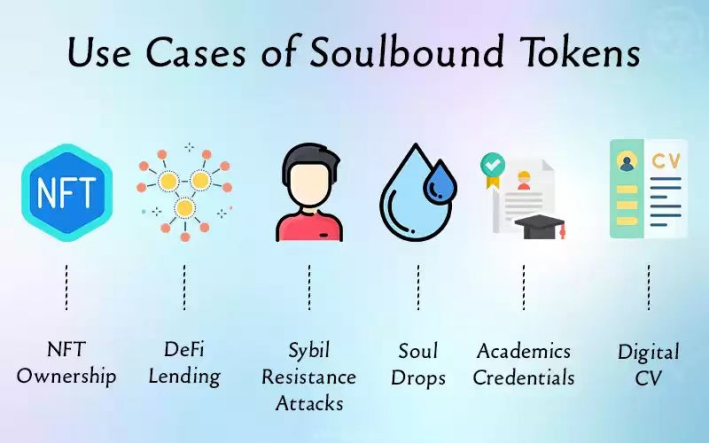
Imagine what comes next: any institution or individual could issue SBTs to a fixed wallet, such as:
-
- Your alma mater
-
- Employers you’ve worked for
-
- Sports honors earned
-
- Charitable organizations you've participated in
-
- DeFi platforms where you’ve lent funds or provided liquidity
-
- DAOs you've deeply engaged with
Yes, your wallet could receive all kinds of SBTs—much like a trophy wall in gaming.
Since SBTs are non-transferable and non-tradable, they lack the speculative nature we see in today’s NFTs. While NFTs play games of scarcity among non-fungible items, SBTs mark identity differences through the intrinsic attributes of a fixed wallet holder. This new type of NFT, detached from trading, is poised to steer the entire crypto industry back toward exploring new value in social contexts. My intuition says the following will likely happen soon:
-
- Decentralized social platforms supporting SBTs may emerge, paving the way for a “social-first, then financial” path in crypto markets
-
- Multiple NFT marketplaces will quickly add dedicated SBT wallet sections
-
- Cryptocurrency exchanges will conduct airdrops targeting existing KYC users
It’s certain that a potential SBT explosion lies ahead—and it will likely be chaotic, with airdrops flying everywhere. Let the bullets fly.
4. When It Comes to Evangelism, Vitalik Stands Alone
In my personal opinion, if SBT (though some might jokingly read it as “sick pervert”) must be translated into Chinese, “Soulbound Token” should be rendered as 灵魂绑定令牌 (linghun bangding lingpai), translating “Token” as 令牌 (lingpai) is not novel—it's consistent with how “Mint” is used in today’s NFT markets, both having roots in computer science terminology. The reason is simple: Soulbound Tokens are non-tradable; insisting on translating “Token” as “代币” (currency/token) would confuse most people.
Actually, Vitalik independently published an article titled “Soulbound” in February this year, introducing the idea of designing non-transferable NFTs inspired by the “soulbound” mechanic in World of Warcraft. This reminded me of an online conversation four years ago with Vitalik, where he mentioned his youthful obsession with World of Warcraft before discovering Bitcoin.
Gamers are already familiar with the term Soulbound—it originated in MMORPGs (massively multiplayer online role-playing games), notably in the classic World of Warcraft, where soulbound items are high-end gear permanently tied to a specific character, usable only by the player who obtained them, and cannot be traded or sold.
Same game, different outcomes. Vitalik didn’t waste his time playing WoW. How I wish among the over 100 million Honor of Kings players, a crypto legend would soon emerge.
Needless to say, Vitalik is the most visionary archmage in the entire crypto forest. I recall a blockchain engineer based in Silicon Valley casually mentioning the importance of technical influence in blockchain projects last month. He described Vitalik as a second-rate engineer, first-rate researcher, and an unparalleled evangelist. I could tell—he wasn’t being sarcastic, but offering high praise.
What kind of world does Vitalik envision with DeSoc?
I once saw a well-known Taiwanese entertainer, after launching her own NFT, append a suffix to her Twitter name—Web3 Citizen. Beyond her celebrity status, she wanted to emphasize a new digital identity: a citizen of the Web3 world.
Vitalik’s proposal of SBT attempts to answer a crucial question within crypto-utopia: for any citizen of Web3, beyond asserting sovereignty over a sacred wallet address, there remains one timeless philosophical inquiry—Who am I?
Yet, I’ve seen online critics raise concerns about SBT:
-
- How to prevent interference from bots and automated systems?
-
- Will this truly solve trust issues in the crypto world?
-
- Could it violate principles of fairness in future competitions?
-
- And a deeper concern: do we really want to return to the same mechanisms of contribution and power that dominate our current world?
Writing this, I begin to understand Wittgenstein—a thinker I once found more puzzling than general relativity. Physics gives us headaches; philosophy might drive us mad.
“The limits of your language mean the limits of your world.” So said the philosopher.

Join TechFlow official community to stay tuned
Telegram:https://t.me/TechFlowDaily
X (Twitter):https://x.com/TechFlowPost
X (Twitter) EN:https://x.com/BlockFlow_News
 @wangfeng_0128