Proof of Utility: A Solution for Quantifying NFT Benefits through the SBT Technical Framework
TechFlow Selected TechFlow Selected
Proof of Utility: A Solution for Quantifying NFT Benefits through the SBT Technical Framework
During the creation and operation of NFT projects, we once wondered whether it's possible to record holders' actions on-chain and reward them accordingly?
 Navigating Web3 tides with focused insights
Written by: Brother Xiaomao, N_0
In a January article this year, Vitalik Buterin introduced the concept of Soulbound Tokens (SBTs), proposing that NFTs with social value could experiment with soulbound mechanisms. Orange Book also elaborated on this idea in its article titled "Why Soulbound Tokens Are a Good Idea," envisioning blockchain-based representations of social behaviors—what they call "social coins." The discussion around how to empower NFTs has long been debated within the space, and the NFT community continues to grapple with several contentious issues:
- There is currently no technical standard or on-chain framework for quantifying NFT utility, making it difficult to measure on-chain;
- NFT holders cannot actively choose which utilities they want—they are passively waiting for unexpected airdrops;
- There is no existing on-chain technical framework allowing both NFT projects and users to jointly determine and maintain rewards based on on-chain behavior.
Fortunately, many NFT projects are still innovating in the area of NFT empowerment. For example, Moonbirds' Nesting mechanism introduces an empowerment model that puts the critical dimension of “time” onto the blockchain. While creating and managing NFT projects, we began to wonder: Could holder behaviors be recorded on-chain and rewarded accordingly? Based on these theories, we increasingly believe that Soulbound Tokens (SBTs) can play a pivotal role in solving these empowerment challenges.
It's not just about the NFT itself—can NFT rights and privileges be soulbound?
NFTs Representing Holder Souls and On-Chain Behavior
- Holder actions (holding or trading) determine how many Soulbound Tokens (SBTs) they receive
NFT Soulbound Token – Mapping to Holder Rights
- SBTs generated through holding activity can unlock project rewards and benefits
One clear goal of this mechanism: NFT holders can proactively select and unlock specific project benefits, instead of passively receiving unknown airdrops every time they check their wallet.
For instance, profile picture (PFP) NFT projects typically reward holders by airdropping new NFTs (such as banners or stylistically matched pets). Usually, NFT holders can only wait passively. But imagine if such projects adopted an SBT-enabled technical framework—holders could freely choose which rewards they’d like to earn during the holding period.
What Are NFT Soulbound Tokens?
Orange Book explains the concept of Soulbound Tokens in its article: "Soulbound Token (SBT) is a non-transferable token—similar to powerful in-game items that, once picked up, become permanently bound to your account and cannot be transferred. A 'Soul' refers to the wallet address holding the SBT, which may belong to either an individual or an organization."
Within the envisioned Proof of Utility SBT framework, you can think of SBTs more vividly as wishes granted by the Dragon Balls from the anime 'Dragon Ball Z.' Each Dragon Ball represents one SBT, consuming one wish. The difference is that these "wishes" represent actual benefits promised by different NFT projects based on their resources and roadmaps, featuring the following characteristics:
- Non-transferable and tied to the owner’s address
- Limited total supply, with potential for future issuance by the project team
- Can be used on-chain to unlock or redeem benefits provided by NFT projects
- Determined by the NFT holder’s on-chain behavior, including holding duration and other factors
Under this technical framework, we consider “time”—the length of time an NFT is held—as a crucial on-chain factor determining NFT value. Inspired by Moonbird, we created the HODL CLOCK, isolating this key component of a non-custodial staking mechanism. Thus, by proving the amount of time an NFT has been held on-chain, holders can earn corresponding on-chain proof of reward—namely, Soulbound Tokens. Additionally, this mechanism helps establish an on-chain honor system for NFT holders, enabling them to freely choose among various privileges. The diagram below illustrates a conceptual example:
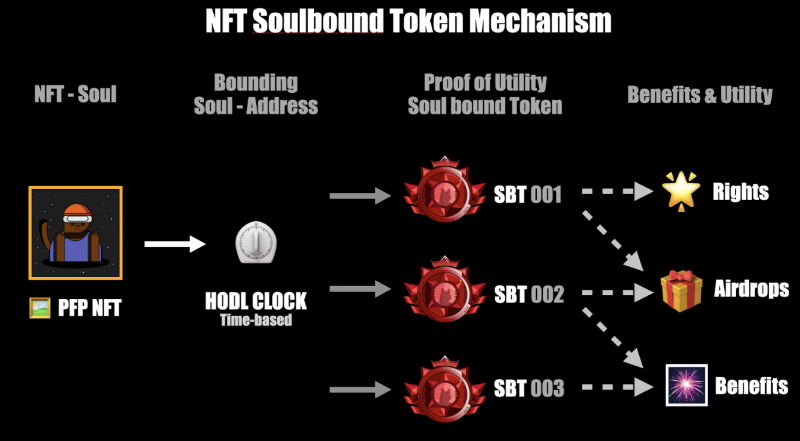
Integrating the SBT Framework: Enabling Long-Term Reward Mechanisms Based on On-Chain Behavior
Since the NFT space is still in its early stages, earlier forms of utility and "game mechanics" may eventually fall out of favor as markets evolve. To avoid becoming obsolete, NFT teams must continuously innovate new gameplay elements.
So, is it possible to design a long-lasting, adaptable technical framework for NFT projects that supports evolving gameplays? Imagine that NFT Project A introduces new gameplay mechanics and encodes new resources into its smart contract. We can use the following template to invoke holder behaviors and define all possible future rewards:
(New Gameplay) Name of Game: Compete for HODL Reward
(Participants) Game Members: NFT tokens
(Player Resources) Resources: Clock associated with each NFT token
(On-Chain Actions) Action Space: {mint, transfer by owner, transfer by broker, burn}
(Reward Mechanism) Reward Function:
Actions lead to modifications in resources.
Rewards are calculated based on the resources held by each member.We implement the resource modification function in the smart contract:
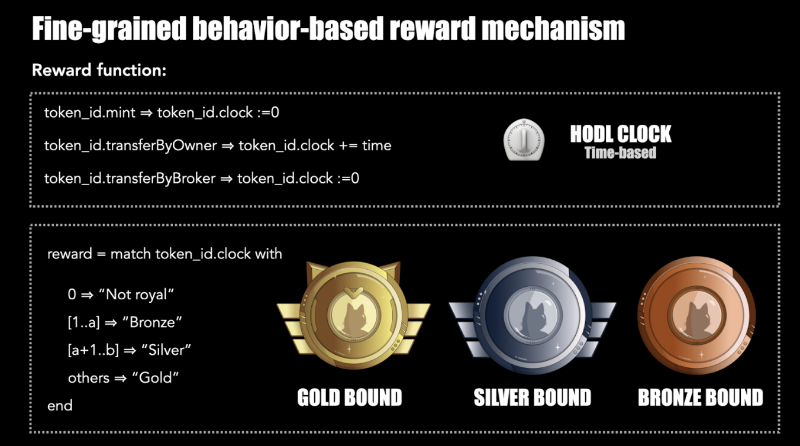
token_id.mint ⇒ token_id.clock := 0
token_id.transferByOwner ⇒ token_id.clock += time
token_id.transferByBroker ⇒ token_id.clock := 0Afterwards, we tune the reward function based on resources:
reward = match token_id.clock with
0 ⇒ “Not royal”
[1..a] ⇒ “Bronze”
[a+1..b] ⇒ “Silver”
others ⇒ “Gold”
end
If NFT projects follow this technical framework, adding a new gameplay mechanic becomes akin to filling out a new form:
Name of game: #a string describing the rule
Game members: #a set of identities
Resources: #a set of variables stored in the smart contract
Action space: #a set of functions defined in the smart contract
Reward space: #a set of utilities guaranteed to game membersReward function:
Resource mapping:
f: #Action space ⇒ #Resources
Parameterized reward mapping:
g: #parameter_list * #Resources ⇒ #Reward space
Unlike most existing roadmaps or Moonbird’s Nesting system, this SBT framework—combined with Hodl Clock and nested Utility Functions—offers greater flexibility. Moreover, the reward parameters under the SBT framework are adjustable. Projects can first implement known current benefits while leaving room to adjust uncertain future ones later—helping prevent issues like mass hoarding of SBTs or dilution of high-value benefits due to sudden influxes of SBTs.
In essence, this system provides NFT users with non-transferable on-chain credentials (SBTs) from project teams, aiming to create a fairer on-chain economic reward system and embodying innovative ideas the NFT space seeks to realize:
- It’s not just the NFT itself—the way users interact with their NFTs also becomes part of the NFT’s value, recorded immutably on-chain.
- Establishing an on-chain framework between NFT projects and users—for example, recording user behaviors on-chain so they can be invoked via smart contracts, with final outcomes co-determined by feedback from both users and project teams.
MaoDAO M³ Labs is piloting this technical empowerment framework for Ready Player Cat holders and is working to develop it into a plug-and-play Protocol available for broader adoption by other NFT projects.
Take Ready Player Cat as an example to further understand how this SBT framework works in practice: Step 1: Users can opt-in to activate the HODL CLOCK for their cat (which stops counting upon any marketplace trade). Step 2: After meeting the required holding time, users receive corresponding Soulbound Tokens, allowing them to freely choose from various benefits. These benefits are closely tied to new projects incubated by MaoDAO M³ Labs, including a new NFT collection called Ready Player Soul, an NFT lottery infrastructure tool named NFT Luckbox , and a Twitter NFT tracking plugin BlockTracker currently in testing. Step 3: The project team introduces new gameplay, yet retains the previous honor system—ensuring a fairer reward structure remains intact.
This time, the design of NFT gameplay and rewards will live on-chain—and the power to choose which benefits to unlock lies entirely in the hands of the holders themselves! (More information will be released when the test version launches)
Reference
Soulbound
https://vitalik.ca/general/2022/01/26/soulbound.html
Decentralized Society: Finding Web3's Soul
https://papers.ssrn.com/sol3/papers.cfm?abstract_id=4105763
Why “Soulbound Tokens” Are a Good Idea | Oracle Weekly
https://orangexyz.mirror.xyz/dMr6F43Aiz79vuZgO0-d392BgG8elD86osAZ_xhsCRc
Join TechFlow official community to stay tuned
Telegram:https://t.me/TechFlowDaily
X (Twitter):https://x.com/TechFlowPost
X (Twitter) EN:https://x.com/BlockFlow_News