








Understanding Regen Web3: How Extractable Ambient Value Impacts the Real World?
TechFlow Selected TechFlow Selected
Understanding Regen Web3: How Extractable Ambient Value Impacts the Real World?
Here's why you should care about Regen Web3, and why it's worth your time to pay attention.
 Navigating Web3 tides with focused insights
Written by: Kevin Owocki, Bankless
Translated by: TechFlow intern
A new type of project and model is emerging in Web3 that combines profit speculation with positive impact on humanity and the planet—this is known as Regen Web3. It's a game-changer, and no one understands it better than Gitcoin founder and host of Green Pill, Kevin Owocki. In today’s newsletter, let’s dive into it.
TL;DR
There’s a lot of noise in Web3, but an emerging ecosystem offers a strong value proposition: real-world impact combined with investment returns.
These "Regen Web3" projects—many still in early stages—are scalable, built for transparent governance, and capable of 10x to 100x growth over the next decade. Here’s why you should care about Regen Web3, and why it deserves your attention.
Capital Rotation in the Regen Web
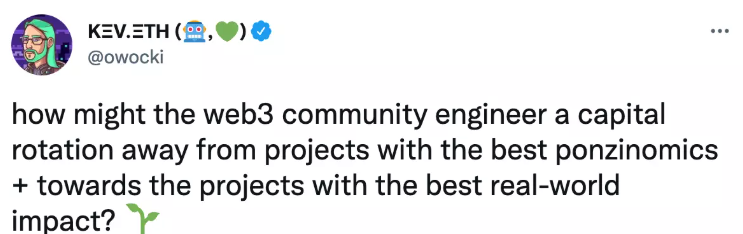
As the ecosystem matures, capital will increasingly flow toward projects creating the most humanitarian value—not just those extracting economic value.
In this article, we evaluate emerging Regen Web3 models based on risk and return potential. Projects at the top are already operational today, while those at the bottom remain more theoretical but hold significant upside.
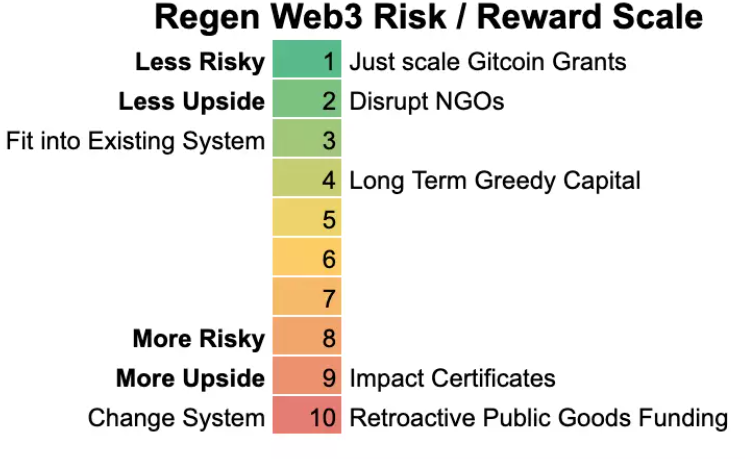
1. Gitcoin Grants (Low Risk, High Upside)
Gitcoin Grants is a capital allocation mechanism that has already raised $64 million for Web3 public goods, primarily through Quadratic Funding.
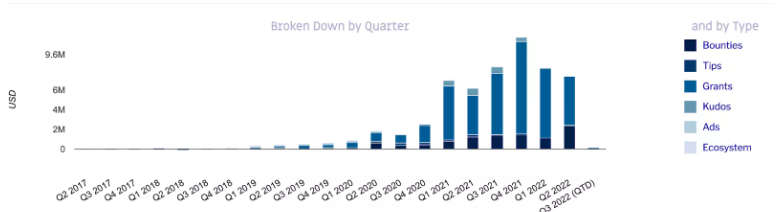
Each quarter, the Gitcoin community allocates $3 million to a matching pool, distributed based on crowdfunding outcomes. In Q2 2022 alone, Gitcoin facilitated $7.4 million in value transfers.
But this only scratches the surface of the value created by public goods within our ecosystem. Open-source software and Ethereum have generated billions in public value. To reach that scale, Gitcoin must grow 1,000x. To achieve this, Gitcoin launched Aqueduct—a mechanism enabling any DAO ecosystem to fund its public goods via Gitcoin Grants.
With Aqueduct, Gitcoin will automatically run co-funding rounds alongside its quarterly grants to support public goods across ecosystems. Each additional round of quadratic funding becomes an opportunity for any given project to serve others—an upward spiral of positive externalities.
For example, Project X₁ achieves a matching multiplier of Z₁ in round Y₁. If you include X₁ in rounds Y₂, Y₃...Yₙ, then its total multiplier becomes Z₁×Z₂×Z₃×...×Zₙ.
2. Disrupting NGOs (Medium Risk, High Upside)
$25 trillion is allocated annually by governments and NGOs to public goods. With the benefits of transparency, immutability, global reach, and programmability offered by Web3, how can Regen DAOs transform the management of these public goods?
Regen Web3 projects disrupt the traditional nonprofit sector, which suffers from excessive bureaucracy, lack of transparency, and high administrative overhead—resulting in donations being heavily diluted before reaching actual charitable work.
A stark example: Africa has received trillions in aid over the past 60 years, yet per capita income today is lower than in the 1970s, and much of the population remains in poverty.
Government institutions fail to maximize the benefits of public assets.
Regen Web3 does not replace traditional nonprofits—it empowers them. Due to their inherent transparency, accountability, and minimal bureaucracy, Web3-native projects are better positioned to scale and amplify the impact of every dollar in ways nonprofits cannot.
3. Incentivizing Long-Term Greed (High Risk, High Upside)
One flaw in our current system is that it incentivizes short-term performance and profits at the expense of long-term returns and impact. Many impactful long-term investments struggle to attract funding because investors lack short-term incentives. This is the marshmallow test for adults, investors, and human nature.
With Regen Web3, we can create asset classes where capital earns sustained returns over longer time horizons (>10 years), encouraging investments that deliver both short- and long-term value.
4. Retrospective Public Goods Funding (Very High Risk, Very High Upside)
Economies, systems, and people act according to incentives. The outcomes we get depend on how we design incentive structures. For different results, we need to change the rules of the game.
Currently, Regen Web3 projects operate under suboptimal incentive systems that reward private value creation by founders more than public value generation.
Retrospective public goods funding can change that.
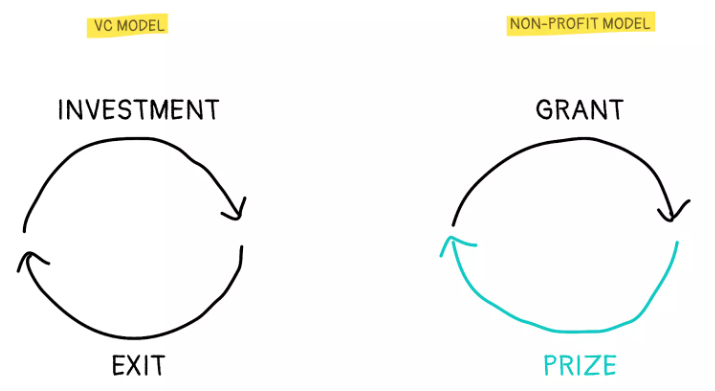
With retrospective funding, we can build incentive structures that reward impactful founders with exit-like rewards, similar to those in for-profit ventures.
As Vitalik Buterin wrote: "The core principle behind retroactive public goods funding is: ‘It’s easier to agree on what was useful than what will be useful.’"
Since measuring and rewarding past impact is easier than predicting future impact, this has become a mechanism for Regen Web3 projects to distribute rewards based on users’ verifiable, retroactive contributions.
The most prominent example is Optimism’s retroactive airdrop. As funding for public goods grows, we can in turn incentivize investors—not just extract private gains.
Here’s a visual I borrowed from Nick Barr:
Here’s an interesting story related to Optimism: Karl Floersch, Optimism’s co-founder, proposed Ether’s Phoenix—a concept to reward contributors to public goods.
5. Verifiable Impact >> Impact Certificates (Very High Risk, Very High Upside)
How do we verify the impact of different projects? The solution: Impact Certificates. These can be awarded to projects generating measurable impact in their domains.
How it works: On an impact market, holders of Impact Certificates can sell them to projects they believe are creating real change. This creates a speculative market centered around value-creating projects—unlike luxury goods (think PFP NFTs). Profits emerge when new owners drive positive actions that generate impact.
This systematically shifts Web3 incentives, linking revenue creation directly to impact creation.
Extractable Vibes Value—VEV: Vibes Extractable Value
If you knew you’d be rewarded for positive impact, how would you change your behavior? In a world that rewards impact creators, how will you position yourself ahead of the curve? How to get early (in Regen Web3):
1. Find a mission-driven project, join it, and start adding value.
2. Once you find such a project—and especially if you love it—get involved early, or you’ll miss out on VEV.
3. Every project needs the right person to discover its virtuous cycle and unlock success. By getting in early, you’re creating opportunity.
The existence of VEV is also why DAOs are so powerful—positive vibes foster shared purpose and mission, aligning values with value creation and income.
Let’s dive deeper into the world of Regen Web3. Join a DAO, participate in investing, contribute to Gitcoin Grants. Become part of the projects shaping the future of Web3—one that measures impact and builds technologies and financial systems we can’t yet imagine.
Join TechFlow official community to stay tuned
Telegram:https://t.me/TechFlowDaily
X (Twitter):https://x.com/TechFlowPost
X (Twitter) EN:https://x.com/BlockFlow_News
 Bankless






