








Developer Guide: What Programming Languages Should You Learn When Transitioning from Web2 to Web3?
TechFlow Selected TechFlow Selected
Developer Guide: What Programming Languages Should You Learn When Transitioning from Web2 to Web3?
Which language should a programmer focus on when transitioning to Web3.0: Solidity, Go, Haskell, or Rust?
 Navigating Web3 tides with focused insights
For developers transitioning from traditional software development to Web3.0, which programming language should they focus on among Solidity, Go, Haskell, and Rust?
01 Introduction
While terms like metaverse and NFT have become familiar, those within the industry still recognize that Web3.0 remains in its early stages, with new solutions, business models, concepts, and ideas emerging constantly. At the same time, this unstoppable wave has created massive demand for talent, making blockchain developers one of the most sought-after professionals.
In 2021, more developers joined Web3.0 than ever before, with over 34,000 people entering the field throughout the year. Similar to traditional finance, employment in the blockchain sector is at an all-time high.

[As shown] After Bitcoin's price surge in 2017, recruitment numbers rose significantly year-on-year; during the Covid-19 pandemic, as Bitcoin prices continued to climb, hiring maintained this upward trend.
Traditional internet developers already master languages such as Python, C++, Truffle, JavaScript, and Golang, so professionals with Web2 skills can transition into Web3 relatively easily.
Currently popular blockchains beyond Ethereum include Cardano, Solana, Avalanche, and Tezos. These platforms use various programming languages, meaning developers with expertise in any of them will find opportunities. Naturally, joining larger developer communities offers greater advantages due to richer tutorials, compatibility libraries, and plug-and-play tools for porting dApps. Of course, mastering a combination of multiple coding languages will undoubtedly broaden one’s path in blockchain development.
This article summarizes some of the most valued programming languages today: JavaScript and Solidity used on Ethereum, Haskell—the foundation of Cardano’s native Plutus language, Go used by Cosmos, and Rust used by Solana, NEAR Protocol, and Polkadot.
02 JavaScript & Solidity: Ethereum
Ethereum supports four domain-specific languages: Serpent (inspired by Python), Solidity (inspired by JavaScript), Mutan (inspired by Go), and LLL (inspired by Lisp)—all designed from the ground up for contract-oriented programming.
Among these, Solidity is Ethereum’s preferred language. It incorporates all features of Serpent and has syntax similar to JavaScript, making it easy to learn and use. Since JavaScript is already widely known among web developers, millions of programmers already possess foundational knowledge for Ethereum smart contract development.
As object-oriented languages, JavaScript and Solidity share many similarities but serve different purposes. JavaScript has long been used in web development to add interactivity to websites, bringing dynamic user experiences and functionality to life.
Like web and mobile apps, JavaScript can be used in Web3 development to create dApps. However, note that when building blockchain applications, developers should use JavaScript libraries such as web3.js and ethereum.js, which allow users to interact with Ethereum nodes via HTTP, IPC, or WebSocket—locally or remotely. These libraries also provide plug-and-play tools enabling dApps to integrate seamlessly with Ethereum.
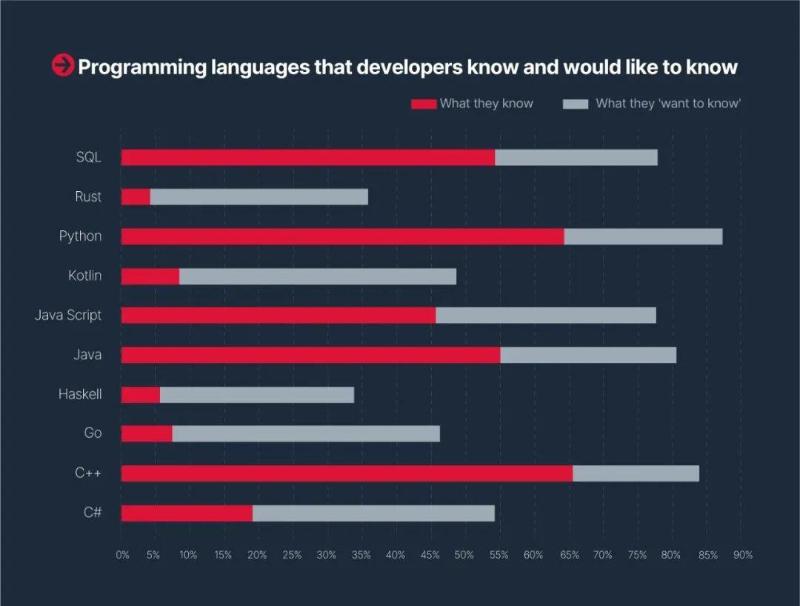
[As shown] Data indicates that proficiency in Rust, Kotlin, Haskell, and Go forms an ideal skill set for developers. Source: HackerEarth 2021 Developer Survey
Solidity is not particularly complex—it resembles a compact version of JavaScript—making it accessible to many developers.
Although Solidity is relatively young, with a smaller community and fewer reusable standard libraries, both the community and codebase have grown rapidly since 2020. By the end of 2021, there were over 2,000 active developers. Given that Ethereum remains the largest development ecosystem, Solidity is undoubtedly one of the most widely adopted golden languages in the blockchain industry.
With the arrival of Ethereum 2.0, combining Solidity with other languages to build dApps on Ethereum presents significant advantages. For many developers aiming to enter Web3, this remains a fast track.
03 Haskell: A Pure Functional Web3 Language
Haskell is a general-purpose functional programming language often positioned as the underlying customized language for Plutus—the smart contract programming language on Cardano.
At its core, Haskell provides a theoretical framework for describing and evaluating functions, where each function behaves mathematically, offering high security. In Haskell, functions perform low-level tasks and define what the program must accomplish. It is also a statically typed language, allowing code to be easily evaluated during compilation, ensuring type checking results in clean, clear, and correct code.
It uses lazy evaluation, skipping irrelevant code unless necessary, resulting in faster program execution. Additionally, it is convenient for developers because it leverages automatic memory management (AMM), eliminating the need to manually handle memory allocation in dApp development.
As of 2021, only a handful of Web3 developers used Haskell, and it had not yet gained widespread acceptance. Haskell has a steep learning curve, limited libraries, a small developer base, and slow growth. Nevertheless, Haskell plays a crucial role in producing high-quality software, and mastering it helps developers stand out.
04 Go: Cosmos and Polygon SDK
Go is an open-source general-purpose programming language introduced in 2009 by Google engineers. It is an explicitly statically typed language aiming to combine Python’s ease of development with the efficiency of compiled languages like C++.
Cosmos and Polygon SDK commonly use Go. It boasts extensive native libraries and cross-platform compatibility, including support for mobile devices. Moreover, it utilizes "Goroutines," enabling dApps to launch quickly and execute tasks without consuming excessive memory. Go can also run multiple threads simultaneously, efficiently handling heavy workloads.
Examples of Go in Web3 include the Polygon Edge SDK—a modular framework for dApps and blockchains used to build Ethereum-compatible networks. It connects third-party networks to Ethereum’s blockchain, enabling their own solutions to transfer ERC-20 tokens and ERC-721 NFTs. Other Ethereum implementations can be embedded into Go using the Go Ethereum client.
Go is not difficult to learn, especially for developers familiar with JS or C, whose logic aligns well with Go’s initial learning curve. Those with experience in C/C++ or Java can pick it up even faster.
According to the 2020 Stack Overflow Developer Survey, Go was quite popular, with over 62% of respondents saying they enjoyed using it and would continue developing with it.
05 Rust: Simplicity, Concurrency, and High Efficiency
Rust was first released in 2015 by a former Mozilla employee. It is a multi-paradigm programming language focused on safety and performance, built with speed and efficiency in mind—offering zero-cost abstractions, inheritance, and functional features.
Rust delivers remarkable speed and memory efficiency. Its rich type system and ownership model guarantee memory and thread safety, eliminating many common bugs at compile time. Additionally, it supports concurrent (and parallel) code, enabling fast transaction processing. This gives Rust programs excellent scalability, achieving higher transactions per second (TPS) than other languages due to its high throughput.
Zero-cost abstraction ensures that abstractions introduce almost no runtime overhead, meaning there is no performance difference between low-level code and code written with abstractions. This principle has become central to Rust’s design philosophy.
Rust also provides excellent documentation and a user-friendly compiler that helps diagnose issues efficiently, boosting productivity. Developers spend less time optimizing code because the compiler handles abstraction optimization. Even compared to optimized code in other languages, Rust applications run faster.
Moreover, Rust integrates well with other languages, allowing seamless interoperability—calling into another language or being called by it. This feature highlights Rust’s value in an interconnected digital world.
Due to these advantages, in a 2020 Stack Overflow survey of developers, Rust ranked as the “most loved programming language,” with approximately 86% of respondents expressing interest in continuing to code with Rust in the future.
Polkadot’s launch and its adoption of Rust directly led to increased job openings for Rust developers. Meanwhile, by the end of 2021, Solana’s active developer count had grown from around 180 to nearly 1,000—an increase of nearly 500%. This demonstrates Rust’s strong application potential.

Rust is best suited for high-throughput and concurrent operations.
06 Conclusion: Rust Is a Rising Star
Since Web3 protocols require fast and robust performance when processing tens of millions of untrusted inputs, Rust holds distinct advantages. It handles complex functionalities at lightning speed while reducing errors related to memory, bounds, null variables, uninitialized variables, or integer overflow.
Although Rust has a steeper learning curve, many developers are still drawn to learn it. Using Rust enables the creation of stronger dApps, reducing many common bugs and ensuring applications behave as intended after deployment. Its concurrency capabilities make it ideal for handling tens of thousands—or even hundreds of thousands—of transactions per second, positioning Rust as a perfect choice for Web3 applications and virtual world economies.
On the other hand, Solidity offers a vast community and extensive Ethereum libraries. This network effect fosters collaboration and increases the likelihood of specific dApps gaining broader utility.
Demand for developers in each language is rising, and those proficient in multiple languages will have more career options. Currently, demand for Solidity developers is extremely high, but learning Go, Haskell, or Rust may offer greater competitive advantage, as fewer developers work with these languages—and employers highly value them.
Join TechFlow official community to stay tuned
Telegram:https://t.me/TechFlowDaily
X (Twitter):https://x.com/TechFlowPost
X (Twitter) EN:https://x.com/BlockFlow_News
 @SupraOracles






