What Did Vitalik Say at the Ethereum Shanghai Summit? A Review of the Latest Developments in the Ethereum Ecosystem
TechFlow Selected TechFlow Selected
What Did Vitalik Say at the Ethereum Shanghai Summit? A Review of the Latest Developments in the Ethereum Ecosystem
Besides improvements in the Ethereum ecosystem and applications, what other areas are seeing enhancements?
 Navigating Web3 tides with focused insights
Written by: Dimension Tech
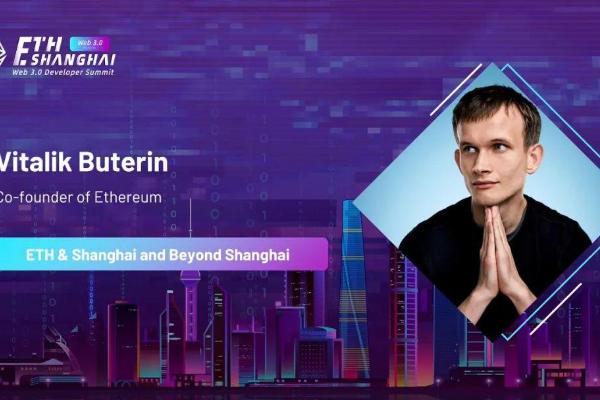
Today, I'd like to talk at the Ethereum Shanghai Web3 Developer Summit (ETH Shanghai Summit), hosted by Mask Network, co-organized by China Biodiversity Conservation and Green Development Foundation and Business China, and sponsored by the Ethereum Foundation. Vitalik Buterin, co-founder of Ethereum, delivered a keynote speech titled "ETH & Shanghai: Connecting Inside and Outside."
Full Speech Transcript
Today, I want to discuss recent changes in the Ethereum protocol. I know many people are eager to learn about Ethereum’s transition from PoW (Proof-of-Work) to PoS (Proof-of-Stake). Beyond developments in the Ethereum ecosystem and applications, what other improvements are underway?
The main topic today is the "Merge"—the Merge refers to the shift from the original PoW consensus mechanism to PoS. Since the beginning of the Ethereum project, we've been working toward this transition. We've spent seven years on the Merge. Now, our efforts are finally bearing fruit—we completed the Merge on Ropsten, one of Ethereum's testnets, just a week ago. On June 8, we will finalize preparations. If everything goes smoothly on testnets, we expect to execute the Merge on the mainnet this summer. This will be our next major milestone—the largest action we’ve ever taken—and it will lay the foundation for any future chain upgrades involving the Merge.
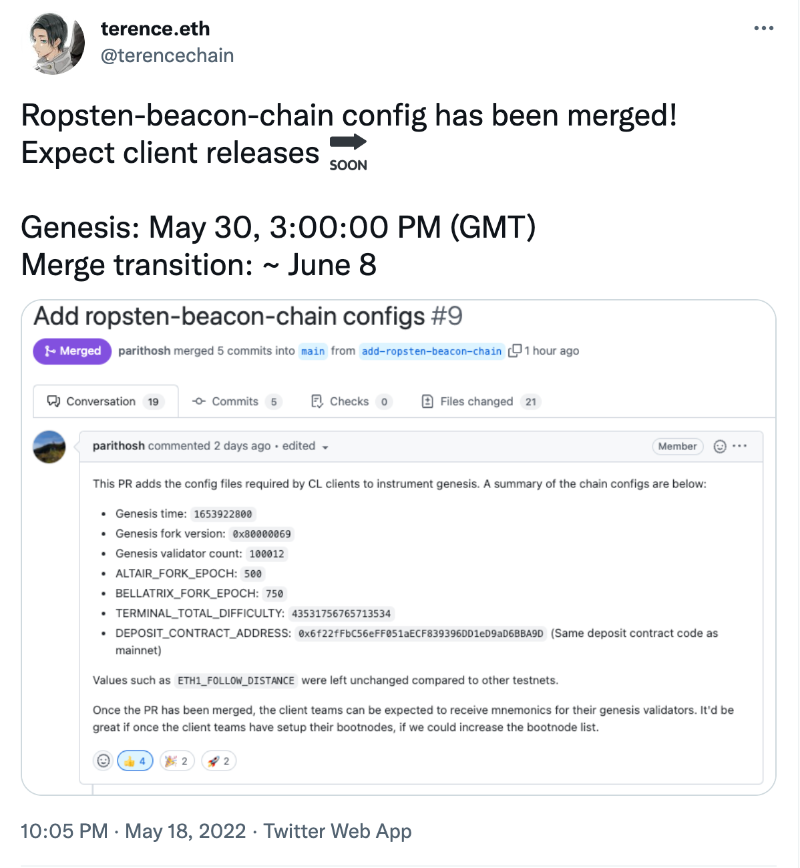
Barring unforeseen issues, the Merge should begin in August. Of course, problems may arise during testing, potentially delaying the mainnet Merge—possibly pushing it into September or October. But the arrival of the Merge is near. So let’s consider: what happens after the final Merge?
On this point, back in May I published a paper outlining proposed protocol upgrades. These developments have long existed within the Ethereum developer community—the beacon chain and PoS have already been under development for over a year and a half. The beacon chain already supports limited users. EIP-1559 is now live. Many new changes lie ahead over the coming years. To help clarify them, I’ll divide them into five parts: Merge, Surge, Verge, Purge, and Splurge.
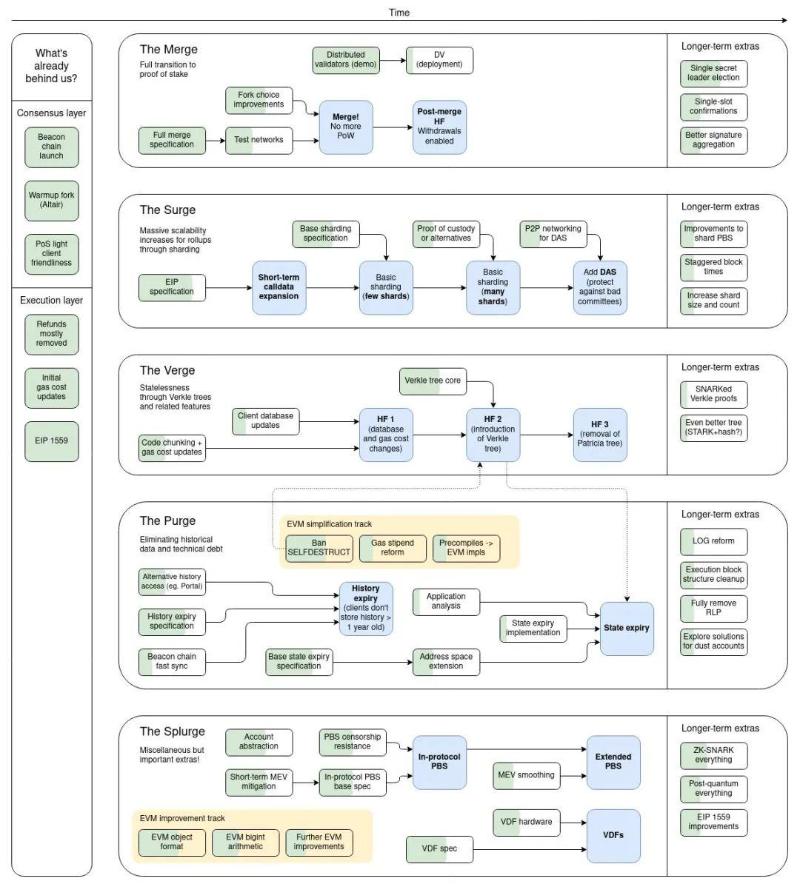
“Merge” means switching from PoW to PoS. “Surge” refers to sharding, increasing scalability so rollups can handle massive transaction volumes. For this, we designed EIP-4844 (Proto-danksharding). I believe there are many innovative ideas around sampling shard data. Then there’s “Verge,” which involves adopting Verkle Trees, enabling Ethereum nodes to operate more efficiently. This would allow even low-end computers to easily run validators, making the protocol more decentralized and allowing more people to participate in verifying the Ethereum chain. There will be many positive feedback loops during the Merge process.
Take “Purge,” for example—it improves efficiency by eliminating permanent storage of historical block data. Node providers won’t need to store all past data; they only need to keep roughly one year’s worth. Long-unused data can be moved to separate storage, freeing nodes from retaining it.
Some parts of the Ethereum protocol are overly complex, making node creation difficult. These could be removed from the core protocol and simplified via Splurge, which includes essential updates. There’s also an upcoming virtual machine upgrade—a specific solution that means we’ll spend more time discussing our plans.
In short, many changes are coming. I don’t think every single one must happen. Even if nothing else follows the Merge, Ethereum will still be a strong system. That said, I believe completing the Merge successfully will make Ethereum significantly better. After the Merge, the first major step will be EIP-4844. What deserves close attention in the near term is how sharding will boost Ethereum’s overall scalability.
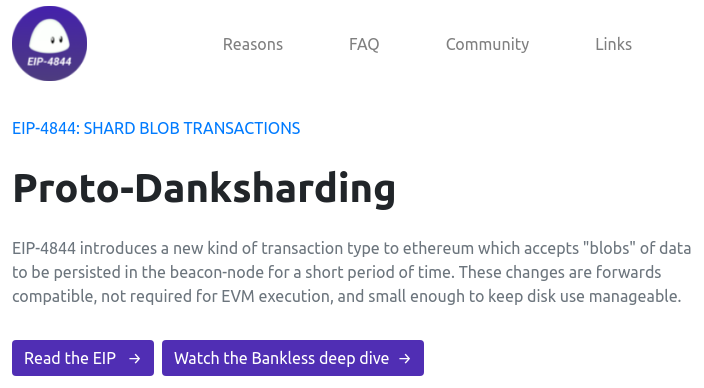
Recently, the sharding roadmap has undergone significant simplification. I’ve developed some ideas around Danksharding, introduced late last year. Danksharding has made the sharding roadmap much simpler. Previously, with 64 shards, there were 64 proposers. In practice, this caused excessive duplication and confirmation overhead, leading to centralization risks. But in danksharding, only one proposer selects all transactions and data entering a slot.
The key feature introduced by EIP-4844 is a new transaction type: blob-carrying transactions. These resemble regular transactions but include an additional large data component called a "blob." Blobs are very large (~125 kB) and far cheaper than equivalent calldata. However, blob data is not accessible to EVM execution—only commitments to blobs are visible to the EVM. Since validators and clients still need to download full blob content, EIP-4844 targets a data bandwidth of 1 MB per slot, rather than the full 16 MB.
Nevertheless, because this data doesn’t compete with existing Ethereum transaction gas usage, substantial scalability gains remain. Projects such as Arbitrum, Optimism, StarkNet, Polygon, and other rollups will benefit greatly from EIP-4844, attracting more developers and improving rapidly.
Currently, EIP-4844 is only the first phase of Danksharding—all nodes still download all data—but it accomplishes much of Danksharding’s groundwork. While unable to handle 16M data yet, handling 1M is still a major leap forward. We’ve done extensive work here, and over the next six to nine months, further progress will continue. I believe EIP-4844 will become a critically important part of the ecosystem. I’m highly optimistic about its progress.
That covers sharding. Now let’s move on to Account Abstraction. Account abstraction is currently just an idea of mine, allowing users to create wallets with arbitrary account rules behind them for enhanced protection.
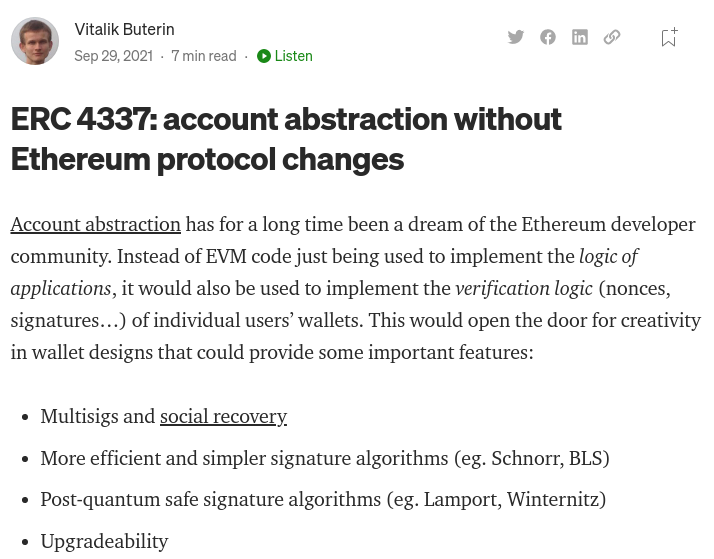
For instance, right now you might have one wallet with one private key. If that key is stolen, your assets are gone. But what if you had an account secured by three private keys? If one is stolen, no problem—you still have two. If another is lost, hackers still can't do anything with those two. You can use the last key to urgently modify your account settings.
This example might still sound complicated, but abstract accounts are actually much more convenient in practice.They enable powerful features such as multi-signature and social recovery, making it easier to regain access to compromised accounts; more efficient and simpler signature algorithms to defend against attacks; and built-in upgradability.
To realize these capabilities, we developed the ERC-4337 standard. ERC-4337 isn't an EIP—it's an ERC, meaning it doesn’t require modifying Ethereum’s base protocol or technical specifications. In fact, ERC-4337 can already be used to create accounts and send transactions. A vibrant developer community is already building on ERC-4337. I hope they can refine it faster, and I encourage developers and users alike to join in.
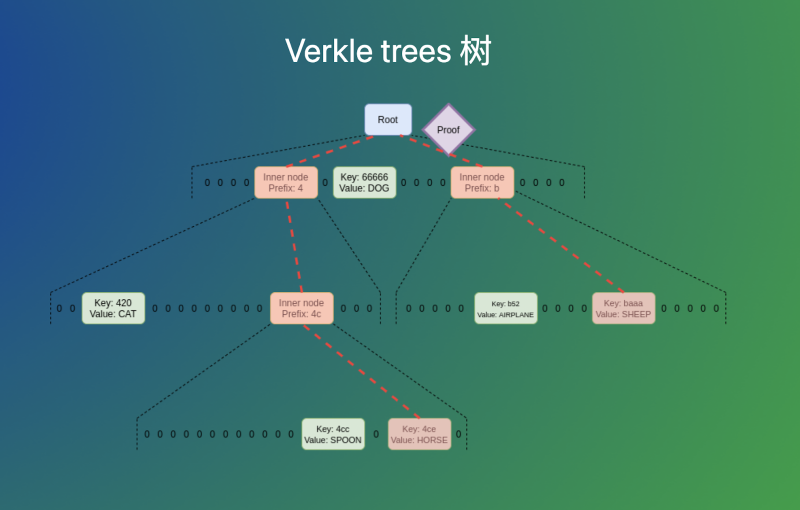
Now let’s talk about Verkle Trees—upgrading to Verkle Trees will allow verification of Ethereum blocks without requiring any disk space. Currently, verifying Ethereum blocks requires storing complete blockchain data—about 40–50 GB—and validating blocks sequentially. With Verkle Trees, verifying individual blocks becomes much easier, requiring no additional context. This enables lightweight clients that can verify every Ethereum block without local storage. Blocks can be verified in any order, making it faster and easier for diverse users to run nodes—an important improvement for decentralization and security.
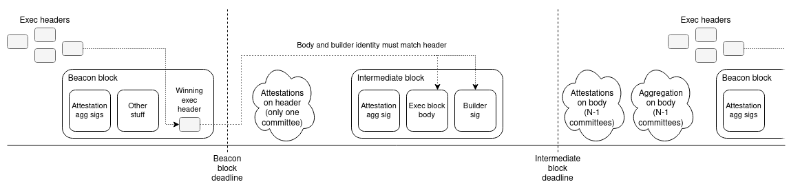
MEV Solutions. I believe MEV is increasingly recognized as a major issue, similar in scale to challenges faced by Ethereum itself. When MEV is allowed, miners or PoW block producers can reorder, insert, or censor transactions within blocks to profit at users’ expense due to their full control over block construction. The challenge in solving MEV lies in designing an ecosystem that prevents PoS from becoming centralized. Much work remains. I’ve proposed an idea called proposer-builder separation (PBS). Anyone interested can read more here: (https://notes.ethereum.org/@vbuterin/pbs_censorship_resistance). It's a novel concept pointing toward a long-term direction for PoS.
Another new idea proposes long-term modifications to PoS. One significant change is single-slot finality, allowing blocks to achieve finality within a single slot instead of the current 64 slots. This would speed up transaction finality while simplifying the protocol and strengthening resistance to MEV attacks. Though still in early experimental stages, active research is ongoing. This is a long-term goal—perhaps three to five years away—but it represents a major enhancement to Ethereum’s operation model, making it simpler, more robust, and worth watching.
One thought I have about the Ethereum ecosystem is that today, the crypto space—including Ethereum—is overly focused on financial applications.Financial applications are good and important, but they carry significant risks.I believe that constantly optimizing and developing financial applications brings considerable risk. Some early DeFi ideas from the past two years were excellent—MakerDAO, early stablecoin concepts—truly innovative. But recently, attempts to improve DeFi protocols feel excessive and unconvincing. Take Luna and UST, for example—they said, 'Oh, collateral is needed for stablecoins—let’s create one without collateral.' They succeeded, and it worked well during the bull market for two years, with prices rising steadily. But when Bitcoin and Ethereum prices dropped, Luna completely collapsed, causing losses exceeding tens of billions of dollars.
I think many people became interested in DeFi initially due to dissatisfaction with traditional finance and its systemic collapse in 2008. That crisis revealed how financial systems prioritize efficiency over resilience and stability during extreme events. Unfortunately, DeFi has gone too far in that same direction. The problem is, much like innovation in finance, it often just creates higher-risk products. Even improvements like Uniswap V2 to Uniswap V3 offer only marginal enhancements. The difference between Uniswap V2 and V3 isn’t huge, right? Do you even know the difference between Uniswap V3 and V4? I suspect it will be even smaller. While better DeFi is welcome, it won’t revolutionize the world. I think people enter crypto because they truly want to change the world and build something big. And I just don’t see financial apps having that transformative impact. I believe it’s more meaningful to encourage developers to explore other domains.I think DeFi is great—I believe we need our own DeFi—but we also need more, such as blockchain-based non-financial applications.
One application I'm excited about is Sign-in with Ethereum (SIWE). Essentially, whether it’s a dApp or regular app, you can log in using your Ethereum account. Even on a centralized chat app like chat.blockscan.com, you can still use your Ethereum address to sign in. More and more services are adopting this, and we hope to see wider adoption of Ethereum as a login method. Compared to centralized login systems, SIWE offers many advantages. First, it’s not tied to any centralized identity—you control your account. No company can arbitrarily suspend your access. It empowers data sovereignty and personal identity ownership. Plus, it has network effects: logging in with your Ethereum account also connects your ENS domain. You can prove ownership of Humanity proofs (proof-of-humanity), POAPs, NFTs, or verify other credentials. All these applications being built on Ethereum can interoperate seamlessly. I find this incredibly exciting.
Soulbound Tokens—one idea I’ve been advocating—is set to launch this year. The concept centers on tokens that cannot be freely transferred. These tokens hold value in creating trust and identity, but that value shouldn’t be transferable because it's inherently tied to the holder. You own it, but you can’t sell, trade, or rent it. This is a technical challenge we’re actively tackling. I’ve considered ways we might implement it and monetize utility through such tokens. Soulbound tokens give meaning to identity and reputation, opening new possibilities for decentralized governance. Any non-financial application stands to benefit greatly.
We already have DeFi. Perhaps next we’ll see DeGov. Optimism is a project I’m particularly interested in because it pursues a vision I deeply care about: governance beyond token-based voting.
Most popular DAOs today rely on token-based governance—ten times more tokens mean ten times more voting power. I’ve written extensively on this. Current voting models have serious flaws and limitations. Token holders gain benefits while taking minimal risk. But under alternative models—non-token-based, non-transferable civic governance, or bicameral systems—we’d need real dialogue and negotiation to drive major decisions. This is a long-term governance experiment. As more governance experiments and DAOs emerge, vast opportunities will unfold. We’re already seeing diverse DAOs—for example, VitaDAO, researching longevity—what I’d call “Science DAOs”: decentralized science. I’m thrilled to see DAOs expanding across fields and evolving toward privacy-preserving governance.
We already have apps like Tornado Cash protecting financial privacy, but I find non-financial privacy applications even more interesting. MACI, a privacy-preserving voting system we’ve been developing for over two years, has made significant progress. Privacy-preserving reputation systems like UniRep Social, and numerous zero-knowledge-proof-based privacy applications are advancing rapidly. For developers looking to build today, focusing on non-financial applications—or hybrids combining financial and non-financial aspects—would be a smart choice.
Many exciting things are happening within the Ethereum protocol—consensus layer improvements are particularly promising. But discussing the broader ecosystem is equally important. My big-picture view of the Ethereum ecosystem is this: the crypto space, including the Ethereum community, is currently placing too much focus on financial applications—even though they are important.
Ethereum’s roadmap is stabilizing, with growing consensus on future directions. If you’ve followed Ethereum’s evolution, you’ll notice that changes to the roadmap have become increasingly rare. Two or three years ago, the roadmap shifted frequently. But over the past year, changes have been minimal. I believe Ethereum is now progressing steadily along a clear path—which is excellent.
Looking ahead, most innovation will occur at higher layers. Core Ethereum improvements remain vital, but greater emphasis will shift to applications, ecosystems, infrastructure, Layer 2 protocols, Sign-in with Ethereum, privacy tools, and more. I believe we should see more high-quality applications, especially non-financial ones. I hope this inspires developers working on these ideas. The Ethereum ecosystem is vast, filled with fascinating areas to explore and research. Today, the tools available for people to accomplish extraordinary things are more powerful than ever. I’m excited for all the incredible things people will build in the future!
Join TechFlow official community to stay tuned
Telegram:https://t.me/TechFlowDaily
X (Twitter):https://x.com/TechFlowPost
X (Twitter) EN:https://x.com/BlockFlow_News