The mystery behind UST's collapse: where is the market headed next?
TechFlow Selected TechFlow Selected
The mystery behind UST's collapse: where is the market headed next?
UST Plunges in Dramatic Crash: Is Algorithmic Stablecoin a False Proposition?
 Navigating Web3 tides with focused insights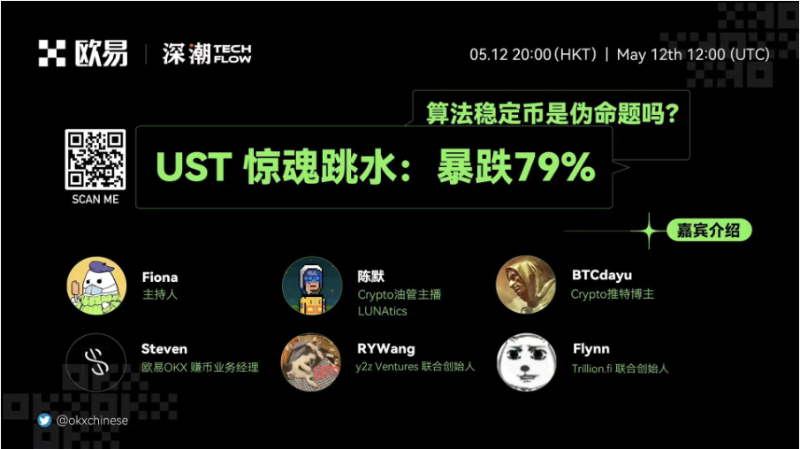
Compiled by: TechFlow Intern
Note: This article is a transcript of the Twitter Space co-hosted by OKX and TechFlow on May 12, titled "UST Plunges into Chaos: Is Algorithmic Stablecoin a False Proposition?"
Host: Fiona - LD CAPITAL
Guests:
· Chen Mo - Crypto YouTuber, LUNAtics
· Dayu - Crypto Twitter Influencer
· Steven - Earn Business Manager at OKX
· RYWang - Co-founder of y2z Ventures
· Flynn - Co-founder of Trillion.fi
Full Transcript:
Fiona:
Today’s event officially begins. First, we’re all participants in the blockchain space and have likely noticed the recent market crash. To some extent, this Terra collapse marks an important turning point. Terra has long been a prominent public chain ecosystem in the crypto world, known for its stablecoin protocol built around UST. The entire ecosystem was designed to expand UST’s utility and use cases, aiming to make UST as ubiquitous as the US dollar. Its competitive strategy differs significantly from other chains like AVAX. Before the crash, Terra’s total value locked (TVL) was astonishing—peaking at $14 billion worth of UST on-chain on May 6. The turning point came on May 8, when over $2.9 billion worth of UST was withdrawn, causing UST to slightly decouple from USDT, trading briefly between $0.997 and $0.998.
Afterward, I began tracking three key on-chain metrics: first, the market caps of UST and LUNA; second, the total amount of deposited UST; and third, the ratio of UST to 3Crv in Curve pools.
These three metrics sequentially collapsed. First, LUNA’s market cap fell below that of UST. Then, the amount of deposited UST sharply declined as large amounts were swapped for USDT, USDC, or DAI and exited the market, creating massive selling pressure. Meanwhile, the UST-3Crv pool shifted from an initial near 1:1 ratio to being about 86% UST and 14% 3Crv just before the crash, when LUNA was around $40. This event unfolded like a death spiral, step by step. By the time all UST flooded the market, there was no force left to absorb it. In my view, Terra’s collapse stemmed primarily from flaws in its economic model—an architecture that enabled rapid growth but also led to its freefall within days. Broader market weakness acted more as a catalyst, amplified by fast information dissemination and panic-driven stampedes. A mythic empire built over three years collapsed in less than five days.
Now, I’d like to invite Chen Mo to share: After the collapse and depegging, what measures did Terra take to try to recover? And what are your thoughts on where UST and the LUNA ecosystem might go from here?
Chen Mo:
Terra had actually prepared for a potential death spiral by introducing BTC and AVAX as reserves, with plans to add more assets to back UST. The idea was that during a LUNA price decline, BTC could help absorb some of the downward pressure. Looking back, however, this plan didn’t unfold smoothly. The BTC reserves weren't sufficient to support such a large market cap. After the crash, Terra did attempt rescue operations, including injecting capital from early fundraising rounds and external investors like JUMP.
Terra’s earlier approach with the UST-3Crv pool on Curve was later seen as unwise. Because everything on-chain is transparent and publicly visible, attackers could easily exploit weaknesses—a double-edged sword of blockchain transparency. During bank runs or crises, a project’s strength becomes fully exposed. In financial markets, a better strategy would be using minimal capital to leverage broader market participation in stabilization, rather than continuously dumping funds into a pool while others drain liquidity—such one-sided efforts tend to fail.
Later, we observed that certain on-chain addresses stopped adding funds to the pool, while exchanges like FTX, Binance, and OKX appeared to act as market makers pushing prices up—this is speculative. Based on UST’s price movement, it initially held between $0.8 and $0.9, then dropped to a low of ~$0.66 before being propped back up by rescue capital for about one to two days. Soon after, it crashed again, falling to between $0.2 and $0.3. That marked Terra’s first round of intervention.
The second wave involved tapping into BTC reserves. There’s no clear evidence whether these BTC were sold directly, offloaded via OTC deals, or used as collateral. But Terra clearly used its BTC holdings—the on-chain address no longer holds BTC, only a small amount of AVAX. Most believe the BTC were sold because the broader market saw a sharp联动 drop. Even if BTC were moved through OTC channels or sold to institutions/market makers, they would still need to be gradually liquidated. Given the prevailing monetary tightening by the Fed and declining BTC value, institutions are unlikely to hold BTC long-term due to risk exposure.
DK then proposed two measures: accelerating the two-way minting of LUNA and UST, and reducing Anchor’s yield to around 4–5%. Originally, the two-way minting mechanism had hard limits—both speed and volume caps. Once Proposal One passed, these restrictions were lifted, increasing LUNA issuance speed by roughly 3–4x. This meant LUNA would be rapidly and massively inflated to save UST. The arbitrage logic is simple: when UST trades below $1, users can burn $1 worth of UST to mint $1 worth of LUNA, then sell LUNA for USD and buy back UST. But now, the speed isn’t enough to restore parity, and LUNA’s performance has been extremely weak, allowing many to profit from shorting.
DK chose to save UST at the expense of LUNA—a controversial decision. LUNA represents the core value of the entire ecosystem. Validators, projects, early builders, and users held substantial LUNA, much of which was staked in Terra Station with a 21-day lock-up period, preventing timely exits. They could only watch helplessly as their holdings approached zero. You can’t save both sides—UST is too critical. First, the viability of the entire ecosystem hinges on UST. If the foundational stablecoin fails, the whole project collapses. Second, every project in the ecosystem prices its services in native UST, not via oracle-fed USD rates. Think of Terra as a country—UST is its currency exchange rate. Lose that, and every business and asset inside plummets in value alongside it. Without external pricing benchmarks, if UST remains depegged, all ecosystem projects will effectively fail.
One reason to save UST: many institutional funds flowed into ecosystem projects, and failure could trigger serious downstream issues. Another: UST has real-world payment applications in Korea—similar to Alipay—with banks and enterprises deploying capital into Anchor. A UST failure could disrupt offline payments and lead to legal risks. Plus, there are vested interests among builders and core teams.
Fiona:
Thank you, Chen Mo—your explanation is very clear, and I completely agree. UST functions like national currency—equivalent to the US dollar or Chinese yuan. Right now, the Terra ecosystem resembles Zimbabwe, with a broken monetary system leading to economic collapse. Flynn, I noticed about $2.7 billion worth of UST was staked in Anchor. With LUNA now insolvent, how do you think the ecosystem will handle this kind of “bad debt”? Do you believe UST can ever return to $1?
Flynn:
There’s still debate about handling this depeg situation because the ecosystem has already been breached. The team essentially faces two choices: sacrifice UST or sacrifice LUNA. But no matter how much LUNA is burned, it cannot return to its previous $18 billion market cap—that’s reality. Withdrawing from Anchor now feels like a battle royale; in my view, it’s already worthless. More importantly, consensus has eroded—not just UST’s value, but trust itself has collapsed. In my opinion, UST would need to shrink to around $1 billion or fall below half of LUNA’s market cap to have any chance of restoring system health.
Fiona:
I feel DK is still actively trying to fix things—even though this structure had Ponzi-like elements, his actions are quite admirable. Next question: due to UST’s volatility, OKX implemented timely risk controls, helping users redeem their funds from the Anchor protocol. Steven, how did OKX respond so quickly, and how do you approach risk management for on-chain products?
Steven:
OKX Earn is essentially the metaverse of wealth management. We help users access curated DeFi products, simplify onboarding, eliminate gas fees, and enable safer participation in various yield-generating opportunities.
We evaluate projects across five dimensions:
1. Technical Layer: Smart contract risks;
2. Financial Layer: “Matryoshka” risks (high-leverage single-direction positions prone to cascading liquidations);
3. Ecosystem Layer: Holistic understanding of the project’s ecosystem, favoring lower-risk assets like lending protocols or stablecoin pairs on DEXs;
4. Project Layer: Continuous monitoring of governance proposals and close communication with teams;
5. Macro Layer: Tracking breaking news, Fed rate hikes, regulatory developments, etc.
We encourage users to rationally assess their holdings during bear markets, read project reports, and follow updates. If you lack time to monitor projects closely, consider checking OKX Earn to see if we offer related services. In this harsh market, we’ll stand with users until the next bull run. We’ve also optimized redemption times—partial withdrawals for most staking assets now settle in 30 minutes instead of 24 hours, with further improvements planned.
Fiona:
I noticed USDT started slightly depegging last night, possibly due to surges in USDC and BUSD. Could UST’s collapse be triggering concerns about traditional stablecoins like USDT? Dayu, can you explain the key differences in mechanisms between them?
Dayu:
They’re entirely different. Algorithmic stablecoins like LUNA often feature sophisticated economic models, but we’ve learned these elegant designs may not work in practice. USDT, by contrast, doesn’t rely on complexity—it simply issues tokens backed 1:1 by USD reserves. For every USDT issued, Tether holds one dollar in a bank. The more people use USDT, the more interest Tether earns on those deposits—that’s its business model. However, audits later revealed Tether doesn’t hold full 100% backing—much like today’s UST can’t be fully redeemed. While theoretically not 1:1, I still believe USDT is far from collapsing. It operates more like a central bank or the Federal Reserve.
I once had high hopes for algorithmic stablecoins because decentralized worlds need decentralized money. But now I see USDT as relatively safe. Compared to central banks’ 8–10% reserve ratios, USDT’s shortfall seems minor. Redeeming USDT has barriers: unlike LUNA, which anyone can instantly swap, redeeming USDT takes days and incurs high fees—say, 5%. So even if USDT dips slightly, few users bother redeeming, especially given fears of regulatory scrutiny over fund origins. On secondary OTC markets like Binance, trading USDT doesn’t fundamentally threaten its stability. Given its massive market cap, shorting USDT like LUNA is exponentially harder. High entry barriers and enormous market depth make USDT inherently more stable.
Fiona:
Thank you, Dayu—I fully agree. I believe all yield-bearing assets carry some degree of leverage or “matryoshka” structure. That’s why I trust USDT’s stability—if USDT collapses, there won’t be survivors in crypto. Now, RY, what’s your take? How likely are stablecoins to withstand extreme stress tests like this?
RY:
All currencies—including stablecoins, dollars, and renminbi—carry collapse risk. How do we define that risk? With LUNA or UST, the danger lies partly in full transparency, which invites attacks. Crucially, LUNA’s founder didn’t “cheat”—DK was remarkably honest. Yet historically, many crypto crises—whether stablecoin crashes or BTC plunges—were resolved through opacity or “cheating.” For example, during the March 2020 crash (“312”), major exchanges like BitMax simply pulled the plug. Traditional finance also resolves crises through opaque means—insider deals sacrificing latecomers to stabilize the system.
If USDT faced such a crisis, what would it do? Ultimately, it comes down to price. What you see as USDT depegging is often caused by a few whales dumping suddenly, spreading rumors beforehand, or abruptly removing liquidity from Curve—essentially a price manipulation issue. If we had to pick the lowest-risk stablecoin, it would be BUSD. Why? Because Binance can “cheat.” In a crisis, Binance could shut down operations temporarily, let insiders short the market, resolve issues behind the scenes, then relaunch.
All coins face collapse risks. Even the alleged mastermind behind UST’s downfall likely used USD to short it. At its core, UST was competing against the dollar. When it failed, it had no fallback. But Binance does have fallbacks. USDT, based on past behavior in 2016 and 2018, also has contingencies. In April 2020, despite price weakness, USDT kept distributing tokens into exchanges like Huobi and Binance, where they were exchanged for BTC and transferred to U.S. platforms. People noticed deeper USDT/BTC order books on Asian exchanges. To counter downward pressure, you must create something that keeps rising. Sustained bubble creation can offset forces trying to burst it—but pegging directly to the dollar is dangerous.
Fiona:
Yes, this touches on decentralization vs. centralization and the role of “cheating.” Reflecting on LUNA, I think if they’d coordinated with exchanges to pause UST redemptions and prevent mass withdrawals, they might have stabilized things. Let me ask: what deeper industry-wide impacts do you foresee from UST’s depeg, especially for the algorithmic stablecoin sector?
Chen Mo:
I believe this has significant implications for the algorithmic stablecoin space. Prior attempts had short lifespans, but Terra succeeded in enabling real payments and listing on major centralized exchanges, achieving strong external liquidity. As a decentralized stablecoin, it was nearly successful. In hindsight, perhaps the team grew too fast without adequate preparation—being young and underestimating risk management. Before UST’s collapse, numerous copycat projects emerged, including ones by Feng Ge. This incident will undoubtedly affect similar ventures.
UST’s market cap once surpassed DAI and BUSD, and LUNA ranked among the top 10 cryptos. For such a project to implode in just four to five days affects not only algorithmic stablecoins but the entire industry. It raises questions about crypto’s maturity and prompts reevaluation of high-FDV public chains. Even if UST returns to $1 someday, regaining former heights will take time—rebuilding trust and consensus isn’t quick. Users suffer both financial loss and psychological scars.
Fiona:
Yes, LUNA collapsed overnight. Flynn, what long-term effects do you see for algorithmic stablecoins or crypto overall? Could this loss of confidence spread to traditional institutions?
Flynn:
There are many conspiracy theories about LUNA’s collapse—claims it was targeted—but evidence is lacking. Still, this raises a point: as a decentralized project, Terra should have allowed some opacity early on to protect itself; excessive transparency makes it vulnerable to attacks. Though Terra advanced far in the algo-stable space, it remained an early-stage project. DK is idealistic—his transparency deserves credit—but it also became a fatal flaw.
Looking ahead, future algorithmic stablecoin projects may adopt greater opacity as a protective measure—a likely trend. Also, regarding algorithmic stablecoins, what users truly want isn’t algorithms or stablecoins per se, but decentralized dollars. The blockchain world doesn’t need “stable” coins defined by inflation resistance or anti-dollar sentiment. Users want USD equivalents. If that’s the goal, algorithmic USD is a false premise—better to abandon it altogether. The concept will face renewed scrutiny.
Fiona:
True—UST wasn’t overly transparent yet achieved great success. But with Terra’s collapse and Anchor’s TVL plummeting, we can guess funds were dumped relentlessly. Does such transparency put undue pressure on teams? RY, what’s your view?
RY:
On impact:
· A top-10 project vanishing overnight fuels massive shorting, affecting prices and sentiment.
· Institutions holding LUNA incur losses. Many have LPs and performance targets—they may reduce exposure and sell other assets.
· Traditional finance faces ripple effects, reassessing whether to stay, exit, or hedge.
Early-stage teams should first build service-based use cases—places where people can spend money. Services must come first. Ethereum gained credibility because smart contracts offered tangible utility. I believe stablecoins shouldn’t rely on algorithms but on real services. Not criticizing LUNA—it did well, with broad UST adoption. But the problem was ~80% of usage was concentrated in Anchor yield farming. Risk diversification should’ve begun when LUNA listed on Coinbase last year.
Looking forward, whether a stablecoin is algorithmic matters less than whether it’s tied to real services. As services grow, demand for the stablecoin grows. If the service is robust—consumption, revenue inflows, gaming, whatever—it doesn’t matter. For example, Uniswap could modify its model: with large revenues, it could function like a bond issuer, backing a new currency.
Fiona:
RY cited a telling figure: previously, LUNA’s market cap was ~$18.6B, with $14B locked in Anchor. Once initial rewards dried up, where would future yields come from? That’s a huge issue. The ship was too big to turn. Trapped in a death spiral with no circuit breaker to slow the fall, it ended in disaster—a tragic loss. One final question: From a user perspective, UST deeply hurt trust. Short-term faith in algorithmic stablecoins may vanish. But in three years, when memories fade, is there still a future for them?
Flynn:
Crypto has no memory. Everyone saw UST collapse in five days, yet Ponzi schemes remain the dominant narrative. All projects use such mechanics to attract early users—it’s unavoidable. LUNA grew so large because users gambled on luck. When the next similar project launches, people will join again. In my view, LUNA’s collapse wasn’t due to mechanism flaws, but operational missteps.
The biggest issues were excessive leverage and Anchor’s unrealistic 20% APY, which ultimately culminated in tragedy. Had UST stayed under $1–3B, it might have operated safely for years, expanding use cases like Korean offline payments. Confidence in algorithmic stablecoins can return if teams adjust tokenomics and operations. User confidence depends solely on price—if it rises high enough, trust returns.
Fiona:
Thank you, Flynn. It’s not just crypto—traditional stock markets also obsess over share prices. Market memory is short. When the next cycle arrives or conditions improve, new projects will write their own history. Finally, let’s discuss the broader market outlook—especially how Fed rate hikes and balance sheet contraction affect crypto.
RY:
Recall late 2018. The Fed can shift policy with a single statement. Currently, the U.S. Treasury supports deflationary measures. Though Yellen started dovish as Fed Chair, she’s now hawkish. Watch not just the Fed, but Yellen’s stance. Also, after the November 2022 midterms, Republicans may gain power—their platform favors lighter regulation. We should wait for the next bull market, ideally until BTC hits new highs, before diving into altcoins. Amid many headwinds, focus on promising new projects and maintain confidence.
Fiona:
Thanks, RY. I agree: observe more, act less. Those following U.S. equities know markets have plunged since late April. My sense is liquidity has vanished. Crypto and traditional finance are highly correlated—they move the same capital. With shrinking liquidity, downside risks outweigh upside potential. Let’s navigate cautiously through cycles. No matter the market, Ethereum remains Ethereum. Steven, what’s your take?
Steven:
First, welcome everyone to OKX Earn. When investing in crypto, ask yourself: What am I really earning? Why did Bitcoin, Ethereum, and altcoins rise so sharply? Much of it traces back to Trump-era QE and monetary flooding. Last year, ARK Invest’s ETF soared, while Buffett’s blue-chips—coal, natural gas, Occidental Petroleum—lagged badly. The top five U.S. tech firms—Google, Apple, Tesla—now account for 20% of S&P 500 market cap. Their earnings surged from 2016–2019, and speculative sectors like gene editing and space exploration thrived. Valuations rose largely due to excess liquidity, driven by two key factors: stock buybacks and dividends. Together with loose money, these fueled the rally.
Similarly in crypto, when the tide recedes, what remains? Only projects with thriving ecosystems. Two questions arise: Will the tide return? And how do we define ecosystem vitality?
The tide won’t return soon. The U.S.’s biggest challenge is soaring CPI. Despite strong employment data, America is a service-driven economy with extreme wealth inequality—ordinary people get little. With high inflation and no savings culture, households live paycheck to paycheck. Without balance sheet contraction, people can’t afford food or gas. Some suggest boosting productivity or creating new income streams. But are there revolutionary technologies emerging—like moon-based factories?
How to define ecosystem vitality? Most crypto projects are本质上 Ponzi schemes, but everything is Ponzi to some degree—internet subsidies were Ponzi too, funded by VCs instead of retail. Web3 relies on later entrants. Focus on whether a project can sustainably acquire users. If not, exit—because the model will fail. This requires heavy research. Do you have time? Will the effort pay off? Thus, crypto investing will resemble Wall Street: fewer retail traders, more institutions, professionals managing money. Hence, I recommend OKX Earn—professional wealth management for crypto.
Fiona:
Thank you, Steven. OKX offers many financial products—worth exploring, though not investment advice. Lastly, I’d like to bring in Chen Mo—what’s your outlook for the market?
Chen Mo:
Regarding market outlook, crypto has been tightly coupled with U.S. equities since last year—something many dislike, as most hope crypto moves independently. Crypto was supposed to be anti-fragile or inflation-resistant. But now it behaves more like a capitalized asset. This reflects industry evolution: traditional capital enters and reshapes the game. Users inevitably feel the impact.
Join TechFlow official community to stay tuned
Telegram:https://t.me/TechFlowDaily
X (Twitter):https://x.com/TechFlowPost
X (Twitter) EN:https://x.com/BlockFlow_News