Profondeur | De l'origine d'Internet à un Web 3.0 décentralisé
TechFlow SélectionTechFlow Sélection
Profondeur | De l'origine d'Internet à un Web 3.0 décentralisé
Les définitions du Web 1, 2 et 3 ne sont pas strictes ; pour une personne, la définition stricte du Web pourrait simplement être l'intrusion d'une frontière virtuelle entre deux étapes dans une autre étape.
 Dédié à des analyses Web3 approfondies
Text: Mickey Maler
Translation: 0xzshanzha
Web 1.0 is a conventional concept upon which our current Web 2.0 stands. The world is currently transitioning from Web2 to Web3, raising many questions about what Web3 will look like.
Although this article does not delve into the origins of the web and its first evolutionary phase, it outlines the foundations that established Web2 and those for the upcoming Web3 — a future of freedom and the semantic web. The semantic web, sometimes also called Web 3.0, is an extension of the World Wide Web through standards developed by the World Wide Web Consortium (W3C), designed to make internet data machine-readable.
Note that this article uses the terms "Web 3.0" and "Web3" interchangeably.
Preface
The internet we use today is largely based on Web 2.0. But what exactly is Web 2.0?
For many people, Web2.0 mainly refers to social media such as Facebook, but this isn't very accurate. Indeed, social media constitutes a significant part of Web2's evolution, and Facebook is undoubtedly one of the era's most important contributors. Facebook created Messenger and provided the first globally adopted web platform allowing additional applications to be added to the web, opening up numerous possibilities for others. These innovations dynamically transformed the web environment. However, Facebook does not entirely define Web2. Instead, Facebook and other media organizations were among the first to capitalize on the foundational technologies of Web2, whose emergence made the internet a layered platform architecture where applications could be built. They were pioneers of Web2, but Web2 itself is not them—just as Edison’s light bulb was an innovation in electricity, yet electricity itself is not Edison’s light bulb.
The concept of Web 3.0 begins where Web2 stagnates. Its primary goal is to improve upon Web2's shortcomings—mainly in the areas of data protection and privacy—by using blockchain and zero-knowledge proof (ZKP) technologies. Web3 is not equivalent to the Ethereum network or any web built on a specific blockchain, nor is it equivalent to browser extensions like MetaMask, even though these can serve as gateways to Web3. Web3 has infinite creative potential to enhance your web experience. But regardless of how Web3 evolves, we must never forget the most crucial aspect of this coming era: safeguarding sovereignty over your privacy and free will.
Before the Web 1.0 Era
The internet began developing with the World Wide Web (WWW). The term “internet” encapsulates methods of communication between computers managed via physical wiring and networking protocols. Conceived in the 1960s and 1970s as an academic and military project, the internet started being used for commercial services in the 1990s.
Throughout this article, you’ll frequently encounter the word “web,” derived metaphorically from an interconnected (spider’s) network, reflecting how the internet displays interlinked web pages and applications within web browsers.
Web 1.0 — Generation of Read-Only Static Pages (Approximately 1989–2005)
Websites built during the Web1 era appear extremely simple by today’s standards. Typically composed of text and low-resolution images due to slow internet connection speeds at the time, Web1 sites were usually static and read-only—meaning website administrators had to manually publish content, and users could only passively consume information displayed on screen. There was little content with which users could interact; common features standard today—such as liking posts, uploading data, or leaving comments—were relatively rare back then.
Key Features of Web1.0
1) Content served from server file systems
2) Files exist solely in the form of "one WebForm and one document"
3) A read-only web with limited user interaction, requiring no login or registration
4) Static pages linked across the internet via clickable hyperlinks
5) Server-side page construction using Common Gateway Interface (CGI)
6) Frames and tables used to position and align elements on pages
7) Keyword-based search functionality
8) Lack of web standards
9) First appearances of Flash and Java
10) Limited banner advertising
Web 2.0 — Generation of Dynamic Websites (Approximately 2002–Present)
Web2 augmented Web1 capabilities through asynchronous models, enabling users to query the web and servers synchronously—thus allowing responses with varying delays without freezing or delaying communication.— JulioMoros (Sovryn)
All the pages we interact with today are products of Web 2.0. Let's examine how Web2 differs from Web1:
1) Information flows both ways: while information comes from webpages as in version 1.0, the web now also gathers information from us; these pages offer enhanced functionality and improved appearance, made possible by higher data throughput capacity
2) In terms of available content volume, the web surpasses all other media combined
3) Webpages can link together like programs, forming rich, functional dynamic applications usable across multiple devices—not just hyperlinks between simple pages
4) Information can be found through keyword searches and content categorization, further facilitated by tagging users (typically brief one- or two-word descriptors)
5) Use of aggregation technologies (e.g., RSS feeds) to notify users of content changes
6) Utilizing user-provided information (e.g., location) to tailor web content accordingly
7) Web delivering content or services based on user needs and preferences using collected user data
8) Tracking of user behavior online
9) Freely classified information, allowing users to retrieve and organize data independently
10) Flow of information between site owners and users via online comments
11) Development of APIs available for self-use, such as software applications
12) More interactive advertisements
Since 2002, Web2 has gradually risen, with one of its main features—MSN Messenger, launched in 1999—becoming popular around 2003. People born in the 70s and 80s often used it! Shortly afterward, in 2004, Facebook emerged and reshaped our perception of social media.
While Web 1.0 was primarily text and small images, version 2.0 includes large videos and any other data sharable and distributable via high throughput. Web 2.0 is both a platform for building innovative technologies and, from a web development perspective, a space where users are treated as flowing objects. Applications such as online banking, e-commerce, Uber, Airbnb connect to Web2 and build specific services atop it.
The major leap from Web1.0 to Web2.0 lies in using websites for communication and response—initially in the form of users leaving comments at the bottom of articles. This innovation first allowed readers to contribute their own content to the pages they were reading. It marked the first step toward user-to-user interaction. The second step enabled users to create profiles and upload their data onto the network. Finally, they gained the ability to create groups, interact with others’ content, and assume key roles such as administrators or moderators.
This dynamic interactive nature of Web2 is commonly described as the read-write web.
The Web2.0 phase also ushered in an information boom, as answers to questions became searchable from various sources. Although social media is often cited as defining Web 2.0, it represents only a part of it. The recent trend driven by Facebook views Web 2.0 as a platform supporting other applications. This is achieved by opening APIs and allowing users to add apps to their accounts, sharing certain information (e.g., interactions with their social dynamics).
Thus, Web 2.0 became the age of blogs, forums, wikis, and social media, evidenced by WordPress, Wikipedia, Twitter, Facebook, Instagram, etc.
However, perhaps most importantly, Web2 also revolutionized the web browser's "question-and-answer" interaction model, now offering suggestions for potential expenditures, such as restaurant tips or shopping advice. Moreover, seemingly ubiquitous targeted ads are heavily influenced by your online activities. For instance, if you click “like” in a thread discussing a particular video game, expect similar or related content to appear in your social space.
You may have noticed that the web ads, products, and recommendations shown to you differ from those presented to your friends. This happens because the web collects information about your online activities—such as your purchasing behaviors—and uses it to customize content according to your preferences. While early versions of Web2 allowed you to buy specific goods without specifically targeting your interests, in recent years, your particular behaviors have become prime targets for data collectors.
In short, unless you invest significant effort into online privacy measures, you are inevitably under surveillance by the web.
It is precisely this need for privacy, along with the simultaneous demand to freely use various internet functionalities (to express oneself in any form, use internet services, games, or simply consume data), that creates the critical challenge Web3 must address. Fans of blockchain technology might already understand this, but others may not yet see the opportunities offered by this technology. Before entering the final chapter of this article, we should familiarize ourselves with Web2’s underlying technologies and site characteristics.
Some of the Most Important Website Features in Web2 Include:
1) Users as first-class entities within the system, featuring prominent profile pages including attributes such as age, gender, location, recommendations, or reviews from other users
2) Ability to establish connections among users through linking to other users as “friends,” membership in various “groups,” and subscriptions to “updates” or RSS feeds from other users
3) Capability to publish content in diverse forms: photos, videos, blogs, comments, rating others’ content, tagging self or others’ content, controlling privacy settings, and empowering users to create their own web content
4) Other more technical features include public APIs allowing third-party enhancements and “mashups,” embedding various rich content types (e.g., Flash videos), and communicating with other users via internal email or IM systems
5) Cross-device communication
Key Underlying Technologies That Enabled Web 2.0
1) Ajax stands for Asynchronous JavaScript and XML, one of the key visible building blocks among popular Web 2.0 technologies. Definition of asynchronous: “Asynchronous communication is any type of communication where one party provides information, followed by a time delay before the recipient receives it and responds.”
a. Ajax combines multiple technologies integrating web page presentation, interactive data exchange between client and server, client-side scripting, and asynchronous updates of server responses. The Ajax intermediary resides on the client side, sending requests to the server and updating the page asynchronously. A key component of Ajax based on open standards is the XMLHttpRequest (XHR) application programming interface, which script languages use to exchange data between clients and web servers. Many popular dynamic web applications, such as maps, utilize XHR.
b. The main purpose of Ajax is to allow scripts to act as HTTP (or HTTPS) clients, sending/receiving data from web servers using various common HTTP methods (currently supporting GET, HEAD, POST, PUT, DELETE, and OPTIONS). Thus, Ajax enables dynamic layout and reformatting of web pages, reducing required reloads by sending partial requests and interacting with servers on-demand. Responses from servers are processed asynchronously by browsers.
2) Flash (created by Macromedia, now owned by Adobe): Flash objects can provide similar functionalities, capable of asynchronous communication with servers once downloaded. For example, YouTube videos can start playing before the entire movie is received. Users download a compact Flash object that downloads a small prefix of the video and starts playback while asynchronously fetching the remainder. Currently, Flash is mainly used to render rich embedded objects such as videos, audio, and games.
a. There was a time when Flash led technologically. Over time, however, more and more websites and mobile apps stopped using Flash. Better alternatives for creating films, audio, and other interactive media include jQuery or HTML5.
b. Flash was deprecated in 2017 and completely discontinued in 2020.
Review Before the Final Section
So far, we’ve described a web that purely serves users from centralized servers. Simple and static Web1 evolved into an enhanced, dynamic, faster version—Web2—with extensive social features.
These servers have centralized owners and, in most cases, single points of failure—a database vulnerable to seizure, theft, abuse, or shutdown by governments. This implies two things:
Seized content can be used against users since social media sites hold copies of your personal data
Centralized services can shut down anytime, meaning giants can ban users with or without justification
In some countries, Facebook, Google, YouTube, and many other Web2 platforms are fully restricted.
In certain regions, people aren’t allowed access to the internet.
To end this section on a slightly humorous note, we must mention the final issue making this space even more frustrating: due to the General Data Protection Regulation (GDPR), every website throws countless cookies at users, exacerbating the problem.
So now, is there a way out?
Yes!
Servers must partially transition to public blockchains—public blockchains that leverage the power of zero-knowledge proof (ZKP) technology to make the network unstoppable.
Adoption of blockchain is not just a buzzword in 2022—it reflects the true direction of current development.
El Salvador became the first country to accept Bitcoin as official currency, and Texas is legalizing Bitcoin taxation.
This is already happening; don’t miss this event.
Why might this happen? Please continue reading the final part of this work.
A word to all libertarians, tech-savvy individuals, cyberpunks, and freedom fighters: “Stay Sovryn.”
Concept of Web 3.0 — A Personalized Web Designed for Data Consumption While Protecting Privacy
The third stage of web development should enhance everything we know about Web2. This version will invite us into virtual reality worlds, allowing us to comfortably attend museums, concerts, or exotic destinations from home. In a world where we can apply personalized settings and preferences to shape our reality, our creativity can transcend current limitations. However, for now, the privacy and security aspects of Web3 are even more important.
Regarding creation in the semantic web… “In Web2, applications are designed to be interactive. But this interactivity cannot be further defined by users—except for font choices, color themes, or language. By contrast, imagine your own preferences shaping your web experience. Compared to read-only Web 1 applications, Web 2 enables immersive and interactive digital media. It ushered in decades of engaging content aimed at providing users with great freedom—Youku, Facebook, Twitter, Amazon. Twenty years before the concept of the internet existed, all these applications enriched or reshaped our lives in ways most people couldn’t have imagined. Now, over two decades after Web2 fully unfolded, we’re considering rebuilding the internet again. Web2 designs applications so developers can interact with users, constrained by their tools and boundaries of the internet. Now we can only imagine what would happen if Web 3 breaks through these imagined boundaries and offers a way to individually shape the internet experience for each user.” – Unikum (Sovryn)
On sovereignty and freedom… Web technologies from blockchain provide users strong, verifiable guarantees regarding the information they receive, what information they relinquish, why they pay, and what returns they get. The Web3 movement aims to create a decentralized network enabling all blockchains to communicate. It is a set of inclusive protocols providing building blocks for application developers. These building blocks offer a completely new way to create applications. View Web 3.0 as an executable Magna Carta—"the foundation of individual liberty against arbitrary tyrannical authority."
– Gavin Wood, 2018 (Ethereum, Polkadot, Kusama)
While Web2 is described as the read-write web, Web3 can be described as the read-write-trust web. Trust is achieved by establishing verifiability at the core layer. This is accomplished by adding blockchain to Web2, bringing new possibilities just as Bitcoin and cryptocurrencies enhanced the financial world.
Another focus of development will be the use of proxies.
Users’ blockchain addresses (hexadecimal codes) serve as unique aliases—you can track them, but you cannot immediately associate them with a specific person.
Web3 is a set of related technologies aiming to make the web and internet more decentralized, verifiable, and secure. It intends to give us the ability to freely interact and create on the internet while protecting us digitally through proxies or ZKPs when our privacy or even life safety is threatened.
Beyond ZKP’s ability to anonymize users, ZKP holds an even stronger ace. It can handle unlimited transactions with almost no latency and extremely low fees. While storing large amounts of data exceeds current technological capabilities, ZK already allows anonymous transfer of large data blocks, leaving no trace wherever they go.
This technology was first used alongside the Lightning Network—a decentralized network utilizing smart contract functions in blockchains, capable of transferring videos in a decentralized manner and accepting all possible payments. The Lightning Network primarily focuses on using payment channels to improve Bitcoin’s scalability and accelerate Bitcoin transactions (TX).
In the future, an increasing number of decentralized applications will autonomously operate following Bitcoin’s footsteps, without needing maintenance by any single party. Maintenance and development will still be required, but these can equally be handled by free, open-source communities rather than companies led by CEOs. This autonomy is a highly significant property absent in any other technology, and Bitcoin possesses this characteristic due to its robust economic incentive mechanisms.
Goals of Web3 Include:
1) Building trustless infrastructure using smart contracts—you can do anything on the web without worrying about technical flaws or fraud working against you.
a. Voting in elections
b. Borrowing money from or lending to others
c. Participating in NFT markets
d. Anonymous broadcasting
2) Enabling users to freely interact globally without intermediaries.
3) Empowering users with control and ownership over their data, identity, security, and transactions.
4) Granting censorship resistance—i.e., giving users the ability to publish any content, ensuring no authority can delete it (unless the authority bans the entire internet).
The Web3 Movement Includes:
1) Blockchain and decentralized web (dweb) projects and linked data initiatives
2) Technologies adding functionalities for securely linking data and programs, cryptographic verifiability, transaction processing, peer-to-peer (P2P) connectivity, and trustless interoperability
3) Decentralized computing and storage supporting fully autonomous applications (dapps)
Key Aspects of Web3:
1) Directly linking webpages and programs to each other while bypassing intermediary organizations, cutting out middlemen, and achieving publicly verifiable transparency
2) Transforming centralized applications into decentralized protocols that are more secure but harder to build
3) Improving existing structures and introducing new functionalities:
a. Enhanced synchronization between mobile apps and the web
b. Content accessible across multiple applications, with every device connected to the network, enabling service usage anywhere
4) Using the semantic web to improve web technology demands, creating, sharing, and connecting content through search and analysis based on understanding word meanings rather than keywords or numbers
5) Ability to use platforms that connect other platforms—i.e., platforms that interact across platforms or share spaces spanning multiple platforms
6) Augmented reality and virtual reality
7) Digital 3D spaces designed for extended periods of immersion—museums, concerts, video games
8) Machine learning, automation, and artificial intelligence; computers can distinguish information like humans, providing faster, more relevant results and becoming smarter to meet user demands
9) DeFi and peer-to-peer interactions
Web3 as Blockchain-Enhanced Web
Another way to understand Web3 is as an enhanced version of Web2 with additional blockchain features such as NFTs, DeFi, and currently hyped buzzwords that have existed since the 1990s—the metaverse. In Web3, blockchain plugins like MetaMask will become standard tools serving as portals into these domains. People will be able to:
1) Trade their items, whose ownership is tied to the NFT tokens they hold.
2) Accept DeFi as an alternative to their banking system.
3) Applications like decentralized finance (DeFi) will benefit in Web3 from increased liquidity and the ability to build networks of services that interact across communities, expanding their user base and available resources.
4) Transfer assets across blockchains using blockchain bridges like WormHole (or other bridge platforms not compromised by human factors, e.g., RelayChain—note: the WormHole hack occurred midway writing this sentence; part of the issue stemmed from Solana smart contract code).
5) As blockchain technology matures, some projects are addressing this by building “bridges” between networks. Transitioning to a world of blockchains and interoperable systems will allow applications to build upon each other’s services and strengths. As new, decentralized, and interoperable internet begins forming, this could significantly impact a wide range of services.
6) Participate in virtual reality worlds combining multiple games or even entire gaming platforms (like PlayStation and Xbox).
Games, platforms, graphical interfaces—when a technology inherently exists within Web3, none of these remain boundaries. You’ll be able to transfer your avatar from one game to another, spend currency earned in one game in another.
Web3 and Personalized Preferences
From the standpoint of searchability and how search results are returned to users, Web3 doesn’t differ much from Web2.
In Web2, users search for answers and receive results most searched by other users. In the current iteration of Web 2, results are also filtered and ranked based on your personal preferences or adjusted using information gathered from tracking your online status and behavioral patterns. You can use voice commands in your car to directly search the web for a nearby Japanese restaurant currently open, highly rated by users, and matching your previous search preferences. Web search will locate the nearest restaurant based on your smartphone’s location and order results based on information provided in your profile or your order history. Then, the web will ask whether you’d like to preview the menu and have it read aloud to you.
However, the main difference between this Web2 process and the one in Web3 lies in anonymity. This means, for example, that you will be able to perform searches without anyone knowing your identity, location, or any other information from your personal dataset.
Now, if Web3 wants to compete with Google, although Google’s search exceeds Web3’s current capabilities. With Web3, however, users could search something via Google without Google or anyone else determining the source of the search. Given Google’s history of censorship—hiding or altering the “true” rankings of webpages deemed objectionable, whether under pretexts of “misinformation” or “danger,” or merely because certain pages pose competition to Google or its partners—this capability is especially valuable today.
Therefore, as you can see, the challenge Web 3.0 should address is privacy on the internet.
Why Blockchain Transforms Today’s Data Monarchy into a Data Democracy
TLDR – Because it guarantees anonymity.
As previously mentioned, whenever we use web services, we lose control and ownership of our data. This occurs because sending and receiving data creates local copies on both machines. This isn’t only a privacy issue. It’s also a major problem in e-commerce operations’ backend within supply chains of goods and services, where document processing and data management are cumbersome, costly, and inefficient. When we send data over the internet, we cannot control what happens to it because we cannot see data on others’ servers.
Blockchain introduces a completely new way to store and process data, built upon the idea of peer-to-peer (P2P) technology eliminating intermediaries. P2P technology isn’t new, but blockchain elevates it to a new level. With blockchain, all computers in a node network possess equal levels of information; all data is transparent to every computer in the network, while cryptography ensures privacy. This way, users on the network benefit from data transparency while preserving privacy for all involved participants.
Blockchain makes this possible through new advances in zero-knowledge (ZK) technology.
The acronym zk-SNARK stands for “zero-knowledge succinct non-interactive argument of knowledge,” referring to a proof structure that proves possession of certain information—such as a secret key—without revealing that information, and without interaction between prover and verifier.
“Zero-knowledge proofs” (ZKP) allow one party (the prover) to convince another party (the verifier) that a statement is true without revealing any information beyond the validity of the statement itself. For example, given the hash of a random number, the prover can convince the verifier that indeed a number with that hash value exists, without revealing what the number is.
From https://z.cash/technology/zksnarks/
In practice, zero-knowledge proofs can also serve as safeguards for web democracy, as a key component of any democracy is the right to vote freely without fear of consequences. Being unable to hide one’s identity while fearing free speech is a sign of tyranny. A true democracy should:
1) Keep your private voting decisions confidential
2) Verify that eligible voters cast ballots without accessing voter preferences
3) Ensure each vote carries equal value and weight compared to any other voter
In some countries, this remains impossible—but it could change through the anticipated implementation of Web3 with ZKP.
Technologies implemented in Web3 will enable voting in an untraceable manner that respects people’s privacy and freedom.
Core Concepts of Data Democracy in Web3:
1) Uncensorable, anonymous, and peer-to-peer commerce
2) Uncensorable and anonymous social media
3) Governance systems: “Allowing all users to participate and allocate budgets of any project to whomever we choose.”
The last point is currently lacking in some Latin American and even European democracies.
Here are some examples:
Example 1: Web3 and Governance Systems
The best example of Web3 applied to governance systems is the rise of Decentralized Autonomous Organizations (DAOs). Over the past seven years, DAOs have shown us that real power is exercised primarily through approving budgets, secondarily through electing representatives or delegates. Previously, in a world lacking technology enabling ordinary citizens to directly approve or oppose proposals, electing representatives arose from scalability needs. Web3 changes this—ZK can scale this concept for mass adoption. **In a world ruled by corruption and debt creation, giving more power to those with more money is madness. Yet, in a world where we can enforce agreements more effectively through incentives rather than threats of force, in a world where proof and smart contracts generate money, more ethical and productive individuals will ultimately earn more money and greater voting power.
A drawback of these technologies in governance systems is recognizing the possibility of Sybil attacks. To learn more about this topic and understand how proof-of-work functions as prevention against Sybil attacks, please read our previous article.
Example 2: Budget Allocation
This resembles donating to a charity, except you have no control ensuring the money will be used as intended. Governance systems based on smart contracts can ensure funds are used only by winning parties and solely for fulfilling certain commitments/purposes.
This is precisely what smart contracts and governance systems aim to solve in the future.
Web3 is paving the way for the next evolutionary stage of the web—a stage where data monarchy transforms into data democracies, and rights usurped by intermediaries and third parties return to ordinary people.
Only then can you exercise your sovereignty—free from exploitation, questioning, and surveillance.
Final Summary
Disclaimer: This is merely personal opinion, not financial advice, and I take responsibility for nothing.
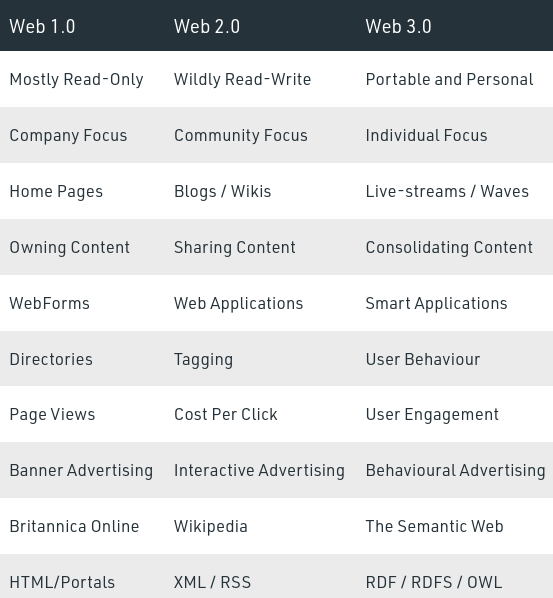
Definitions of Webs (1,2,3) are not strict; for one person, a rigid definition of the web might merely intrude upon virtual boundaries between two stages. Some avoid categorizing the web by technological milestones altogether, simply distinguishing new and upcoming content from outdated or standardized content.
Key Points to Remember:
Web1 - Users are consumers, content created by professionals
Web2 - User-generated content, existing centralized web
Web3 - Still an evolving concept, but fundamentally about decentralized distributed content and technologies, impacting the web in the following ways:
1) Independent with no single point of failure
2) Sustainable despite various risks of data loss
3) Censorship-resistant (this is the goal)
4) Enabling encrypted payments and decentralized finance
5) Leveraging the power of ZKP and public blockchains
Bienvenue dans la communauté officielle TechFlow
Groupe Telegram :https://t.me/TechFlowDaily
Compte Twitter officiel :https://x.com/TechFlowPost
Compte Twitter anglais :https://x.com/BlockFlow_News