








Yuan Lianxian | Wang Yuehua de Derun Innovation : Le métavers connaîtra un tournant décisif dans les trois prochaines années
TechFlow SélectionTechFlow Sélection
Yuan Lianxian | Wang Yuehua de Derun Innovation : Le métavers connaîtra un tournant décisif dans les trois prochaines années
Wang Yuehua, associé du fonds d'innovation Derun, possède 18 ans d'expérience dans l'industrie des semi-conducteurs et a créé trois entreprises. Après avoir rejoint le fonds Draper Dragon, il s'est transformé d'ingénieur en investisseur.
 Dédié à des analyses Web3 approfondies
Interview|Fang Qinyu
Draper Dragon Innovation Fund (originally from DFJ Dragon Fund) is a global venture capital fund that has been investing in the metaverse sector since last year.
Wang Yuehua, partner at Draper Dragon Innovation Fund, brings 18 years of experience in the semiconductor industry and has founded three startups. After joining DFJ Dragon Fund, he transitioned from an engineer to an investor. He previously backed companies such as YeePay, Shenditech, and Kronos Research. Recently, his metaverse investments include Ink Financial, Metaverse.AI, and Dmail.
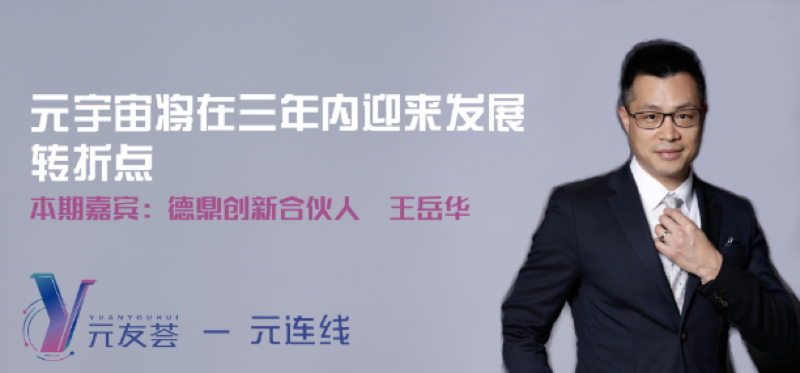
In an exclusive interview with Yuanyouhui’s "Meta Connection", Wang predicted that the metaverse will reach a development turning point within three years, transitioning from early stages to maturity. The key indicators for this shift are lightweight hardware, low cost, low power consumption, and mobility.
“For early-stage investors, the hardest part about investing in the future is daring to imagine the unimaginable and accepting what seems unacceptable,” said Wang. “The first level is comparing new things to existing ones—this allows us to envision their future. The second level involves entirely novel concepts with no precedents, which requires breaking mental boundaries.” He added, “Major U.S. tech companies like Meta, Twitter, and Google have clear three-year plans for the metaverse, offering useful reference points for most people.”
This year, Draper Dragon aims to invest another $50 million in metaverse ventures.
The Metaverse Will Reach a Development Turning Point Within Three Years
Meta Connection: When do you expect the metaverse to mature? What would be the signs of maturity?
Wang Yuehua: I see two aspects. On the hardware side, devices must become sufficiently lightweight, low-cost, energy-efficient, and mobile. On the software side, whether it's virtual e-commerce, gaming, or socializing, there must be enough users engaging actively. If we need quantifiable metrics, we can refer to internet standards such as daily active users, monthly active users, and registered accounts. Judging from Meta's strategy, I estimate that within three years, Meta’s metaverse hardware will reach consumer-grade levels, marking a pivotal moment for the entire sector.
Meta Connection: What are your investment plans for the metaverse this year? What are your targets, and how do they differ from previous years?
Wang Yuehua: This year, we're placing greater emphasis on Web3.0—it’s foundational. This includes edge computing, artificial intelligence, and decentralized data networks.
We still have $50 million to deploy this year, aiming to invest in around 20 additional projects.
Meta Connection: You mentioned that early investors need to take unconventional paths when investing in the future. How does one do that specifically in metaverse investing?
Wang Yuehua: As early-stage investors, we must dare to imagine the unimaginable and accept the seemingly unacceptable. It sounds simple, but execution is difficult. We often encounter bizarre, unprecedented projects—ones without any benchmark or reference.
There are two levels. The first is being able to say a new thing resembles something familiar—that at least gives us a frame of reference.
The second level arises when there's nothing comparable—no way to visualize it. That’s when one must break out of conventional thinking to embrace entirely new concepts. This is precisely the hardest part. These kinds of innovations are like sending the first person to Mars or building the first electric car. Being first doesn’t guarantee success, but if successful, the rewards are enormous.
Think about what today’s Generation Z is thinking—what do they want? From my perspective, I try to imagine the lifestyle of Gen Z in the future. Such imagination helps expand our openness when investing in tomorrow.
A good reference point is observing how major U.S. tech giants are positioning themselves in the metaverse—companies like Meta, Twitter, and Google. They hold numerous strategic meetings and workshops discussing future planning. These strategies typically cover the next three to five years and are relatively easier for people to understand and accept.
Meta Connection: Since the metaverse hasn't matured yet, and you emphasize value investing, how do you practice value investing in this space?
Wang Yuehua: In mature markets, financial investing is possible because financial data is visible. But why is early-stage investing also considered value investing? Because we’re investing in a sector, a direction—not concerned with whether a startup currently generates revenue, or even if its product is still in the MVP phase. We position ourselves as early adopters.
When something new emerges and few people are using it, I use it myself and ask: will many people use it later? If I don’t want to use it, others probably won’t either.
Once we back a project, we stay involved long-term. Because these ventures are so early-stage, longevity is key to success. We aim to be stakeholders, not just shareholders. We hope everyone benefits from the ecosystem we help build.
Focus on Hardware and Decentralized Storage
Meta Connection: You’ve summarized four directions in metaverse investing. Could you discuss your current focus areas and the rationale behind them?
Wang Yuehua: We’re active across all four pillars: technological infrastructure, content and applications, operational services and protocol tools, and new business models. Our primary focus is infrastructure, particularly hardware—including human-computer interaction built upon hardware—and decentralized storage. Although the industry already has various decentralized storage solutions like IPFS, I believe they remain incomplete. I expect new storage models to emerge both domestically and globally—not only regarding how data is stored, but also how it's retrieved and where it goes afterward. Computing power is another key area—we emphasize edge computing, as decentralization increases demand at the edge. Digital identity is also critical, since assets are always tied to digital identities.
Meta Connection: You just mentioned investing in storage-related projects. Specifically, what shortcomings do existing projects in this category exhibit?
Wang Yuehua: Currently, IPFS is widely recognized as the leader in decentralized storage, but in reality, it provides only a superficial and basic solution. Many supporting mechanisms remain underdeveloped and immature. For instance, issues around where to store data, what to store, and how to retrieve it aren’t adequately addressed by IPFS.
More broadly, the infrastructure needed for the metaverse should resemble an entire operating system. Every hardware device or wearable interactive tool requires an OS—like iOS or Android. To enter the metaverse, you’ll inevitably rely on hardware, whose core is the operating system. Its three essential components are human-computer interaction (Input/Output), storage (file system), and computing power (processing). Any metaverse must be built upon such a foundation.
Meta Connection: Could you share specific projects you've invested in, based on your portfolio?
Wang Yuehua: In content and applications, we invested in Highstreet—a virtual e-commerce platform. Virtual e-commerce isn’t just online shopping; it includes NFT minting and digital asset trading. First, you need the concept of virtual land—not real estate in the physical world, but an entry point. With that access, you can build malls, schools, and spaces for socializing and gaming.
We also backed Metaverse.AI, which develops hyper-realistic virtual idol engines. Using motion capture, users can animate avatars and present themselves in anime-style forms.
Dmail is our investment in decentralized email. Most current digital identities are centralized, creating security risks. In metaverse scenarios, decentralization will become fundamental. Why classify this under cross-platform protocols? Because it represents digital identity. A user may have multiple decentralized private identities, each linked to different assets. Through cross-protocol platforms, these identities and assets can interoperate. I believe such cross-platform, cross-protocol projects will be crucial.
Virtual Land in the Metaverse Won’t Be Free in the Future
Meta Connection: Some argue that while virtual land requires payment now, it might become free in the future. How should we think about monetization?
Wang Yuehua: Virtual land currently requires payment, and many projects are still centralized—with developers controlling development and pricing. I don’t believe it will become free—or rather, even if not directly charged, users will need to exchange something of equivalent value to gain usage rights.
There are many virtual land projects today, and we’ve invested in several. We believe the value of virtual land depends on ecosystem growth—the broader the ecosystem consensus, the higher the value. Growing consensus means more users joining.
Meta Connection: Can we interpret the business model of virtual land as simply selling plots for profit?
Wang Yuehua: For project initiators, monetization isn’t an issue—the revenue model includes construction fees and transaction commissions every time land changes hands. Founders should consider how to create long-tail benefits and increasing returns over time. For users, owning a piece of virtual land allows them to rent it out. Why is property in Shanghai more expensive than in Xi’an? Because Shanghai’s businesses support higher land values. Similarly, user demand drives value here too.
Metaverse Projects with Blockchain Offer Greater Commercial Potential
Meta Connection: I hear terms like cross-platform and cross-protocol mostly in blockchain contexts. Are you specifically referring to opportunities in blockchain?
Wang Yuehua: For example, Disney’s game engine for cartoon characters can only be used by Disney, not other companies. A universal engine means all data developed on it can seamlessly move to another platform without changing formats.
Meta Connection: What role does blockchain play in your metaverse investment thesis?
Wang Yuehua: The metaverse itself is an application- and scenario-oriented internet, while blockchain serves as the protocol layer and technical foundation. The integration lies in how blockchain enables new applications within the metaverse. Clearly, leveraging blockchain technology opens up far richer business models and ecosystems. I believe adoption of blockchain will become increasingly widespread across industries, and in the metaverse, it will be inevitable. Most startups in this space already incorporate blockchain modules to some degree.
Meta Connection: What pressures and challenges do you face in the metaverse investment market?
Wang Yuehua: As a global firm, we have abundant deal flow. Our main challenge is the sheer volume of projects—we need more efficient ways to filter and evaluate them.
Meta Connection: You mentioned companies you’re watching in the metaverse space. Which investment firms in this field are you paying attention to?
Wang Yuehua: Firms like A16z and Paradigm. We follow the projects they back and sometimes collaborate with them.
Meta Connection: Whether in China’s A-shares or U.S. stock markets, how do you view the current state of public-listed metaverse stocks?
Wang Yuehua: I’m actually not very optimistic about the domestic situation. Most listed companies in China remain at the conceptual stage. In contrast, some U.S. listed firms are genuinely building tangible products.
About "Meta Connection"
"Meta Connection" is a featured interview series by the metaverse-focused media outlet "Yuanyouhui", spotlighting entrepreneurs and investors in the metaverse space. Hosted by veteran financial journalist Fang Qinyu. For interview inquiries, please contact [email protected].
Bienvenue dans la communauté officielle TechFlow
Groupe Telegram :https://t.me/TechFlowDaily
Compte Twitter officiel :https://x.com/TechFlowPost
Compte Twitter anglais :https://x.com/BlockFlow_News






