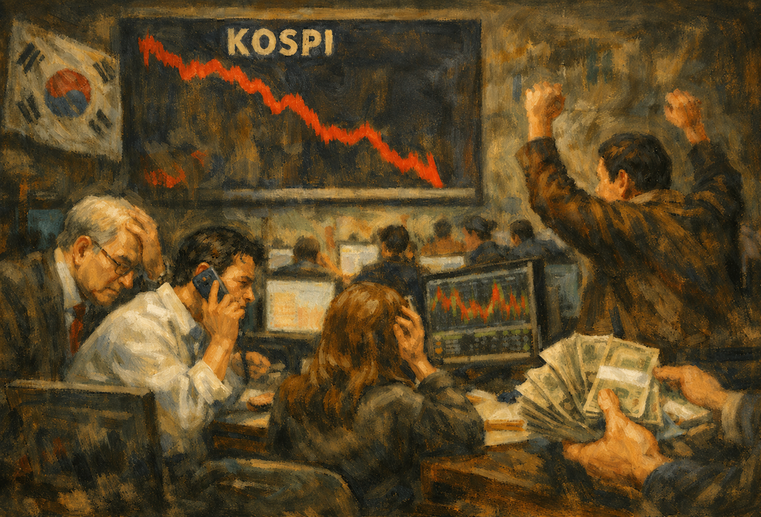
47 jours, de 44 millions de dollars de bénéfices à la ruine totale, le destin du frère Maji scellé par le « théorème de la ruine du joueur »
TechFlow SélectionTechFlow Sélection
47 jours, de 44 millions de dollars de bénéfices à la ruine totale, le destin du frère Maji scellé par le « théorème de la ruine du joueur »
Le grand frère Ma Ji a dit : « Tant que tu es heureux, c'est bien », c'est l'insouciance d'un joueur riche, les gens ordinaires ne devraient pas l'imiter.
 Dédié à des analyses Web3 approfondies
Ma Ji, an artist and tech entrepreneur from the past, is now a major whale in the crypto world. He experienced a staggering rollercoaster of wealth on the Hyperliquid exchange.
Using aggressive leverage strategies, he once pushed his account value close to 60 million USD (with unrealized gains exceeding 44 million).
However, driven by the "gambler's fallacy" and the "disposition effect," he ignored market reversals, frantically doubling down and holding on, attempting to defy mathematical laws.
In just 47 days, he plummeted from the peak to only 1,718 USD remaining—his entire principal wiped out, vividly and cruelly illustrating the final outcome of the "gambler's ruin theorem."
To understand this downfall, you must grasp three concepts: random walk, absorbing barrier, and negative drift.
① Random Walk
Imagine a drunk man walking along a straight line. He flips a coin: heads means one step forward (profit), tails means one step back (loss).
Ma Ji's experience is essentially like the steps of this drunk man. In the short term, he might flip several heads in a row, surging forward, with assets soaring to 60 million USD. But that doesn't mean he's exceptionally skilled—it's merely luck.
② Absorbing Barrier
The path the drunk man walks is asymmetric.
On the left is a high wall (the house/market): formed by the total capital of the market. For an individual, it is virtually infinitely far away. You can never win all the market's money or bankrupt the market.
On the right is a cliff (you): your point of zero principal. For Ma Ji, this point is finite.
As long as the game continues, there's always a chance the drunk man takes consecutive backward steps. Once he touches the cliff (assets reduced to zero), he falls off. Falling means being "absorbed"—the game ends, and you lose any chance to recover.
Because your opponent (the market) is infinite while you are finite, given enough time, you will fall off the cliff with 100% certainty.
This is the "gambler's ruin theorem."
③ Negative Drift
If it were purely a coin toss (50% win rate), it might take a very long time for the drunk man to fall. But in casinos and crypto derivatives trading, fees and slippage act like a strong wind constantly blowing the drunk man toward the cliff. This is negative drift.
Under negative drift, the mathematical expectation becomes negative. In this round alone, Ma Ji paid hundreds of thousands of dollars in funding fees.
So why didn't he cash out when his unrealized profit reached 44.84 million USD on September 18? Why did he lose all his principal? The reasons are as follows:
a. Leverage. Leverage brings the distant "cliff" right before your eyes—only a 4% adverse move (at 25x leverage) is needed to trigger a fall.
b. Martingale strategy. Using limited "ammunition," continuously increasing bets (doubling down) to fight against an infinitely deep market decline inevitably leads to a broken capital chain, crashing into the absorbing barrier.
c. Mental accounting. Why didn't he lock in profits during big gains? Because in a gambler's mind, that 44 million is "the casino's money," and losing it feels acceptable.
Ma Ji said, "It's fine as long as I had fun," reflecting the nonchalance of a wealthy gambler—ordinary people should not imitate this.
Here are three life algorithms:
One: Participate in "Positive Expectation"
Futures contracts and gambling are negative expectation games—avoid them unless you're paying for excitement.
Dollar-cost average into legitimate indices, hold high-quality assets with EV > 0, and be time's ally.
Duan Yongping said ordinary people can profit by dollar-cost averaging into the S&P 500 because such markets exhibit "positive drift."
Two: Stay Away from the "Absorbing Barrier"
Survival is paramount. Avoid leverage; don't let volatility push you off the cliff.
Three: Set a "Stop Line"
Speculators: realize profits when winning, cut losses when losing. Otherwise, according to the gambler's ruin theorem, the end result is zero.
Value investors should use idle funds they can afford to lose, patiently waiting for positive drift.
Bienvenue dans la communauté officielle TechFlow
Groupe Telegram :https://t.me/TechFlowDaily
Compte Twitter officiel :https://x.com/TechFlowPost
Compte Twitter anglais :https://x.com/BlockFlow_News