








Why can't tech giants build successful Web3 products?
TechFlow Selected TechFlow Selected
Why can't tech giants build successful Web3 products?
The underlying logic of blockchain is first and foremost inclusivity—a fairness based on code where the general public are the main protagonists.
 Navigating Web3 tides with focused insights
Author: GW XIE
In July 2021, Paradigm and the Uniswap team published a mathematical paper on DEX called TWAMM, which eliminates time variable T mathematically to allow algorithms to automatically execute orders over a period T. At the time of its release, the industry was excited, viewing it as a new trading paradigm. The AnchorDAO research team also discussed optimization and implementation issues of TWAMM with Dan and Dave from Paradigm, publishing a mathematical review [1]. Later, researchers at Paradigm released an implementation version of TWAMM [2], but even this algorithm built by Paradigm was never brought to market. This raised a key question: for a new DEX product, is innovative algorithm or product strength really what matters? In fact, TWAMM has high barriers to understanding and usage for market makers, users, and project teams alike—far removed from ordinary users and contrary to UNI’s original vision of “everyone can be a market maker.”
Web3 was born of the people and should serve the people. As DeFi matures, however, its accessibility for the general public has grown increasingly difficult, distancing itself further from mainstream adoption. In 2021, the more mature DeFi ecosystem did not explode as expected. Instead, sectors closer to users—GameFi, NFTs, and memes—drove the latest bull run.
The foundational logic of blockchain lies first in inclusivity—a fairness based on code—with the public as the main actors. The web3 wave is essentially a grassroots, bottom-up movement; building web3 products must always start and end with the masses.
One essential nature of blockchain technology is the reshaping and optimization of production relationships—not product-driven innovation. Thus, the core of web3 has never been about technology, algorithms, or even product strength, but rather the transformation of production relations and ownership enabled by tokens—an urgent humanistic mission. Through token mechanisms, value and control are decentralized to users and “builders,” enabling participants to co-create a world that is “permissionless,” “free,” and where “private property is sacred and inviolable.” This is why major web2 companies struggle to build products like Uniswap, Axie, or OpenSea. Behind these protocols isn’t superior product design, but culturally rooted, community-driven development sustained through repeated challenges.
When we ask why web2 giants cannot create outstanding web3 products, I believe “belief” is the biggest reason. This “belief” is not abstract—it is a concrete sense of pride, participation, and excitement cultivated over time within web3 culture. It's tangible when we pay colleagues without bank accounts in crypto, knowing it may bring them new hope; it's real when distributing $5 airdrops to Southeast Asian GameFi users who stayed up all night completing tasks, knowing that $5 might support their livelihood; it's palpable when purchasing an artist’s NFT with crypto, knowing it could be their only income during pandemic times. It is precisely this mission-driven “belief” that enables holders to keep building, even after crypto prices drop 90%, then another 90%.
Web3 Product Strength Under New Infrastructure: Freedom, Serving the Masses
Compared to web2 infrastructure, web3 represents an entirely new foundational layer. If the former is electricity and internet connectivity, the latter’s foundation is data and capital liquidity under a new production relationship:
On the data level, blockchain data is open and shared. It moves beyond the limited API access of web2, allowing anyone, anywhere to connect to this data—data that is, in many ways, eternal. On the liquidity side, DEX-based infrastructure is highly mature, enabling any application to tap into shared liquidity pools for seamless transactions. As DEXs gain greater influence over asset pricing, more market-making capital is drawn into the DEX space, deepening the network bandwidth of liquidity.
Under this new infrastructure, small teams can now build projects (DeFi/NFT/Meme) and issue tokens, democratizing the power to create networks.
Take a web2 securities trading platform: it must contend with risks of hacking, regulation, user trust, liquidity, and complex technical systems including matching engines, operations, and servers. These high barriers limit such platforms to only large corporations. But to build an aggregated DEX, none of these costs apply—you only need to focus on serving users and continuously improving user experience across different scenarios.
Thus, web3’s new infrastructure invites a fundamentally new way of thinking about product design—one centered on reimagining production relationships. When we say tokenomics matter, we mean a restructuring of incentives: tokens create self-sustaining, self-promoting networks where engaged holders naturally spread the word. When we speak of “consensus is king” in web3, it replaces web2’s “traffic is king”—but instead of traffic driven by product features, web3 values organic, consensus-driven growth.
DeFi Needs a New Narrative: Building Scenario-Based Finance
DeFi is an indispensable part of web3, yet it has long lacked protocols or platforms serving mass audiences. With underlying data and liquidity infrastructure maturing rapidly, what comes next? How can DeFi serve trillions in assets and become widely adopted and used daily by hundreds of millions of crypto users?
If we look at how WeChat and Taobao expanded financial inclusion through mobile payments, the next trend for DeFi should be scenario-based financial services. The key goal moving forward should be making DeFi easily accessible so users can seamlessly use it within everyday contexts.
In the next generation of DeFi products, the slogan and mission should be as simple and clear as possible, just like MetaDEX’s mission: DeFi at your fingertip, the next generation of Web3.
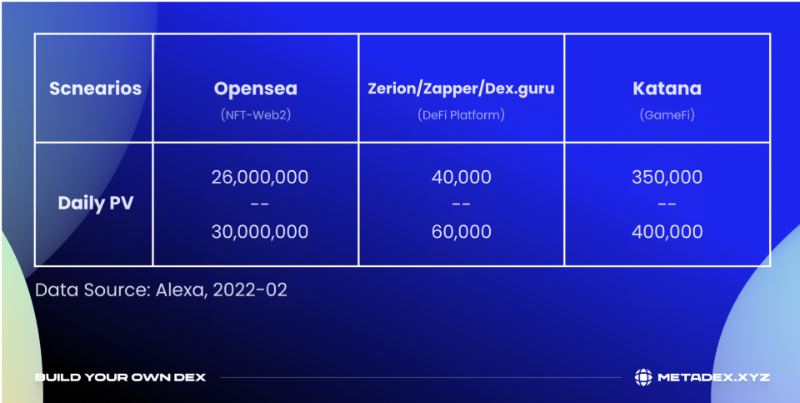
Aggregation platforms are currently the main direction in DeFi, such as Zapper and Zerion, or information aggregators like dex.guru. Yet their average daily page views are only 40,000–60,000, with conversion rates to actual trades at just 0.087%, 0.076%, and 0.042% respectively [3]. By contrast, OpenSea sees nearly 30 million daily page views, with around 50% of visitors accessing MetaMask.io for the first time. Data suggests roughly half of OpenSea’s users come from web2.
The scale difference between these two types of platforms is staggering. What causes this gap? If current DeFi innovation merely involves competing in a zero-sum game against Zapper, Zerion, or DexGuru—or serving the same narrow user base—what meaningful impact does it have?
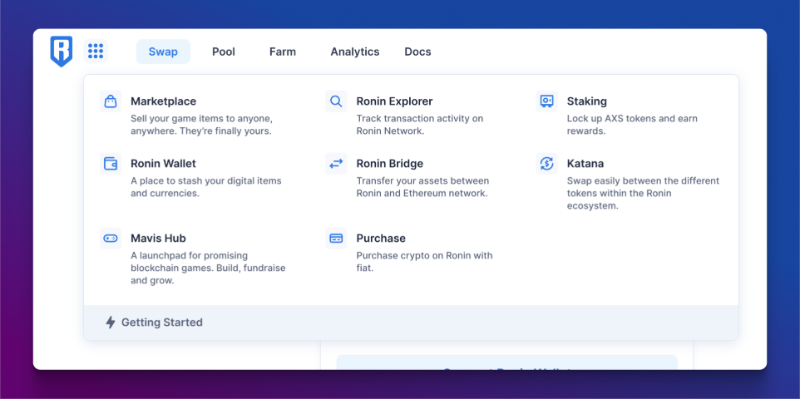
A similar example is Katana, the sidechain for Axie, whose trading volume once surpassed Binance’s peak.
It is clear that:
-
· The DeFi audience served by Zapper, Zerion, and Dex.Guru is insular, small-scale, and suffers from low conversion.
-
· OpenSea’s massive traffic pool can expand the user base for DeFi products by several orders of magnitude.
-
· The Katana protocol shows that DeFi products should be embedded within use cases rather than exist as standalone platforms.
OpenSea functions like the “Taobao of web3,” introducing countless web2 users to wallets for the first time. Compared to today’s unfocused social applications, gaming presents the clearest next frontier. On one hand, game economies can thrive in the web3 environment, becoming “eternal” and “inviolable.” On the other, gamers represent a far larger and deeper user base than NFT collectors, generating significantly greater value. Unlike NFTs’ collectible appeal, games offer users a lifestyle—and for many, a source of purpose and meaning.
MetaDEX: Making DeFi Accessible
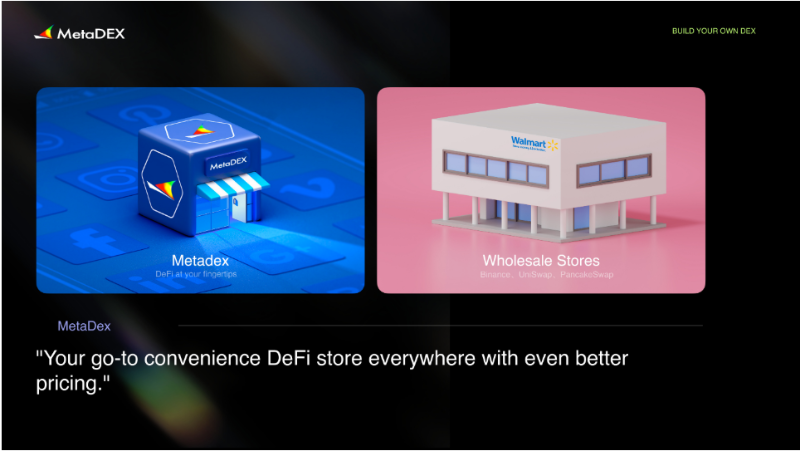
Precisely for this reason, MetaDEX’s algorithm team seeks inspiration for DeFi product design from the production relationships embodied by convenience stores and Walmart. Platforms like Binance, Uniswap, and PancakeSwap have already established robust infrastructure—akin to giant supermarkets. Opportunities to build another “Walmart” are dwindling and increasingly competitive. To reach broader audiences, products should bring DeFi directly into user scenarios, enabling easy access to DeFi functionality wherever users are—achieving financial inclusion in web3 through the model of a 7-Eleven convenience store.
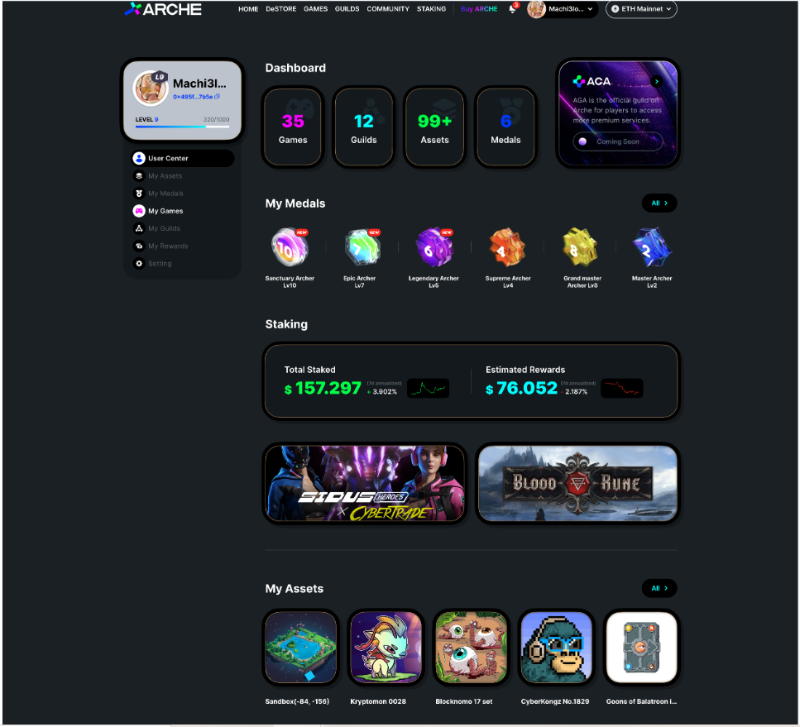
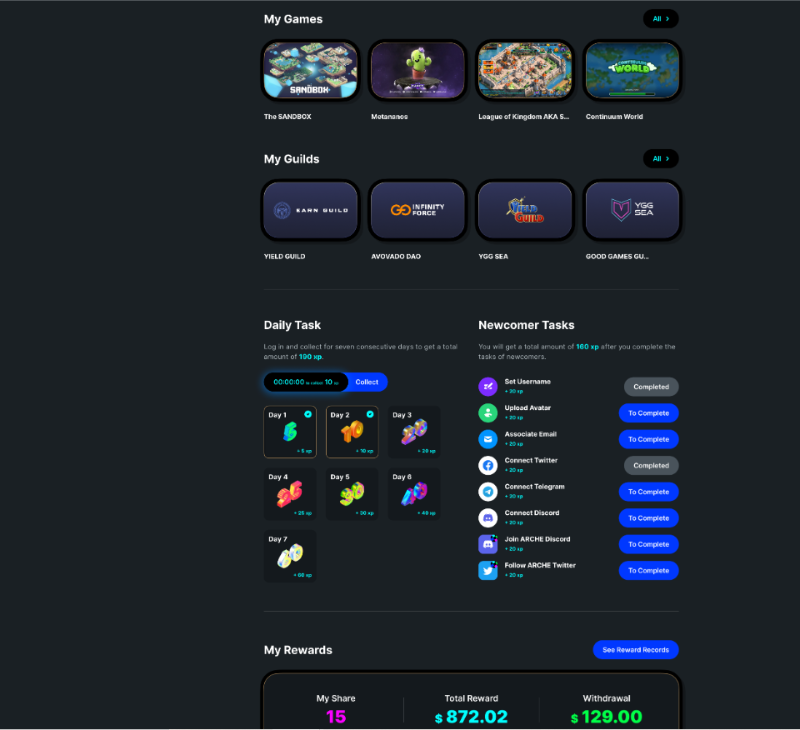
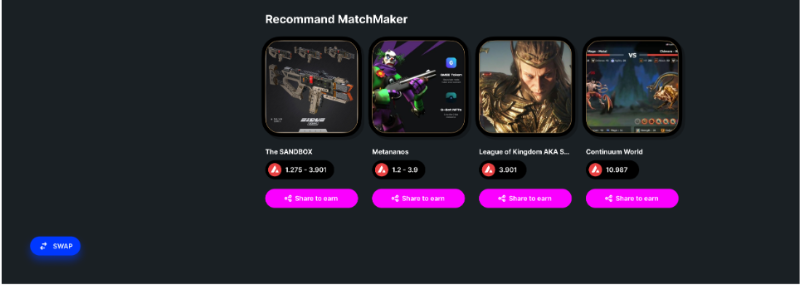
Swap service provided by Arche Network on player pages (powered by MetaDEX)
Current notions of “DeFi as a service” mostly revolve around offering DeFi tools within one’s own platform—still trapped in the logic of platform competition. More importantly, DeFi should evolve into a SaaS system serving diverse web2 scenarios—just as digitalization empowered traditional businesses in the web2 era, financialization in the web3 era must empower real-world use cases.
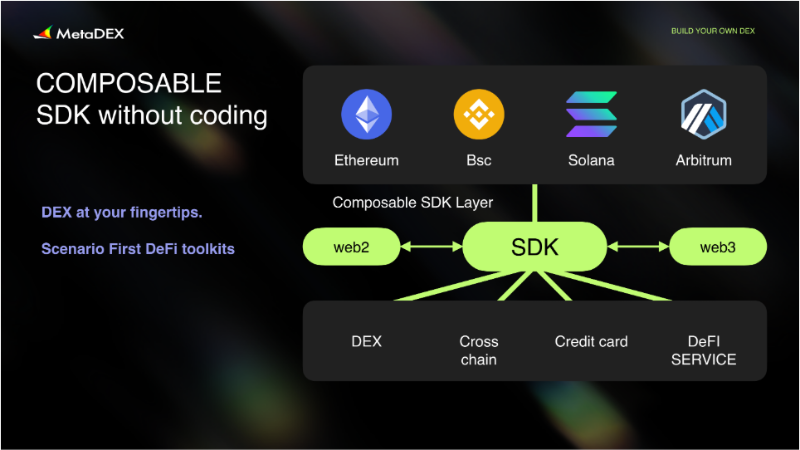
Making DeFi “accessible at your fingertips” means two things:
First, user-facing scenario finance: bringing DeFi infrastructure directly into various application contexts and aligning DeFi functions with those scenarios—rather than building yet another standalone DeFi platform. For instance, integrating credit card-like components in web2 apps; adding cross-chain capabilities within web3 trading interfaces.
In gaming, MetaDEX has launched a micro-transaction algorithm framework [4], designed specifically for small in-game transactions, enabling players to complete trades with one click during gameplay. It also employs innovative AMM designs to improve capital efficiency for market makers.
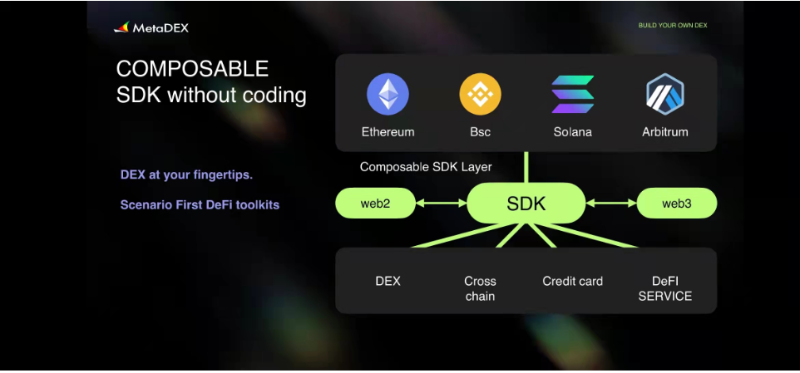
Second, SDK integration for platforms: web3 is an open era, and just as public chains rely on databases like web3js, advancing scenario finance requires continuous development of reusable SDK components. This allows third-party platforms to easily and freely integrate SDKs, enabling one-click access to DeFi features without needing to understand web3’s underlying complexities—ultimately delivering better service to end users.
Join TechFlow official community to stay tuned
Telegram:https://t.me/TechFlowDaily
X (Twitter):https://x.com/TechFlowPost
X (Twitter) EN:https://x.com/BlockFlow_News






