Understanding Merlin Chain: One-Click Sidechain + Open-Source Engine, Building Interoperability for the Metaverse and NFTs from the Ground Up
TechFlow Selected TechFlow Selected
Understanding Merlin Chain: One-Click Sidechain + Open-Source Engine, Building Interoperability for the Metaverse and NFTs from the Ground Up
The Merlin solution mainly consists of three points: one-click issuance of sub-chains, NFT interoperability, and an open-source decentralized game engine.
 Navigating Web3 tides with focused insights
Compiled by Merlin Community Volunteers
Over the past year, millions of NFTs and tens of thousands of GameFi projects have emerged on-chain, making the metaverse the hottest topic. Public chains have offered their own solutions for high concurrency and multi-asset support—Polygon's Layer 2 and Solana both claim to achieve over 65,000 TPS, while Near and ETH 2.0 are just steps away from finalizing sharding scalability.
Today’s metaverse is still in its infancy, with many unresolved issues. Congestion remains a problem: Polygon has recently seen an influx of NFT and GameFi users, causing multiple chain congestions, while Solana frequently experiences outages. Additionally, not all GameFi data is fully on-chain; although NFTs reside on-chain, user data still sits on centralized servers, leading to occasional incidents of "custodian theft." Furthermore, Web3 "interoperability" remains unfulfilled—NFTs from different projects cannot currently interact. For example, true interoperability would allow using a character model from Game A to drive a car from Game C within Game B.
During this nascent phase of the metaverse, the Merlin team has unveiled their latest solution:

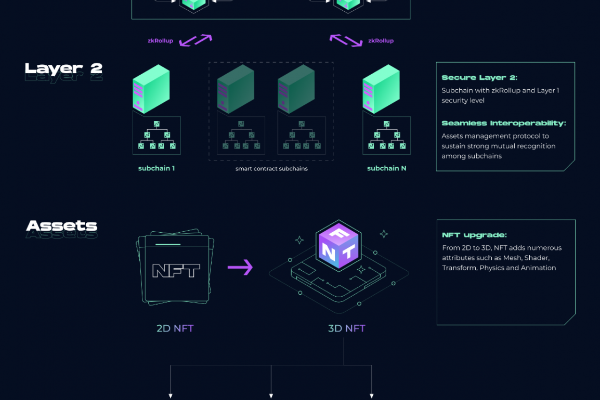
From these materials, Merlin's solution centers around three key components: one-click subchain deployment, NFT interoperability, and an open-source decentralized game engine.
1. One-Click Subchains
If we aim to bring every metaverse application on-chain, the high-frequency data and massive throughput generated by multiplayer interactions cannot be easily supported by a single Layer 1 or Layer 2 technology. Even sharding faces limitations due to cross-shard transaction bottlenecks, preventing infinite scalability. Merlin adopts a layered architecture: Layer 1 handles value transfer, while Layer 2 supports ecosystem applications.
1.1 Scalable Layer 1 Sharding
Merlin’s Layer 1 carries the network’s overall value, providing security and interoperability services for all Layer 2 chains, offering top-tier security and strong scalability. The main chain uses a sharded architecture, where new shards can be added as capacity limits are reached, doubling system capacity.
Merlin employs state sharding, meaning each shard stores only its internal ledger, maximizing scalability. The backbone chain connecting all shards manages shard coordination and routes cross-shard transactions—it is the core of Merlin’s architecture and uses the most secure consensus protocol, requiring every node to verify and broadcast all cross-shard transactions. Moreover, considering that increased shard count could overload the backbone with cross-shard traffic, the backbone itself also features robust scalability. In extreme cases, Merlin’s backbone nodes can horizontally scale hardware resources—additional computing power can be deployed when transaction volume triggers warning thresholds.
1.2 Secure and High-Performance Layer 2 Rollups
Layer 2 hosts the entire application ecosystem and handles the vast majority of network transaction throughput. Merlin’s Layer 2 chains can achieve tens of thousands of transactions per second, meeting any single application’s demands, and can further scale via smart contract-triggered subchains. Merlin’s Layer 2 utilizes zkRollup, leveraging zero-knowledge proofs to ensure Layer 2 security comparable to the main chain. Layer 2 submits transaction validity data to Layer 1, eliminating the need for fraud-proof challenge periods and enabling final transaction confirmation within minutes.
1.3 Smart Contract-Based Chain Deployment
A single Layer 2 chain cannot solve the metaverse’s throughput challenges—that’s why existing Layer 2 networks face congestion.
Current chain-deployment tools have high entry barriers, discouraging small teams and individual developers. Moreover, Layer 2 solutions often lack standardized consensus mechanisms, compromising security. Without unified standards, assets across Layer 2 chains cannot effectively interoperate.
Unlike the current Ethereum ecosystem, where projects issue tokens, Merlin encourages every DApp project to launch its own chain—via Merlin’s smart contracts, users simply send chain parameters through a transaction to a designated smart contract, instantly generating a fully functional Layer 2 chain with physical independence, complete with its own nodes and network. Thus, each DApp subchain can handle high-concurrency metaverse operations without affecting other Layer 2 chains or the main chain.
Furthermore, every Layer 2 chain created via smart contract adheres to identical consensus standards, ensuring functional parity and strong asset interoperability with other Layer 2 chains. And because all subchains use Merlin-specified zkRollup, they inherit security levels comparable to the main chain.
1.4 Layer 2 Deployment and Maintenance
When DApp developers deploy their own Layer 2 chains, they can freely configure nodes based on their needs. For node selection, Merlin offers at least four solutions: developers may opt for physical server nodes to ensure initial throughput and data control; if seeking broader consensus, they can leverage Merlin’s MicroService by calling Kubernetes APIs on the main chain; once a DApp gains wider community consensus, developers can choose a more decentralized global node network similar to other public chains, or utilize Merlin’s globally distributed computing power pool for node services.
1.5 Layer 2 Independence and Exit
Once a DApp’s Layer 2 network achieves stable consensus and develops its own unique ecosystem, its community can detach the Layer 2 network from Merlin Layer 1 governance, forming an independent main chain. When the community confirms that their Layer 2 infrastructure and nodes are robust enough to function autonomously, Layer 2 nodes can submit a transaction to Merlin’s smart contract to exit the Merlin network.
Post-exit, the DApp maintains compatibility with Merlin’s standards and retains “symbiotic” characteristics, preserving asset interoperability and extending Merlin’s NFT & metaverse specifications to a broader ecosystem.
2. Upgraded NFT Protocols and Interoperability
The NFT ecosystem built on ERC721 is thriving, with millions of creators and developers producing new NFTs daily. However, non-fungible tokens should not be limited to JPG images—their extensibility and application scope are currently too narrow. Instead, they should evolve into broader Virtual Assets with scalability and interoperability, ultimately being widely used across numerous metaverse and GameFi scenarios.
2.1 NFT Enhancement and Interconnection
Metaverse NFTs today are fragmented. First, legacy 2D NFTs cannot be integrated into immersive metaverses (unless you’re content with displaying a profile picture in your virtual living room), limiting new GameFi projects’ ability to attract large NFT communities. Second, NFTs cannot move between projects—you can’t take your assets from Game A into Game B. Third, asset ownership is compromised—how your on-chain hash appears and functions in-game is entirely controlled by project teams, resulting in centralized, unregulated control.
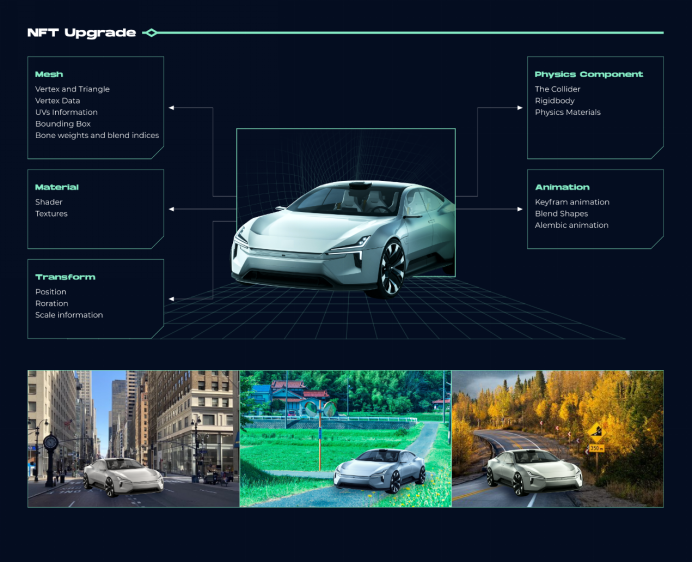
Merlin upgrades NFT parameters by introducing new dimensions atop ERC721, including Mesh, Shader, Transform, Physics, and Animation. These compressed parameters are stored on-chain, while raw assets reside in decentralized storage and are called by DApp developers.
This ensures that regardless of origin, any NFT can be used across different projects, while guaranteeing the utility and attributes of each NFT remain immutable and cannot be arbitrarily altered by project teams.
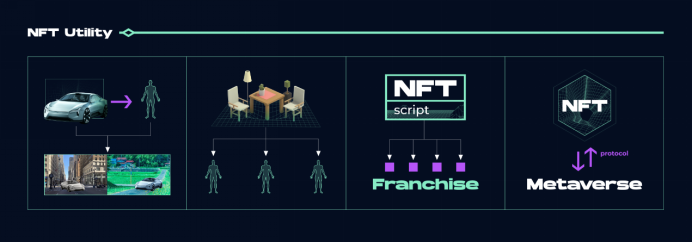
2.2 Expanding NFT Utility
Currently, NFT utility is largely restricted to profile-picture JPGs, naturally confining them to Art & Collectibles. Due to limited usage scenarios and frequency, their primary function remains trading, lacking leasing, fractionalization, distribution, and other financial utilities.
With Merlin’s 3D NFTs interoperable across the metaverse, many NFTs gain practical value and foundational utility. For instance, owners of limited-edition virtual cars can lease them to others who can then drive rented vehicles around open worlds for socializing and showing off.
Likewise, professional designers and modelers can create better-looking wheels—stylish furniture, landscaping, base design assets—and sell them as NFTs either in fragments or via usage rights, reducing development costs for creative but art-limited indie developers. Beyond design assets, game mechanics themselves can be packaged as NFTs and monetized through “franchising.” A developer who designs an innovative “battle royale” mode or creates a more engaging blind-box machine can package and distribute these original gameplay concepts to “franchisees,” earning revenue from a broader user base via smart contracts.
Finally, and most importantly, interoperability will reshape the economic ecosystems of NFTs and the metaverse. An NFT creator might want buyers to immediately bring their asset into a popular metaverse, which in turn shares revenue with the creator (via Merlin’s smart contracts) for driving traffic and assets. Similarly, a GameFi developer launching a new game might invite users with existing NFT assets to enrich their world. If in-game activities lead to asset trades involving those users, the NFT project can share a portion of its revenue with the GameFi developer.
2.3 Creation On Chain
Merlin aims to record the entire metaverse creation process on-chain, fostering deeper interaction between users and developers.
Current metaverse and GameFi projects are developed in black boxes—users have no visibility into whether developers will fulfill promises, and many projects halt development after selling tokens and NFTs. Merlin encourages developers to use the Spike engine and publish progress directly on-chain, allowing users to experience “unfinished” games at any time. Is this merely oversight? Not quite. Developers within the Merlin ecosystem benefit from long-term returns driven by openness and interaction—this embodies the true spirit of blockchain.
First, truly talented teams achieve earlier breakthroughs. When your project is only 10% complete, community players can already test and play it, enabling NFT presales. Imagine preselling brand-new sports cars in an unfinished racetrack—infinitely more exciting than selling static images on Twitter or Discord. Users can test-drive before purchasing, creating exceptional experiences for both developers and users.
Second, user feedback guides development, helping developers avoid costly detours. Indie game developers often have loyal fanbases who deeply engage with demos during development—sometimes even mastering gameplay better than designers. Their suggestions are fed directly back to developers, steering projects toward better outcomes.
Additionally, on-chain metaverses enable earlier user governance. After token presale, users can form their own DAOs before game launch. Having deeply participated in development, these active players largely determine the direction of the open world once live. A decentralized, autonomous utopia thus becomes reality—doesn’t it?
2.4 Compatibility and Upgrading of Legacy NFTs
The NFT market has only taken its first step historically, yet this “small” step birthed successes like BAYC and CryptoPunk. Will these projects enter the metaverse? Of course!
Merlin is natively compatible with the EVM ecosystem and ERC721, allowing these projects to freely upgrade their NFTs at their chosen time—requiring only Merlin’s smart contracts and Spike’s asset plugins. This “enhancement” is seamless and invisible to asset holders: they wake up to find their original Ape still in their wallet, now transformed into a vibrant avatar capable of roaming freely across any metaverse!
3. Spike – Fully Open-Source Standalone Engine
Merlin’s Spike Engine is the first game rendering engine in the blockchain space, built on an open-source framework. All developers can read, use, optimize, and modify its underlying code to build new applications and innovations.
3.1 Unified Runtime Environment
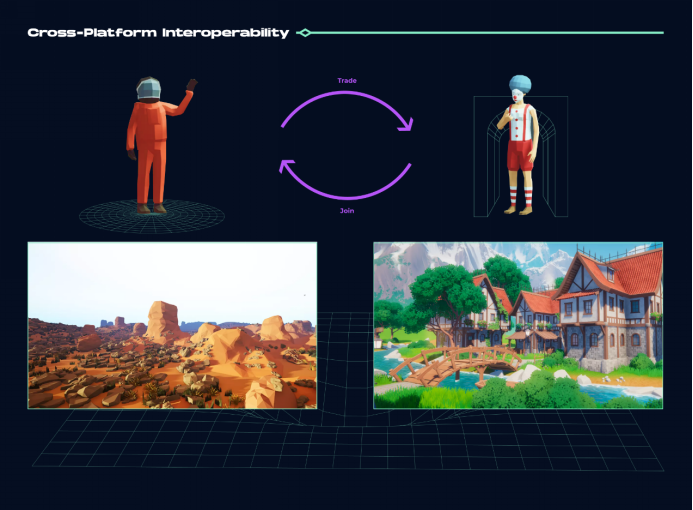
Spike standardizes compilation, rendering, and runtime states across the metaverse, enabling seamless interoperability between different metaverse worlds under the premise of asset compatibility.
Due to traditional engines’ closed nature, two GameFi apps cannot currently share state—games built with Unity or UE4 have locked interfaces and compiled states.
Spike aims to tear down this wall—standardizing engine foundations such as asset definition, rendering pipelines, runtime states, and real-time loading, creating wormholes that connect virtual worlds. Users can see avatars and assets from other worlds within their own and initiate direct cross-world transactions. A friend can invite you to their poker table with one click—no app restart or client reload needed. Different games can even be freely combined within a cyberpunk city; walking into different rooms lets you experience distinct game content, forming a seamless, boundless universe.
3.2 Lower Barriers to Creation
There are over 30 million game developers worldwide, mostly small teams or studios of 2–3 people. Their continuous creativity enriches our virtual worlds, yet only a tiny fraction currently participate in GameFi and metaverse development due to hurdles involving engines, smart contracts, tokenomics, and more.
Spike provides a full suite of open-source tools—and this engine is on-chain from Day 1. Compared to traditional engines like Unity, Spike is smaller, more focused, yet performs competitively—its architecture has already powered AAA titles. Spike integrates game engine workflows—including compilation, rendering, asset input—with on-chain smart contracts.
Moreover, Spike is more developer-friendly, offering intuitive UI, modeling tools, automated rendering, and support for simpler scripting languages like Lua (similar to Roblox Studio, which has attracted over ten million individual developers with an average age under 20).
Remixing and secondary creation become easier—developers no longer need to reinvent the wheel. They can purchase successful scripts and project files from other developers and build new ideas upon proven gameplay mechanics.
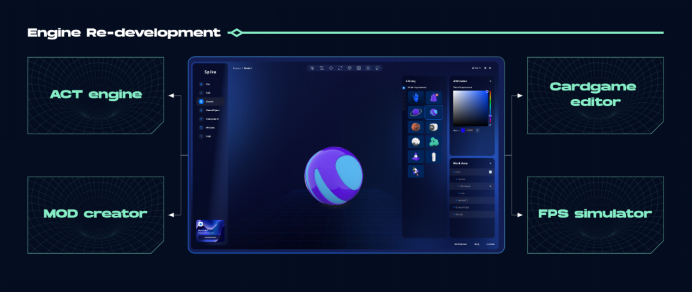
3.3 Diverse Developer Tools
All底层 code of Spike Engine is open-source, supporting extensive secondary development.
Developers can modify and streamline Spike’s core to create new engines serving specific ecosystems—an outcome encouraged by Spike’s open-source philosophy.
Alternatively, to better serve niche markets, developers can customize and package Spike into easier-to-use single-purpose editors—such as card mod builders or FPS simulators—making game creation simpler and more idea-focused rather than engineering-intensive.
3.4 Cross-Platform Community
Metaverse worlds created with Spike Engine feature interoperable asset types and engineering frameworks, opening vast possibilities for future ecosystems.
For example, content platforms can let early-stage games raise funds via tokens, enabling passionate fans to co-develop; mid-development games can offer real-time previews, asset presales, and governance voting; post-launch NFTs can be experienced, traded, or leased across various environments. Within a fully on-chain metaverse ecosystem, more open and decentralized gaming guilds emerge as DAOs, fueling liquidity and activity with traffic and capital.
Additionally, decentralized identities and relationship graphs can form, giving rise to new autonomous metaverse organizations. Based on DAO mechanisms, productivity activities such as remote work, meetings, and education can occur within virtual spaces.
Summary:
Based on available information, Merlin offers three comprehensive protocols:
-
Smart contract-based L1/L2 chain deployment ensuring security and performance,
-
A new NFT protocol enabling cross-metaverse usage and interaction,
-
Interoperability across on-chain metaverses, covering assets, creation, and user experience.
In summary:
-
Merlin’s standout feature is one-click chain deployment, granting DApps their own physically independent zkRollup subchain;
-
Spike’s strength lies in enabling foundational metaverse interoperability, allowing free circulation of users, assets, and environments.
Ultimately, both address the same core challenge: Metaverse Creation on Chain.
Merlin’s core architects are blockchain professionals with over seven years of experience, well-versed in cryptography and distributed systems, formerly founders of notable BlockDAG, DeFi, and other public chain projects. For technical collaboration or inquiries, contact info@merlinchain.io
Join TechFlow official community to stay tuned
Telegram:https://t.me/TechFlowDaily
X (Twitter):https://x.com/TechFlowPost
X (Twitter) EN:https://x.com/BlockFlow_News