Deep into TCG (Turtlecase Gang): Creating the First NFT Exclusively for Young People
TechFlow Selected TechFlow Selected
Deep into TCG (Turtlecase Gang): Creating the First NFT Exclusively for Young People
Introducing social elements into NFTs to create a "second face" for young people.
 Navigating Web3 tides with focused insights
By Professor Zhou
The NFT market faced a harsh winter over the past year. Since the LUNA incident in May, both the overall market cap and trading volume of NFTs have dropped significantly from their peaks. Many projects gradually lost momentum during the downturn, with some even fading into obscurity.
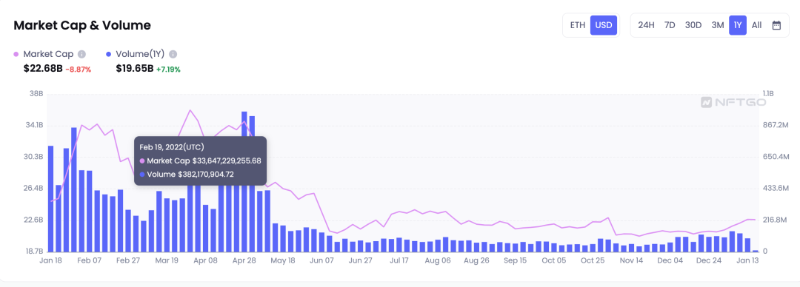
Data source: NFTGO & STILT
On the other hand, the crypto market appears full of promise as younger users pour in. Research from overseas indicates that Gen Z and Millennials account for nearly 94% of all cryptocurrency buyers—a youth-driven market has clearly taken shape.
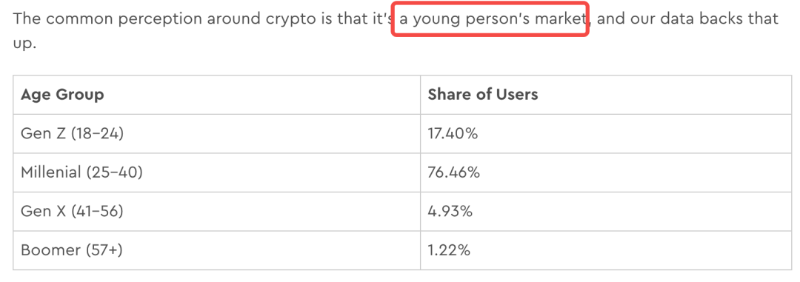
When a weakening market meets an increasingly youthful user base, perhaps we should ask: How can we win over young users and build distinctive, sustainable NFT projects that survive and thrive in the second half of the NFT era?
For young people entering Web3, NFTs—with their unique cultural attributes and more intuitive expression—may be easier to embrace. But this sense of belonging is often one-way in most projects. Holding an NFT usually means only showing off or signaling personal taste, whether because the avatar matches your style or purely as an investment. The PFP itself lacks mechanisms to enable two-way interaction.
As NFTs become social symbols and second identities in the virtual world for young people, enhancing social functionality becomes a new frontier. If NFT projects want to cultivate community culture, they must also create conditions for user interaction. Turtle Case Gang (hereinafter TCG) is precisely such a pioneer.
Beyond designing NFT visuals that better reflect the lifestyles of young people, TCG integrates plug-ins compatible with Web2 social media, helping NFT holders quickly form communities, discover like-minded peers, communicate, and earn rewards.
A Phone Case as Unique as You
As a profile picture (PFP) NFT, visual appeal and design often determine whether a project can develop a distinct culture and go viral. In Turtle Case Gang (TCG), creators portray a collective image of today’s youth: behind every uniquely styled phone case is a young person taking a selfie—but none show their face.
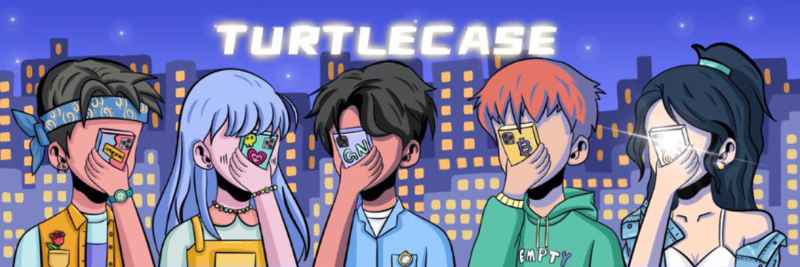
The brilliance lies in how accurately it reflects reality: young people are spending more time than ever in virtual worlds, where digital identity often outweighs real-world identity. In this context, NFTs can represent each young individual—and combinations of elements like phone cases, clothing, styles, and accessories in TCG allow users to express their individuality.
The spirit conveyed by TCG characters closely mirrors the lived experience of youth, forming a solid emotional foundation. This is validated by its fundamental performance: TCG consists of 3,777 NFTs, launched in July last year at 0.04 ETH. As of writing, the floor price has stabilized around 0.12 ETH—about a tenfold increase from its lowest point.
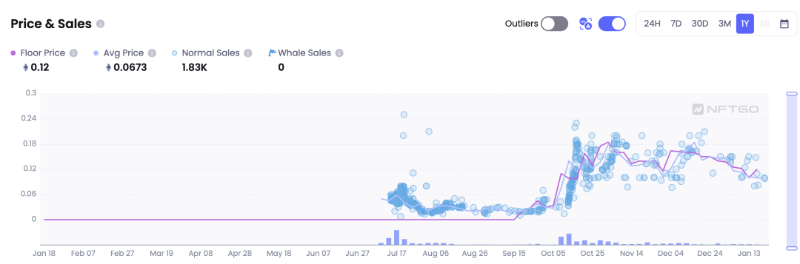
Data source: NFTGO
Frankly, launching in July last year—amid frequent negative events and unfavorable market conditions—was not ideal. Yet, TCG’s price performance remains relatively satisfying. Especially considering that many projects launched around the same time have since faded from public view, TCG stands out as particularly impressive.
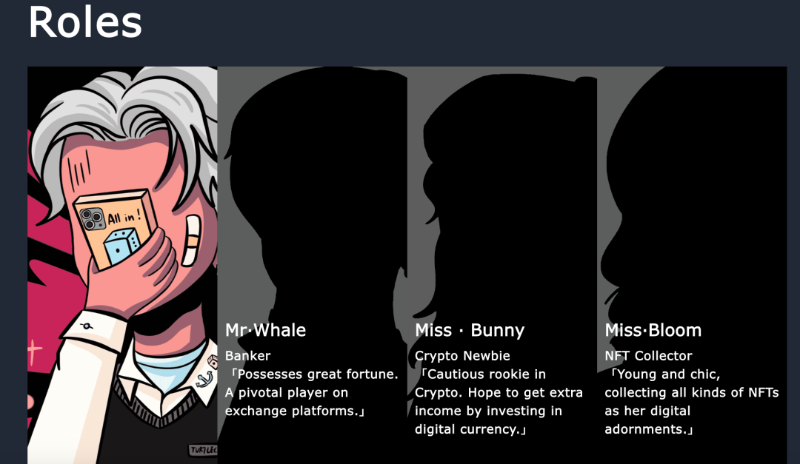
If we focus solely on the NFT content itself, what did TCG get right? The answer is still resonance and identification with young users. The image of someone holding a phone and taking a selfie may feel familiar—it draws from everyday, relatable, and widespread scenes in young people's lives, making it easier to gain their认同ment.
This sense of identification has already been proven within mature domestic Web2 products. In an interview by Huxiu with Soul, a popular Chinese social app for youth, founder Zhang Lu said: “New generations bring new needs, which call for new products—products that better align with today’s youth ideologies, preferences, and current societal trends.”
Soul’s operational data offers even clearer evidence: Average spending on virtual avatars in its personality mall exceeds 40 RMB, with one user purchasing up to 53 times; consumers aged 18–27 make up the largest group, exceeding 50%. While Web3 and Web2 differ in product form, the shared preferences among users of the same age group cannot be ignored.
Most NFT projects target younger audiences whose profiles resemble what the Soul team described:
First, they are more willing to pay for digital products and services that highlight individuality;
Second, they strongly dislike cookie-cutter identity labels and crave authentic, interest-based socializing, deeply identifying with niche subcultures formed around their hobbies.
Returning our attention to TCG, it’s clear that the personalized “phone-face”形象 helps young users identify and spend—but a static PFP alone struggles to meet deeper “social needs.” Therefore, TCG introduces additional social features and gameplay to expand beyond pure PFPs, exploring new possibilities in product design.
Connecting External Traffic Through Social Features
Beyond strong visual design, consensus around NFT culture is crucial for any project to grow from launch to popularity. Expanding cultural consensus requires continuous inflow of external traffic—growing the community attracts more holders and supporters, broadening the project’s influence across diverse groups.
This expansion of influence relies heavily on users actively discussing, sharing, and using the NFT during social interactions. Beyond standard activities organized by project teams, how can users organically engage socially around the NFT? TCG’s answer: Create social conditions and scenarios directly through product functionality.
The most prominent example is Let's Meme, a Twitter-integrated plugin. As a lightweight browser extension, Let's Meme extends NFT users’ social connections and community organization with minimal setup and usage barriers.
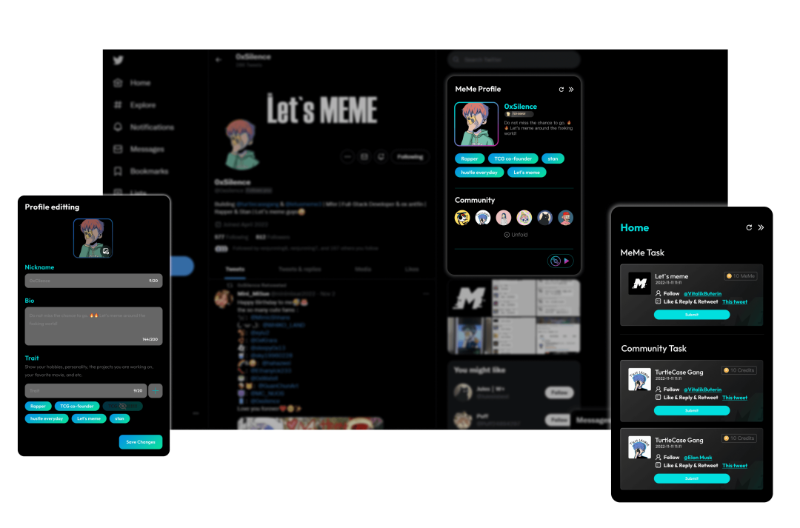
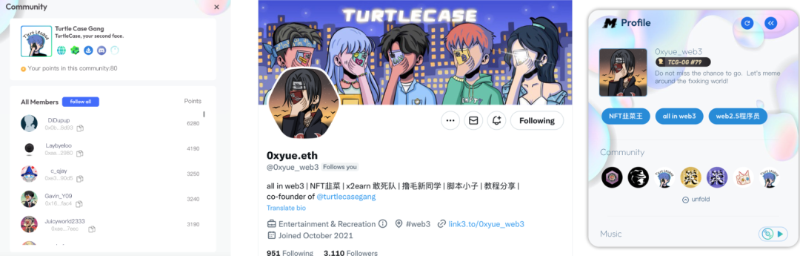
First, automatic formation of social relationships and communities. When users connect their wallet to the plugin, if they already hold a TCG NFT, the plugin automatically connects them to the TCG community. It also lists other members who own the same series, allowing users to follow all or select individuals with one click.
This means TCG maps social relationships among NFT holders. Typically, owners of the same NFT share similar tastes, but it's hard to find these holders just from viewing an NFT—making it difficult to create spaces for fan interaction.
Discord, Telegram groups, or OpenSea profile pages might serve this need, but information is scattered and not crypto-native. You can’t easily search what NFTs each member holds or their other interests. With the Let's Meme Twitter plugin, however, a clear chain of “NFT → Holder → Social Connection” is established. You can pinpoint the Twitter account behind any specific NFT number and reach out directly.
More importantly, you can explore further via their Twitter feed to discover valuable accounts and content. Thus, an NFT avatar becomes more than a static image—it links to dynamic social networks and real-time information when enhanced by the plugin.
Second, “Traffic-fi” mechanics based on community. By automatically grouping players who own the same NFT, the plugin aggregates community traffic—creating opportunities to amplify influence and attract new external users.
For instance, TCG admins can use Let's Meme to post Twitter-related marketing tasks—such as likes, follows, retweets, or mentions—with rewards in points, tokens, whitelist spots, or NFTs. Other community members can claim and complete these tasks, and incentives boost their willingness to promote the project.
Through this “traffic + incentive” model, NFT holders naturally become builders of the community. TCG fosters a collective action mindset—often seen when large numbers of members simultaneously voice support under the same topic.
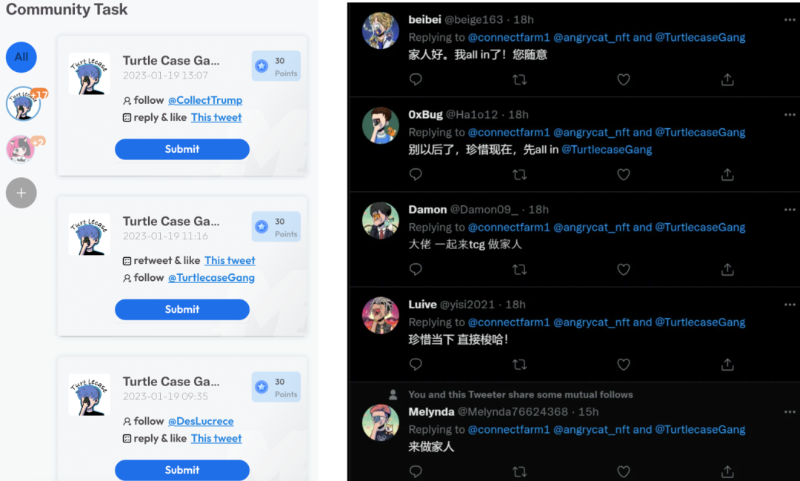
From an outsider’s perspective, such coordinated actions draw attention—even those unfamiliar with TCG may become curious, recognizing the cohesion and strength of its community. Since Twitter is primarily used by non-Chinese speakers, overseas NFT projects typically gain quicker traction. However, TCG, powered by the Let's Meme plugin, is building a compelling case of a Chinese-language project reaching global audiences and capturing international traffic.
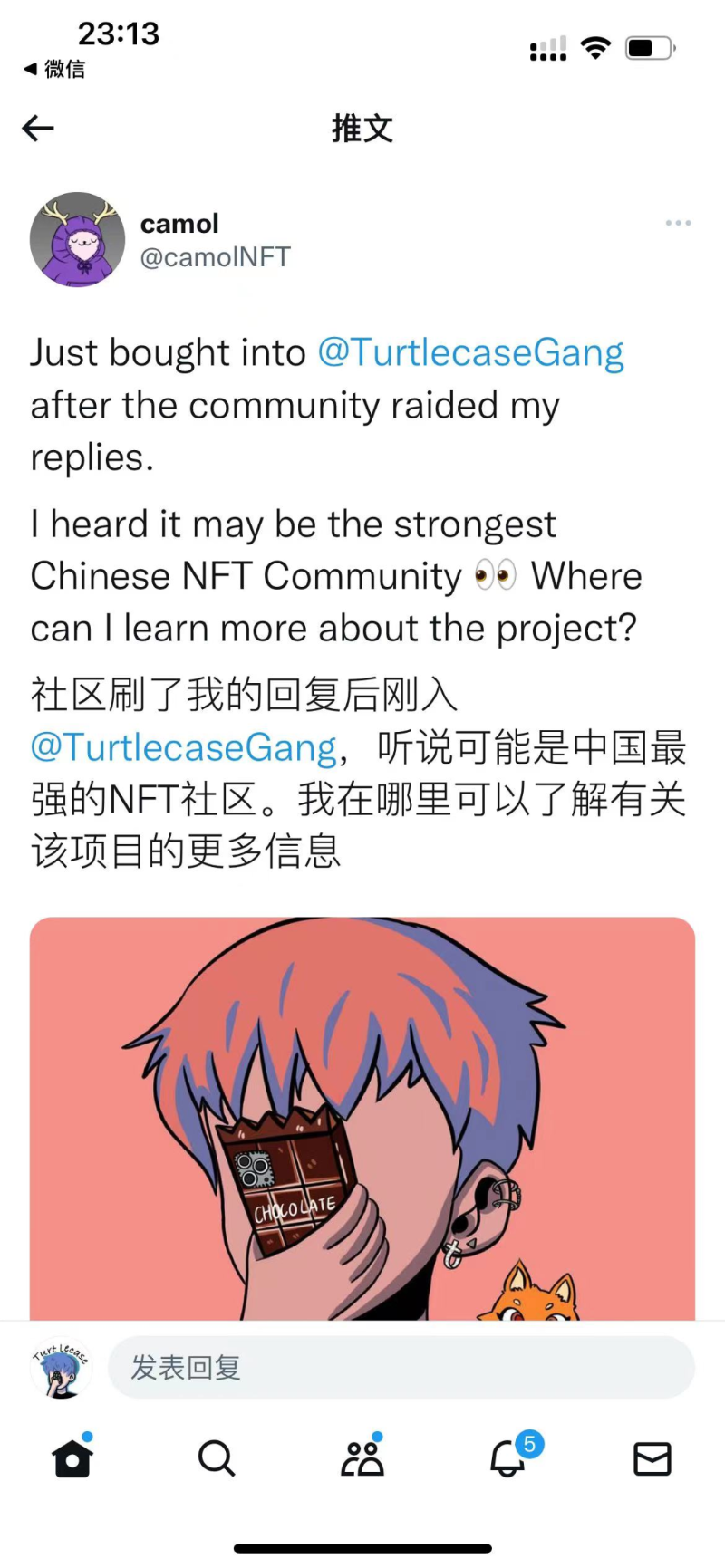
Moreover, TCG’s price performance seems to validate the effectiveness of this “traffic + incentive” approach. Since the Let's Meme plugin entered beta, TCG’s floor price rose from 0.01 ETH to around 0.1 ETH.
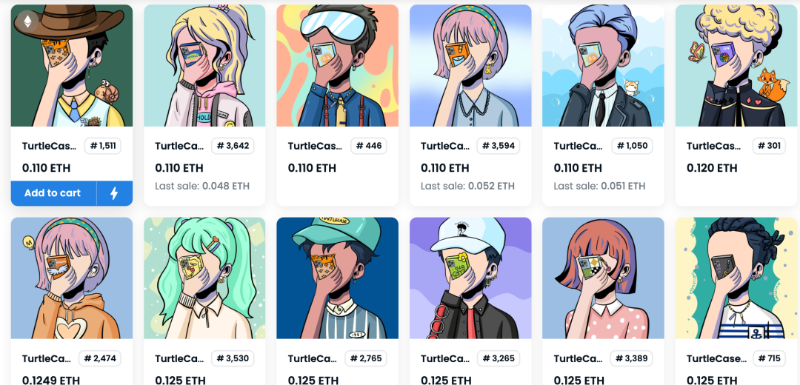
Beyond TCG, this model shows broader positive externalities. Currently used exclusively by TCG, from a technical standpoint, other NFT projects could fully integrate this plugin to enable similar engagement, opening new paths for Chinese-language projects to build communities and expand globally.
On another front, the “traffic + incentive” model can generate massive traffic pools. Once a project accumulates significant traffic, it can evolve into a distribution platform—matching advertisers with user demographics and preferences—to unlock new commercialization avenues for NFT projects.
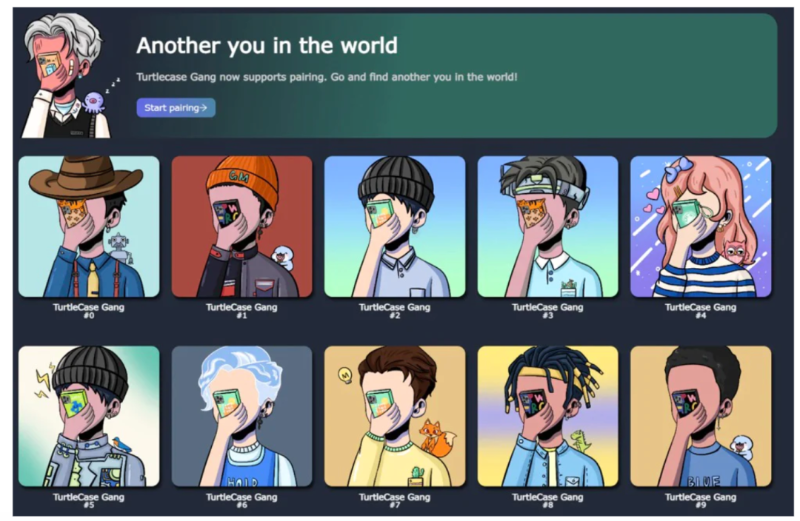
In addition to the plugin, TCG has introduced other innovative features. For example, online: every TCG NFT generates a paired CP NFT number upon minting. Players can check numbers and contact each other via social accounts. The official site also provides a matching portal to help users find their counterpart faster.
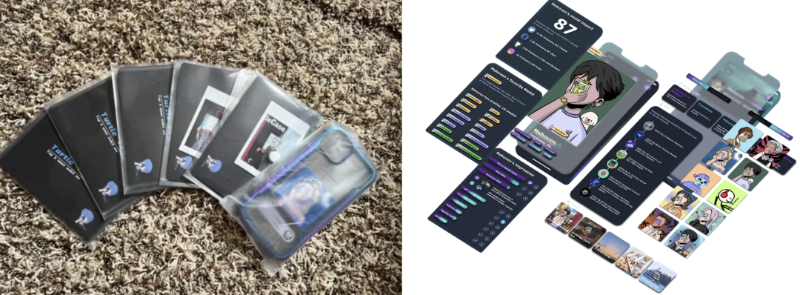
Offline, TCG developed physical smartphone cases with NFC capabilities for further innovation: others simply tap their phone against the case, and the owner’s TCG profile pops up—including their on-chain info, reputation, and more. This serves as an excellent tool for breaking the ice, sparking conversations, and building connections at real-world events.
Beyond Culture: Hardcore Security Tech and Team
Beyond youth culture and community-building, another notable aspect is TCG’s underlying security technology. In the crypto world, wallet thefts occur frequently. Once private keys are compromised, assets are almost always drained. But TCG aims to change this with hardcore solutions.
In addition to its main NFT smart contract, TCG independently designed a smart contract called “ERC-721G,” offering anti-theft protection for NFTs. Its function resembles the “item lock” feature common in video games: using this contract allows control over NFT state changes. At any time, users can log in to the TCG website to “lock” their NFT. Upon first login, they’re prompted to bind an email; unlocking later requires an email verification code.

This means that even if hackers obtain a user’s private key, they cannot complete the unlock process or transfer the NFT from the wallet. Currently, the TCG team has fully open-sourced the ERC-721G contract and published a technical paper for research and learning. Other projects can integrate this open-source contract to prevent similar theft incidents.
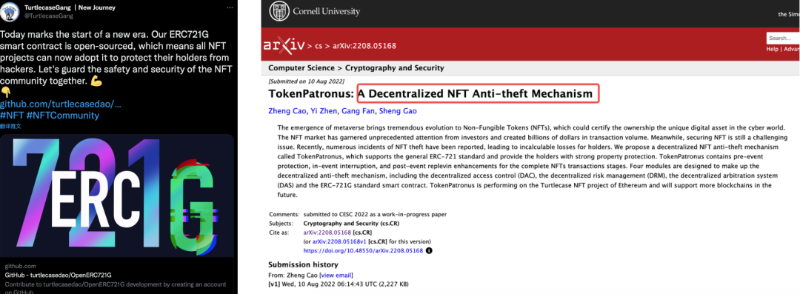
Furthermore, early warning and monitoring before risks occur are equally important. Building on the anti-theft contract, TCG developed a solution named “Big Brother”—an NFT theft protection system.
By combining ERC-721G, risk-control oracle contracts, and centralized operations strategies, it enables risk analysis and monitoring backend capabilities, providing end-to-end protection including “pre-event blocking,” “in-event prevention,” and “post-event compensation” to jointly safeguard NFT holders’ assets.
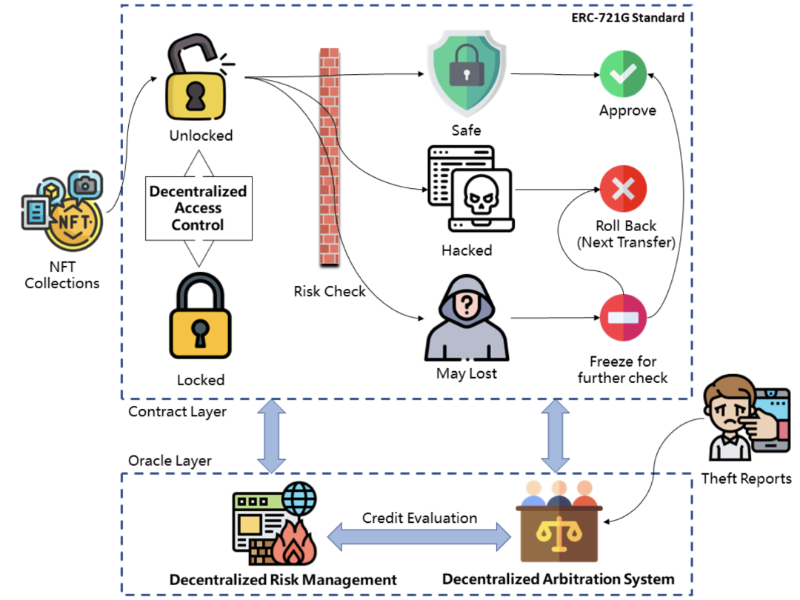
Whether it’s the anti-theft contract or the monitoring system, their sophistication exceeds typical expectations for an NFT project. As a PFP NFT, TCG theoretically only needed to focus on art and culture. Asset theft is a pain point affecting all NFT holders—a shared problem space. Most projects lack motivation or rationale to solve it; a more rational approach would be waiting for others to provide solutions and then integrating them. TCG chose instead to lead by doing it themselves.
This drive comes partly from team members who previously suffered high-value asset losses due to wallet breaches, but also reflects a sense of justice and responsibility aimed at benefiting the entire industry. Behind such inclusive efforts lies a technically robust team. Reportedly, TCG’s tech team has over 10 years of deep expertise in cybersecurity, with core members hailing from China’s top-tier security projects, bringing sharp awareness and professional competence in digital asset protection.
Beyond technology, TCG’s overall team composition is highly diverse—featuring PhD researchers alongside seasoned product and engineering talent from leading Chinese internet firms like Ant Group and ByteDance. This blend enables greater potential for product innovation. Additionally, team members come from elite universities worldwide—including the University of Virginia, UC Berkeley, NYU, University of Leeds, and Zhejiang University—and the core team has prior successful entrepreneurial experience. This diversity positions TCG well to build the largest Chinese-speaking community.
Future Outlook
As the NFT sector enters its second half, relying solely on a static avatar won’t suffice to capture young users or ensure long-term growth. From Turtle Case Gang, we see a promising direction: using NFTs as a starting point, activating young users’ social instincts and community-building potential through plugins and tools, accumulating traffic while actively expanding outward to pursue commercial partnerships and new revenue models.
Looking ahead to this year’s roadmap, TCG will double down on this strategy. We can clearly see a three-pronged optimization path of “product + technology + community building”:
Product-wise: continue expanding gameplay and collaborations around the TCG NFT series to solidify the project’s foundation;
Technologically: refine its pioneering ERC-721G anti-theft contract and submit it as an EIP proposal to establish a widely recognized standard;
Community-wise: optimize community management tools and governance methods to improve user acquisition and engagement. Once traffic and stickiness reach critical mass, monetization and commercialization will naturally follow.
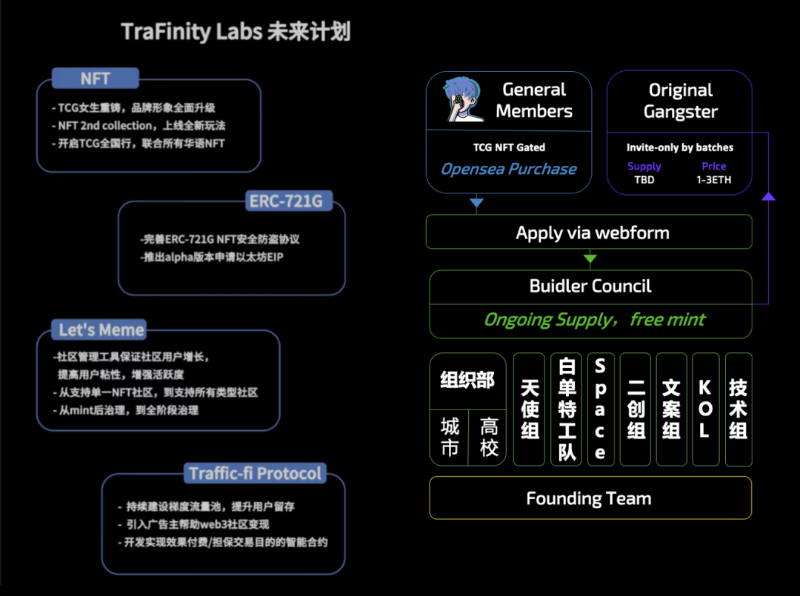
Among these three pillars, product and technology refinement largely depend on the project team’s own execution. But for community building, involving more users—shifting from “self-built” to “co-built”—is a more practical and sustainable approach.
Thus, TCG’s solution is to inject fresh energy into community development through its “Builder Council” initiative:
Both TCG holders and users from other NFT projects can apply to join the Builder Council. Once onboard, members can contribute their strengths in regional business development, marketing campaigns, content creation, and technical research;
In return, they receive benefits such as free mints for future TCG NFTs. Outstanding contributors are recognized as “project OGs.” This tiered, talent-driven design encourages active participation, empowering users with a sense of ownership, recognition, and reward.
Overall, TCG’s product and marketing design have shown initial success. Yet, the industry’s exploration remains in its infancy. We’ve seen too many NFT projects shine briefly before vanishing—few sustain momentum or innovate continuously.
No one stays young forever, but there will always be young people. As newer, younger users enter crypto, designing features and experiences that match their social needs and self-expression—capturing untapped blue-ocean markets—may be the true long-term path to explosive growth.
Join TechFlow official community to stay tuned
Telegram:https://t.me/TechFlowDaily
X (Twitter):https://x.com/TechFlowPost
X (Twitter) EN:https://x.com/BlockFlow_News
 CryptoDada