








Web3's Next Breakthrough Moment: Mobile Applications
TechFlow Selected TechFlow Selected
Web3's Next Breakthrough Moment: Mobile Applications
Mobility represents a platform shift and a paradigm shift in the way the internet operates.
 Navigating Web3 tides with focused insights
Author: Golden Hour
Translated by: TechFlow Intern
In 2013, media and technology analyst Benedict Evans delivered a talk titled "The Smartphone is Eating the World," exploring how mobile devices on an unprecedented scale were beginning to reshape the internet and the entire economy. At that time, 56% of American adults owned a smartphone (compared to over 85% today). We can't imagine what will happen in the next decade, just as I've said before—technological innovation often emerges when we seem to need it least.
Benedict Evans’ insight was prescient. He understood that every wave of technology (railroads, software, smartphones... dare I say, web3) brings about new business models. So it’s no surprise that shortly after his talk, we saw the rise of native innovations in smartphone applications: Uber in 2009, Snap in 2011, Lyft in 2012, DoorDash in 2013—the list goes on.
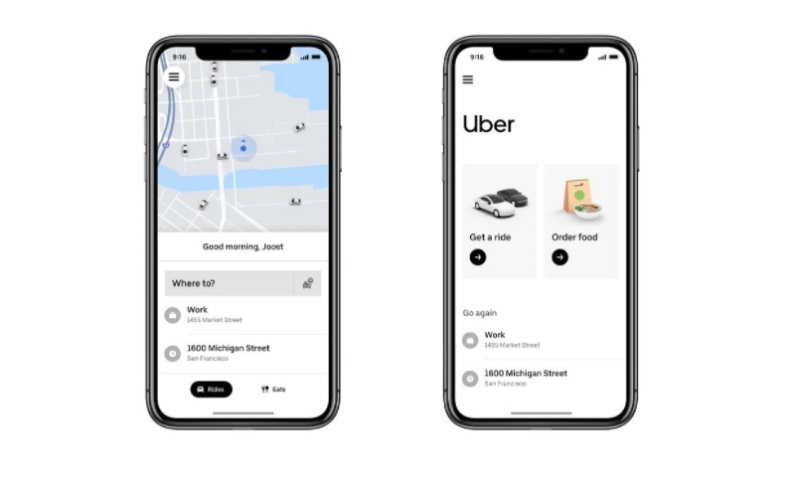
Mobility represents a platform shift—a paradigm change in how the internet works. It increases scale and consumer sophistication, making apps easier to use. Phones are different from desktop computers; they’re portable. You can take them anywhere and seamlessly perform all kinds of tasks—making calls, taking photos, checking maps, processing payments, listening to music, browsing app stores. Unlike the desktop web, smartphones are inherently social. Apps can access the phone’s address book, gaining immediate access to a ready-made social graph; they can import photos from the user’s camera roll or easily grab location coordinates to build location-based networks.
From a broader historical perspective: In 1999, 80 billion consumer photos were taken on film. In 2014 alone, 800 billion photos were shared across social networks. Suddenly, everyone became a photographer. Smartphones represented not only a new generation of computing devices but also the birth of a new generation of users—the casual user, accessible to anyone.
Today, Web3 is largely web-native, with almost no widely adopted mobile-native Web3 applications. As Packy McCormick wrote, “If Web3 wants to reach the same scale as the internet (4.66 billion users), it currently penetrates less than 1% of that market.” I believe that if we want to achieve this goal, our next step must be cultivating mobile-native Web3 applications to attract casual consumers into the ecosystem.
So what kind of mobile-native Web3 user experiences might emerge? Like everyone else, I can only speculate—but here are a few examples that come to mind:
1. Geolocated NFTs, such as Mirage and Dropverse. I’d love to see the emergence of new social graphs based on location—something akin to an NFT version of Zenly. Superlocal is working on an interesting iteration.
2. Augmented reality Web3 games, such as Jadu.
3. At this point, anything combining augmented reality and NFTs (I envision a world where we bring NFTs into videos on Snapchat, TikTok, and Instagram).
4. Social Web3 wallets, such as Genesis or Family.
5. Highly visualized "loot bags" and NFT galleries, such as Surreal and Cyber.
The biggest obstacle to Web3’s mobile adoption lies in Google and Apple still taking revenue cuts from all in-app transactions occurring on their mobile-native platforms. I’ve seen signs that Apple may open up in this area, but the situation is still evolving. (Note: This is precisely why I’m excited about something like ethOS, which aims to become Ethereum’s first native mobile operating system—permissionless design, decentralized browser, dApp store, and robust wallet support.)
My favorite takeaway from Benedict Evans’ talk is this: when technology is fully adopted, it disappears. You can test this theory against the historical trajectory of nearly any technological innovation. Below, I tested it using the terms “railroad,” “computer,” “software,” and “mobile phone,” tracking each word’s frequency in the Google Books corpus from 1900 to today.
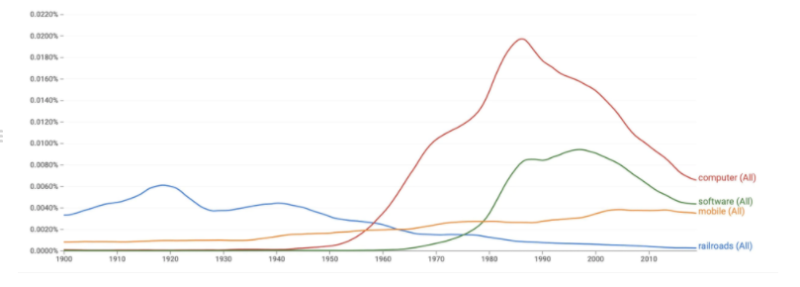
You can see that each term follows some form of a bell curve, peaking in relevance at a certain point, then declining from there. Eventually, the term essentially… vanishes. Benedict Evans was right. Now let’s apply the same test to the terms “Web3” and “Crypto” from 2018 to today.
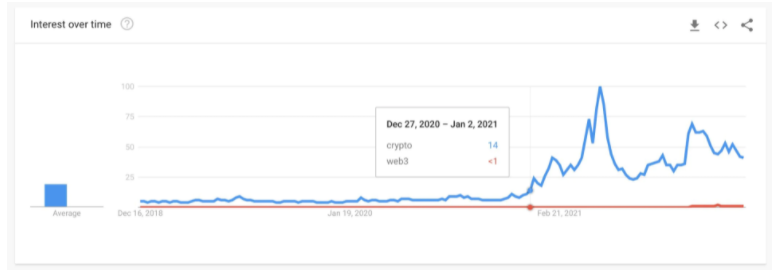
Clearly, “Web3” and “Crypto” are far from reaching a similar bell curve. We are nowhere near full adoption yet—and I believe mobile-native applications will help us get there.
Join TechFlow official community to stay tuned
Telegram:https://t.me/TechFlowDaily
X (Twitter):https://x.com/TechFlowPost
X (Twitter) EN:https://x.com/BlockFlow_News






