








Race Capital Investment Memo: Why Did We Invest in FTX in 2019?
TechFlow Selected TechFlow Selected
Race Capital Investment Memo: Why Did We Invest in FTX in 2019?
Race Capital was one of the earliest investors in projects such as FTX and Solana, with early investors in FTX achieving over 100x returns on their investments.
 Navigating Web3 tides with focused insights
The Three Founders of Race Capital
Source: Race Capital
Compiled by: ChainCatcher
In mid-July, FTX announced a $900 million funding round, bringing its valuation to $18 billion and making it one of the highest-valued companies in the cryptocurrency industry.
As a result, early investors in FTX have achieved over 100x returns. Race Capital (formerly Proof of Capital) was one of the earliest institutional investors in FTX, participating in an $8 million seed round in July 2019. Recently, the firm released its original investment memo outlining its rationale for investing in FTX, including strengths and risk factors.
Summary
Date: July 24, 2019
To: Race Capital Investment Committee
Capital Transactions Team: Chris McCann and Edith Yeung
Company Contacts: Sam Bankman-Fried (CEO) and Darren Wong (CMO)
Subject: Investment Proposal for FTX
Total Round Size: $8 million
Additional Notes: FTX is a spin-off from Alameda Research, one of the top quantitative hedge funds in the crypto space.
Company Description:
FTX is a cryptocurrency futures and derivatives exchange. Launching a new top-tier exchange is no small feat—since its beta launch on June 1, 2019, the platform has already exceeded $150 million in daily trading volume.
FTX offers standard crypto futures products such as Bitcoin, along with innovative offerings like altcoin indices, index futures, and leveraged products up to 101x.
Additionally, they have developed an advanced liquidation engine in-house, significantly reducing the risk of clawbacks or socialized losses to profitable users—a major concern traders face with existing platforms.
Key Metrics:
Employees: 10 total
Trading Volume: $50 million on June 11, $150 million on June 22, $250 million on July 4, $300 million on July 5
Revenue: (redacted)
User Geography: Primarily Asia (China, Hong Kong, Singapore, Vietnam, Japan, South Korea), Russia, and Europe.
Execution
The FTX team is among the most execution-focused teams we’ve encountered in crypto—their changelog proves it:
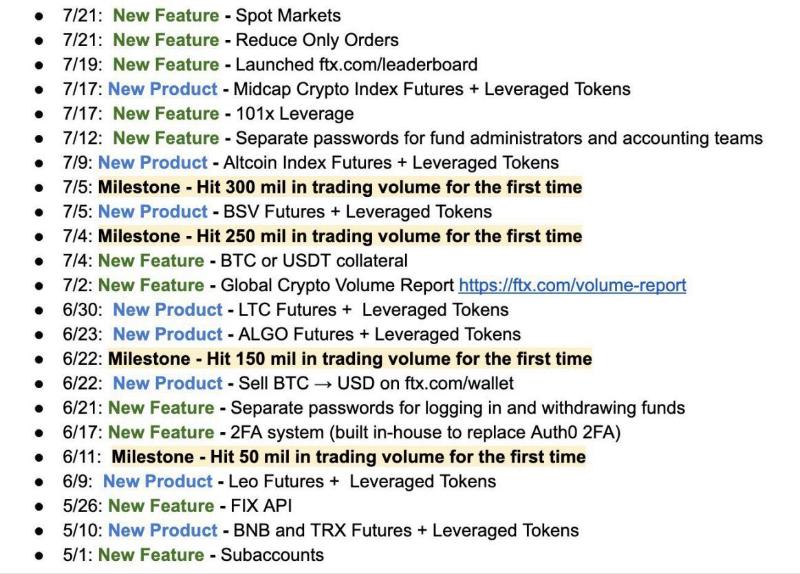
Internal milestones from the team
Investment Highlights
In a short period, FTX launched and gained significant early traction in derivatives trading. Their goal is to become the leading global derivatives exchange, displacing BitMEX, Huobi, and OKEx.
Deep Trading Expertise
A key reason for FTX’s strong appeal lies in the team’s experience operating Alameda Research—one of the top crypto quant funds.
Founded in October 2017, Alameda Research manages over $100 million in digital assets and trades between $600 million and $1.5 billion daily across thousands of products—including all major cryptocurrencies and their derivatives. The FTX team built the exchange they wanted to see exist, and it has already resonated within the crypto ecosystem.
Founders
Sam Bankman-Fried, CEO and founder of FTX, lives and breathes trading. Sam has a large following that watches his live trading sessions, and trading dominates every conversation he has. He also frequently engages with new traders across all FTX community channels.
Similar to Ethereum’s Vitalik Buterin, we appreciate seeing founders who are deeply passionate about what they’re building. Clearly, Sam and his team are traders at heart—this is evident in everything they build and communicate.
Huge Market
While Coinbase and Binance focus primarily on spot markets, the futures market is just as large. On July 25, 2019, the total daily spot market volume was $10 billion, while futures markets reached $11 billion daily. Moreover, in the futures space, the top three players (BitMEX, Huobi, OKEx) typically see three times more volume than spot exchanges.
Furthermore, there is currently no futures exchange with its own native exchange token. Binance, a spot-focused crypto exchange, has one of the most valuable tokens in the market (market cap of $4.5 billion). We expect a comparable token (FTT) to emerge in the futures space.
Race Capital Investment Thesis
One of our core investment themes is financial infrastructure. Today, exchanges are the primary drivers of financial activity in the crypto ecosystem, and derivatives exchanges generate trading volumes comparable to spot exchanges.
Given FTX’s deep trading expertise, strong product-market fit, and early traction, FTX has the potential to become the leading derivatives exchange in the crypto market.
Market Size / Industry Landscape
Currently, the subset of futures exchanges is much smaller compared to spot exchanges. Below is a full list of crypto futures exchanges ranked by volume:
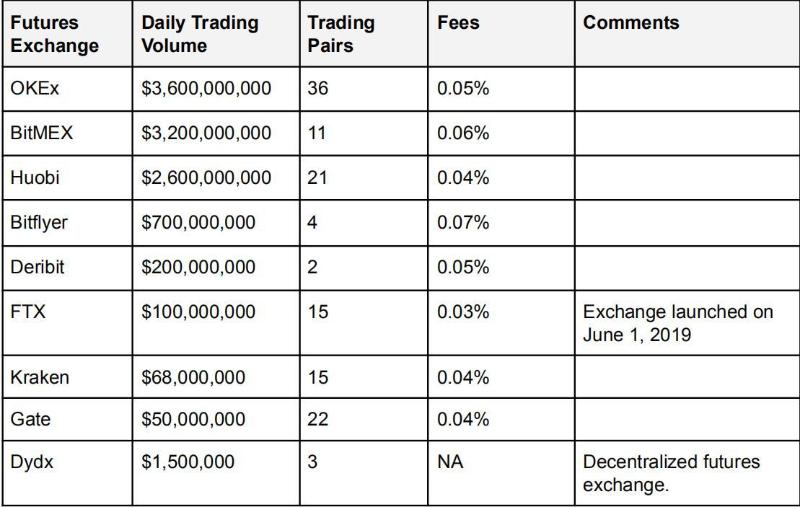
Data as of July 25, 2019
Volumes fluctuate monthly, but BitMEX is the undisputed leader in crypto derivatives.
BitMEX raised only a single angel round in 2015 (estimated at $200k), so public information about the company is scarce. However, based on available data points, BitMEX is estimated to be valued at $3.6 billion, generated $83 million in revenue in 2017, and operates out of Hong Kong’s most expensive office space. Conservatively, BitMEX currently generates approximately $500 million in annual revenue (based on volume and fees).
In derivatives markets, liquidity begets liquidity, so one of the biggest questions is how FTX will gain a foothold. Beyond the team's experience, from a market opportunity perspective, BitMEX is currently under investigation, resulting in a surge of net capital outflows from the exchange.
We believe this has opened up the market just as FTX was preparing for its official launch on June 29, 2019. If FTX can replace BitMEX as the dominant futures exchange, the platform stands to capture immense value.
Team
After extensive conversations with the FTX team in San Francisco and Hong Kong, we believe FTX has assembled one of the strongest crypto technology and trading teams, with members from Jane Street, Google, Huobi, PayPal, Blackstone, Facebook, and SIG. The organization consists of engineers and product leaders experienced in building large-scale trading and exchange systems.
Sam Bankman-Fried, CEO. Before founding Alameda, Sam was a trader at Jane Street Capital’s international ETF desk, where he traded various ETFs, futures, currencies, and equities, and designed automated OTC trading systems.
Gary Wang, CTO. Gary was a software developer at Google, where he built pricing aggregation and service systems for Google Flights. He graduated from MIT with degrees in mathematics and computer science.
COO Constance Wang previously worked at Credit Suisse in private banking AML/KYC and risk control before joining Huobi Global as a business development manager. There, she focused on expanding institutional business and managing strategic partnerships with crypto exchanges across the Asia-Pacific region.
Darren Wong, CMO. Darren was an early software engineer at Simility, an ML-based fraud detection startup later acquired by PayPal. He has audited smart contracts for projects like Wabi and was an early investor in dozens of ICOs. He holds degrees in applied mathematics and economics from Johns Hopkins University.
Jennifer Chan, CFO. With 10 years of experience in private equity and fund operations, she previously served as Head of Investment Accounting at Blackstone Group and AVP at Deutsche Bank. She graduated from HKUST with a degree in accounting.
Nishad Singh, VP. Nishad was a software engineer on Facebook’s App Machine Learning team. He graduated from Berkeley with honors in electrical engineering and computer science.
Andrew Croghan, Head of Business Development. Andy led Susquehanna International Group’s (SIG) crypto initiatives, helping it become one of the first major institutions in the space. He spent five years trading options on the floor at SIG.
Investment Considerations
Unique Positioning
FTX is built by traders, for traders, aiming to become the world’s largest crypto futures exchange. It has gained impressive early traction, reaching over $300 million in trading volume in under 30 days, and its products resonate strongly within the crypto trading community.
Meaningful Growth Opportunities
We identify three main growth drivers for FTX:
Full Suite of Futures Products
Traditional futures exchanges primarily focus on Bitcoin derivatives. For example, 90% of BitMEX’s volume comes solely from Bitcoin (perpetuals, 60-day, and 30-day deliveries).
FTX applies these same concepts to the long tail of crypto assets, offering:
-
Mid-cap Token Index Futures — futures products based on all mid-market-cap crypto assets
-
Stablecoin Futures — catering to demand for speculation on stablecoins (especially Tether), with tools specifically designed for trading them
-
Shitcoin Index Futures — a tongue-in-cheek product aggregating all the long-tail cryptos people love to hate (aka “shitcoins”)
-
Exchange Token Futures — an index of all exchange tokens, a popular category among traders. All these products were uniquely created by FTX and loved by traders.
Thanks to strong founder-market fit, FTX has been able to create products that traders actually want to trade.
Unique Market Infrastructure
There are “exchange-as-a-service” providers, but the FTX team chose to build their own exchange from scratch. Key reasons include:
-
Real-time performance — the exchange must handle transactions at scale in real time
-
API-first — FTX is building an API gateway for both professional and retail traders
-
Multiple collateral types — unlike BitMEX, FTX allows margin using any asset type (e.g., Bitcoin, Ethereum, stablecoins, etc.)
-
Simplified tech stack — FTX has built an internal OTC desk to handle large orders, eliminating reliance on external providers
FTX’s motto is “by traders, for traders,” and its underlying technical infrastructure reflects that philosophy.
Expanding TAM for Future Traders
Futures are traditionally seen as complex financial instruments, difficult for retail investors to understand. Historically, futures have thus been limited to a small group of sophisticated traders and firms.
FTX has abstracted away much of the complexity in creating futures products and delivered them in an intuitive way accessible to most traders in the crypto ecosystem.
Therefore, we believe FTX will not only capture market share from existing futures exchanges (like BitMEX) but also expand the total addressable market (TAM) of traders these platforms serve.
Below are interface examples from BitMEX and FTX:
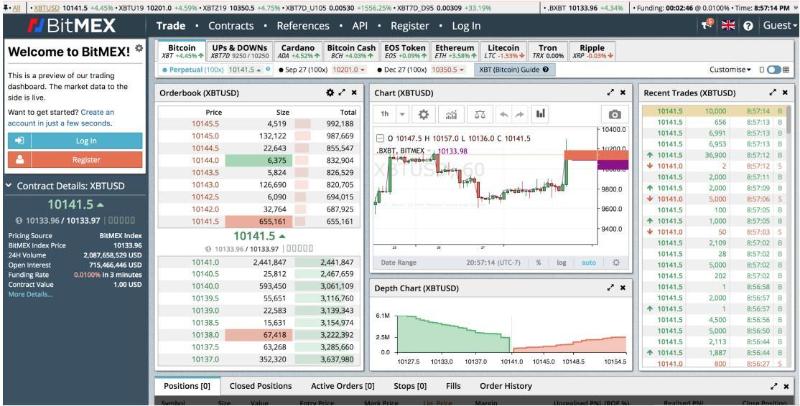
BitMEX trading interface
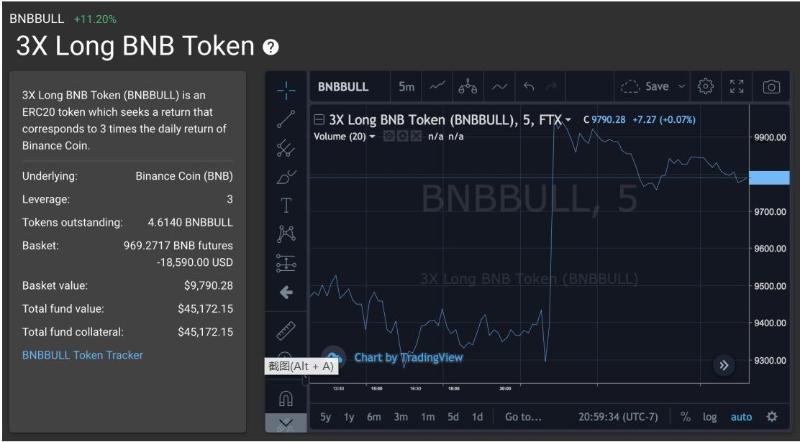
3x Leverage Token (BNB) product
Expansion into Asia
FTX has placed much of its core team in Hong Kong and is focused on attracting major Asian traders and trading firms to the platform.
Asia is the central hub for global crypto trading volume, and most top-tier exchanges are based here. FTX has already seen meaningful traction in these regions and is doubling down on efforts to bring more regional traders onto the platform.
Risk Factors
-
Alameda vs FTX
It remains unclear how much time Sam will dedicate to FTX versus Alameda. Given the pace of execution, we believe dedicated time for FTX exists, but this remains to be seen.
-
Trading on their own exchange
Exchanges need market makers to launch, and Alameda will serve as FTX’s initial market maker. Over time, the team plans to onboard more market makers, but this remains a key risk. We’ve spoken with other quant funds who hesitate to trade on FTX due to this conflict.
-
Other derivatives platforms launching their own exchange tokens
If a current top derivatives exchange (e.g., BitMEX) launches its own platform token, FTX’s momentum could slow down.
-
Regulatory Risk
Like BitMEX, FTX must be careful with KYC, AML, and compliance practices when onboarding new customers. Fortunately, KYC has become more standardized, and third-party providers can support this function—but if mishandled, it remains a significant risk.
-
Large spot exchanges launching derivatives products
If Binance or Coinbase launch their own futures products, the derivatives market will face increased competition. Currently, derivatives and spot markets are largely separate, but we don’t expect this to last forever.
If BitMEX, Huobi, and OKEx continue dominating the futures space, FTX may be pressured to rely solely on net new customer acquisition.
-
DEXs becoming the dominant form of trading
If decentralized exchanges (DEXs) become the primary mode of trading, decentralized derivatives platforms like dYdX could capture the largest market share in the future. So far, there’s little evidence of this happening, but the DEX space warrants monitoring.
-
Major hack or security incident
A major hack or loss of funds would severely damage trader confidence and make it harder for FTX to attract users to a new exchange.
Investment Terms: (redacted)
Exit Strategy: (redacted)
Join TechFlow official community to stay tuned
Telegram:https://t.me/TechFlowDaily
X (Twitter):https://x.com/TechFlowPost
X (Twitter) EN:https://x.com/BlockFlow_News






